Herald of Rome Profile picture
Herald of the Romans. Telling the story of the Roman world, focused on the Middle Ages, based on academic sources. History threads & real art, no AI images.
May 7 4 tweets 8 min read
People online are arguing about whether modern Greeks are the only descendants of the medieval Romans of the East. Greeks say they are, others react that they are not, but a lot of that disagreement is really Greeks and foreigners using very different definitions of descent and ethnicity. So before answering the question, we first have to define ethnicity and nation, because this is not just about blood, and it is not just about claiming a label.

1. What Ethnicity Means

Anthony D. Smith defines an ethnicity as a named human community held together by shared ancestry, shared historical memories, common culture such as language, religion, and customs, a link with a homeland, and a sense of solidarity. It is the same kind of peoplehood the ancient Greeks themselves recognized through shared blood, shared language, shared religion, and shared customs. So the real question is not just who has Roman ancestry, but who continued the east Roman people as a living historical community.

2. What I Am Actually Claiming

With that in mind, my argument is not that Greeks own ancient Rome or descend alone from all Romans, because that would be too much. Many peoples descend from Roman-era populations, and many later nations took pieces of Roman civilization, but descent from Roman-era people, or borrowing from Roman civilization later, is not the same thing as living continuity with the medieval Roman world of Constantinople.

My claim is more specific, that modern Greeks are the only living continuation of the east Roman people and their culture as a historical community, the way it existed for most of the medieval empire's history.

My claim is more specific, that modern Greeks are the only living continuation of the east Roman people and their culture as a historical community, the way it existed for most of the medieval empire’s history and as it naturally evolved afterward. Of course there were changes, but that is how historical continuity works.

3. East Roman Culture as Lived Continuity

The east Romans had a living culture made from Greek language, Orthodox Christianity, Roman political memory, icons, hymns, saints, feast days, monasticism, folk traditions, and the memory of Constantinople as the Queen City.

After the empire fell, those things did not vanish and then get revived later as an aesthetic. They continued inside Greek-speaking Orthodox communities as a living culture, in church, in speech, in songs and musical traditions, in laments, in family customs, in village life, and in the old identity of Romiosini.

4. Why Descent Alone Is Not Enough

Descent on its own does not preserve an identity, since people can descend from Roman subjects while having no living Roman culture left. But culture on its own is not enough either, because someone copying icons or chanting hymns or calling himself Roman today is not suddenly the continuation of that historical people.

A real continuation needs both, descent from the historical community in some meaningful sense and the survival of its language, religion, memories, customs, and identity through time.

5. The Problem of “Too Many Romans”

There is also the issue of what Kaldellis calls “too many Romans.” If Roman simply meant anyone living under the emperor, then the word would stop describing a real people and would become only an abstract legal label. This is also why the modern label “Byzantine” creates confusion, because it can mean either every subject of the empire or only the Roman majority from whom the minorities were distinguished.

As Kaldellis says in Romanland, the label “obscures the difference between imperial subjects who were ethnically Roman and those who were not.” He makes the point directly: “Rather than a scarcity of Romans, we may now face the embarrassment of too many Romans. Some historians believe that everyone living within the empire or under the emperor’s jurisdiction was automatically a Roman, which turns what appears to be an ethnonym into an abstract formality.”

But he rejects that view, because “not everyone living within the empire or serving the emperor was regarded ethnically as a Roman. The Byzantine empire was inhabited by both Romans and non-Romans, and the latter were designated by separate ethnic names and frequently associated with stereotypes.” So the empire could rule non-Romans, use non-Roman soldiers, and even assimilate foreigners into the Roman people, but that only proves that Roman identity had real boundaries.

It was not just residence under the emperor. It involved belonging to the Roman historical community through law, culture, language, religion, homeland, memory, and assimilation into the people, a real ethnic group.

6. Why Modern Greeks Are Different

Other peoples got off the Roman bus earlier and built their own states and identities, so they may have Roman ancestry or Roman influence, but they did not continue as the Greek-speaking Orthodox Roman people of Constantinople. Greeks did.

The medieval Roman world survived only directly in the people who kept its language, its church, its songs, its saints, its memory of fallen cities and heroes like Digenis Akritas, and its longing for the City. The empire fell, but its people did not disappear. They continued as Romioi and as modern Greeks.

7. The Church as the Surviving Roman Institution

After the empire fell, the Greek Orthodox Church helped carry the Roman people through four centuries of Ottoman rule because it was the main surviving Roman institution, and it took on many of the roles that the Roman state had once held for the Roman nation.

People sometimes claim that Roman institutions were completely lost when the empire fell, but this overlooks the Church, since the Ottomans preferred dealing with religious institutions over secular ones, so the Patriarchate of Constantinople was made head of the Rum millet and put in charge of the Romioi as a people. That meant the Church carried their political and ethnic interests, ran the courts that handled their marriages, inheritances, and family disputes, kept their schools, and protected their literature and language.

The institution that had been the spiritual heart of east Rome ended up holding the whole Roman nation together when there was no longer a Roman state to do it. The Patriarchate was also put in charge of the non-Roman Orthodox peoples, just like the Roman state had been in medieval times and now in place of it, and it promoted east Roman culture among them, including the Greek language, which the east Romans called both Greek and Romaiika, meaning Romaic or the Roman language.

8. From Romaios to Hellene

The later shift from Romios to Hellene was not a swap that created something unrelated, because the two names meant the same thing. The medieval taboo that made Hellene mean pagan was gone, so it could finally be used the way Graikos and Romaios always had been. Hellene took the place of Graikos, which is the word the east Romans themselves used to distinguish themselves from the Latin West.

As Anthony Kaldellis puts it in Hellenism in Byzantium, "Graikos differentiated a Greek-speaking Roman from a Latin-speaker. These labels did not necessarily carry ideological weight, but sometimes they did, as in the exchange of insults between Michael III and pope Nicolaus I in the 860s." Greeks made Hellene their primary national identity to emphasize the Greek-speaking territories and churches, which were the core of that east Roman empire. Romios kept going in everyday speech, in church, in folk songs, and in laments, and Hellene meant the same thing to them, literally, eventually also becoming the primary ethnic identity, but without implying that they are not Romioi and the descendants of the medieval Romans.

9. Ethnicity and Nation Without One State

You can see the same logic in Cyprus today, where people call themselves Cypriot but mean Greek, because the state is its own thing while the nation behind it is the same. The logic was the same in antiquity too, since the Greek city-states didn't share one state but were still one Greek people. A single legal state has never been the test of who counts as the same nation, so modern Greece and Cyprus do not continue the east Roman state in any legal sense, but they continue the same people through the same logic, and they have kept alive its central institution, the Church, which as I explained earlier was much more than just a religious institution.

10. Continuity Through Change

In case some people think I am saying the East Romans were only “medieval Greeks” or “medieval Greece” using a fake Roman title, that is not my argument. They claimed the real Roman inheritance, but Roman identity itself had changed through history. In The New Roman Empire, Kaldellis compares this to the Ship of Theseus, saying that the Roman polity “gradually changed its component elements over the centuries, but never lost its underlying identity. It built a new capital in the east, lost the old one in the west, converted to Christianity, absorbed new populations, forgot Latin to fully embrace Greek, and adapted its institutions to meet new challenges as they came.”

The point is that people can change language, religion, capital, and institutions without becoming a completely different people, as long as the change happens through continuous historical development rather than a later artificial revival. So when I say modern Greeks continue the east Romans, I am not denying that the east Romans were real Romans. I am saying that modern Greeks descend from the east Romans and continue the later form that Roman identity and the Roman ethnic community took in the medieval empire: Greek-speaking, Orthodox, Constantinopolitan, and of course, Roman.

Sources:

Anthony D. Smith, The Ethnic Origins of Nations (Oxford, 1986).

John Hutchinson and Anthony D. Smith (eds.), Ethnicity (Oxford: Oxford University Press, 1996).

Anthony Kaldellis, Romanland: Ethnicity and Empire in Byzantium (Cambridge, Massachusetts: Harvard University Press, 2019).

Anthony Kaldellis, Hellenism in Byzantium: The Transformations of Greek Identity and the Reception of the Classical Tradition (Cambridge: Cambridge University Press, 2007). The song above is “Ο Κωνσταντίνος ο μικρός / Μικροκωσταντίνος,” a Greek traditional akritic folk song from Northern Greece. It belongs to the medieval frontier-song world of the Akritai, the border warriors of the east Roman frontiers.

Akritic songs are Greek folk songs about the Akritai, the frontier warriors who guarded the borderlands of the medieval east Roman world, especially along the eastern frontier with the Arabs, but also in wider Greek-speaking frontier regions. These songs survived to this day in Greek oral tradition and are part of modern Greek culture, which is why they matter as evidence of historical memory and cultural continuity.

They are usually about warriors, raids, border fighting, captivity, heroic strength, family honor, love, death, exile, and the struggle between the human world and wild forces. Some are realistic war songs, while others become almost mythic, with heroes fighting monsters, wrestling with Charon (personification of Death), crossing impossible distances, or facing death like epic figures.

The most famous akritic hero is Digenis Akritas, whose name means something like “the two-blooded frontier man,” because he is usually presented as having mixed Roman and Arab ancestry. His songs and legends show the frontier as a place where cultures meet, fight, and create heroes.
Aug 23, 2025 7 tweets 3 min read
In 588 AD,

the east Roman army rebelled. To calm them, Patriarch Gregory of Antioch addressed them with:

"O men, Romans in both name and deed… even when you have a grievance toward your generals, there is nothing of greater importance to you than the republic."

[Thread]🧵Image The eastern army mutinied after the emperor Maurice tried to cut their pay by 25% while still expecting them to buy their own equipment. The mutiny turned violent, soldiers even stoned an image of Christ and tore down portraits of the emperor, but they still marched to repel a Persian invasion, defeating the enemy.Image
Aug 22, 2025 20 tweets 7 min read
Did the East Romans see themselves as a nation?

Here's what they said about nations, race, identity, and barbarians.

[Thread]🧵 Image In the 10th century,

Emperor Constantine VII Porphyrogenitus wrote:

"For each nation (ethnos) has different customs and divergent laws and institutions, it should consolidate those things that are proper to it, and should form and activate the associations that it needs for the fusion of its life from within its own nation.

For just as each animal species mates with its own race (homogeneis), so it is right that each nation also should marry and cohabit not with those of a different tribe (allophylon) and tongue (alloglossoi) but of the same tribe (homogeneis) and speech (homophonoi)."

- Constantine VII, De administrando imperioImage
Aug 12, 2025 25 tweets 10 min read
Most people think that the Roman Republic ended with Augustus.

But the Romans in the empire still saw themselves as a republic!

[Thread]🧵 Image Today, "Republic" means something different, which causes confusion. The res publica (politeia in Greek) was not a specific type of regime such as a "monarchy," "aristocracy," or "republic", our definition of that word is a modern twist. Image
Jul 27, 2025 10 tweets 6 min read
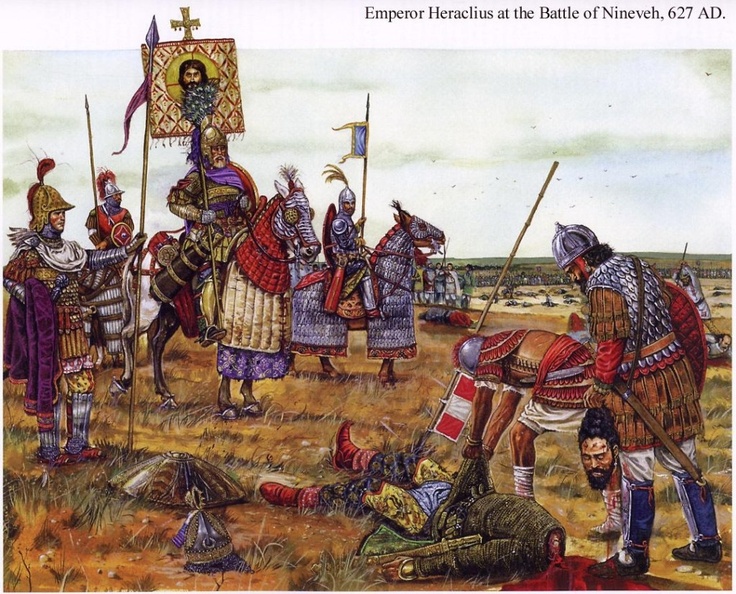
How did the Christian Roman Empire see war?

They didn’t need crusades, for every war was already holy, because all enemies threatened God's empire.

The emperor led God's chosen people, the Romans, in a constant, sacred struggle for survival and dominion.

[Thread]🧵 Image All text that follows is quoted directly from the book Byzantium at War AD 600-1453 by John Haldon:
The medieval eastern Roman world was a society in which the virtues of peace were extolled and war was condemned. Fighting was to be avoided at all costs. Yet the Byzantine empire nevertheless inherited the military administrative structures and, in many ways, the militaristic ideology of the non-Christian Roman empire at its height.

The tensions which these traditions generated were resolved by a political-religious ideology or world view which melded Christian ideals on the one hand, with the justification of war as a necessary evil on the other, waged primarily in defence of the Roman world and Orthodoxy-literally, correct belief.Image