High Yield Harry Profile picture
@Buyside_Hub Founder. Levered Finance Memes & Satire. I write @hyhnewsletter and @wallstrollup
Jan 6 11 tweets 5 min read
As many new people join along, I forget that I really should tell the "story" of High Yield Harry.

Here's the tale and the journey over the past 5.5 years Image I started this account as an Analyst in my parent's basement in July 2020. So for many of you, you got to see me "mature" and become more senior over the past 5.5 years.
Outside of work, there was really not a lot to do in 2020 due to stay at home orders, so I had a lot of time to mess around on IG & here.

I don't think finmemes were that big on here in 2020, and I was mainly an Instagram focused account.

Banking Pledge, Hoeing for Yield, Litquidity, OG Arb Andy, Liens of NY, and Levered Lloyd were some of the accounts I couldn't get enough of in 2017-2019.
Oct 12, 2025 4 tweets 8 min read
So this isn’t really First Brands specific - I just don’t think ppl outside of Credit fundamentally understand the diligence dynamics of Public Credit vs Private Credit. And that ppl will try to correlate the problem of poor managers to broader and systemic issues.

Let’s dive into it. My ultimate view is the problems in Credit are with poor managers and those with risk-on mandates. The most important thing I can say is that you can’t define all lenders in the same bucket. Some groups are better educated, higher compensation, more diligent, have more thorough processes, have low risk parameters, and have competitive dynamics that give them higher quality deals. Meanwhile some firms have lower comp, a less experienced team, quicker processes, higher risk parameters to deploy quality, a willingness to focus on relationships over deal quality, or because of where they sit in the market they have to take on lower quality deals.

Credit Suisse in particular, was a high risk culture and long before its eventual demise there were a lot of questions about what it was financing and the quality of the deals it was agent on or heavily exposed to. But just because Credit Suisse is Credit Suisse, it doesn’t mean JP Morgan is Credit Suisse.

Jefferies has also fallen into the bucket of generally being pretty risk on, which has helped them in a lot of instances, obviously not here.

So i’m not a believer in ‘private equity is a bubble” or “private credit is a bubble” and instead of you need to more so call out the firms that aren’t performing - they have to do continuation funds because they can’t fundraise, their deals are constantly going through LMEs, etc.

Let me go through how i view diligence in Public Credit and Private Credit. Unfortunately, asset-based finance isn’t really where I spent my time, but I can opine a little there.

I just think it’s important to distinguish where the risks could be and what could generally be fine. Public Credit:

There is fundamentally an information problem in the public credit markets, I cannot overstate how poor the financial disclosures are for privately-held, sponsor-backed names.

I saw a tweet on this the other day saying public credit does more diligence than private credit. I frankly do not agree. The median diligence in private credit is significantly higher in public credit and much closer to private equity level diligence. The lack of information and poor disclosures, means a lot of Public Credit folks (falls in the broadly syndicated loan (BSL) CLO bucket) will never truly be flying with full visibility. Sure, top managers go really deep with expert calls, significant industry research, and have more transparency with publicly traded names - but I’m sick of pretending there’s full transparency in the private equity backed leveraged loans market.

The fragmented nature of the public credit markets also makes agent and lender negotiating leverage quite poor. There were 81 members in the First Brands majority ad-hoc group! That’s incredibly fragmented! So we’re talking 100+ lenders on every single deal ofc. Many of which behave quite differently and cave quickly to cov-lite deals and poor documentation.

Additionally, syndication processes move quite rapidly, they’re not set up for this fragmented group of lenders to have much negotiating power or leverage (even post early looks). Repricing timelines are very fast turnarounds but new deals can be 10-14 day turnarounds. So if you’re not onboard with a doc change, there may be 12-24 other lenders who could care less and will do the deal 25bps tighter. These dynamics are not constructive in being able to push for stronger documentation, better rates, and more answers to your diligence questions.

Your ability to get in front of management varies significantly by the size of your shop. If you work at a top manager with a ton of $$$, you will get the time of day and a bunch of ass-kissing from a lot of parties. If you do not, you are treated materially differently.

I think a big problem too in CLO land is that a lot of analysts are extremely stretched. They’re not covering 30-40 names (some are ofc) - many are covering 60-90!!! Which is nuts and far too many to manage. Many CLOs have their Analysts overstretched with coverage to keep headcount manageable and because they view that a lot of names don’t really need very tight monitoring (+ are liquid). Higher-risk names certainly do, but there’s a lot of “sleep at night” credits that make up the ~150-200 names in a CLO (25-100bps of exposure a CLO).

The quality of analyst in Public Credit also varies quite significantly. I am shitting you not, there is likely a very large portion of CLO investors who didn’t really appreciate off-balance sheet risk in their underwriting and may not incorporate it into their view on leverage.

A big weakness too is the public credit market is full of “old economy” “managed decline” and low EV companies that have a harder time growing out of problems. If these companies were perfect or great, they usually wouldn’t be high yield. And generally the “great” companies get overlevered because of how amazing their CF is!

I don’t think my weakness in public credit has been about taking too much risk - it’s more so been about getting spooked easier and not wanting to take as much risk on. So I come at a lot of this from that lens.

Ultimately, the public market is set up for the median investor to not necessarily get the disclosures and documentation that they would ideally want. It doesn’t necessarily inhibit the most diligence analysts or mean bad things are set to come - it’s just how the industry is set up.

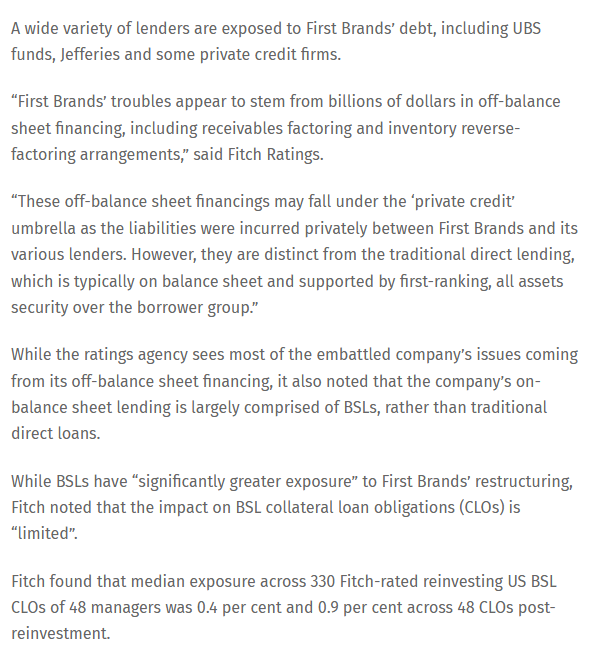
Also, here’s Fitch’s view re: First Brands CLO exposure:Image
Sep 4, 2025 9 tweets 3 min read
Nikita is saying to rip some educational content out there - so here we go

Let's dive into a "day in the life" of a Public Credit Analyst

I will do Private Credit next. By way of background, I'm a Public & Private Credit guy, with some restructuring & equity experience too. Your day can be quickly derailed by any news flow or new issue. Let’s start with news flow.

You should have a massive BBG screener of every name in your coverage and how they’re trading – monitoring daily levels, but I’m generally freaking out if something has leaked down a point or two over a 5 day period.

You should have custom alerts for every name in your coverage, both on Bloomberg or via google or an RSS feed or something else. Bloomberg is pretty good at picking up news flow, but need more sources, including BBG industry chatrooms.
Jul 22, 2025 5 tweets 2 min read
Private Credit has been a fast growing asset class and my bread and butter. We've looked at a TON of direct lending comp data - at big shops like Antares, Apollo, Ares, GS, and Golub.

On Buyside Hub, we're absolutely loaded with Private Credit comp data - here's our findings: Your compensation is going to vary greatly depending on sweaty of a shop you are. Sure sweaty doesnt mean as sweaty as investment banking, but some direct lenders genuinely pull 45 hour works while others are tightly aligned with sponsor schedules and stuck burning the midnight oil.

$150k base salaries are the standard across several shops but top shops might be $175-$185k, creeping towards $200k (where a lot of senior associate base is). 100% bonuses are the expectation across some of the stronger institutions - although a 1.25x or 1.5x is not improbable at some places.

Now you're seeing why Private Credit can be so attractive for someone with only 3 years of work experience.
Dec 27, 2023 8 tweets 1 min read
A lot of people have been asking for more details about the guy behind High Yield Harry.

Think I’m long overdue to share 🧵👇‼️ I live in the American Gardens building on West 81st street. My name is Patrick Bateman. I'm 27 years old.
Oct 2, 2022 6 tweets 2 min read
A lot of people are talking about CDS - but not everyone in finance knows what this means.

Time for a thread to explain 👇🧵 CDS refers to compact discs - a disc with a readable surface that’s adaptable for the storage and delivering of data.

The first compact disc was developed by Sony in 1982 to store and play digital audio recordings.