JYOT is a magnanimous effort to create a spiritual revolution under the guidance of Ga. Jainacharya Sri Yugbhushansuri. RTs & Like not endorsement. info@jyot.in
Apr 30 • 5 tweets • 2 min read
1/3. Seventy-nine years after Independence, a senior counsel today asked India's Supreme Court to inherit a colonial-era jurisdiction over Indian religions.
The argument is a textbook case of unfinished decolonisation.
Senior Adv. @IJaising offered two grounds: 1. Such jurisdiction existed under Warren Hastings and Indian courts inherited it. 2. India has no ecclesiastical courts, so civil courts must fill the gap.
Both collapse on the slightest examination.
2/3. 𝗚𝗿𝗼𝘂𝗻𝗱 𝟭 - 𝗔 𝗯𝗼𝗿𝗿𝗼𝘄𝗲𝗱 𝗽𝗼𝘄𝗲𝗿 𝘁𝗵𝗮𝘁 𝗻𝗲𝘃𝗲𝗿 𝗲𝘅𝗶𝘀𝘁𝗲𝗱.
Colonial-era courts could pass on jurisdiction only over Christianity. The British Parliament legislated for own Church, nothing else. A derivative temporal power cannot exceed its source.
The Shankaracharya Mathas, Jain Acharya lineages, Sikh Takhts, Buddhist Sangha, none were ever within Warren Hastings' spiritual remit. The Crown never claimed jurisdiction over them. It could not have.
If independent India could inherit any ecclesiastical jurisdiction at all, it could only be over Christianity, the one faith its predecessor sovereign actually legislated for.
Not over Hinduism. Not over Jainism. Not over Sikhism. Not over Buddhism.
Her argument, taken seriously, excludes every Indian religion she seeks to apply it to.
Apr 5 • 43 tweets • 32 min read
#1. India has never been a theocratic State. It is not one today. Indian religions have always held the domain of Dharma and the domain of the State as separate.
The Supreme Court must reaffirm this - says Spiritual Sovereign H.H. Yugbhushansuriji.
#SaveReligion #JainacharyaOnSabrimala #RuleOfJustice #Sabarimala #IndianCivilisation
#2. When religion steps into temporal governance - that is overreach.
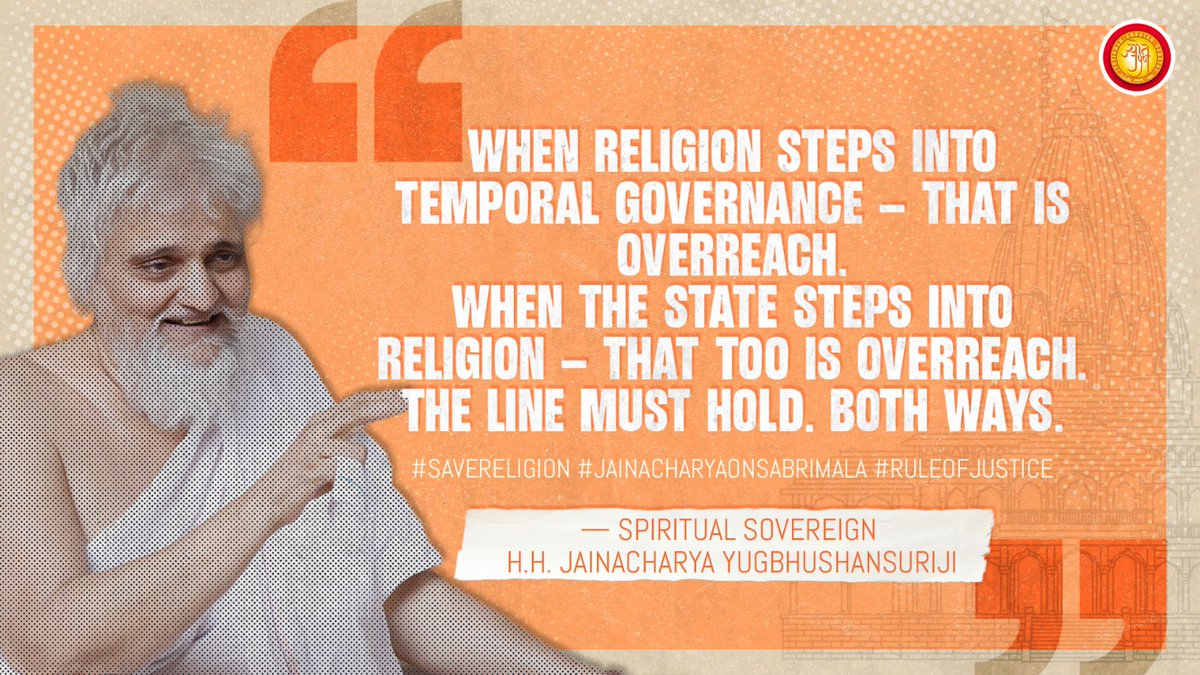
When the State steps into religion - that too is overreach.
The line must hold. Both ways.
- Spiritual Sovereign H.H. Jainacharya Yugbhushansuriji