Inverted Lambda Profile picture
Decentralized Robotics Infrastructure
Apr 13 โ€ข 8 tweets โ€ข 2 min read
The Economic Layer for Embodied AI

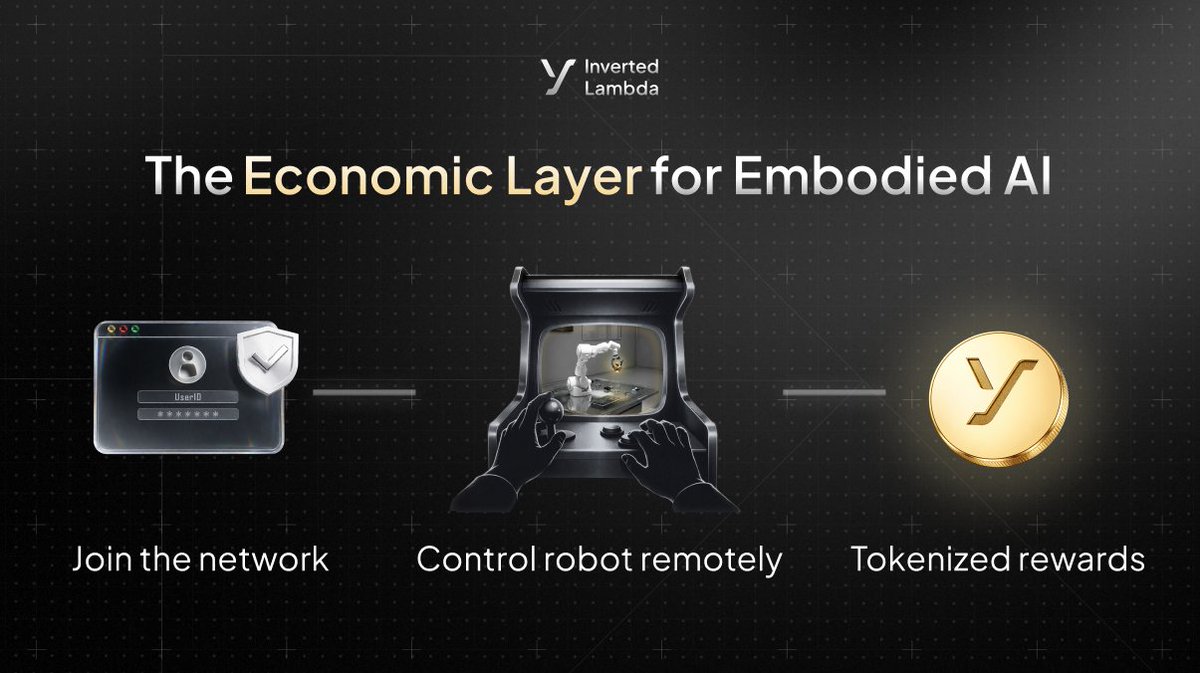
Inverted Lambda is building an economic layer for embodied AI, where people can earn by contributing to real robot operations and data collection. Unlike past crypto cycles, where move to earn and learn to earn trends collapsed due to rewards not being tied to lasting demand, Inverted Lambda connects contributor effort directly to a verifiable external need.
A thread ๐ŸงตImage That demand comes from embodied foundation models. These systems need large amounts of high-quality interaction data to become useful in the physical world. It is not enough for a model to see images or videos. It needs demonstrations of action, control, recovery, and real-world manipulation.
Apr 9 โ€ข 5 tweets โ€ข 4 min read
๐ˆ๐ง๐ฏ๐ž๐ซ๐ญ๐ž๐ ๐‹๐š๐ฆ๐›๐๐š: ๐‡๐จ๐ฐ ๐€๐ˆ ๐ฆ๐ž๐ญ ๐‘๐จ๐›๐จ๐ญ๐ข๐œ๐ฌ

1. A word on incentives

Teleoperation is the hidden engine of embodied AI. But asking humans to perform repetitive, highโ€‘precision remote tasks for hours is not sustainable without fair compensation.

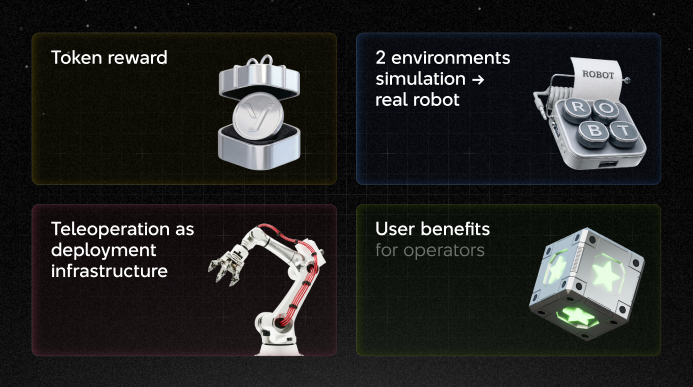
Thatโ€™s why we start with a decentralized, tokenized reward system. Every time an operator completes a teleoperation task - whether driving a simulated robot through a warehouse or guiding a real humanoid arm to pick an object - they earn native tokens. These tokens are transparent, tradeable, and can be staked or used to access premium datasets.

No more centralized points of failure. No more delayed or opaque payments. Just verifiable work โ†’ verifiable reward.

A thread ๐ŸงตImage 2. A twoโ€‘world platform: simulation first, realโ€‘world second

Our platform supports teleoperation in both simulation and the real world โ€“ but with a mandatory step in between.

All operators start in simulated environments. This is where they learn the controls, test edge cases, and build muscle memory without risking expensive hardware. Each environment improves their control skills. Upon completion, they earn NFT badges. These badges are nonโ€‘transferable proofs of skill recorded on chain. Reputation as an onโ€‘chain assets that built gradually. Trust is earned, not given.
To further enforce accountability, we use a staking and slashing mechanism. Operators stake tokens before controlling real robots. Safe operation preserves their stake. Violations or reckless behavior result in slashing.
This system aligns incentives. Good operators build reputation and keep their stake. Bad are filtered out before they cause harm.

Simulation first, to build reputation on chain. Stake to operate. Slash if misbehave.Image