Man 2025 is really the year of awakening. But do conservatives really have what it takes to understand what has happened?
“In the meantime, Javits continued to press the NATO Parliamentarians for advice
and collaboration. He recruited Dr. Aurelio Peccei, who was also associated with the Italian consulting firm Italconsult, to assist with securing European investors.
37 Some of the most distinguished political and economic leaders of the United States, Europe and Latin America were invited to attend meetings that would establish ADELA.”
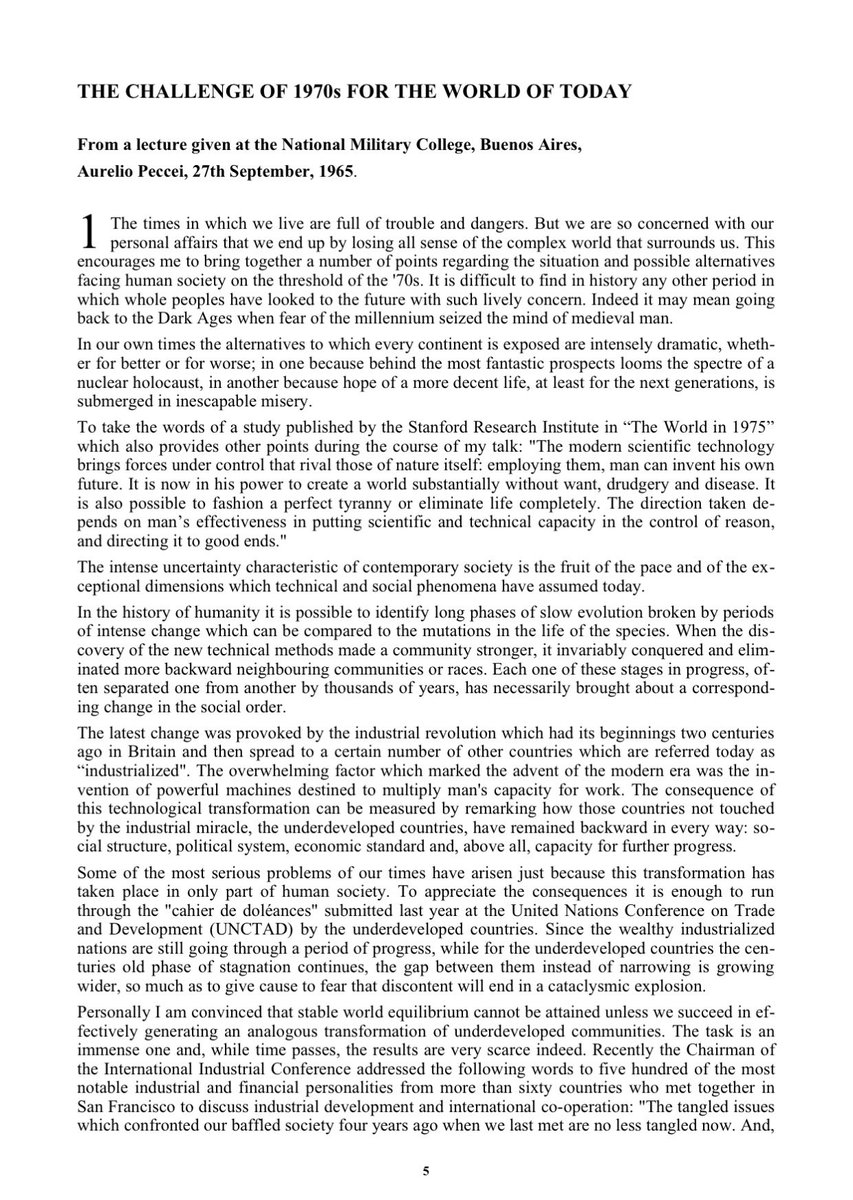
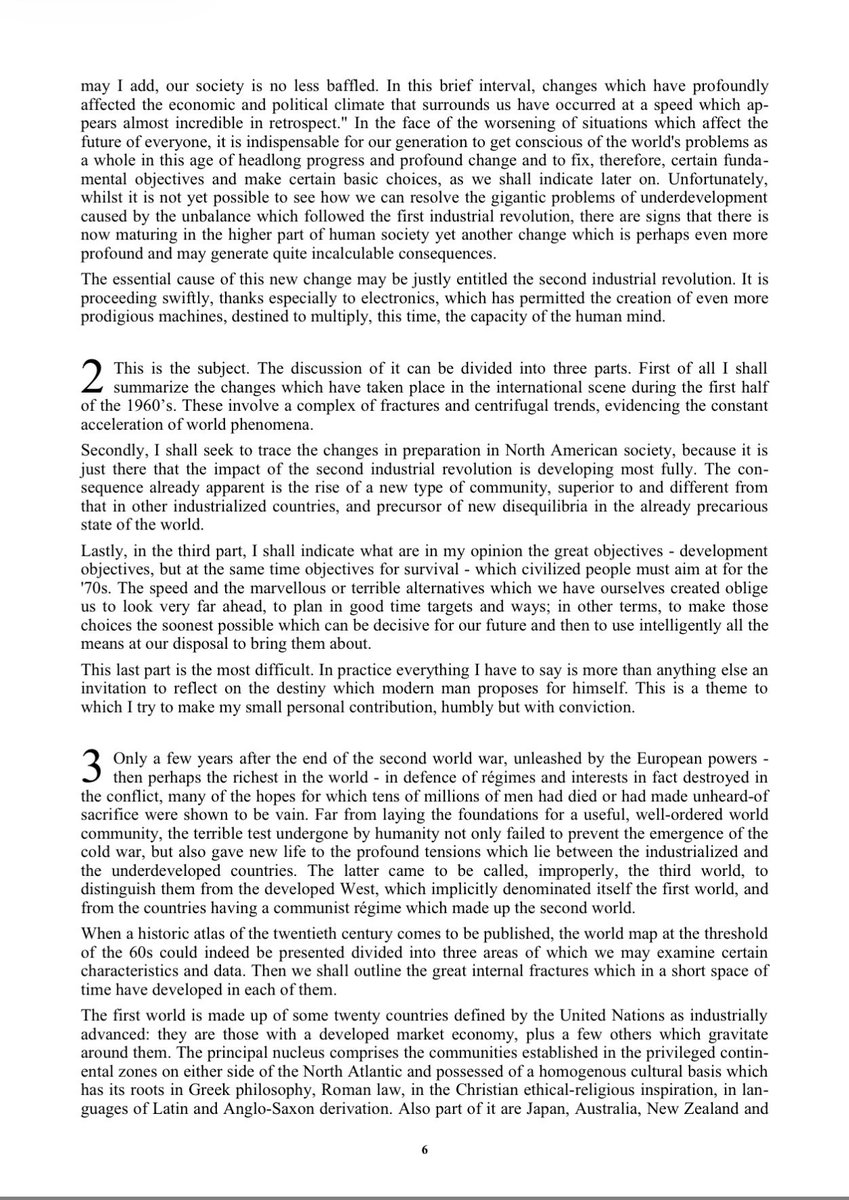
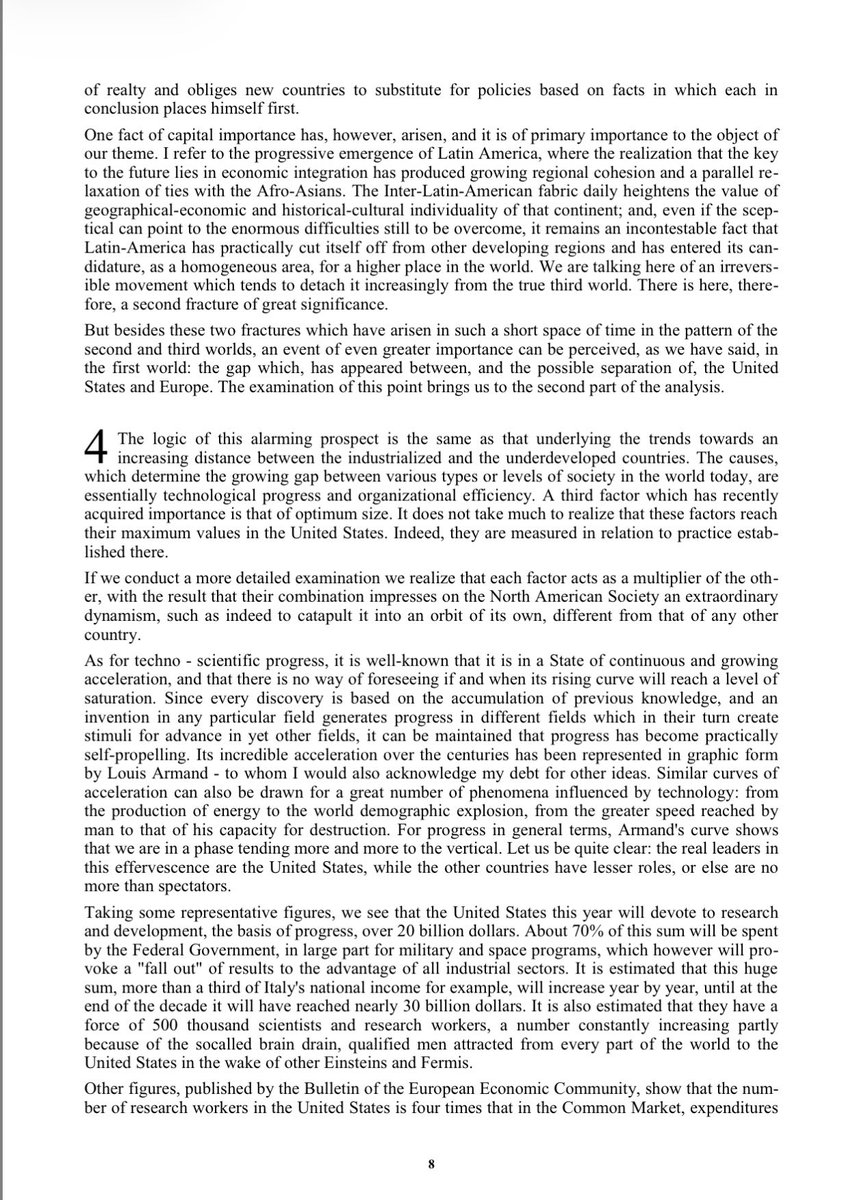
“The clearest executive-branch engagement came in 1965: Peccei’s September 1965 speech in Buenos Aires promoting ADELA drew the attention of Secretary of State Dean Rusk (who served under both Kennedy and Johnson). Rusk ordered it translated into English and distributed within U.S. government circles, indicating official approval and interest.”
Grok
The Heritage Foundation was founded in 1973. Almost all of the groundwork had already been completed for the new world order. All that was left was for it to be institutionalized which came with our 200th anniversary bicentennial celebrations in the form of “global education” for “Interdependence” and was even kicked off with a sublimation of our literal founding document the Declaration of Independence by a Declaration of Interdependence.
Here, the Club of Rome report titled “No Limits to Learning” (1979) explains what this injection of a “global education” purpose was:
“But the real significance of the global dimension of learning may be illustrated by highlighting the role of learning in the attainment of a
"new international order". The calls for restructuring the international order, which started with political decolonization and are being followed by quests for new economic, cultural, and communication and information orders, have become the leitmotif of the contemporary international agenda. The demands for and resistances to the redistribution that such new orders imply are largely a function of the values, mental attitudes and socioeconomic institutions established and reinforced through learning processes. Without a new learning perspective - one that would permit all nations and people to grasp how they should change those of their prevailing values no longer consistent with the changing realities and exigencies of the contemporary world - it is highly unlikely that any new international order can be peacefully and harmoniously established Systems of values hold the answer as to whether the future relations among and within societies will be conflictory or consentient in nature.”
No Limits to Learning (1976)
The Club of Rome
The Heritage Foundation appears to have been created not as a means to coalesce likeminded people around idea but to be controlled opposition to a plan that was already well underway. How many articles in the Hertiage archives talk about Limits to Growth, Interdependence, Global Citizenship Education, a new international order or the like since its founding?
@IlyaSomin
Oct 25, 2025 • 14 tweets • 22 min read
Part I:
1921: The Chinese Communist Party (CCP) is founded in Shanghai, emerging from Marxist study groups amid growing nationalist & revolutionary sentiments in China following the May Fourth Movement. This lays the groundwork for communist organizing against warlords & imperial influences.
1927-1949: The Chinese Civil War unfolds in phases, beginning with the CCP’s alliance & subsequent split from the Nationalists (Kuomintang) under Chiang Kai-shek, interrupted by the Second Sino-Japanese War (1937-1945), & culminating in the CCP’s victory in 1949. The conflict solidifies Mao Zedong’s leadership & the principles of Maoism, emphasizing peasant-based revolution & ideological conformity.
1946-1953: The Macy Conferences, a series of interdisciplinary meetings in New York sponsored by the Josiah Macy Jr. Foundation, pioneer American cybernetics by bringing together scientists like Norbert Wiener, Gregory Bateson, & Warren McCulloch to discuss feedback systems, information theory, & human-machine interactions. These gatherings influence fields from psychology to systems theory, setting the stage for later explorations in control & behavior modification.
1949: On October 1, the People’s Republic of China (PRC) is established under CCP rule, marking the end of the civil war & the beginning of Maoist governance. Maoism evolves as a distinct ideology adapting Marxism-Leninism to Chinese conditions, including mass campaigns for ideological alignment.
Early 1950s: Maoist Thought Reform programs, often termed “brainwashing” in Western discourse, are implemented in China to re-educate intellectuals, landlords, & dissidents through confession, self-criticism, & group pressure, aiming to instill total loyalty to the CCP & reshape society during land reforms & anti-rightist movements. These techniques draw international attention amid Cold War fears of communist psychological control.
1961: Edgar H. Schein’s book Coercive Persuasion: A Socio-psychological Analysis of the “Brainwashing” in Communist China is published, analyzing Maoist thought reform as a systematic process of breaking down & rebuilding individual identities, based on interviews with POWs from the Korean War. In the same year, Robert Jay Lifton’s Thought Reform and the Psychology of Totalism: A Study of “Brainwashing” in China appears, detailing eight psychological themes of totalitarian control observed in Chinese re-education camps, influencing Western understandings of ideological indoctrination. Also in November, the United States Agency for International Development (USAID) is created under President Kennedy to coordinate foreign aid, reflecting U.S. efforts to counter communist influence through economic development amid global ideological battles.
1962: Rachel Carson’s Silent Spring is published on September 27, exposing the environmental dangers of pesticides like DDT and sparking public awareness of ecological harm from industrial growth, which fuels emerging environmental movements and policies.
1965: Aurelio Peccei, an Italian industrialist involved with the Atlantic Community Development Group for Latin America (ADELA), delivers a speech in Buenos Aires highlighting global economic disparities & the need for systemic planning. This inspires figures like Alexander King (OECD science director), Dean Rusk (U.S. Secretary of State), Jermen Gvishiani (Soviet planner), & Carroll Wilson (MIT professor) to explore collaborative approaches to worldwide challenges, paving the way for international think tanks.
1966-1976: China’s Cultural Revolution, launched by Mao to purge capitalist and traditional elements, intensifies thought reform through Red Guards and academic institutions, which are mobilized to enforce ideological purity. U.S. intelligence reports from the late 1960s & early 1970s, amid the Vietnam War era, describe internal chaos, purges, & the use of universities as tools for revolutionary indoctrination, informing Western strategies toward China.
Part II:
1968: The Club of Rome is founded in April during a meeting in Rome organized by Peccei and King, as an informal group of intellectuals, scientists, and leaders to address global problems like population growth and resource depletion through systems analysis. Later that year, Richard Nixon wins the U.S. presidential election on November 5, promising to end the Vietnam War and restore order amid domestic unrest.
1969: Nixon, inaugurated in January, embarks on a European tour from February 23 to March 2 to strengthen NATO alliances, visiting Rome on February 27-28 where he hosts an after-dinner gathering with leading Italian citizens, including Peccei, discussing global economic and technological issues. Peccei’s book The Chasm Ahead is published, warning of impending crises from unchecked growth and advocating for international cooperation. On April 10, Nixon addresses the NATO Council in Washington on the alliance’s 20th anniversary, emphasizing adaptation to new global realities like environmental and population pressures. Erich Jantsch reviews The Chasm Ahead in the journal Futures, praising its call for systemic forecasting. On July 18, Nixon sends a special message to Congress on population growth, highlighting it as a profound challenge requiring family planning and resource management, influenced by emerging environmental concerns.
Late 1960s: The French Group of Ten (Groupe des Dix), an informal discussion circle of French intellectuals and officials, forms around 1969 to debate futures studies, technology, and society, achieving cross-disciplinary dialogues on planning before dissolving around 1974-1975 amid shifting priorities.
1970: The U.S. Environmental Protection Agency (EPA) is established on December 2 by Nixon’s executive reorganization, consolidating environmental functions in response to pollution crises amplified by works like Silent Spring.
1971: The European Management Forum (later the World Economic Forum) is created in January by Klaus Schwab, hosting its first symposium in Davos to promote stakeholder capitalism and global business dialogue. On August 15, Nixon suspends the U.S. dollar’s convertibility to gold, ending the Bretton Woods system due to inflation, trade imbalances, and dollar overvaluation, aiming to stabilize the economy amid global pressures.
1972: Nixon and Henry Kissinger visit China from February 21-28, meeting Mao Zedong to normalize relations; Kissinger discusses philosophy, global strategy, and mutual interests like countering Soviet influence, marking a thaw in U.S.-China ties amid ongoing Cultural Revolution insights. The Club of Rome releases its first report, The Limits to Growth, in March, using computer models to propose that exponential growth in population, industry, and pollution would lead to collapse unless curbed through policy changes; it sparks global debate, with praise for foresight but criticism for pessimism and methodological flaws.
1973: At the European Management Forum in Davos, Peccei speaks on The Limits to Growth, urging business leaders to adopt sustainable practices amid economic turbulence.
1974: Seymour Hersh publishes articles in The New York Times on December 22 exposing massive CIA covert operations, including domestic spying on antiwar activists, triggering public outrage and investigations.
1975-1976: The Church Committee, a U.S. Senate select committee chaired by Frank Church, investigates intelligence abuses from January 1975 to April 1976, uncovering CIA assassination plots, illegal surveillance, and covert actions; it recommends reforms like congressional oversight, FISA courts, and restrictions on executive power to prevent future violations.