Jacob Ben-David Linker 🪬🕎✡️🕎🪬 Profile picture
Yiddishe kop, neshama, un mensch. I am not a Jew with trembling knees. Rooted Cosmopolitan. American, and proudly so.
Aug 13 • 4 tweets • 2 min read
An old Palestinian woman in Syria says that the Arab armies told them to evacuate, and they could return shortly after Arab victory.

This article is from 2025 in NPR. Image npr.org/2025/02/10/nx-…
Aug 5 • 9 tweets • 7 min read
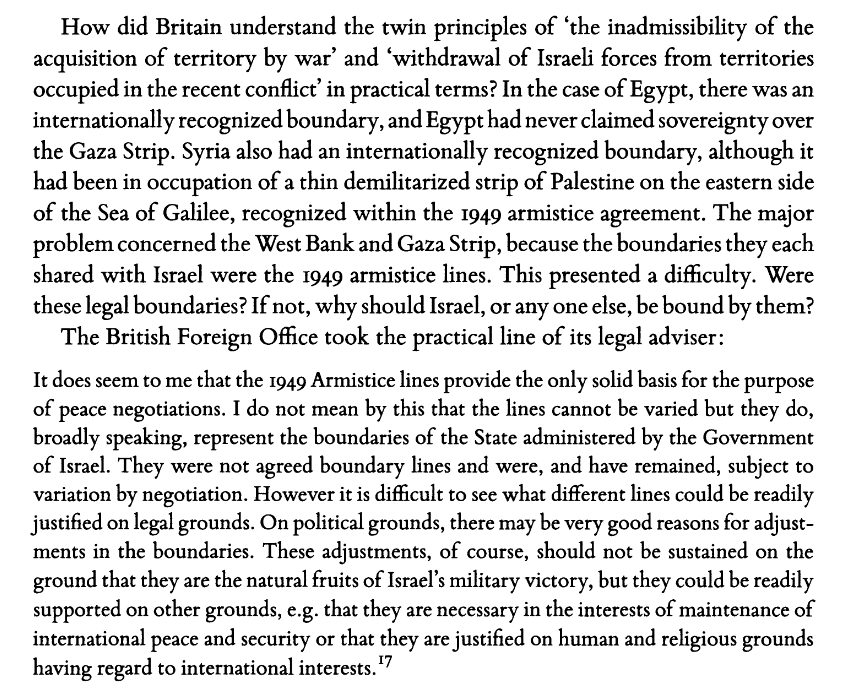
Britain’s Memorandum of Understanding, in embracing the false view that the Palestinians are entitled to all lands held by Jordan and Egypt on June 4 1967, has abandoned the original British Foreign Office understanding of UNSCR 242 - a resolution Britain was a principal drafter thereof!

Starmer's gov is essentially contending that it lied for decades or for decades it did not understand a document that it drafted.

As originally interpreted by the foreign office, Israel was entitled to retain a strip of land just over the Green Line (from Tulkarem to Latrun, as they figured) and to absorb lands around Jerusalem to decongest the area. This was what "secure

Governing principles included modest strategic depth, reunification of municipalities divided by the armistice line, key hilltops, rationalization of the line so that you didn’t have roads and buildings divided by the line of 1949, etc.

What’s wild is that in negotiations Jordan - whose claim over the West Bank Britain recognized - accepted this interpretation. King Hussein was willing to assent to Israel annexing East Jerusalem and lands along the Green Line so long as he got the Gaza Strip in exchange and a return of the Christian and Muslim Quarters of the Old City.

Where does this interpretation come from?

There are five factors.

[1] Israel in its declaration of independence accepted the principle of partition, though it did not commit to any particular boundaries. Under this reasoning, Israel cannot claim the *whole* of former Mandate Palestine. But what it doesn't desire is sort of a question mark.

[2] The Armistice Agreements of 1949 which Israel had with Egypt, Jordan, and Syria included provisions (at the Arabs' insistence) that the Armistice Lines were not boundaries. Ergo, they did not involve any waiver of political claims across the Armistice Line.

Under this understanding, negotiations with Jordan in the coming decades all involved adjustments. Ideas of ceding and swapping areas along the Green Line were common. One idea discussed in the Anglo-American mediation in the early-to-mid 50s for example was something like the little Triangle, villages east of Lod and Ramla, and Beisan going to Jordan in exchange for lands in the Hebron Hills being ceded to Israel. That's land swaps using the Green Line as the basis of legitimatizations, but there's a lot of flexibility in that respect.

[3] This understanding of the 1949 Armistice Agreements not prejudicing future claims comports with a 1948 UN Security Council Resolution about Armistice Lines in what had previously been Mandatory Palestine. United Nations Security Council Resolution 6 (UNSCR 6) (1948) "Calls upon the interested Governments, without prejudice to their rights ... with regard to a peaceful adjustment of the future situation of Palestine... to withdraw those of their forces which have advanced beyond the positions held on 14 October".

Lots of areas recognized as Israeli prior to June 4 1967 were captured between 14 October 1948 and the end of fighting on January 7 1949.

[4] UNSCR 242 - passed in the wake of the Six Day War, and principally drafted by the United States and United Kingdom - says that Israel has to withdraw from "territories occupied in the recent conflict". It does NOT say ALL territories or THE territories.

This was a deliberate omission meant to leave wiggle room for negotiation. There had been months of efforts by Arab and Arab-aligned nations to get the UNSC Resolution to include language like "THE" or "ALL" included. This was rejected. The drafting history is clear: the notion that Israel had to withdraw from all lands was rejected.

Notably, other UNSCR's withdrawal provisions from various conflicts prior to UNSCR 242 routinely use specific language about the territory to be withdrawn from.

SC Res. 3 (1946): Calls for "the withdrawal of all USSR troops from the whole of Iran"

SC Res. 61 (1948) [mentioned above]: "Calls upon the interested Governments, without prejudice to their rights ... with regard to a peaceful adjustment of the future situation of Palestine... to withdraw those of their forces which have advanced beyond the positions held on 14 October"

SC Res. 82 (1950): "Calls upon the authorities in North Korea to withdraw forthwith their armed forces to the 38th parallel"

SC Res. 143 (1960): "Calls upon the Government of Belgium to withdraw its troops from the territory of the Republic of Congo"

SC Res. 210 (1965): "Calls upon the parties [India & Pakistan] to... promptly withdraw all armed personnel to the positions held by them before 5 August 1965"

[5] UNSCR 242 says that Israel is entitled to a "right to live in peace within secure and recognized boundaries"

Per [4] and [5], the older principle of peace between Israel and the sovereign of the West Bank was modified. Yes, negotiations would be based upon the Green Line. But rather than land swaps being an operative principle, it would be a matter of territorial adjustments being in Israel's favor.

[6] Per the British Foreign Office's original interpretation of UNSCR 242, such favorable adjustments had to have some justification other than "because we won". This could mean humanitarian reasons (reunification of jurisdictions and metro areas divided by the armistice line of 1949), strategic hilltops, some strategic depth along the Green Line for Israel, absorption of roads divided by the Green Line, etc. Reunification of metro areas would go beyond a single jurisdiction being divided, as Lord Caradon spoke of it being absurd that two municipalities with strong links - Tayibe and Qalqilya - were divided by the Armistice line.

Notably, such adjustments were in accordance with what many international law scholars at the time believed was allowed to be kept by a power after a defensive war - even if the aggressor power had proper title to the territory beforehand. And they also comport to a different common view about a "self-help" right of countries to use force to take territory they have a solid claim to,

The Green Line isn’t irrelevant in this understanding. You still are expected to have secure borders established “based on” the line. But it isn’t a sacred boundary to be devoted to with scrupulous exactitude either.

And King Hussein of Jordan in negotiations had acquiesced to this view. By 1973 he was willing to yield a slice of land along the Green Line and East Jerusalem, sans the Christian and Muslim Quarters of the Old City. This is especially important because (i) Britain recognized Jordan's title to the West Bank, (ii) the Arab League recognized Jordan as the trustee and guarantor of the West Bank, and (iii) UNSCR 228 from 1966 implicitly recognized Jordanian sovereignty in the West Bank by referring to the region as "the territory of Jordan."

Britain's current government has embraced a position insisting on a Palestinian right to all of the lands held by Jordan and Egypt on June 4 1967. This is a position Britain expressly rejected when it drafted UNSCR 242. This is a gross misreading of the relevant history and historical understanding

To say otherwise would mean that UNSCR 242’s promise of secure borders is a lie. And it would mean that the British either lied for decades about a Security Council Resolution that Great Britain helped to draft or were too stupid to understand a document that Great Britain drafted. Source for prior UNSCR Resolutions other than 228; and historic interpretations of the right of countries in defensive wars to acquire title to territory is this paper by @EVKontorovich

chicagounbound.uchicago.edu/cgi/viewconten…

UNSCR 228 (1966) is here
digitallibrary.un.org/record/90503?l…

Ruth Lapidoth on UNSCR 242
jstor.org/stable/41575856

Source for original British Interpretation of UNSCR 242
jstor.org/stable/2453867…
Jun 1 • 4 tweets • 2 min read
“It only proves the desperation to deny a massacre”.

Yes. People tend to deny things that didn’t happen. Why is there such desperation to *assert* that there was a massacre?

There’s a strange contemptuous spirit that many have against the new aid mechanism.

***

But anyways, footage has thus far been released of
(1) 45 minutes of footage at the aid distribution site (compressed into a sped up 14 minute video) from the relevant time period showing no “massacre” or substantial tumult.
(2) Palestinian gunmen (presumably Hamas) shooting at Gazans in Khan Yunis trying to get to the aid site.

There is no footage or imagery of a massacre having taken place. Just folks online saying stuff and reporters abroad buying it and spreading faulty unsubstantiated claims.

If something new emerges, I’ll eat crow.

But for now, this just seems to be another PR-ploy to delegitimize the new aid mechanism which is undermining Hamas. Lots of folks who don’t like Hamas meanwhile are believing it because of a mix of contempt for anything Israeli and not wanting to admit that other sources they trust (NGOs, mainstream media, etc) can get things so grossly incorrect.
Apr 27 • 5 tweets • 2 min read
It seems to me the protesters showed up at Chabad HQ because Ben Gvir was there, but protesters' chants, symbolism, and rhetoric was hardly Ben Gvir specific

Chanting "we don't want Zionists in our city" in Haredi Crown Heights isn't wise.

1/3
Chabad politically was pro-UTJ in Israel. And the Rebbe's non-racism was substantial in NYC and American politics. Shirley Chisholm, for example, took inspiration from the Rebbe.

But they've had political blind spots I think.

2/3
Mar 21 • 7 tweets • 2 min read
Far Leftists became Nazis a long time ago. Image Image
May 24, 2024 • 5 tweets • 3 min read
An interesting debate between a Jordanian and a Palestinian. The gist of this is that many Palestinians, though opposed to Zionism in theory, in practice weren't super bothered by it. They'd never actually say they weren't bothered by it, but their revealed preferences was that they generally prioritized keeping to themselves, prioritized benefitting from the Jewish (Zionist) presence, or prioritized their personal relationships with Jews. People weren't for Zionism, but antizionism wasn't actually a super huge priority for a lot of Palestinians even in 1948.

Also ... a lot of Palestinians just straight-up accepted partition and wanted to be gobbled up by Jordan. Others didn't mind being annexed to Israel. In 1948, most people appear to have perceived their options as "Mufti, Jews, or Abdullah." Palestinians actually revolted against Egyptian conquest in favor of Abdullah. Others asked the Israelis to occupy them first before Arabs could get to them. Palestinian opinion was fascinatingly mixed.

1948 could be seen as a product of the most extreme Palestinian faction (Husayni) which dominated Palestinian politics through whipping up emotions/fears/hate and by violent intimidation and reprisals proceeding to internationalize the matter and bringing the outside Arab world into it.

Like, look at what caused Deir Yessin. Husayni blockading 100,000 Jews in Jerusalem. The Battle of Deir Yessin was a relief effort on the siege and a bunch of clusterfucks led to a bunch of civilians getting killed due to what at best was gross negligence toward civilian life and at worst was straight-up indifference. Then a Khalidi in Jerusalem thought it would be a good idea to lie and say there were rapes and mutilations and stuff in the hope that it would whip up Palestinian opinion to fight and international opinion to intervene ... and the actual result was a lot of Palestinians who otherwise wouldn't have fled ended up fleeing.

And then after Deir Yessin, Palestinian and Jordanian forces committed revenge massacres against Jews in Kfar Etzion and Jerusalem. Whoops!

So there you've got the pattern. Mufti does a thing, Jews respond to the thing that gets other Palestinians hurt, Mufti ally whips people up, other Arabs intervene, other Arabs are shocked Palestinians are actually just terrified of everything going on and didn't really wanna have to deal with all the fighting going on ... and then proceeded to shame and humiliate Palestinians like crazy after 1948.

And to be frank, the nastiest stuff the Israelis did in 1948 often was less directed at the Palestinians (though they suffered the cost) than at others. Why is it that when the Israelis intentionally expelled people it was always along the borders? Because their focus was on outside Arab States.

Also, Britain and the US were scheming with Jordan to have Jordan gobble up the Arab portion of the mandate. The idea of Israeli-Jordanian partition of Palestine probably was the one with the broadest consensus. And that basically remained the generally-agreed resolution structure until 1988. Egypt and Syria meanwhile whipped up the 1948 War to screw with Jordan, and later supported the Mufti's insurgency (remember, he was dictator of Gaza until ~1953) and the PLO for the same reason. Also, Ben Gurion (1) before 1948 did send Golda Meir to try and keep Palestinians from fleeing Haifa but (2) after the war proceeded to refer to those who fled as "traitors" when being really resistant to people returning.

This doesn't make sense unless there were actual positive social relations and a sense that coexistence was possible, which was shattered by the war.
Apr 24, 2024 • 18 tweets • 10 min read
Lol, one of the sources linked to in Vox's Article states what in 1920 was well-known: Palestinian identity was deemed a subset of Syrian identity.

It also is dismissive of what had been some 2000 years of the area being Jewish majority or plurality.

archive.org/stream/caseaga…

Image Continuing, it is dismissive of the idea of Jews constituting a "nation" ... even though Jewish national identity is one of mankind's oldest ones. It's up there with China and Iran in terms of how old it is.
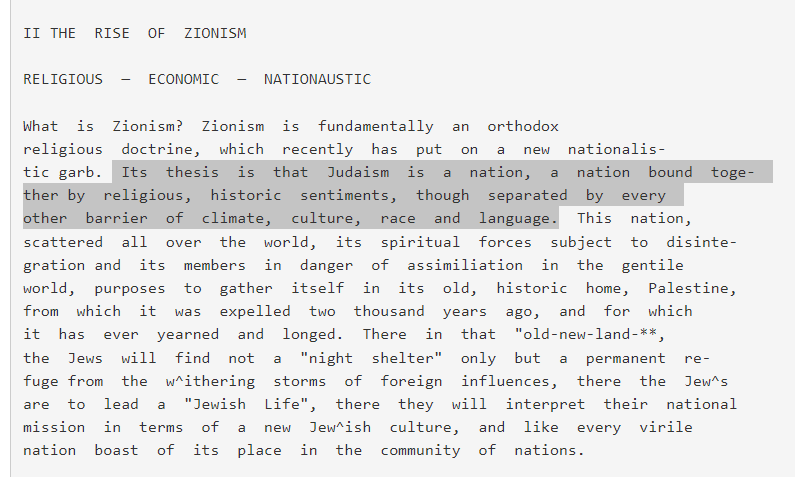
This attitude continues to pervade antizionist discourse: Jews aren't a real people, according to the antizionists.Image
Mar 8, 2024 • 20 tweets • 10 min read
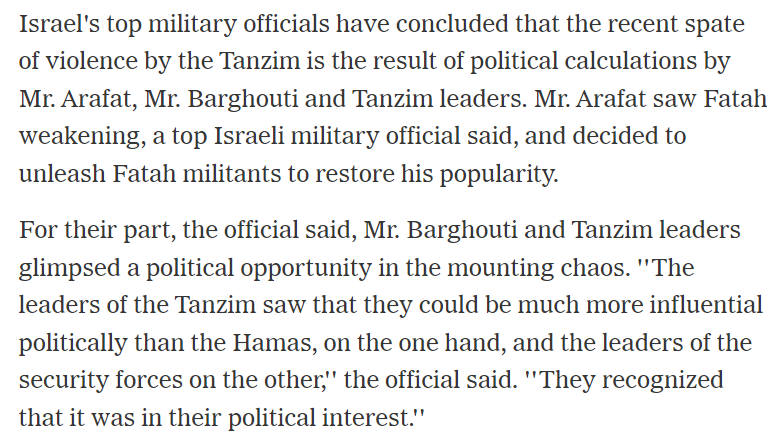
Rounding up the Marwan Barghouti stuff today, here's a thread.

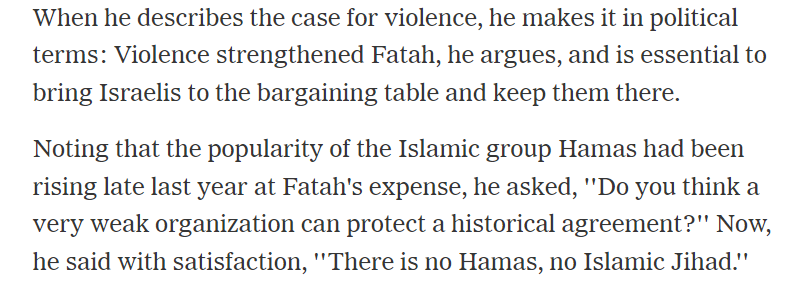
1. New York Times 2002. Barghouti discusses the role of violence in strengthening Fatah's political position in Palestinian politics, and says he thought settler civilians were fair game.

nytimes.com/2002/03/07/wor…


Image
Image
Image
2. Haaretz 2012. Barghouti admits he funded and purchased arms for Fatah members who attacked Israeli civilians in settlement blocs. He also received reports from such orgs.

haaretz.com/2012-04-19/ty-…
Image