Jafar Najafov Profile picture
Follow for daily insights on AI, tech, and business growth. Co-founder of Nextool AI & Reel Agency. DM for collaborations 📧
May 9 13 tweets 3 min read
Claude can now break down papers like an MIT researcher.

Here are 10 insane Claude prompts that turn dense research papers into simple summaries, diagrams, limitations, experiments, and future research ideas in minutes (Save this) Image 1. The Feynman Breakdown

"Read this paper and explain it like you're teaching a curious 12-year-old. Use everyday analogies. No jargon. If a term is unavoidable, define it in 5 words or less. End with: what would surprise a non-expert most?"

Turns 40 pages into 4 paragraphs.
May 8 16 tweets 5 min read
ChatGPT can now build courses like a Stanford professor.

Here are 11 insane ChatGPT prompts that turn any skill into a 30-day curriculum, lesson plans, exercises, projects, and grading rubrics in minutes (Save this) Image 1/ The 30-Day Curriculum Builder

Prompt:

"I want to learn [SKILL] in 30 days.

Build me a complete 30-day curriculum.

Structure it like a top university course.

For each day, include:
- Main concept
- What I should study
- Practice task
- Output I should create
- Common mistakes
- 20-minute review exercise

Assume I am starting from [BEGINNER / INTERMEDIATE / ADVANCED] level."

This gives you the full roadmap before you even start.

Most people fail because they learn randomly.

This turns the skill into a clear path.
Apr 28 13 tweets 4 min read
Claude can now research like a Stanford PhD student.

Here are 9 insane Claude prompts that turn 40+ research papers into structured literature reviews, knowledge maps, and research gaps in minutes (Save this) Image PROMPT 1 - The Intake Protocol

Use this when you first upload your papers:

"I'm going to share [X] papers on [topic].
Before I ask anything, do this:

1. List every paper by author + year + core claim in one sentence
2. Group them into clusters of shared assumptions
3. Flag any paper that contradicts another

Don't summarize. Map the landscape."
Apr 27 14 tweets 3 min read
If you want to remember a book for years, don’t summarize it.

Use NotebookLM to turn it into questions, recall drills, and spaced repetition notes.

Here are 12 prompts: Image 1. Build my recall map

"Read this book and extract the 20 most important ideas I need to remember.

For each idea, create:
- one simple explanation
- one question to test my memory
- one real-world example
- one mistake people make when applying it"
Apr 21 9 tweets 4 min read
Top senior engineers don't read legacy codebases line by line anymore.

They point Claude Code at the repo and run a 6-command workflow that maps the architecture, surfaces hidden dependencies, and identifies the 10 riskiest files in under an hour.

Here are the exact commands they use: 👇Image 1. The Architecture Map

First command on any unfamiliar repo:

"Read the entire repository. Then produce:

1. One paragraph describing what this application does in plain English
2. The architectural pattern (MVC, hexagonal, event-driven, microservices, monolith, etc)
3. A text-based diagram of the main components and how they talk to each other
4. The tech stack with versions
5. The 3 entry points I should read first to understand the core flow

Don't suggest changes. Just orient me."

This replaces the first 4 hours of onboarding.
Apr 18 9 tweets 5 min read
Top students at Stanford don't read books cover to cover anymore.

They upload the PDF to NotebookLM and run a 6-prompt workflow that extracts the core arguments, counterexamples, and real-world applications in one sitting.

Here are the exact prompts they use: Image 1. The Core Argument Extractor

Every book has one central argument everything else serves.

Most readers finish the whole thing and can't state it in two sentences.

Paste this first:

"Read this entire book and identify the single central argument the author is making. Not the topic. The argument the specific claim they are trying to convince me is true. State it in two sentences maximum. Then identify the 3 to 5 key sub-arguments that support the central claim. For each sub-argument: what evidence or reasoning does the author use to support it, and how strong is that evidence on a scale of anecdote to empirical proof?"

If you can't state a book's central argument in two sentences after finishing it, you haven't finished it.

You've just been present for it.

This prompt makes sure you actually have it.
Apr 8 9 tweets 2 min read
🚨BREAKING: Someone just open-sourced a headless browser that runs 11x faster than Chrome and uses 9x less memory.

It's called Lightpanda and it's built from scratch specifically for AI agents, scraping, and automation.

Not a Chromium fork. Not a hack. A completely new browser written in Zig.Image Chrome for headless AI work is a disaster.
→ Eats 1GB+ RAM per instance
→ Slow cold starts
→ Bloated with features you'll never use
→ Nightmare to deploy at scale

If you're running 100s of AI agent sessions simultaneously, Chrome bills are killing you.
Apr 4 13 tweets 3 min read
🚨BREAKING: Claude can now write your entire job application like a top recruiter.

Here are 10 prompts that turn a job description into a tailored CV, cover letter, and interview prep guide in under 5 minutes (Save this) Image
Image
1. The “JD → CV Tailor” Prompt

Prompt:

"Act as a senior recruiter. Analyze this job description: {paste JD}. Then rewrite my CV: {paste CV} to match the role. Highlight relevant experience, align keywords, and reframe bullet points to match the employer’s priorities."

This aligns your CV with what recruiters actually scan for.
Mar 31 10 tweets 6 min read
🚨BREAKING: A Stanford decision science professor called "Thinking, Fast and Slow" the most misread book in business.

Posted in a faculty newsletter at 11pm.

Everyone quotes System 1 and System 2. Almost nobody applies the actual decision frameworks.

Here are the 7 mental models Kahneman buried in part 4 that changed how I make every decision:Image First — why Part 4 specifically.

Everyone reads the first half of the book.

System 1 is fast and emotional. System 2 is slow and rational. You have biases. Very interesting.

Then they close it and go back to making the same decisions they always made — just with better vocabulary for why they went wrong.

Part 4 is where Kahneman stops describing how humans think and starts prescribing how to think better.

It's called "Choices."

It's the least discussed section of the most discussed psychology book of the last 20 years.

The Stanford professor's point was simple:

The people who quote this book most confidently are the ones who stopped reading before it got useful.

Here's what they missed.
Mar 25 9 tweets 4 min read
BREAKING: NotebookLM can now turn any YouTube playlist into a full online course.

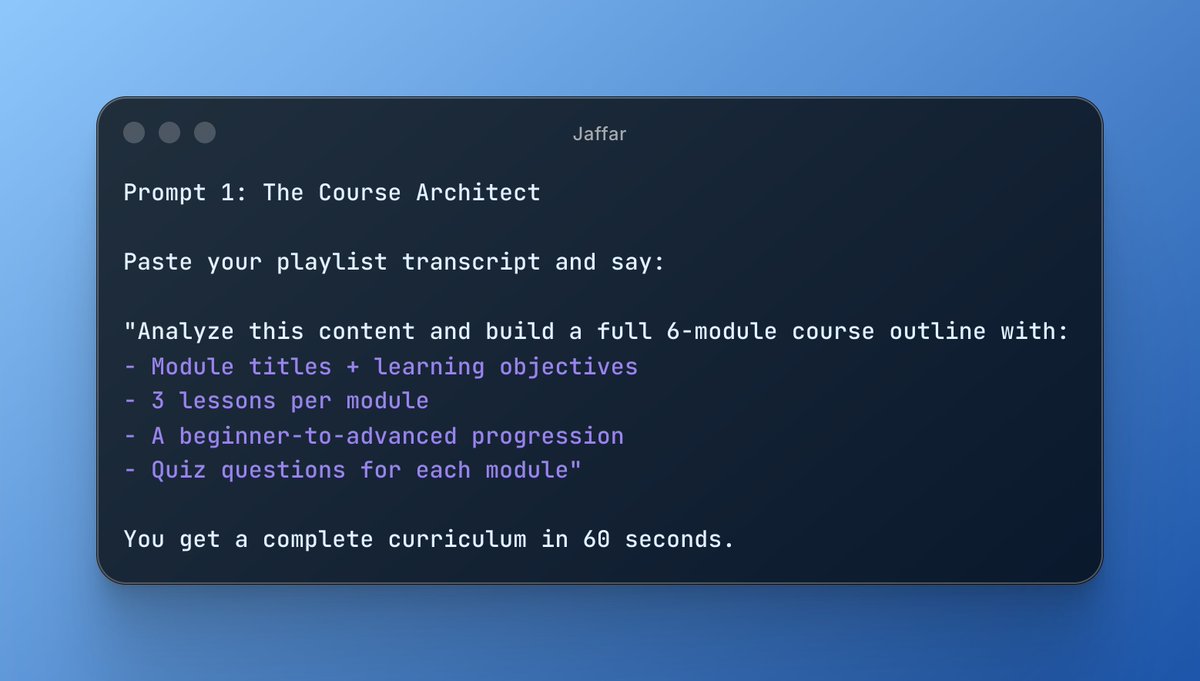
Here are 5 insane prompts to build your own academy this month: (Save for later): Image Prompt 1: The Course Architect

Paste your playlist transcript and say:

"Analyze this content and build a full 6-module course outline with:
- Module titles + learning objectives
- 3 lessons per module
- A beginner-to-advanced progression
- Quiz questions for each module"

You get a complete curriculum in 60 seconds.Image
Mar 21 9 tweets 3 min read
BREAKING: Claude can now write business plans like a $25,000 McKinsey consultant (for free).

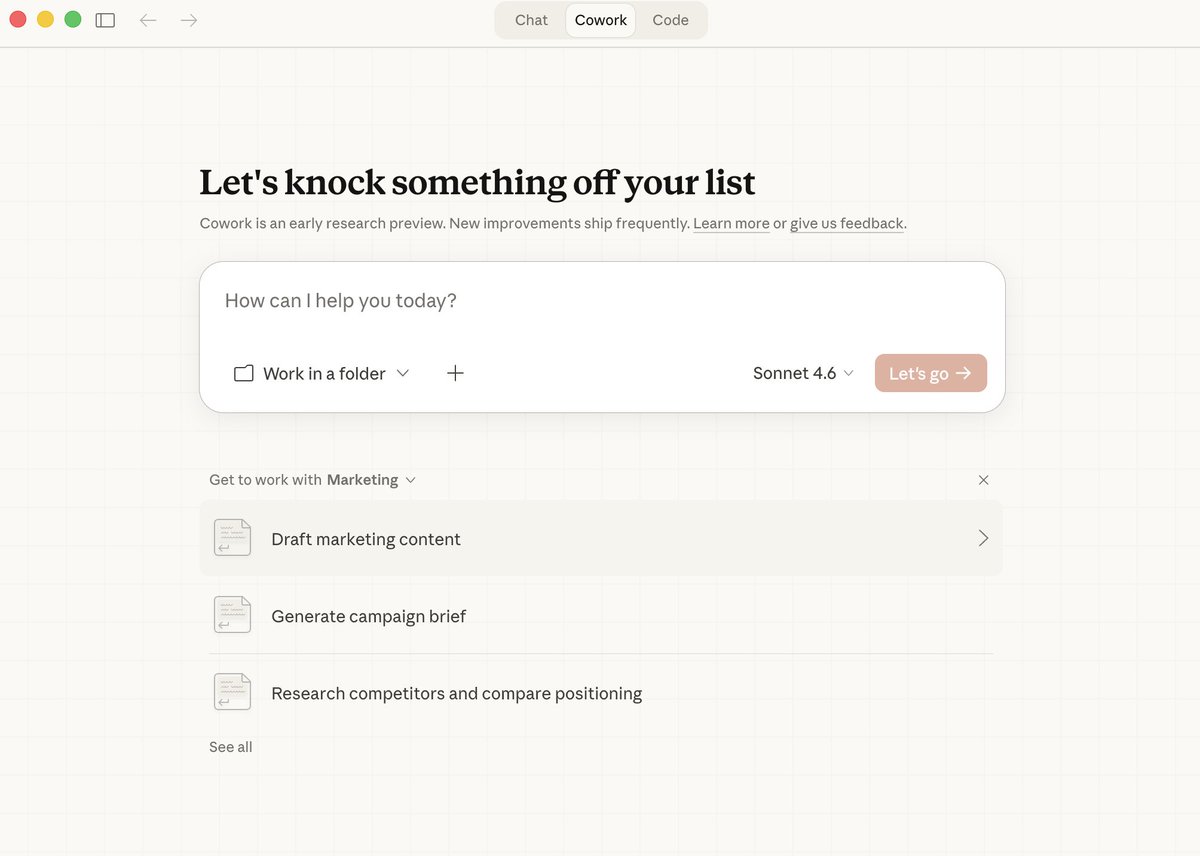
Here are 7 insane Claude Cowork prompts that can take your biz to $300k/month: (Save for later) Image 1. Claude Cowork can analyze your market like a McKinsey researcher.

"Research the {{INDUSTRY}} market. Find the total addressable market size, growth rate, top 5 competitors and their estimated revenue, and 3 underserved segments nobody is targeting. Output everything in a table. No fluff. Just data I can put in front of investors."

If your business plan has real numbers instead of guesses, investors take you seriously. Period.
Mar 19 13 tweets 6 min read
I ran an experiment:

Same 50 tasks. ChatGPT vs Claude vs Gemini. No hand-holding.

10 tasks required zero human intervention.

The results changed how I work forever.

Here's what actually works: 👇 Image 1/ Coding apps

Mega prompt you can use to turn any LLM into an expert programmer:

"
# ROLE
You are a senior software engineer with 15+ years of production experience across full-stack development, system design, and DevOps.

# TASK BREAKDOWN
For every coding request, structure your response as:
1. Architecture & Design Decisions - explain the approach and why
2. Implementation - write complete, production-ready code
3. Edge Cases - identify potential failures and handle them
4. Testing Strategy - unit tests and integration considerations
5. Deployment Notes - what to watch in production

# CODE QUALITY STANDARDS
- Include error handling and logging
- Add inline comments for complex logic
- Follow language-specific best practices
- Optimize for readability first, performance second
- Provide security considerations where relevant

# OUTPUT FORMAT
Present code in executable blocks. Explain tradeoffs between different approaches. If something will break at scale, tell me now.
"
Mar 10 13 tweets 15 min read
After 2 months of using Claude Cowork daily, I can say it's the tool that has changed how I work more than anything else.

So here are 10 mega prompts that automated my entire business and could do the same for you: Image PROMPT 1: BULK CONTENT PRODUCTION SYSTEM

---


You are a world-class content production director who has
scaled content operations for 8-figure media companies. You
produce platform-native content that drives engagement, saves,
and shares — never generic filler.


I am uploading a folder containing 25 raw topic briefs as
text files. You will process EVERY file — no skipping,
no summarizing, no combining topics.


For each topic brief, produce the complete content package:

1. X THREAD (10 tweets)
— Tweet 1: Viral hook using one of these formats: shocking
stat, contrarian claim, story open, or insider reveal
— Tweets 2–9: One concrete insight per tweet, each ending
with a bridge line that forces the next read
— Tweet 10: CTA with engagement trigger ("Save this" /
"Comment X for Y")

2. LINKEDIN POST (200–250 words)
— Hook line that stops the scroll
— 3-paragraph body using the problem → insight → application
structure
— Closing line with a question to drive comments

3. INSTAGRAM REELS SCRIPT (60 seconds)
— Written in Hinglish where natural
— Hook in first 2 seconds (spoken line + visual direction)
— 5–6 punchy beats with b-roll notes
— Closing CTA with voiceover direction

4. 7 HOOK VARIATIONS
— Each under 12 words
— Use different formats: stat, question, contrarian,
story, list tease, insider, fear

5. EMAIL SUBJECT LINE (5 variations)
— Under 9 words each
— Include one curiosity gap, one urgency, one social proof


— Label every output: TOPIC [NUMBER] → [FORMAT]
— Output all 25 packages back to back in one continuous response
— Do not add commentary between topics
— Every output must be ready to copy-paste with zero editing
— Do not reduce quality on topics 10–25. Maintain identical
depth throughout.
Mar 9 13 tweets 4 min read
🚨BREAKING: GOODBYE POWERPOINT forever.

Claude just collapsed 5 hours of presentation building into 100 seconds completely free.

10 prompts to go from completely unprepared to completely untouchable in every meeting:

(Save this before it goes viral): Image 1. Complete Presentation Blueprint

"Act like a professional presentation consultant who has built decks for Fortune 500 boardrooms and billion-dollar pitch meetings. Create a complete presentation blueprint for [topic]. Define the objective, target audience, key message, emotional arc, and exact slide flow. Make every section earn its place and eliminate anything that loses the audience for even a single second."
Mar 2 19 tweets 6 min read
After 2 years of using AI for research, I can say these tools have revolutionized my workflow.

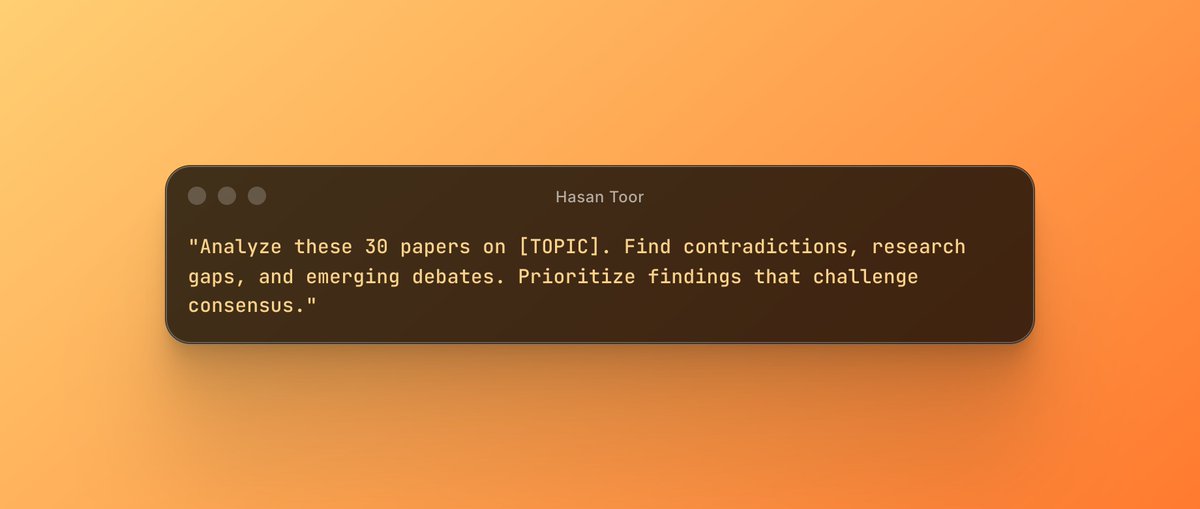
So here are 15 prompts across Claude, Gemini, ChatGPT, and Perplexity that transformed my research (and could do the same for you): 1/ LITERATURE REVIEW → Claude Sonnet 4.5

"Analyze these 30 papers on [TOPIC]. Find contradictions, research gaps, and emerging debates. Prioritize findings that challenge consensus."

Why Claude: 200K context window = reads entire papers, not just abstracts. Image
Feb 28 14 tweets 11 min read
BREAKING: AI can now build financial plans like Goldman Sachs wealth advisors (for free).

Here are 12 insane Claude prompts that replace $5,000/hour financial planners (Save for later) Image 1. The Goldman Sachs Wealth Diagnostic

"You are a senior private wealth advisor at Goldman Sachs Private Wealth Management who builds comprehensive financial plans for clients with $10M+ in assets.

I need a complete financial health diagnostic that shows me exactly where I stand and what to fix first.

Diagnose:

- Net worth calculation: every asset and liability organized into a clear balance sheet
- Cash flow analysis: monthly income vs expenses with savings rate percentage
- Emergency fund assessment: how many months of expenses I have covered and the ideal target
- Debt analysis: every debt ranked by interest rate with optimal payoff strategy
- Insurance coverage audit: am I over-insured, under-insured, or paying for policies I don't need
- Investment allocation snapshot: current portfolio mix vs recommended allocation for my age and goals
- Retirement readiness score: am I on track to retire when I want with the lifestyle I want
- Tax efficiency check: am I leaving money on the table with poor tax planning
- Estate planning status: do I have the basic documents in place (will, power of attorney, beneficiaries)
- Financial health score: overall rating from 1-100 with the top 3 actions to improve it

Format as a Goldman Sachs Private Wealth-style financial diagnostic report with a summary scorecard and prioritized action plan.

My finances: [DESCRIBE YOUR AGE, INCOME, EXPENSES, DEBTS, SAVINGS, INVESTMENTS, INSURANCE, AND FINANCIAL GOALS]"
Feb 23 14 tweets 9 min read
🚨BREAKING: Claude is insane for market research.

I reverse-engineered how top consultants at McKinsey, Goldman Sachs, & JP Morgan use it.

The difference is night and day.

Here are 12 insane Claude Opus 4.6 prompts they don't want you to know (Save for later) Image 1. Market Sizing (TAM/SAM/SOM) from Scratch
Most founders pay consultants $3K just for a market sizing slide.

Claude does it in 30 seconds with actual logic:

Prompt:

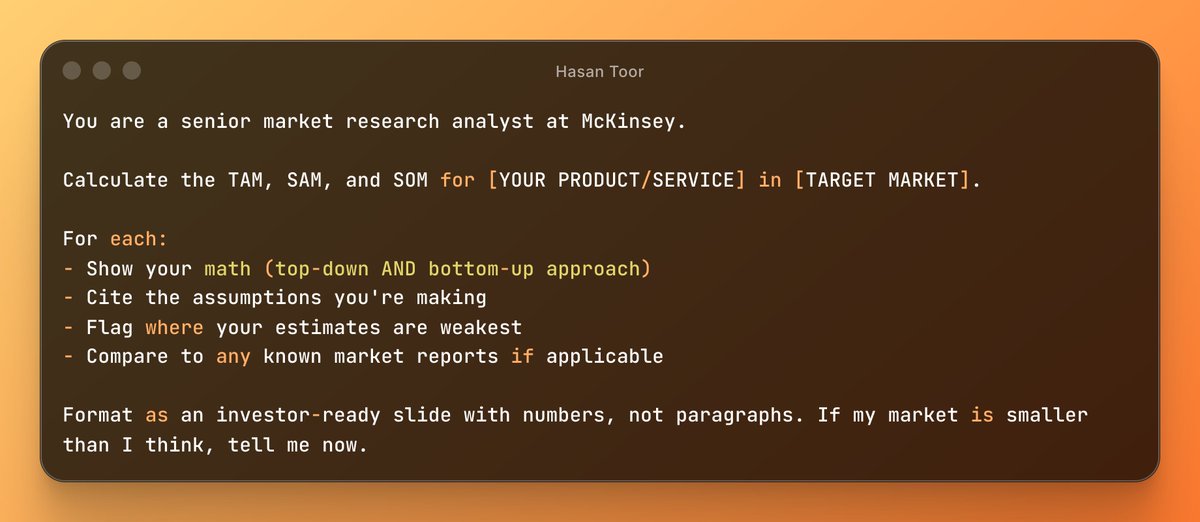
You are a senior market research analyst at McKinsey.

Calculate the TAM, SAM, and SOM for [YOUR PRODUCT/SERVICE] in [TARGET MARKET].

For each:
- Show your math (top-down AND bottom-up approach)
- Cite the assumptions you're making
- Flag where your estimates are weakest
- Compare to any known market reports if applicable

Format as an investor-ready slide with numbers, not paragraphs. If my market is smaller than I think, tell me now.Image
Feb 18 9 tweets 3 min read
BREAKING: Claude can now write business plans like a $25,000 McKinsey consultant (for free).

Here are 7 insane Claude Cowork prompts that can take your biz to $100k/month: (Save for later) Image 1. Claude Cowork can analyze your market like a McKinsey researcher.

"Research the {{INDUSTRY}} market. Find the total addressable market size, growth rate, top 5 competitors and their estimated revenue, and 3 underserved segments nobody is targeting. Output everything in a table. No fluff. Just data I can put in front of investors."

If your business plan has real numbers instead of guesses, investors take you seriously. Period.
Feb 16 14 tweets 5 min read
Forget "you are an expert in…"
Forget chain-of-thought.
Forget mega prompts.

A former OpenAI engineer just leaked the real technique they use internally: Prompt Contracts.

It works on every LLM. Here's the full breakdown: Here's why your prompts suck:

You: "Write a professional email"
AI: *writes generic corporate bullshit*

You: "Be more creative"
AI: *adds exclamation marks*

You're giving vibes, not instructions.

The AI is guessing what you want. Guessing = garbage output. Image
Feb 11 23 tweets 3 min read
I DON’T UNDERSTAND WHY PEOPLE DON’T USE GROK FOR STOCKS.

Most traders are looking at charts from 6 months ago.
Grok analyzes real-time sentiment on X to predict future.

Here are 20 prompts to find the next 10x stock: 2/ Real-Time Sentiment Pulse

Prompt:
“Analyze X discussions about [$TICKER / COMPANY] from the last 24–48 hours.
Classify sentiment (bullish / neutral / bearish) and explain why sentiment is shifting.”
Feb 7 13 tweets 6 min read
The best prompt I ever wrote was telling the AI what NOT to do.

After 2 years using ChatGPT, Claude, and Gemini professionally, I've learned:

Constraints > Instructions

Here are 8 "anti-prompts" that tripled my output quality: Image 1/ DON'T use filler words

Instead of: "Write engaging content"

Use: "No fluff. No 'delve into'. No 'landscape'. No 'it's important to note'. Get straight to the point."

Result: 67% shorter outputs with 2x more substance.

The AI stops padding and starts delivering. Image
Image