1️⃣ Understand the meter, otherwise you won’t understand the results.
2️⃣ Measurements inside the airplane, from front to back, and where we were seated.
3️⃣ Where to sit and why.
4️⃣ If you get a very bad seat, here is what to do
1/4 🧵
Understand the meter, otherwise you won’t understand the results.
Why did I measure with two meters?
Because I’m not comparing them. After learning how they work, I realized they overlap, but they behave differently.
Keep in mind I’ll use:
‘T’ = TriField
S&S = Safe and Sound
S&S measures roughly 200 MHz to 8 GHz
‘T’ in RF mode measures roughly 20 MHz to 6 GHz
That overlap includes cell towers, Wi-Fi (2.4 & 5 GHz), Bluetooth, phones, aircraft RF systems, most 4G and much of 5G (sub 6)
🌩️I magine an electromagnetic storm ⛈️
Both meters are watching the same storm.
The ‘T’ helps you see the storm move around you in real time.
The S&S tells you how violent that storm is and how long you’re standing in it 👀
On the ‘T’, RF mode measures RF power density (instantaneous peaks).
ELEC mode measures low-frequency electric fields (wiring, lamps).
MAG mode measures low-frequency magnetic fields like:
Electric motors (fans, pumps, compressors)
Transformers (power bricks, adapters)
Aircraft electrical systems
Seat motors (recline mechanisms)…
⚠️ Important: on the ‘T’, ELEC or MAG are NOT RF, even though ELEC uses volts.
S&S volts measure RF electric field strength (~200 MHz–8 GHz).
This is radiofrequency radiation, part of a propagating Electromagnetic wave.
‘T’ mode ELEC volts measure low-frequency electric fields from wiring and nearby voltage.
This is NOT radiation and does NOT propagate like a wave.
🔎👉 Same unit. Different physics 💁🏻♀️
You cannot compare them, even if the numbers look similar.
If you only have one meter like the ‘T’, your priority in an airplane is 👉🏻RF👈🏻
Commercial aircraft are saturated with RF sources, not low-frequency wiring fields.
✈️ Planes are RF environments so measure RF
🤔 Now, why did I start with volts and then switch to microwatts on the way back?
I didn’t switch units to compare numbers. I switched units to answer different questions.
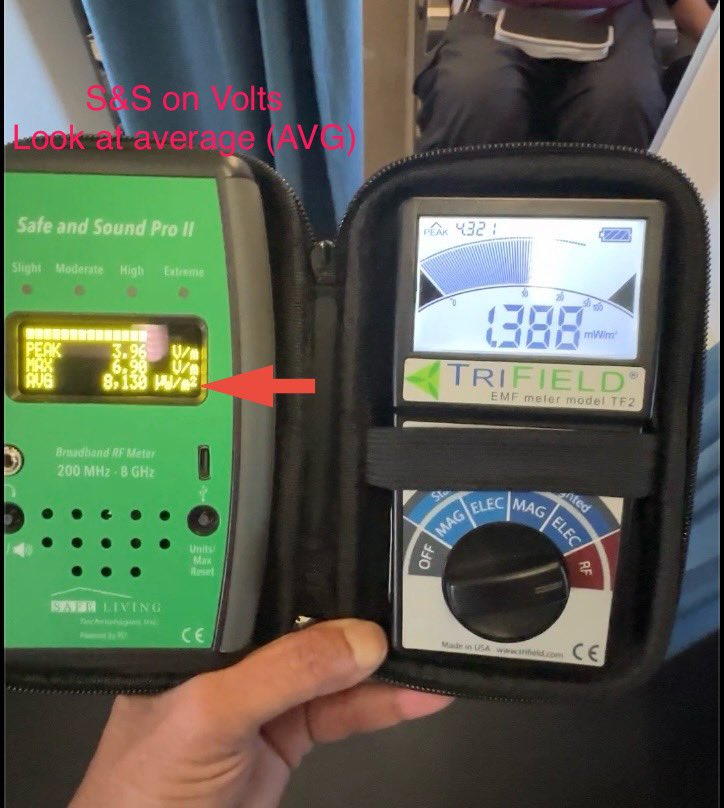
When the S&S is in volts, it shows how strong the RF field is in the space overall.
In simple terms: how “charged” the environment is. When I switch it to microwatts, it shows how much RF energy is actually hitting the body, including spikes and how much exposure builds up over time.
The ‘T’ stays in RF power (milliwatts) the entire time and acts like a real-time spike alarm 🚨
So one meter shows the background field, and the other shows the hits. Together, they give the full picture.
Yes, I could use only the S&S. But the ‘T’ reacts instantly and makes rapid, moving, on-off pulses very easy to notice as they happen, which is “especially useful” in environments like airplanes, where signals shift, turn on and off, and move through the cabin.
The S&S is excellent for showing overall RF load, averages, and maximum exposure over time.
Using both isn’t about necessity or redundancy, it’s about clarity.
One gives fast situational awareness. The other gives context.
🙌🏻 When both meters are side by side, what should you look at?
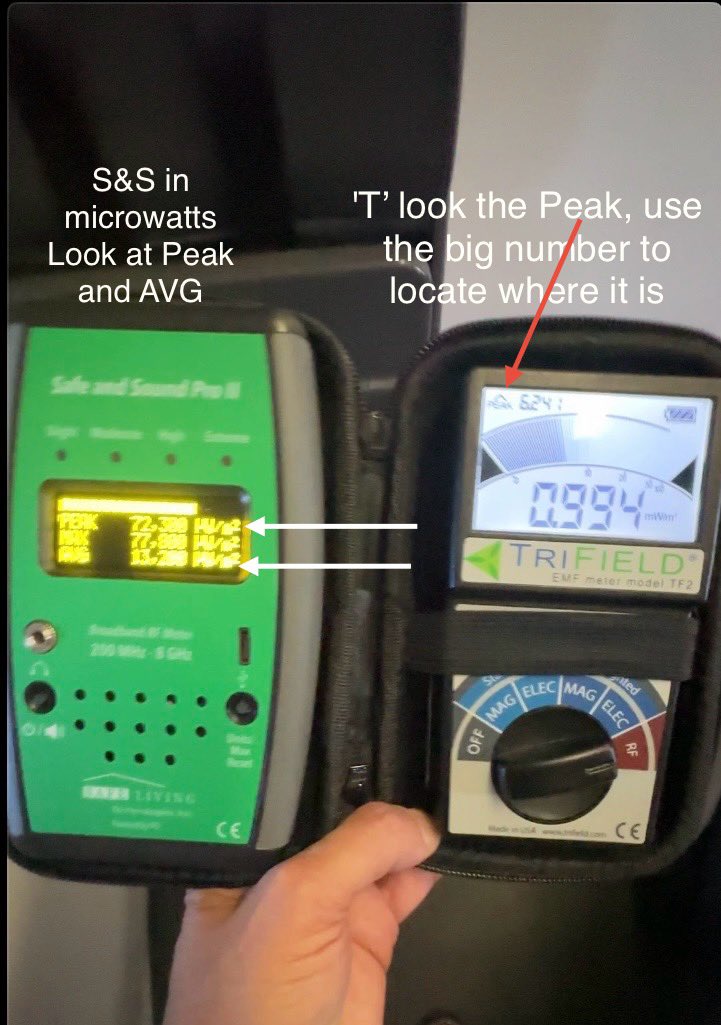
First: PEAK on both meters
Peaks show when something turns on, transmits, or pulses; this is what stresses biology the MOST.
If both spike at the same time, something real is happening.
Then use S&S AVERAGE for context.
Peaks show the danger moments.
Average shows how long you’re soaking in it 😬
Pay attention ‼️ 👁️ 👁️
If S&S is in volts, focus on the “average”
If S&S is in microwatts, look at both peak and average.
On the ‘T’, always watch the PEAK in the upper left corner. But follow the fast movement of the big number; that movement shows you where the source is located.
🧠✨ That’s how you read the environment.
Next 🧵 2/4 Measurements inside the airplane, from front to back, and where we were seated.
🧵 2/4 Measurements inside the airplane, from front to back, and where we were seated.
Everything inside an airplane depends on the inverse square law 📐 and on how many people are onboard, how many devices are being used, and what systems are active at that moment.
What I measured:
1 - Near the front of the cabin, what many people casually call the “cockpit area”
2 - Between the wings, both in front of and behind the turbines
3 - In the back of the airplane 4- Where my husband and I were seated
Now, an uncomfortable truth 😐
To give you a perfectly “clean” measurement, the airplane would need to be empty. That’s reality.
When a plane is full or half full, you must include: how many people are using their devices, who is connected to Wi-Fi, who is charging phones or laptops, which systems are on or off, and even when people switch devices during the flight. All of those variables create peaks on the meters, and any one of them can be the source.
Because of that, I will not give you fixed numbers to copy and paste. I know that makes some people uncomfortable, but it would be misleading. This is real life, not a lab.
What I can tell you is based on this specific flight, knowing how many people were onboard and what was happening at the time. But always remember: your next flight will be different depending on passenger load and device usage.
On the plane I measured ✈️
The back of the airplane showed the highest average on the Safe & Sound and also the highest peaks on both meters.
The second highest area was the front of the cabin near the cockpit.
The lowest of the three was between the wings near the turbines.
My intention was to measure areas where a few seats were empty and where more people were sleeping and not actively using devices. Unfortunately, some people tried to stop me. As you can see in the back of the cabin, someone was talking to me in Norwegian. I did have permission from the crew, but due to the ignorance and discomfort of others, I had to stop the test.
Anyway… the reality is this ✋
On airplanes, no place is truly safe. Some places are better, others worse, and many depend entirely on the moment and the number of people using devices around you.
If you want exact peak and average values from the Safe & Sound (front, middle, back) and peak values from the TriField, you would need to go frame by frame and draw your own conclusions. I won’t do that, because in this context it is meaningless.
Regarding seats 💺
Again, it depends on where the window is located and how many people around you are using devices. As you can see, in the middle section where I was seated, the difference was not dramatic. Look at the peaks; they move back and forth depending on activity.
What I can do is tell you where to sit depending on specific situations.
Next 🧵 3/4 Where to sit and why
Dec 28, 2025 • 11 tweets • 30 min read
1/11 🧵
Strategic Relocation in El Salvador (or Anywhere Else)
This is NOT a tourist thread.
The places we visited:
San Salvador
El Tunco
El Zonte
La Libertad
Ahuachapán
Santa Ana
Costa del Sol, from Los Blanco to La Puntilla
I spent 16 days in El Salvador, and this thread focuses only on what matters to me.
What works for me may be bad for you.
What I care about may be irrelevant to you.
Keep that in mind: we are not the same.
So what am I looking for?
I am looking for a piece of land where I can:
have a food garden
keep a few chickens for eggs
fish myself or easily buy seafood from local fishermen
To make this possible, I need:
1️⃣ Safety
Without it someone can invade, steal, rape, kill…
That’s exactly why no one wanted to go to El Salvador before Bukele cleaned it up 👀.
Safety is non-negotiable.
2️⃣ Less government tyranny
What is the point to have a land if the government can confiscate it, restrict what you can plant, or kill your animals because of a fake “bird flu” to control what you do..
3️⃣ Fertile land
To grows food
4️⃣ Water
Without reliable water (including rivers, streams, raining…)we can’t grow food.
Water is essential, including the possibility of a well if needed.
5️⃣ Sun
The older we get, the more sun we need.
I need a stable sun environment.
If you choose cold, you must embrace it, because cold becomes your “sun.”
I don’t like cold. I need real sun.
6️⃣ Coastline & DHA
Coastlines and sometimes lakes or rivers, are where you get DHA. But preferably the ocean.
Near the coast where is a focus.
7️⃣ Small population
I don’t want to live in a city.
Why?
Inverse square law of EMF radiation; the part few people understand
👉🏻 x.com/lightmeaway/st…
I want to live where power lines are above my head, not under my feet.
8️⃣ Hospital & pharmacy
As much as I hate to say this, I need them.
I have a kidney transplant.
I depend on medication to keep that kidney alive.
Without access to a pharmacy:
I go back to dialysis
And people on dialysis don’t live very long
Hospitals are necessary just in case things go wrong, and they are where the dialysis are.
Modern kidney transplants don’t last forever because:
The same medications that suppress immunity, also slowly damage the kidney
It’s a double-edged sword.
That’s why I must do blood tests every 3–4 months:
Too much medication = kidney deteriorates faster
Too little = immune system fully awake
Get the balance wrong, and the kidney is gone.
That is what I’m looking for.
Next 2/11🧵 🚨BIG Observations
2/11 🧵 🚨BIG Observations
Before I break down each place, here’s a few baseline observations below.
These points apply to ALL locations we visited, so I won’t repeat them again in every thread.
1️⃣ Construction & underground cables
Construction is everywhere. El Salvador is pushing a long-term plan to bury electrical cables, starting in cities and tourist areas(not in Costa del Sol for now)
⚠️ Personally, I see this as a negative.
Overhead cables are visible, you can avoid them.
Once it’s underground, you can’t escape it. It can spreads through soil for kilometers, depending on mineral composition.
2️⃣ Meat food prices
Anything that comes from cows is very expensive:
butter, fresh milk, meat
The good news:
Cows are pasture-raised
Organs are much cheaper (my favorite)
There’s no “organic” label, because everything is organic by default.
3️⃣ Candles
Hard to find and very expensive.
There is no candle culture.
For me, candles are essential for circadian rhythm.
After 6pm it gets very dark.
4️⃣ Swimwear & cultural shock
If you are shy, be aware.
Salvadorians do not wear swimsuits.
Over 90% swim in shorts 🩳 and t-shirts👚
In LOCAL not touristic areas, wearing a small swimsuit gets stares. Not curiosity, shock.
I’m not shy, so I didn’t care.
5️⃣ Cooking (PUFAs everywhere)
The entire country cooks with PUFA oils:
canola & seed oils
Just like most countries. If you want to eat healthy, cook yourself
6️⃣ Cell towers
Cell towers and antennas are everywhere; even in remote areas where you’d expect none.
I didn’t measure as accurately as I could have, because at the time I didn’t fully understand another part of the inverse square law of EMF radiation (I only learned this after I left).
My phone was in airplane mode.
Wi-Fi was turned off (with ❌)
Bluetooth was off, but without the ❌ indicator.
My meter was also not in sound mode, because it interfered with my ability to record my voice, and so on.
I understand this now. Unfortunately, I learned it too late, and repeating the measurements wouldn’t have changed the overall picture anyway.
That said, EMF exposure in El Salvador is still much lower than in many places I’ve been.
7️⃣ Safety
Extremely safe everywhere we went.
We were in places where locals thought we were lost, because they had never seen tourists there.
You can still see scars from the past: old barbed wire and security remnants.
The country is clearly transitioning into a new phase.
8️⃣ Police, locals & buses
Police and locals are friendly and helpful.
Bus drivers?
Not so much.
Because of competition, bus drivers:
race each other; drive aggressively; yell; rush passengers…
If you’re slow getting on or off, they may: grab your bags & yell.
Inside the bus, passengers help you; not the driver.
👀 Watch that part.
9️⃣ Food & markets
Everything that grows is organic by default from animal to everything else. The land is extremely fertile. Fruit trees are everywhere: backyards; roads; highways; forests; beaches
Mango trees grow like weeds, and mango trees are demanding trees. Even in sand, with little nutrition, fruit trees thrive.
The best place to buy food is: street markets; local vendors.
Avoid chain supermarkets. Buy from locals; they’re everywhere.
🔟 Prices
There are two prices:
1 for locals
2 non-locals
Most food on the streets has no price tag; prices are spoken
You don’t need to negotiate aggressively.
You can simply say: “This is all the money I have.”
Most sellers accept; sometimes you get less-perfect fruit. It tastes the same.
Clothing and fixed goods usually have set prices.
1️⃣1️⃣ Stray animals (hard truth)
This was heartbreaking(I’m an animal lover)
Mostly dogs: starving; injured; broken backs; dead on roads…
I’ve never seen this at this scale before. believed me, I’m Brazilian live in 9 country and visit 75. I was shocked.
1️⃣2️⃣ Chemtrails
Yes, little in some places.
1️⃣3️⃣ Surveillance
In the areas we visited: none.
Just a few private cameras.
Next 3/11 🧵 San Salvador
Nov 10, 2025 • 10 tweets • 16 min read
1/10 🧵⚡ REDOX STEP BY STEP FOR BEGINNERS
Redox = your body’s ability to make and hold energy.
Think of it as your battery life.
🔋 High redox = strong charge, sharp mind, fast healing.
⚠️ Low redox = weak charge, fatigue, sickness.
Coherence = how well your cells talk to each other using light, magnetism, and electric signals.
When that communication breaks, disease appears exactly where the signal failed.
🧠 Together:
➡️ Strong batteries (redox) + clear communication (coherence) = a body that works like nature intended(healthy, synchronized, and self-repairing)
Your goal is to keep moving in that direction by adding small steps that bring you closer to nature as much as possible.
Now let’s begin
🎯 REDOX STEP 1/9 🧵 Location, Location, Latitude
You can’t heal in the same environment that made you sick.
Your latitude decides your spectral diet.
Near the equator, red and UV bathe you all year; high charge, high repair.
Far north, you trade UV for magnetism and cold.
Ignore that swap, and your biology pays interest in disease.
If you hate the sun but love Wi-Fi, you’re living upstream from extinction.
Move where your circadian rhythm matches your daylight hours.
If you stay north, embrace cold water and seafood; if you live south, respect heat and hydration.
The first prescription any doctor should write is a new zip code.
If your location broke your mitochondria, no supplement or doctor can fix it while you stay there.
Your biology obeys physics, not pharmacy. 👀
The light you live under, the magnetism beneath your feet, and the frequencies in your air decide whether your cells make energy or inflammation.
Every “chronic illness” is a mismatch between your biology and your environment.
Doctors treat chemistry, but life runs on physics.
Even a weekend trip to a quiet coastline can show you what “good data” feels like to your nervous system.
Takeaway: If your environment drains electrons, change the environment. Supplements can’t out-compute bad physics.
Your zip code is more important than your genetic code.
YES, IT IS!
🗣️ “Healing isn’t a pill; it’s a location. You don’t need a new doctor… you need a new latitude.”
I know. I’ve being there.
Picture: 1 year in a Norwegian Hospital, January 2018
🌞 REDOX STEP 2/10 🧵 Sunrise is non-negotiable.
Your day begins when the first photons hit your retina and skin… your master clock(SCN) syncs every organ.
If you start your day with TV, your phone, or a computer, you’re already on the road to diseases; you just don’t know it yet.
That signal decides your cortisol peak, thyroid output, digestion, mood, and sleep timing later that night.
Miss the sunrise, and every downstream hormone fires off-beat.
Clouds, fog, or snow don’t matter; infrared still gets through.
Five unbroken minutes outdoors beats any vitamin D capsule.
If you start work before dawn, use a near-IR lamp while dressing or 🕯️ (as a bridge, never as a replacement) it jump-starts mitochondrial charge without frying your retinas with blue.
Watch the sun with your naked eyes; not from behind a window, neither with sunglasses.
The sun is your first medicine; your mitochondria take attendance at dawn.
Takeaway: Morning light is software; without it, your hardware misfires all day.
Picture: Walk the talk, sunrise. We were the only ones on Virginia Beach, USA - Setember 2025

 🧵 2/4 Measurements inside the airplane, from front to back, and where we were seated.

