Geostrategerist. Policy wonk. Political adviser. Author: https://t.co/JcTDdsUVh1. Traveler of antique lands w/the lovely @cmgoodlander. Views my own.
Dec 27, 2025 • 6 tweets • 6 min read
“Another important factor is that Sweden is a consensus society…Swedes feel an intense emotional pressure to conform to these ideologies. To speak against them too strongly is to endanger not just one’s social life but one’s career.”
It’s funny how people bend themselves into pretzels trying to avoid accepting that the Roman Empire was fiscally -and- morally bankrupt. Here, though, are the data points:
—Even from early on (ca. AD 100) we have letters home to parents from soldiers complaining that the army doesn’t issue them enough clothes (and could mom and dad please send some socks - it’s cold here on the frontier)
—Extraneous items of army gear start getting dropped as early as AD 100 (the standard-issue legionary pugio/dagger is absent from Trajan’s Column); there are signs of armor being simplified all through the following century
—Military service became a de facto hereditary profession during this time - nobody else wanted to sign up (indicating a lack of social “buy-in”), and “auxiliary” cohorts in particular simply recruited soldiers’ illegitimate sons
—Caracalla’s extension of universal Roman citizenship (which also voided the distinction between citizen legions and non-citizen auxiliary cohorts) essentially formalized this and further rendered participatory citizenship meaningless (everyone was now equally worthless)
—It’s contested, but not convincingly: This is also when the barbarianization of the army starts in earnest, with legionaries starting to carry German-style spathae (long swords) instead of short gladii
—The army also starts to skimp on steel and armor throughout the period after the Severans - Vegetius claimed troops often no longer wore armor, and while he’s not reliable per se, it’s tough to see how the claim would pass a laugh test if it weren’t true; this is also when the highly effective long-headed javelin, the pilum, gets traded in for less effective (but cheaper) short-headed darts; army helmets also become crappier during this time (made from weakly joined halves instead of one-piece bowls), and flat oval shields (long deemed inferior) replace the classic cylindrical scutum
—Army tactics and organization become cruder during this time - the old, highly nimble and complex legionary evolutions in formation (mad possible by the cohort system) are replaced by cruder phalanx tactics, initially as an expedient against cataphracted cavalry (the Alans), but apparently becoming SOP everywhere
—Taxes, meanwhile, become confiscatory, with 25+ percent of the empire’s income extorted from its denizens, and particularly from the poor - there’s even an argument that Christianity emerged as an anti-tax movement, even though Paul had to tell the Roman church to pay its taxes so as not to get in trouble (and in fact that itself serves as evidence)
—Christianity, meanwhile, regarded Rome as a dreaded beast and eagerly awaited its fall (this is the whole point of the Book of Revelation), and was rapidly gaining followers; its belief system was completely incompatible with the old ways (which allowed plurality of worship but couldn’t accommodate denial of the existence of other gods) - all data points for a massive legitimacy gap
—The coinage was debased down to nothing over three centuries, and inflation got so out of control Diocletian famously tried to control it by imperial fiat (the Edict on Prices)
—Patronage networks multiplied - the only way to get anything done in politics was to have money -and- know people who did, and the money in question (per the above) was malappropriated tax money
—This might explain the army’s fiscal woes (gross corruption siphoning off funds), but in any case even though most of the (multiplying) imperial offices were military, many of these are thought to have been similar to Georgian or Victorian “colonelcies” - where an official might collect a military paycheck and hold a military office but not have a unit to command
—By extension, it’s at least theorized that some army units may, for this reason, have existed only on paper (rather like the Afghan National Army…or the US NGO apparatus)
—While the empire had always had an institutional deficit, particularly with regard to imperial succession, eventually contenders for the imperial throne, perhaps as partly as a downstream effect of the obliteration of the citizen-noncitizen distinction, invoked support from Gothic invaders (on the one hand), and were indifferent to imperial security (on the other) - the last person to give a damn was Stilicho, who was killed by the emperor Honorius for his pains (being a successful general made on a political threat); Honorius in turn famously told Romans in Britain he could not protect them and, secure in his palace at Ravenna with his pet chicken named Rome, allowed the actual city of Rome to be sacked
—The actual deposition/abdication of Romulus Augustulus in 476 is held to have merely formalized a “done deal,” but that in itself is significant: Nobody was interested in salvaging the place
And it’s really the last sentence that’s revealing: As the anthropologist Joseph Tainter argues, collapse really happens when the system becomes too expensive (however understood) to be considered worth saving. Rome was fiscally, institutionally, and morally bankrupt - it had been for a while when the Goths finally knocked it over.
Oct 31, 2025 • 58 tweets • 12 min read
Alright: It’s Halloween. Sun’s down. Until I get a life (which could happen at any minute), I’m going to keep with a tradition I set up years ago and do 1 like = 1 scary poast.
This year it’s American folkways: 1 like gets you 1 thing 1 folkway fears, or 1 spooky story from it.
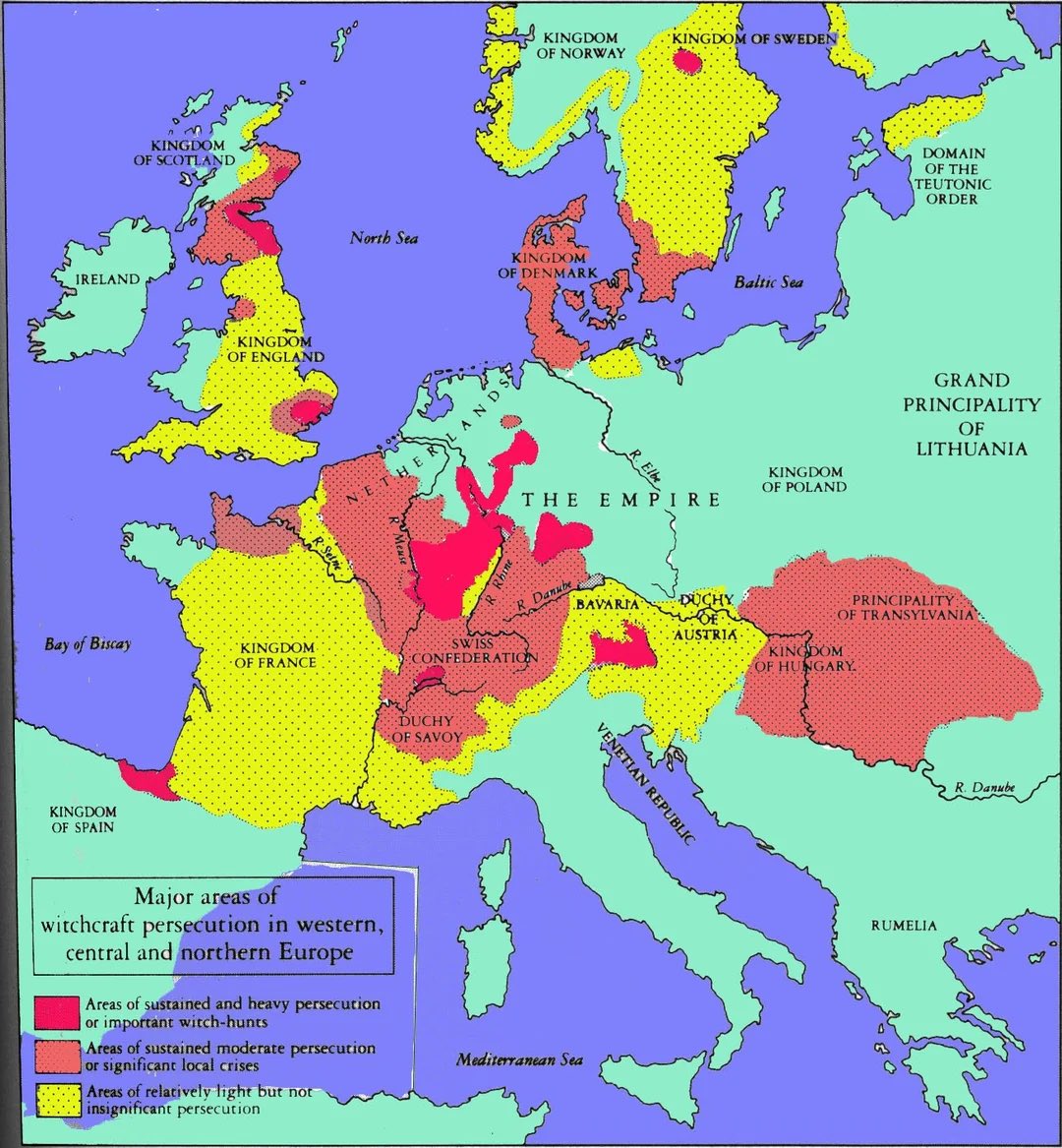
First up was @cmgoodlander, my partner in crime. In that spirit, we’ll start with Greater New England. This one’s almost too easy: Puritans feared witches. This was a longstanding cultural practice in the Puritan heartland of East Anglia, which was the witch-trial capital of England.
Oct 17, 2025 • 45 tweets • 9 min read
Sort of. There were other, bigger problems.
The obvious one was the baggage they carried - Buchanan in particular brought the Holocaust deniers out of the woodwork. No one was going to normalize and legitimize that, or give oxygen to it.
The bigger one is actually less well appreciated. As @Kurt_Steiner is fond of noting, America has always had imperial ambitions; the only question is what kind, and where they might be realized.
Oct 6, 2025 • 10 tweets • 2 min read
They all do - in different ways:
—New England/Yankeedom gives us our understanding of civic militarism and the citizen-soldier; it also initially gave us much of our industry
—Quakerdom, even more than Yankeedom, was the heart and soul of American industrial and engineering might; it also gave us our “get the horrible thing over with” mentality
Oct 6, 2025 • 21 tweets • 3 min read
I’m not picking on NYC or the 17C Dutch, either - the truth is, all cultures have blind spots, and the ones you have in the security realm are the ones that turn into Achilles heels in wartime or geopolitical competition.
For fun, here are a few for the folkways I talk about: …
—Yankeedom/Greater New England: “The rest of the world is evil, so we won’t do business with it, lest we corrupt ourselves; also our brave citizen soldiers can defeat any tyrant’s servants.”
Oct 5, 2025 • 56 tweets • 12 min read
Cultural observations (just for fun): This is what happens when cultures intermingle to the point where one gets confused with the other.
Briefly: “Preppy” clothing represents the New Amsterdam takeover of New England.
Ralph Lauren (born and raised in NYC) founded a clothing brand with (more or less) the intention of out-Brooksing Brooks Brothers. en.m.wikipedia.org/wiki/Ralph_Lau…
Sep 10, 2025 • 57 tweets • 10 min read
A good report on US statecraft at the present moment. I took the opportunity to offer my comments on the basic elements articulated at the top. There’s a lot of good thinking about ends here…and a lot of wishful thinking about means and likely results.
“First, the US needs to create a North American ‘base’. Tariff threats to Canada and Mexico are intended to renegotiate the USMCA on favourable terms to the US with a common tariff vs China, or those with an FTA with it, to prevent transshipment…”
- Endorsed, but this is a big chunk of the problem: …
Sep 1, 2025 • 83 tweets • 16 min read
With all the Venezuela stuff going on, it’s probably as good a time as any to discuss an idea that’s been making the rounds: The idea of the US becoming a “Western Hemispheric power.” (LOOOONG thread follows)
Assume, again, a 1/4 rotation (1 deployed, 1 in readiness for surge capacity, 1 readying, 1 refitting), and possibly 2 more rotations also, 1 in drydock for long-term refitting and 1 in mothballs or low readiness.
For the Mongols or the Manchus to take the capital, the dynasty has to be weak. The question is how to do that. Trying to do it backwards doesn’t work historically.
—Social rot. There is a dispute in Chinese thought between whether one’s parents or the state are the true objective of one’s loyalty, not least because amoral familism is the one countervailing force to the state.
Jun 20, 2025 • 5 tweets • 1 min read
If it were -just- Iran, we could probably get away with breaking it and walking away.
But break Iranian power throughout the heartland of the old Caliphate, and the Sunni jihadis have a field day.
Does it matter? You tell me: Obama ended up re-intervening when ISIS expanded.
The game being played here, of course, is that Saudi, UAE, and Qatar - who own our think tanks - are hoping we’ll step in and solve the problem before it gets dicey. So there you have it.
Jun 19, 2025 • 19 tweets • 3 min read
The phrases “current account deficit” and “dollar reserve” do not appear in this article, nor does any understanding of their implication for this. You can’t mobilize what you don’t have.
“Just because China beats out the United States in many industrial metrics, that does not guarantee that Beijing will effectively mobilize those resources toward war production…”
Look up comparative shipbuilding rates. Please.
Apr 10, 2025 • 27 tweets • 4 min read
Just for fun (because the currency dooming is doomy): I came up with a force structure for a navy for a mid-sized power. Call it naval fantasy football.
This power is a former empire with some residual imperial ambitions and an active interest in exerting global influence, but it isn’t a global hegemonic player. Its goals might include: …
Apr 4, 2025 • 14 tweets • 2 min read
Here’s one long form version. TL/DR: A series of administrations had to show impossible results to the national electorate, so they mined the future for the present and the more vulnerable for the less.
Go back to the ‘70s. The US was in a kind of bankruptcy.
The outsized economic growth from implementing low-hanging fruit (highways, electricity and plumbing - the last US household to get indoor plumbing got it about then, adopting various technologies developed in WW2, etc) was slowing.
Mar 28, 2025 • 11 tweets • 2 min read
Couple things:
—They really can’t - Western Europe has debt/gdp ratios at or near 100 percent, which precludes serious mobilization unless they want to “DOGE” their own welfare states (and they’re not there yet)
—They don’t actually perceive an existential threat
The second one takes some explanation. It’s not, strictly speaking, that Putin won’t come to dominate Europe - he’s pushing on an open door. It’s that they don’t care.
Mar 1, 2025 • 29 tweets • 4 min read
Proponents sense that US hegemony is dysfunctional - I’m not sure they’ve grappled with why, let alone to what degree. Here are some ways the current situation and set of precepts differ from what they should be, using the Cold War as a model:
—There should be an elite consensus on US hegemony; there cannot be a pro-hegemony party and an anti-hegemony one. In the Cold War both parties agreed on policy and famously argued about who could implement it better; no such consensus here.
Feb 14, 2025 • 6 tweets • 2 min read
We just declared the new Cold War. Not the sham fight we’ve been in where we pretend to fight China while cooperating with them. A real one that’s about something.
I opined a while back that the heatmap phenomenon was a case of New England Behaving Badly - where Puritan imperatives to think of communal obligations get repurposed once the individual is detached from the community where that would make sense.