Matthew Zirwas, MD Profile picture
Dermatologist. Accelerationist. Reformed academic. 226 papers published. 100+ clinical trials run. One Textbook authored. Host, Derms on Drugs podcast.
Jun 1 6 tweets 5 min read
You're probably bad, really bad, at making medical decisions.

Almost everyone is.

And I see it hurt people, all the time.

But it's not your fault.

The problem is that most doctors don't have the time to explain the right way and some never learned how.

So, here's a test:

You have disease X.

Which treatment is best?
Treatment A: 80% chance it works. Side effects: 1% D, 3% E, 5% F
Treatment B: 90% chance it works. Side effects: 20% D, 60% E, 90% F
Treatment C: 50% chance it works. Side effects: 0% D, 0% E, 0% F

What's the right answer?Image If you picked one, you were wrong.

There is no right answer.

The best treatment depends entirely on what disease X is, and what D, E, and F are.

If F is the worst side effect and it's mild dry skin, you take B and barely think about it.

If F is death, you never touch B, and suddenly C, the one that "works" the least, looks pretty good.

Same numbers. Opposite answer. The percentages are useless until you know what's behind them.

That's the whole game, and not many people play it right.
May 2 16 tweets 6 min read
Dermatology is wrong about the sun.

And it's killing people.

I'm a dermatologist. 226 publications. I should know.

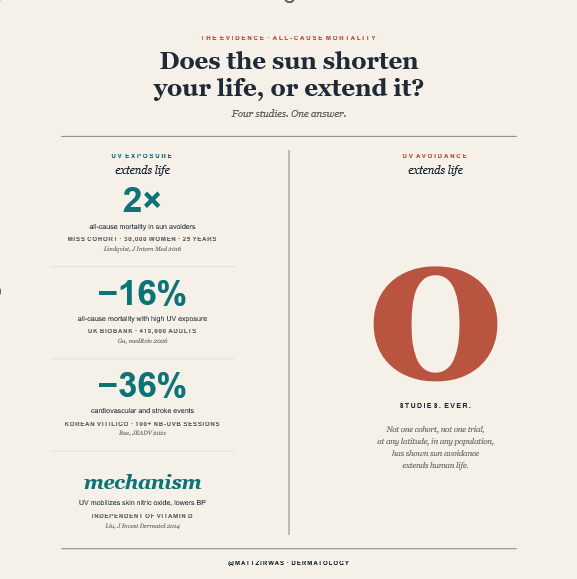
Avoiding the sun increases the risk of dying as much as being a smoker.

We can fix it.

For decades, dermatology's message has been simple: avoid the sun. Wear sunscreen. Seek shade. UV causes skin cancer. End of discussion.

That message is incomplete and outdated.

People are dying because of it. Lots of people.

The evidence has gotten strong enough that the field needs to update it.🧵Image The Data

The MISS cohort followed over 29,500 Swedish women for 25 years.

Women who avoided the sun died at the same rate as smokers who got the most sun.

Read that again. Sun avoidance carried mortality risk comparable to smoking.

The effect was driven primarily by cardiovascular mortality.

Women with the lowest sun exposure had a 60% higher rate of cardiovascular death compared to those with the highest exposure.