Mike Profile picture
LT Investor Largest holding $PLTR $AMD $TSLA (75%) Others $XYZ $AMZN $NVDA $LMT $HIMS $BTC $PYPL $META $SNAP $GOOG $PSFE $DIS $GRAB $WING $DKNG $ADBE $BROS $TSM
Jun 26 14 tweets 8 min read
$AMD's ready for $1T MC w/ Samsung $648B CapEx🧵
Not Financial Advice! DYOR! Research Purpose only!

Samsung’s 1,000 trillion KRW (~$648 billion) decade-long investment, with a heavy emphasis on semiconductors (potentially 300+ trillion KRW for new chip fabs and related infrastructure), directly strengthens @AMD position in the memory-constrained AI ecosystem. This builds on the March 2026 strategic MOU between AMD CEO Dr. Lisa Su and Samsung Chairman Lee Jae-yong, which positions Samsung as the primary (and initially sole) supplier of HBM4 for AMD’s next-generation Instinct MI455X GPUs, alongside advanced DDR5 for 6th-gen EPYC “Venice” processors and the Helios platform.

@AMD needs TSMC and Samsung to get to $1T then $5T long term. Samsung will also be a large customer buying AMD Chips for years to come. Will link varioud subscribers threads from supply chain to different analyses if u are interested.
Otherwise slap the like/repost!

1. Agentic AI and AMD’s J-Curve CPU Growth Opportunity

Agentic AI represents a structural shift in data center architecture from 1 CPU 4-8 GPUs to 1 CPU 1 GPU and significicant higher 3-5 CPU and 1 GPU for Heavy Agentic workloads. Unlike traditional generative AI (heavily GPU-bound for training and inference), agentic systems require substantial CPU resources for orchestration, reasoning, memory management, tool use, planning, and coordination across multiple agents and models. This drives demand for high-core-count, high-bandwidth server CPUs alongside GPUs.

AMD has highlighted this trend explicitly, Agentic AI is accelerating server CPU demand beyond prior forecasts. The company now projects the overall server CPU total addressable market (TAM) growing at >35% annually, potentially reaching >$120B by 2030 (with some analysts view TAM at $233B+ by 2030, IMO it is $500B TAM by 2030). Agentic workloads are expected to become one of the fastest-growing (and potentially majority) segments of this CPU opportunity.

This creates a classic J-curve growth profile for AMD’s EPYC business: initial investments and ecosystem building lead to rapid revenue acceleration as agentic AI adoption scales in enterprise, cloud, and sovereign environments. The CPU-to-GPU ratio in AI infrastructure is evolving, with more CPU-heavy racks needed to power the “brains” of agentic systems.

2. Samsung’s Memory Expansion Directly Benefits EPYC Venice CPUs

The March 2026 strategic MOU between AMD CEO Dr. Lisa Su and Samsung Chairman Lee Jae-yong explicitly extends beyond HBM4 for Instinct GPUs. Samsung and AMD are collaborating on high-performance DDR5 memory solutions optimized specifically for 6th Gen AMD EPYC “Venice” CPUs and the AMD Helios rack-scale platform. I see Samsung as a more responsible memory maker, where this will benefit AMD on supplying the growth through 2030.

~Higher performance & bandwidth, Optimized DDR5 enables Venice’s advanced features (higher core counts, improved memory channels, larger caches) to deliver maximum throughput for agentic AI workloads that are memory-bandwidth sensitive.

~Supply security & scale, Samsung’s new/accelerated fabs and process investments (including advanced DRAM nodes) provide reliable, high-volume DDR5 supply as Venice ramps. This reduces risk for AMD’s customers deploying large agentic AI clusters.

~Platform-level optimization, Joint work on memory for Helios systems ensures tight integration of Venice CPUs with Instinct GPUs and high-speed interconnects, delivering superior TCO and performance for full-stack AI infrastructure.

~Cost & efficiency gains, increased Samsung output helps stabilize or moderate DDR5 pricing over time, improving economics for large-scale EPYC deployments in agentic environments.

EPYC Venice (TSMC most advanced 2nm with highest core) is positioned as a major leap for data center CPUs. Samsung’s memory partnership de-risks and accelerates its adoption curve.

3. Samsung as a Major, Multi-Year Buyer of EPYC Venice for Its Own Data Centers

Samsung’s investment explicitly includes significant AI data center development (via Samsung SDS and group initiatives), alongside “sovereign AI” strategies and hyperscale infrastructure. These facilities will require thousands of high-performance servers for:

~Training and running agentic AI models and workflows.
~Cloud services and enterprise AI offerings.
~Internal HPC, R&D, and manufacturing optimization ( AI-enhanced chip production).
~Broader sovereign and regional AI infrastructure.

Why EPYC Venice is a natural fit:

~The deep memory collaboration (DDR5 optimization) creates strong ecosystem alignment and co-development incentives.
~EPYC processors excel in core density, memory bandwidth, I/O, security features, and TCO with $0.0003-$0.0005/M Tokens(lowest token cost), ideal for the mixed CPU-heavy workloads in agentic AI and general-purpose data center expansion.
~Samsung has already demonstrated use of AMD EPYC in commercial solutions (Network in a Server platforms integrating EPYC CPUs with AI capabilities).
~As a major cloud/hyperscale player building its own infrastructure, Samsung represents substantial, recurring volume over the next 5–10+ years, exactly the timeframe of its investment plan.

This buyer relationship complements AMD’s GPU memory supply deal, creating a virtuous cycle: Samsung helps secure memory for AMD’s Instinct GPUs → AMD supplies optimized CPUs and platforms → Samsung deploys them at scale in its expanding data centers.

Conclusion:

Under Dr. Lisa Su’s visionary leadership, AMD has forged a transformative strategic partnership with Samsung that dramatically strengthens its supply chain resilience and cost structure precisely when it is needed most. The high-level March 2026 engagement between Dr. Su and Samsung Chairman Lee Jae-yong, combined with Samsung’s landmark 1,000 trillion KRW (~$648 billion) decade-long investment in semiconductors, AI data centers, and advanced memory capacity, creates a powerful dual advantage: secured and more predictable memory supply alongside a major aligned customer for AMD’s full-stack data center portfolio

This alliance directly addresses AMD’s core challenge in scaling the exploding Agentic AI market. Agentic AI autonomous, multi-step reasoning systems that orchestrate complex workflows is driving a structural shift toward more balanced, CPU-intensive infrastructure. Analysts will continue to increase Agentic AI CPUs TAM to my target at $500B by 2030. Morgan Stanley already picked AMD as biggest Agentic AI winner, fueled by higher 1-5 CPU : 1 GPU ratios in agentic workloads.

Samsung’s massive capacity expansion including accelerated HBM4 production for Instinct MI455X GPUs and optimized high-performance DDR5 tailored for 6th-gen EPYC “Venice” CPUs and the Helios platform will help moderate memory pricing volatility while ensuring prioritized allocation for AMD. This reduces bill of materials uncertainty, supports healthier gross margins, and de-risks large-scale production ramps critical for meeting surging demand.

Simultaneously, Samsung’s own hyperscale AI data center buildouts position it as a significant, multi-year buyer of EPYC Venice processors. The deep ecosystem alignment (memory co-optimization, joint platform development) makes AMD solutions a natural choice for Samsung’s sovereign AI, cloud, and internal HPC needs creating a virtuous cycle of supply security and demand pull.

Dr. Su’s proactive diplomacy and focus on open, collaborative ecosystems have turned a potential memory bottleneck into a strategic moat. By securing stable, high-volume access to advanced HBM and DDR5 while gaining a committed hyperscale partner, AMD is exceptionally well-positioned to capture a disproportionate share of the Agentic AI J-curve. This not only accelerates Instinct GPU and EPYC CPU momentum but also reinforces AMD’s competitive edge in delivering superior TCO and performance for the next decade of AI infrastructure growth.

Dr. Su and Chair Lee partnership combined with Samsung’s historic investment transforms memory from a constraint into a catalyst powering AMD’s ability to scale profitably in the multi-hundred-billion-dollar Revenue in Agentic AI era.

AMD is winning
Samsung is winning

Not Financial Advice! DYOR! Research Purpose only!

Clip is AI Generated by GROK. x.com/MikeLongTerm/c…
Jul 30, 2025 13 tweets 6 min read
BREAKING $GRAB Q2 ER

-Revenue grew 23% year-over-year (“YoY”), or 19% on a constant currency basis, with YoY growth accelerating from the prior quarter, to $819 million in the second quarter of 2025, driven by growth across our On-Demand and Financial Services segments vs $810.59 million est

Group revenue growth accelerated to 23% YoY (19% on a constant currency basis) to reach another all-time high of $819 million in the quarter. On a segment level,

● Mobility revenue increased 19% YoY (17% YoY on a constant currency basis), driven by continued growth in Mobility MTUs, number of transactions and average order frequency;

● Deliveries revenue increased 23% YoY (18% YoY on a constant currency basis), driven by growth in Deliveries MTUs, number of transactions and higher contributions from our Advertising business; and

● Financial Services revenue increased 41% YoY (38% YoY on a constant currency basis), driven by growth in our lending businesses across GrabFin and our Digital Banks.Image From @AnthonyPY_Tan on Q2

Grab delivered another strong set of results in the second quarter with Group Monthly Transacting Users (“MTUs”) scaling to another all-time high. While at the same time, on-demand GMV re-accelerated to 21% year-on-year (“YoY”) or 18% YoY on a constant currency basis. These top-line trends, combined with our continued cost discipline, delivered our fourteenth consecutive quarter of Adjusted EBITDA growth, while trailing twelve months Adjusted Free Cash Flow expanded to $229 million. These results come from our strategy in harnessing product-and tech-led innovations to drive the ecosystem flywheel faster and to out-serve everyday entrepreneurs in Southeast Asia.

Growth continues to be demand-led, with On-Demand transactions outpacing GMV as we increase our focus on rolling out more affordable services and expanding the addressable market with more price-sensitive users. We also continued to scale up our Financial Services business prudently, with total loan disbursals across GrabFin and our Digital Banks reaching close to $3 billion on an annualized run-rate basis in the second quarter. At the same time, credit risks remained within our risk appetites

Despite the volatility in the macroeconomic environment, the product-led investments we continue to make to enhance the affordability and reliability of our services have further deepened user engagement and retention, and brought new users to the Grab ecosystem. Products launched several quarters ago, such as Saver, Priority Deliveries, and GrabUnlimited, have achieved strong product-market fit and scale, and have been instrumental in re-accelerating our growth rates. As we look ahead, features launched recently, such as those highlighted during our GrabX product day, while still nascent contributors today, will enable us to unlock the next growth stage.

We are also developing new technological solutions and leveraging Generative-AI to improve our value proposition to our users, drivers, and merchant partners. For instance, Grab’s AI Merchant Assistant has been critical in positioning ourselves as the partner of choice for Southeast Asia’s most loved merchants. The Grab AI Merchant Assistant leverages Large Language Models, combining their foundational knowledge with Grab-specific domain expertise and merchant-specific operational and transactional data. This provides merchant-partners with access to enterprise-grade insights, eliminating the need for deep technical know-how or substantial budgets. This product uplifts their earnings and productivity on Grab.

We are also leaning in on the Autonomous Vehicle opportunity. We continue to build new partnerships with more global Autonomous Vehicle partners, participate in more pilots to understand the operational conditions for different autonomous vehicle services, and be part of the regulators’ efforts to improve transport connectivity through autonomous technologies. Earlier this month, Grab, in collaboration with Autonomous A2Z (A2Z), a South Korean full-stack autonomous vehicle technology manufacturer, announced Singapore's first autonomous electric shuttle bus pilot. Through this initiative, we are evaluating the safety performance of autonomous technologies and exploring the potential new high-value job opportunities that this sector could create. In the Philippines, we have also announced that we are working with the Department of Information and Communications Technology (DICT), the Department of Transportation (DOTr), and property developer Megaworld Corporation to launch a pilot study on drone-powered commercial delivery.

Looking ahead to the second half of 2025, Grab remains well-positioned across Southeast Asia, with our investments solidifying our resilience in the face of potential macroeconomic uncertainties. We expect to sustain this top line growth momentum across our business as we drive new users to our platform, improve frequency, engagement and retention with our existing user base. We will also maintain discipline on costs to drive profitable growth and free cash flow generation.
Dec 29, 2022 6 tweets 3 min read
precedenceresearch.com/artificial-int…
$PLTR recently ranked No. 1 in worldwide AI software study.
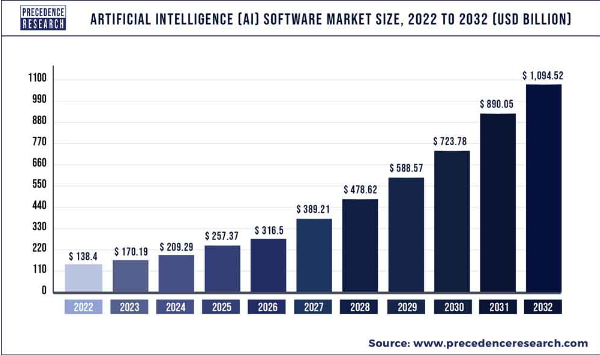
The global artificial intelligence (AI) software market size was evaluated at USD 138.4 billion in 2022 and is predicted to hit around USD 1,094.52 billion by 2032, growing at a CAGR of 22.97% Rising demand for improved business IoT solutions,self-driving cars,and robots will likely drive the growth of the AI software market. AI software is one of the most efficient ways to reduce human efforts consumption;it is integrated into most fields,from healthcare to defense.
Sep 25, 2022 8 tweets 5 min read
We often criticize Dr. Karp for the way he leads $PLTR. But What I have found, the perception of the world on $PLTR is exactly what @peterthiel been written for his thesis for a business:
-Secretive
-Monopoly
-Develop the "developed" world with revolutionary technology
(1/4) @peterthiel Secretive: $PLTR is often viewed as secretive, mysterious. "There are many more secrets left to find, and they will yield only to relentless searchers"-Peter Thiel.
Solving the problems before companies know it. The Solution to the Problems that didn't exist(2/4)