𒆙𝔐ͫ𝔬ͦ𝔡ͩ𝔞ͣ𝔩̍𝔰̾𝔲ͧ𝔯ͬ𝔯ͬ𝔢ͤ𝔞ͣ𝔩̍𝔦ͥ𝔰̾𝔱ͭ𓅃 Profile picture
I promise to be kind and only post about philosophy, science, and animals. 🤞 You won't find much here under 'Posts'. See 'Replies' 👇.
Dec 12, 2025 4 tweets 5 min read
@SDAFS56788141 @DivinelyDesined Alright. ERVs it is! Okay. So i spent some time thinking about how to address the Argument for Common Descent from ERV Insertion Site Distribution with you, @SDAFS56788141.
I think we could have a productive discussion. I will try to make a case that lends credence to one of two conclusions, using an Argument for Common Descent from ERV Insertion Site Distribution:

1) Universal Metazoan Common Descent is the case,
or,
2) The diversity of Metazoan life was deliberately designed. AND the designer deliberately chose to design Metazoan life such as to make it look like Universal Metazoan Common Descent is the case.

While i make the case for #1, each
"That just so happens to be how the designer chose to do it"
rebuttal will lend further credence to hypothesis #2.

First, let's see if we can set some groundwork.
I made a list of points i'd prefer to take for granted for the sake of the argument. One, it can give you a sense of the general framework i'm starting with, secondly, the more of this we can agree on in at least a general sense, the less of a mess we will have to make of this thread. We can squabble over exact numbers or frequencies, but the general ratios and proportions, i think are fair.

1) Mutations happen. Beneficial, neutral, and deleterious. The fitness effect of a mutation is dictated by selection pressures. A mutation does not have to add new information or create whole new structures to have a net-benefit, that is, to have an above neutral frequency of finding itself in future generations.

2) Observations and simple calculations of Mutation and Drift Load dictate that a large portion of metazoan genomes must be non-conserved and uncontrained, effectively serving as a buffer for the mutation load.

3) Most metazoan mutations happen in the much larger non-conserved and uncontrained regions of the genome, where they are effectively neutral.

4) Much fewer mutations happen within the tiny portion of functionally conserved and constrained regions, but are highly prone to removal or neutralization under strong purifying selection.

5) Beneficial mutations are extremely rare, but highly prone to fixation by positive selection pressures.

6) Beneficial de novo mutations are the rarest of the rare mutations. Mutations are far more likely to be beneficial when using preexisting genetic material within less-conserved, less-constrained regions, such as previous duplications, neutralized EVRs, or pseudogenes.

7) Endogenous Retrovirus insertions happen. ERV germline insertion is rare, stochastic, effectively irreversible, but common enough for us to find them fixed across metazoan genomes.

8) Given survivorship sampling bias -seeing only what managed to get fixed through Drift or positive selection- we should see a highly overrepresented sample of beneficial, neutral, or neutralized mutations.

9) If EVR exaptation ever did happen, the same survivorship sampling bias would apply.

10) There are several Retroviral functions that have potential exaptation value.
For example,

10a) The Env Gene: Using the "Jamming the Lock" Antiviral Defense. The polymorphic EVR exaptation "Friend Virus Susceptibility 4" (FV4) provides immunity to leukemia by expressing a "broken" copy of the viral Env protein that blocks entry to particular cell receptors.

10b) The LTRs (Long Terminal Repeats): Viral promoters are ready-made "switches" for tissue-specific host gene regulation. Dispersed insertion sites could potentially coordinate simultaneous expression across complex genetic networks.
10c) The Pol Gene: Viral "cut and paste" integrase machinery exapted for the somatic recombination necessary for adaptive immunity (RAG1/RAG2).
10d) The Gag Gene: Viral capsid packaging for neuronal RNA transport (Arc), capsid assembly proteins as "decoys" to disrupt infectious viral assembly (Fv1).
10e) Or simply "Junk" Spacer Material: Non-coding viral spacers for repetitive protein structures, such as antifreeze glycoproteins.
11) If any two kinds were independently created, they should have independent histories of mutation accumulation within non-conserved and uncontrained regions.

Below is an outline of the Common Descent Argument via ERV Distribution in Apes/Humans to work with.

Premises
P1) ERV Insertion Site Specificity:
An Endogenous Retrovirus (ERV) insertion into a germline cell's DNA is a rare, stochastic (random), and effectively irreversible event. Therefore, the initial genomic location (the insertion site) of a new ERV copy is unique for that specific insertion.

P2) Shared Insertion Site Identity Implies Inheritance:
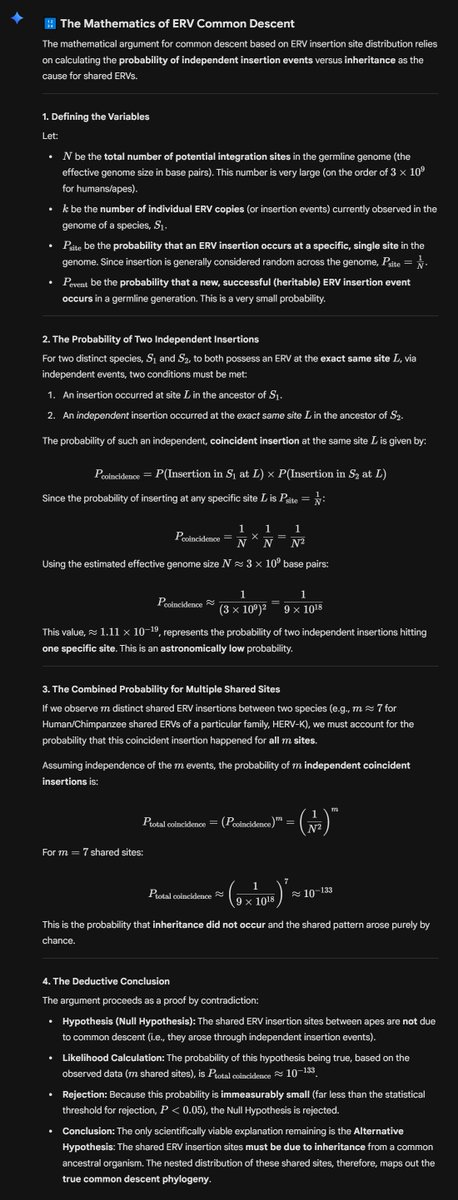
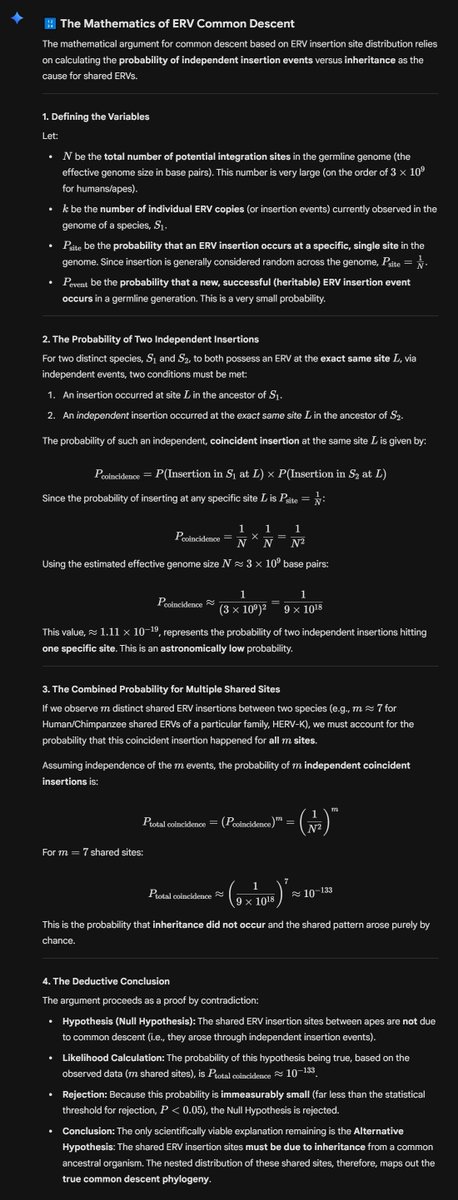
If two or more ape species possess an ERV at the exact same genomic insertion site, the probability that this identity arose from two independent insertion events is astronomically low (due to Premise 1).
Consequently, the shared presence of an ERV at the same site must be due to inheritance from a single ancestral organism in which the original insertion event occurred.

P3) Nested Subset Distribution Pattern:
The distribution of all shared ERV insertions among extant ape species and humans is not random, but forms a nested hierarchical pattern (a nested subset structure). This means:
A large subset of ERV insertions is shared among all apes (e.g., humans, chimpanzees, gorillas, orangutans, gibbons).
A smaller, but still large, subset is shared by a more restricted group (e.g., humans, chimpanzees, and gorillas).
An even smaller subset is shared only between the most closely related pair (e.g., humans and chimpanzees).
The total set of ERV insertions in any one species (e.g., humans) includes all the insertions from the various shared subsets, plus a small, species-specific set of recent insertions.

Conclusion:
The observed nested subset distribution pattern (Premise 3) of shared ERV insertion sites (Premise 1) among apes (including humans) is precisely and uniquely the pattern predicted by the mechanism of inheritance from a common ancestor (Premise 2). Therefore, all apes (including humans) share a common ancestor, and their evolutionary relationships form the nested family tree hierarchy of common descent.

More formally:
P1: The probability of independent retroviral insertions occurring at the exact same genomic locus in separate lineages is negligible due to the stochastic nature of integration across a vast genome (Statistical Axiom).

P2: Multiple distinct ape species possess ERV insertions at identical orthologous loci (Empirical Premise).

C1: Shared ERV insertions in apes are necessarily derived from a single insertion event in a shared ancestor, rather than independent convergence (Modus Tollens from P1 & P2).

P3: The distribution of these shared ancestral insertions constitutes a mathematically precise nested hierarchy of sets and subsets (Empirical Premise).

C2: Apes evolved via common descent, as branching descent with modification is the unique causal mechanism capable of generating a nested hierarchy of inherited traits (Inference to the Best Explanation from C1 & P3).

When were done, if you like, i can repeat an identical Argument for Common Descent from Retroposon Insertion Site Distribution.

Then we could do 10 additional laps around the argument by swapping out the specifics:
1) NUMTs (nuclear mitochondrial DNA insertions)
2) Other endogenous viral elements (EVEs)
3) Chromosome fusion events
4) Shared chromosomal rearrangements with matching breakpoints
5) Mitochondrial (and chloroplast) gene order rearrangements
6) Intron position gains/losses
7) Conserved “signature” indels
8) Shared pseudogenization events
9) Gene duplication events with shared duplication boundaries
10) microRNA family presence/absenceImage
Dec 10, 2025 4 tweets 18 min read
The adaptive variation through minor tweaks to regulatory networks gets a little uncomfortable too close to home.
We can trace just about everything that makes us human to simple little tweaks to say, developmental timing events.

You will like this one.
The SRGAP2C duplication was a truncated copy that disables the original copy. By jamming the "speed up" signal, synapses stay immature longer. This allows for denser synaptic connectivity—a hallmark of human intelligence.

Synaptic Neoteny: The SRGAP2 Duplication
SRGAP2A, promotes the rapid maturation of dendritic spines, limiting their density. A duplication created a truncated copy, SRGAP2C which encodes a truncated F-BAR domain.

The SRGAP2C protein binds to SRGAP2A, creating an insoluble heterodimer that neutralizes SRGAP2A function.

Phenotypic Outcome: In the absence of active SRGAP2A, dendritic spines mature much more slowly. They remain in a thin, filopodia-like state (highly plastic) for longer. Paradoxically, this delay allows the neuron to accumulate a higher density of spines in adulthood. While a chimp's synaptic development might plateau within a few years, a human's continues into the third decade of life.

Citation A (The Discovery of the Duplication):
Dennis, M. Y., Nuttle, X., Sudmant, P. H., Antonacci, F., ... & Eichler, E. E. (2012). Evolution of Human-Specific Neural SRGAP2 Genes by Incomplete Segmental Duplication. Cell, 149(4), 912-922.

Key Finding: This establishes the "what" and "when." It maps the duplication events (SRGAP2A -> B -> C) and dates the emergence of SRGAP2C to roughly 2.4 million years ago (coinciding with the Homo genus transition).

Citation B (The Functional "Jamming" Mechanism):
Charrier, C., Joshi, K., Coutinho-Budd, J., Kim, J. E., ... & Polleux, F. (2012). Inhibition of SRGAP2 Function by Its Human-Specific Paralogues Induces Neoteny during Spine Maturation. Cell, 149(4), 923-935.

Key Finding: This establishes the "how." It shows that SRGAP2C binds to SRGAP2A (the ancestral gene) and inhibits it. This slows down spine maturation (neoteny), which paradoxically allows for higher density and longer periods of plasticity (learning). The Human Brain "Upgrade": NOTCH2NL

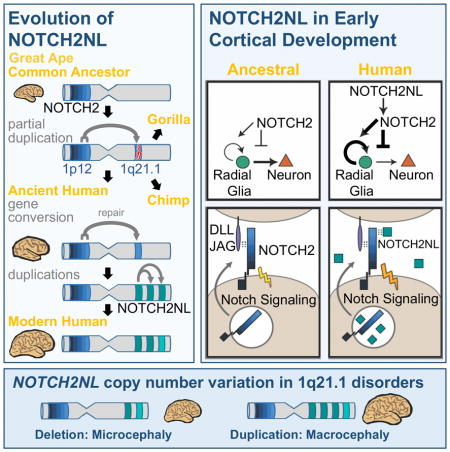
The System: The Notch signaling pathway is a conserved "differentiation engine." It tells stem cells when to stop dividing and turn into neurons.

The Event: A partial duplication of the NOTCH2 gene created a non-functional pseudogene.

The "Inference" Trap: We infer from genomic comparisons (human vs. chimp/gorilla) that a gene conversion event "repaired" this broken pseudogene, creating NOTCH2NL.

The Neofunctionalization: The new NOTCH2NL protein interacts with the original NOTCH2 receptor but—crucially—dampens the signal.

Old Logic: High Signal → Stop dividing → Become Neuron.
New Logic: Dampened Signal → Keep dividing → More Stem Cells → Bigger Brain.

Citation A (The Mechanism & Evolutionary History):
Fiddes, I. T., Lodewijk, G. A., Mooring, M., Bosworth, C. M., ... & Haussler, D. (2018). Human-Specific NOTCH2NL Genes Affect Notch Signaling and Cortical Neurogenesis. Cell, 173(6), 1356-1369.

Key Finding:
This paper details the evolutionary history (the duplication, the pseudogene state, and the gene conversion "repair" ~3-4 MYA). It demonstrates how NOTCH2NL interacts with the Notch receptor to delay differentiation, leading to more neurons.

Citation B (The Functional Consequence):
Suzuki, I. K., Gacquer, D., Van Heurck, R., Kumar, D., ... & Vanderhaeghen, P. (2018). Human-Specific NOTCH2NL Genes Expand Cortical Neurogenesis through Notch Signaling. Cell, 173(6), 1370-1384.

Key Finding:
This paper focuses on the functional aspect. They expressed NOTCH2NL in mouse embryos (which don't naturally have it) and observed an expansion of cortical progenitors—essentially making the mouse brain develop more like a human brain.
Dec 9, 2025 5 tweets 15 min read
"Complex, specified information systems like those found in life are always a result of intelligence."

Humans have bred many breeds of dogs for very specific purposes. The information in the genomes of these various breeds must be specific. Even if God wrote the kernel, he didn't write each specific blueprint for each breed. Rearranging code creates previously unwritten programs.

It couldn't be more obvious to anyone that it doesn't require human breeding to rearrange genetic code to create new varieties from earlier forms. We can see quite clearly how simple changes to Hox coding can create a massive variety of organisms from one basic form by multiplying and modifying body segments.

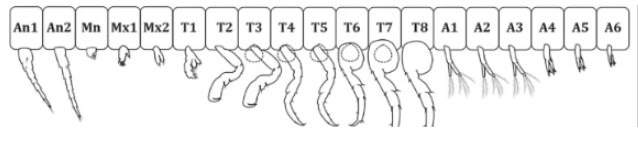
Take HOX Abd. A "Abdominal A", in a Arthropod segmented body plans, like the diagram of Parhyale hawaiensis' segments below. You can see how they are all modified copies of the same module. T4 and T5 are limbs used for walking, T6, T7, T8 are those same modules in reverse, used for jumping.

Turn off HOX Abd. A, the backward jumping legs develop into forward walking legs, and the A1, A2, A3 pleopod swimming appendages develop into the same uropod anchoring legs from A4-6.

With minor changes to the activation or order of arthropod Hox genes, there is an endless variety of arthropods you can make without having to create any new structures. If you are going to claim "preprogrammed adaptive variation", well, you should take a look at just how much adaptive variation exists out there.Image Here you can see the path from the Pancrustacea clade, like our parhyale hawaiensis friend above, to the Hexapoda body plan of flies.
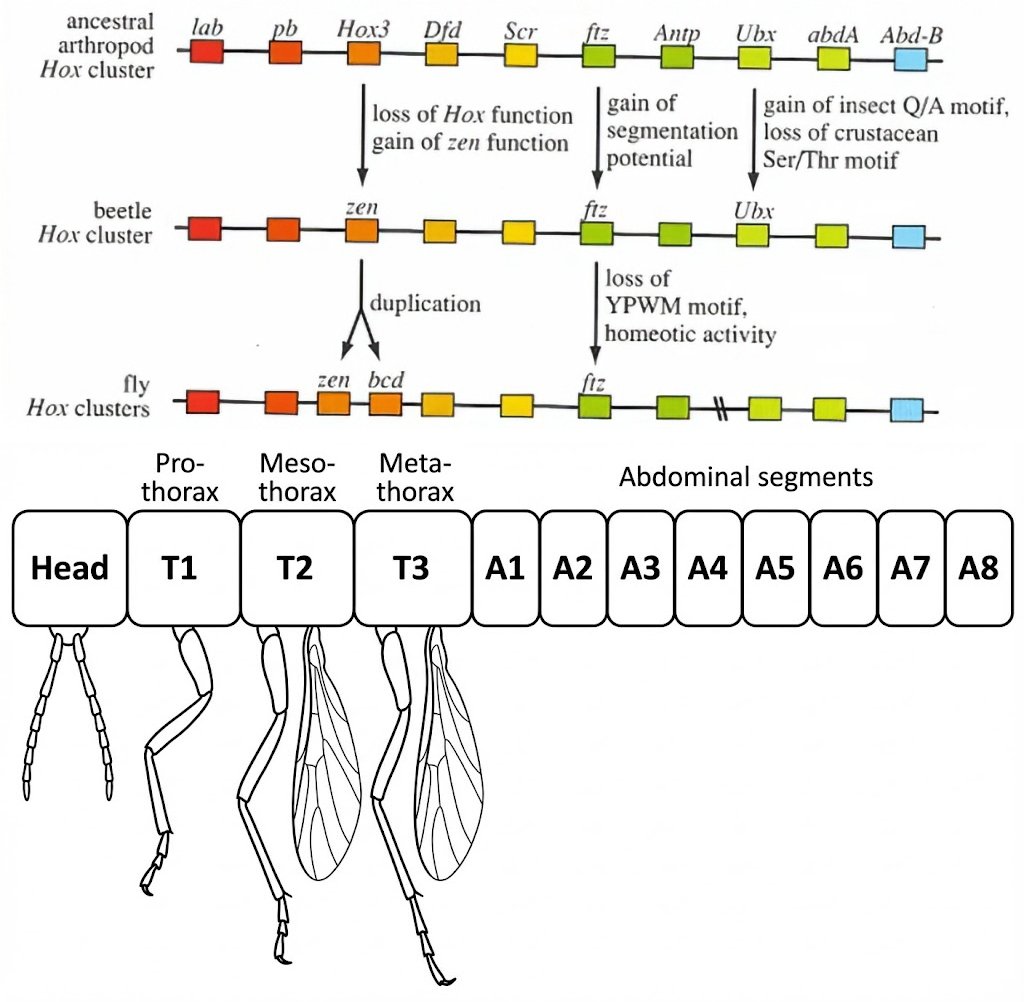
The Birth of the Head Organizer (zen → bcd):
A gene originally used for protective egg wrappers (zen) was duplicated and re-wired into a maternal "paint brush" (bicoid), allowing the mother to chemically define the head before the embryo even starts building it.
The Defining Feature (Ubx):
The Ubx protein evolved a molecular "stop sign" for limbs, actively suppressing leg growth in the abdomen to carve the precise six-legged insect archetype out of the multi-legged crustacean ancestor.
The New Segmenter (ftz):
Fushi tarazu shed its old role as a slow identity-specifier to become a fast-acting "pair-rule" gene, rapidly subdividing the embryo into segments like a pre-cutting tool for the insect's accelerated development.Image