Shanu Mathew Profile picture
Climate, Investing, NBA, & Rap. SVP, Portfolio Manager - Sustainable Investing. Prev: Head of ESG, HY Credit, Startup (acq.) IB. Own Views. RTs ≠ endorsement.
Mar 29 5 tweets 11 min read
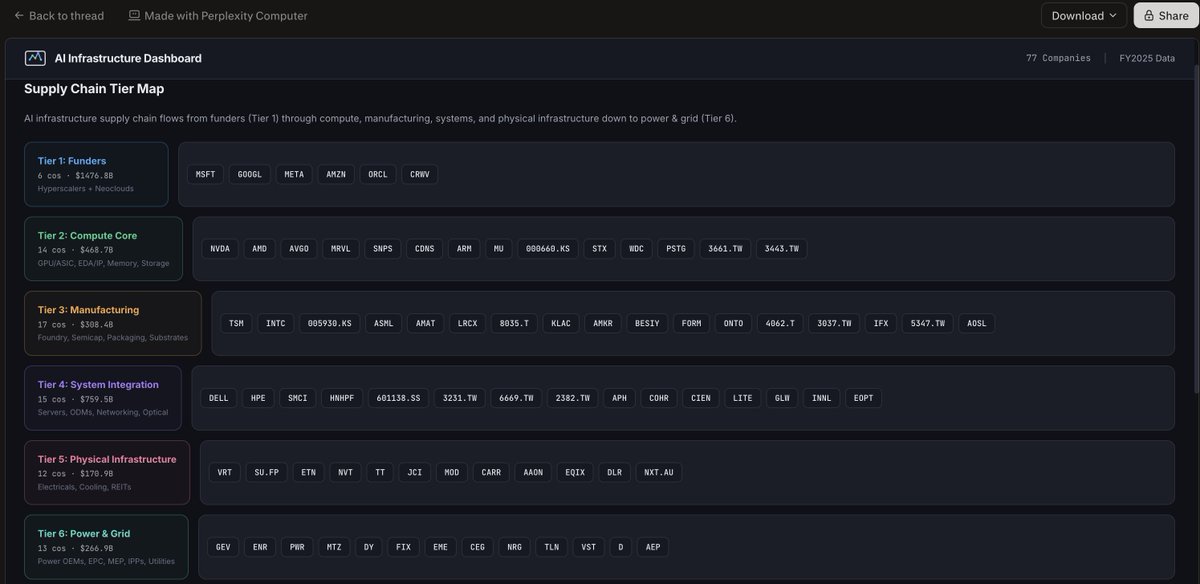
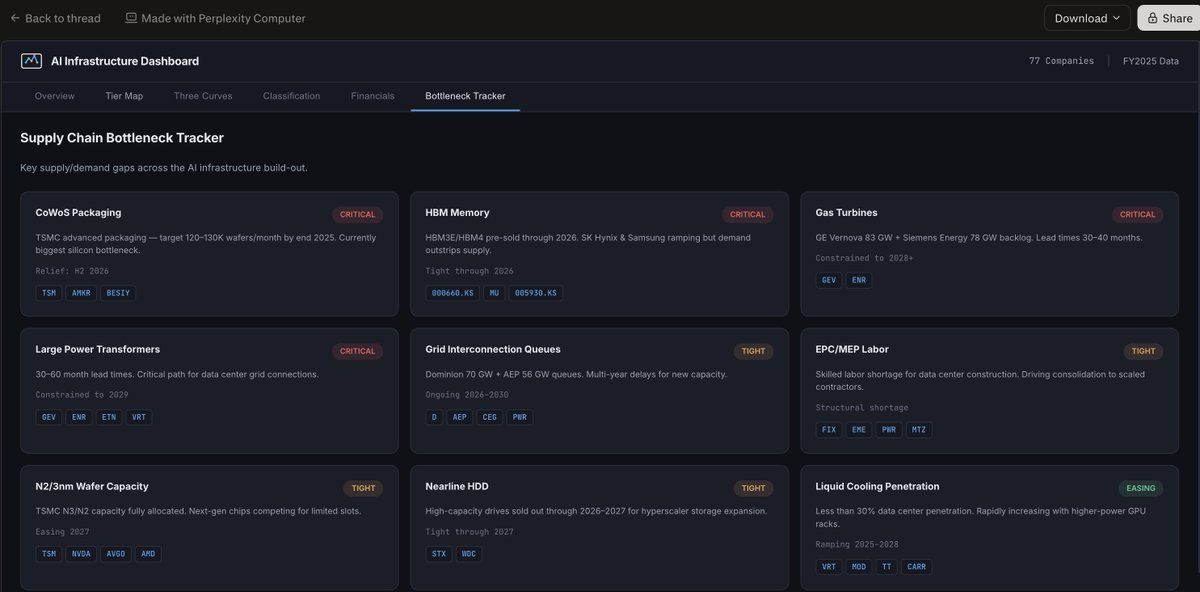
Stress-tested @perplexity_ai @PPLXfinance Computer on a real equity research workflow: Map a representative AI infrastructure supply chain across 70+ companies across multiple tiers with sourced financials, bottleneck analysis, and company classifications. The kind of deliverable that might take a junior analyst days to weeks.

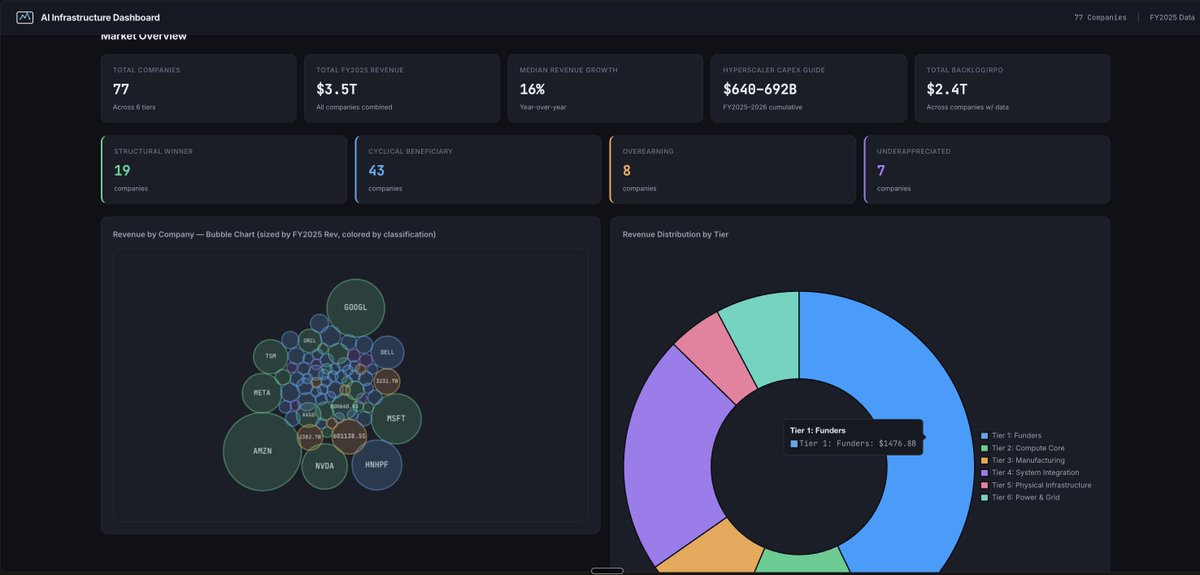
It produced ~2,000 lines of structured research across 4 phased reports (~5,300 credits burned in ~75 minutes of work). Every data point labeled Actual, Guidance, or Estimate with inline source citations. Then it built an interactive dashboard to make the information digestible with 4 deep research .md files compiled.

A cool feature is when it flagged when its own sources conflict. It caught 8 data conflicts and wrote explicit resolution notes. TSMC CoWoS capacity ranges explained as report timing differences. ASML's Q4 FCF anomaly identified as a billing artifact. Intel Foundry's loss methodology change across fiscal years. That is fundamentally different from silently picking a number and requiring an experienced SME to catch it.

Other strong points: hyperscaler capex table aligned across 5 different fiscal year-ends. ORCL RPO correctly flagged as potential overstating near-term conversion (90%+ partner-funded). Power identified as the binding constraint with MSFT carrying $80B in power-constrained backlog. Some interesting analytical observations, not headline summaries.

Where it fell short: never ran the numerical supply/demand gap calculation I specifically asked for (but it was a very large ask tbf). Spot checked multiple data points I know to be true but some ones that also looked off (to be expected, especially across varying degrees of company size and disclosure). Put ~30 companies into one Three Curves bucket (defeats the framework). Some debatable calls (but wouldn't expect AI to be good at this today). A few blog-tier sources where you'd want filings is always the shortcoming of a finance-focused search.

Verdict: Arguably first-draft quality from a mid-tier sell-side initiation. 80% of the work done pretty well. The remaining 20% is exactly what you'd mark up before an experienced analyst or PM sees it. Not the finished product but a remarkable effort in a short amount of time. A research scaffold you can interrogate with actual domain expertise. This was a pretty genuinely cool result and I am intrigued to keep playing around with the tool.

cc: @AravSrinivas @rayyyang @RoshanS97
Prompt: INSTRUCTIONS FOR TASK EXECUTION

This is a large, multi-part research task. Before you begin, assess the total scope and decide how to execute it. You have two options:

OPTION A — SINGLE PASS
If you believe you can complete the entire task in one run with high-quality, sourced, specific output for every section, do so. Do not sacrifice depth for completeness. Every data point must have a source. Every table must be populated with real numbers, not placeholders.

OPTION B — PHASED EXECUTION (PREFERRED IF IN DOUBT)
If the task is too large to complete thoroughly in a single pass, break it into sequential phases. Execute Phase 1 fully, then tell me you're ready for Phase 2, and I will prompt you to continue.

Suggested phasing:
- Phase 1: Tiers 1-2 (Hyperscalers, Neoclouds, Compute/GPU/ASIC, EDA/IP, Memory, Storage)
- Phase 2: Tiers 3-4 (Foundry, Semicap, Packaging/Test, Substrates, Power Semis, Server OEMs, ODMs, Networking/Optical)
- Phase 3: Tiers 5-6 (Electricals, Cooling, DC REITs, Power OEMs, EPC/MEP, IPPs, Utilities)
- Phase 4: Synthesis (Supply/Demand Gap, Three Curves Framework, Overearning vs Durable Growth classification)

Each phase should be a complete, standalone deliverable with fully sourced tables and analysis. Do not produce a shallow overview of everything — I want deep, specific, numbers-backed research on each tier even if that means splitting the work across multiple rounds.

QUALITY RULES THAT APPLY TO EVERY PHASE:
- Every numerical claim needs a source (earnings call date, filing, press release, analyst report, or trade publication). No unsourced assertions.
- If sources conflict, flag the conflict explicitly. Do not silently pick one.
- If you cannot find data for a company or metric, say "data not found" — do not fabricate, interpolate, or substitute commentary for missing numbers.
- Prefer primary sources (company filings, earnings transcripts, investor presentations) over secondary commentary.
- Label analyst consensus estimates as "consensus" — do not present them as confirmed guidance.
- Use structured tables: one row per company, columns per metric/year. Narrative analysis follows the tables, not replaces them.
- Do not pad output with generic background on what AI capex is or why data centers matter. I know the space. Go straight to the data.

Tell me which option you're choosing before you start, then begin.

==============================
THE TASK
==============================

You are a senior equity research analyst covering AI infrastructure. I need you to build a comprehensive supply/demand map for AI accelerators and data center capacity across the 2025-2027 period. This is a professional-grade deliverable, not a summary of headlines.

The AI capex supply chain has six tiers. I want you to research each one systematically.

==============================
TIER 1 — THE FUNDERS
==============================

Hyperscalers: MSFT, GOOGL, META, AMZN, ORCL
Neoclouds: CoreWeave, Lambda Labs, Fluidstack, Nscale

For each, find and document:
- Total capex guidance or announced plans for 2025, 2026, and 2027
- Distinguish between confirmed guidance from earnings calls vs. press reports vs. analyst estimates
- What percentage is AI-related vs. maintenance/other (if disclosed)
- Specific facility announcements (location, MW capacity, timeline)
- For neoclouds: total GPU commitments, major customer contracts, financing structures
- Source and date for every number

==============================
TIER 2 — COMPUTE CORE & MEMORY
==============================

GPUs / Custom ASIC: NVDA, AMD, AVGO, MRVL
Custom Silicon Enablers (EDA/IP): SNPS, CDNS, ARM, Alchip, Global Unichip (GUC)
Memory: MU, SK Hynix
Storage: STX, WDC, PSTG

For each, find and document:
- Current and projected AI-related revenue or shipment volumes
- For GPU/ASIC: known supply constraints (packaging, HBM, CoWoS, power delivery), customer concentration, lead times, backlog data
- For EDA/IP: growth tied to custom ASIC design starts, hyperscaler engagements, TAM expansion
- For memory: HBM capacity allocation, trade ratios (HBM vs commodity DRAM), pricing trajectory, supply tightness duration
- For storage: hyperscaler HDD/SSD contract visibility, nearline capacity commitments, AI-specific workload demand (training checkpointing, inference caching)
- Margin trajectory (gross and operating) and FCF generation

==============================
TIER 3 — FOUNDRY, SEMICAP & PACKAGING
==============================

Foundry: TSMC, INTC, Samsung
Semicap Equipment: ASML, AMAT, LRCX, Tokyo Electron (8035 JP), KLAC
Advanced Packaging & Test: AMKR, BESI, FormFactor (FORM), Onto Innovation (ONTO)
Substrates: Ibiden, Unimicron
Power Semiconductors / PMICs: Infineon (IFX), Vanguard International Semi (VIS), Alpha & Omega Semi (AOSL)

For each, find and document:
- AI-driven revenue exposure as a percentage of total
- For foundries: advanced node (N2/N3) and CoWoS/advanced packaging capex plans, capacity utilization, allocation priorities
- For semicap: order backlog, book-to-bill, cycle duration expectations
- For packaging/test: hybrid bonding adoption, HBM validation demand, 2.5D/3D architecture ramp
- For substrates: ABF substrate supply/demand, pricing, capacity expansion timelines
- For power semis: AI server PMIC content growth, wide-bandgap (SiC/GaN) adoption for 800V DC architectures
- Margin trajectory and FCF generation

==============================
TIER 4 — SYSTEM INTEGRATION & NETWORKING
==============================

Server OEMs: DELL, HPE, SMCI
Asian ODMs: Hon Hai / Foxconn (2317 TW), Foxconn Industrial Internet (FII), Wistron, Wiwynn, Quanta
Networking / Optical: APH, COHR, CIEN, LITE (Lumentum), GLW (Corning), Eoptolink, InnoLight

For each, find and document:
- AI server / networking revenue and growth rates
- For OEMs vs ODMs: market share shifts, direct-to-ODM bypass trends, margin compression dynamics
- For networking/optical: 800G/1.6T transceiver ramp, silicon photonics adoption, major supply contracts (e.g. Corning-Meta fiber deal)
- Revenue pass-through vs. value capture (are margins expanding or compressing as AI revenue grows?)

==============================
TIER 5 — FACILITY INFRASTRUCTURE
==============================

Electricals: VRT (Vertiv), SU FP (Schneider Electric), ETN (Eaton), NVT (nVent)
Cooling: TT (Trane), JCI (Johnson Controls), MOD (Modine), CARR (Carrier), AAON
Data Center REITs / Colocation: EQIX (Equinix), DLR (Digital Realty), NextDC

For each, find and document:
- Data center-specific revenue exposure and growth rate
- Content per MW of IT capacity ($ revenue per MW deployed)
- For electricals: 800V DC architecture adoption, switchgear/busbar/PDU demand, backlog visibility
- For cooling: liquid cooling vs air cooling mix shift, direct-to-chip adoption, rack density trends (100kW+ per rack)
- For REITs/colo: leasing pipeline, powered shell vs turnkey capacity, tenant mix (hyperscale vs enterprise), development yield spreads
- Margin trajectory (are margins expanding with the cycle or staying flat?)

==============================
TIER 6 — GRID, POWER & DEPLOYMENT
==============================

Power OEMs: GEV (GE Vernova), Siemens Energy
EPC Contractors: PWR (Quanta), MTZ (MasTec), DY (Dycom)
MEP Contractors: FIX (Comfort Systems), EME (EMCOR)
IPPs: CEG (Constellation), NRG, TLN (Talen), VST (Vistra)
Utilities: D (Dominion), AEP

For each, find and document:
- Data center / AI-related revenue exposure (actual or estimated)
- For power OEMs: gas turbine and transformer order backlog, lead times, capacity expansion plans
- For EPC/MEP: backlog size and composition, data center as % of total backlog, margin trends, labor availability constraints
- For IPPs: behind-the-meter and nuclear co-location deals, contracted capacity for hyperscalers, PPA pricing trends
- For utilities: interconnection queue depth, timeline from application to energization, rate base growth from data center load, regulatory posture toward large load additions
- FCF generation and capital allocation

==============================
SYNTHESIS
==============================

After completing all six tiers, produce three synthesis deliverables:

DELIVERABLE A — SUPPLY/DEMAND GAP ANALYSIS
Using the data above:
- Estimate total AI accelerator demand implied by Tier 1 capex plans (use reasonable $/GPU or $/ASIC assumptions, state them explicitly)
- Compare against Tier 2-3 projected supply capacity
- Identify the binding constraints at each layer: Is the bottleneck silicon? HBM? CoWoS packaging? Power semiconductors? Substrates? Electrical switchgear? Grid interconnection? Labor?
- Map the timeline: when does supply catch up to demand at each layer, if it does at all in this cycle?

DELIVERABLE B — THREE CURVES FRAMEWORK
Frame the full ecosystem through this analytical lens:
- Curve 1: Orders placed (contracts signed, capex committed, backlog booked)
- Curve 2: Delivery capacity (what can actually be manufactured, built, and energized on the stated timeline)
- Curve 3: Actual demand realization (will the AI workloads, revenue, and ROI materialize to justify this capacity?)

Where are the gaps between these three curves largest? Which tiers or companies sit in the sweet spot where Curve 1 exceeds Curve 2 (demand > supply, pricing power)? Where is Curve 1 running ahead of Curve 3 (overbuilding risk)?

DELIVERABLE C — OVEREARNING vs. DURABLE GROWTH
Classify every company into one of four buckets:
1. STRUCTURAL WINNER — durable competitive advantage, pricing power, long visible backlog, margins likely to hold or expand
2. CYCLICAL BENEFICIARY — real growth but tied to this specific capex cycle, vulnerable to a slowdown or demand plateau
3. OVEREARNING — margins or revenue at unsustainable levels, likely to mean-revert as competition intensifies or pass-through dynamics compress value capture
4. UNDERAPPRECIATED — not yet fully valued by the market relative to the duration and magnitude of the tailwind

For each classification, provide 2-3 sentences of reasoning grounded in the data you collected.

==============================
OUTPUT RULES
==============================

- Use structured tables wherever possible: one row per company, columns for each metric/year
- Every data point needs a source: earnings transcript date, press release, SEC filing, analyst report, or trade press article. If sources conflict, flag the disagreement explicitly.
- Prefer primary sources (earnings calls, company filings, investor presentations) over secondary commentary
- Label analyst consensus estimates as such — do not present them as confirmed company guidance
- If you cannot find a data point, say so. Do not fabricate or interpolate.
- Flag any number where your confidence is lowImage
Image
Image
Image
Dec 4, 2025 5 tweets 3 min read
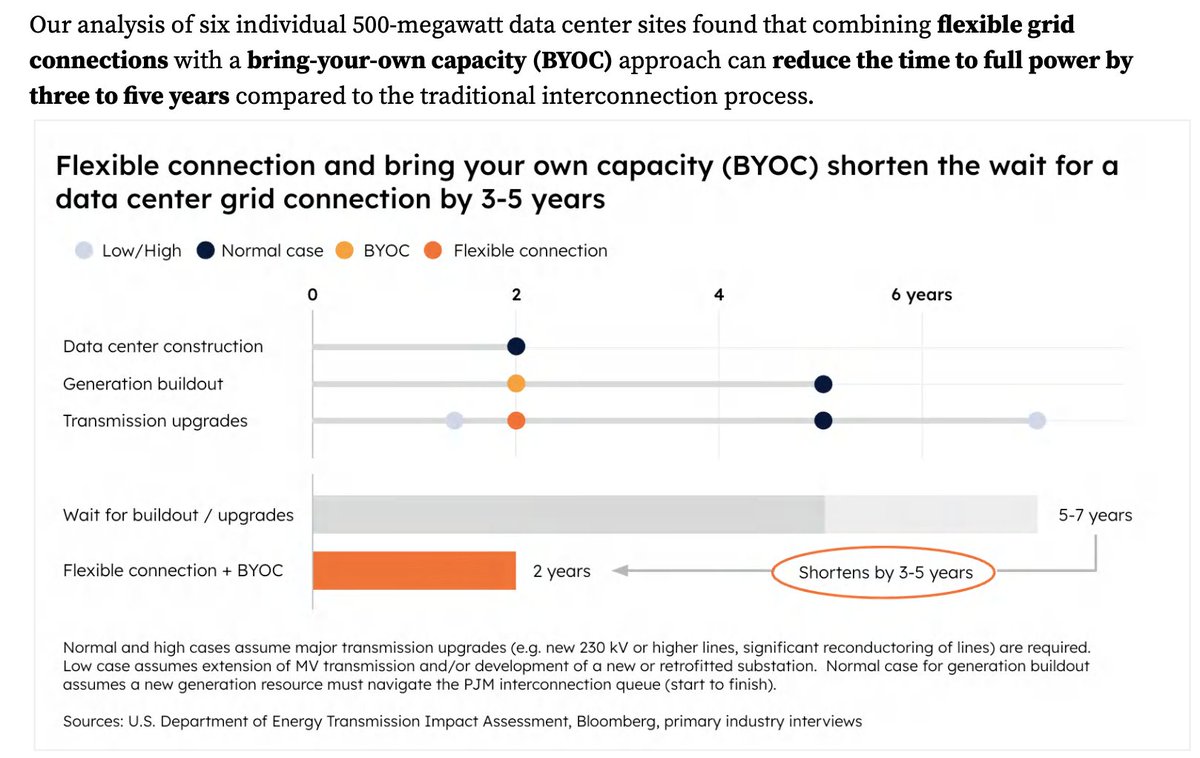
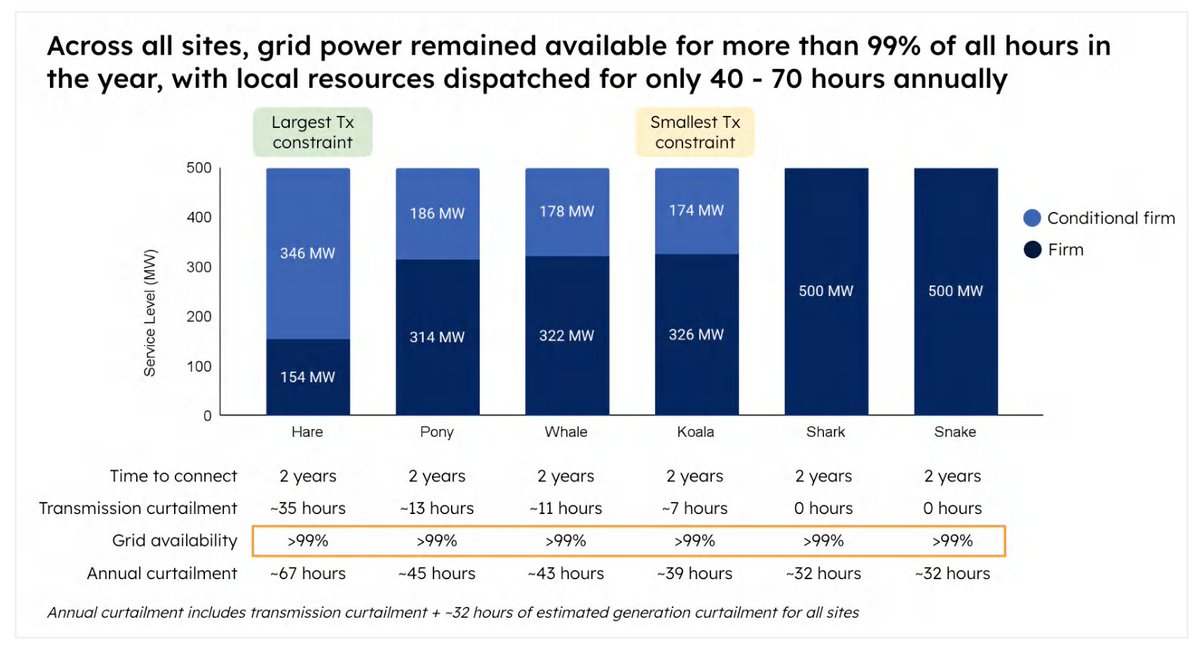
New @CamusEnergy/@Princeton (@JesseJenkins) study: Flexible grid connections + BYOC cut data center interconnection from 5-7 years to ~2 years. Grid power available >99% of hours - on-site resources dispatch just 40-70 hrs/year. Biggest near-term unlock for AI infra bottleneck.Image
Image
Image
Image
Speed to power economics: 3-5 years faster = $2.3-5.5B incremental EBITDA per 500 MW site. Flexibility infrastructure costs $1.2-1.4B. Net positive returns even at conservative $4M/MW revenue with just 2 years of time savings.
Note: this $ figure ($4-$12M per MW is prob only realistic for hyperscaler or neocloud/HPC as a service players)Image
Nov 8, 2025 13 tweets 5 min read
As many have already shared some great slides, I finally went through the full report. Fantastic work by @LBNL @TheBrattleGroup teams!

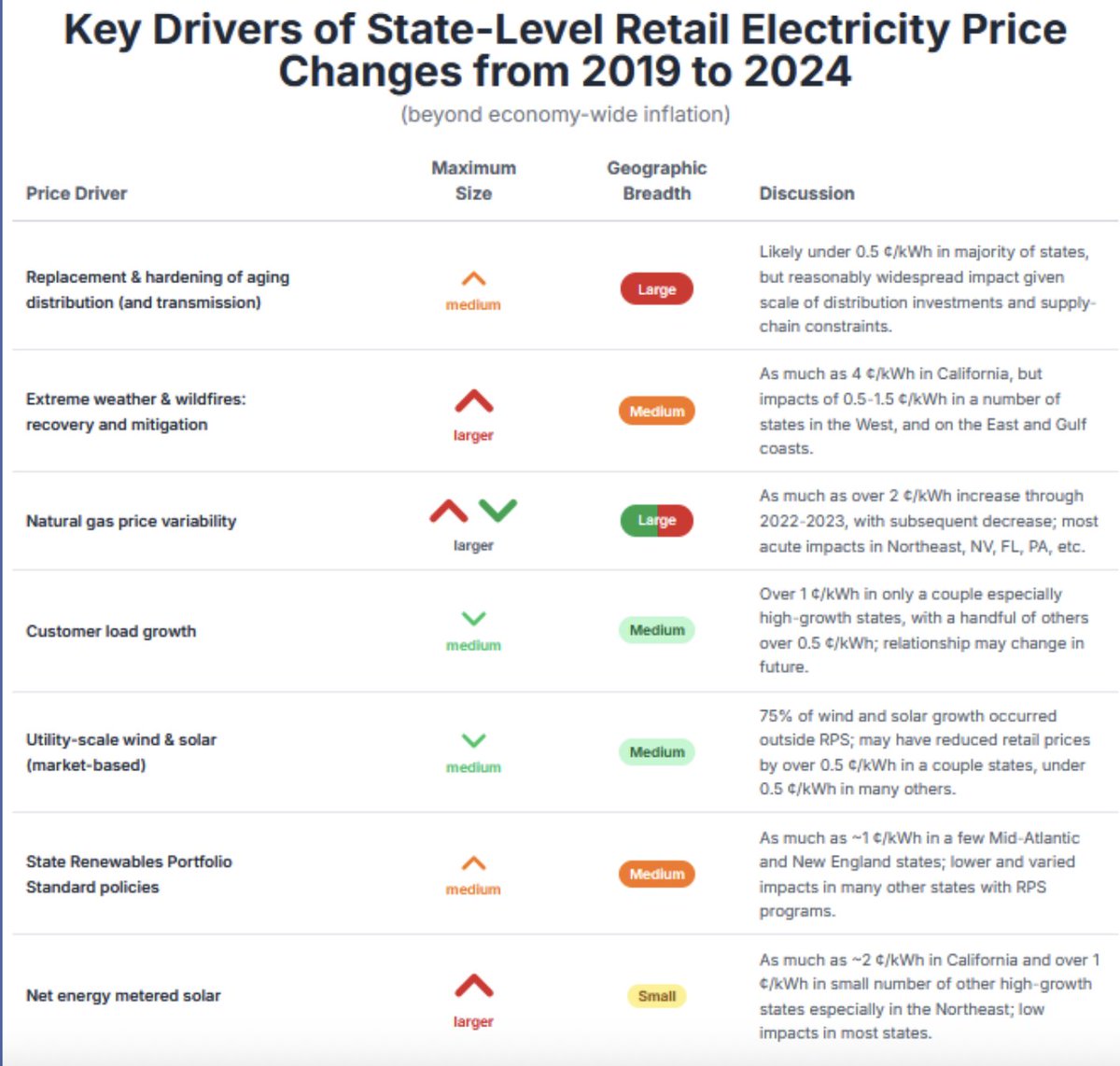
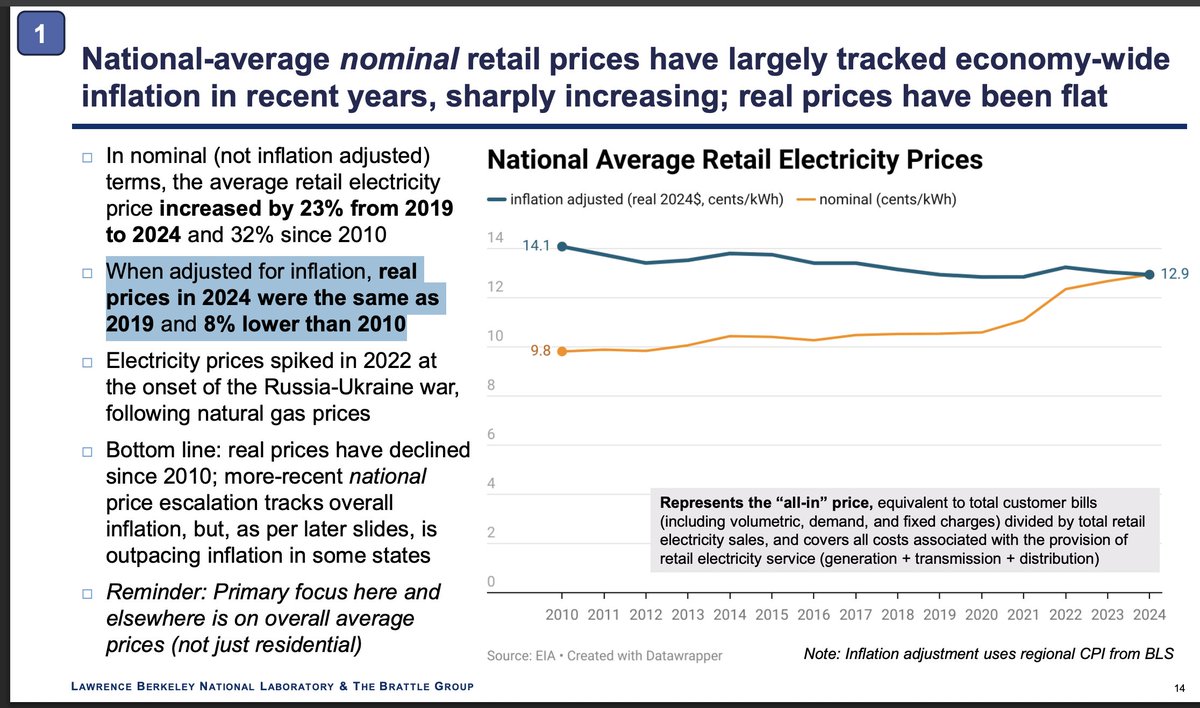
Factors Influencing Recent Trends in Retail Electricity Prices in the United States 🧵. Read if you want to know what's going on with US electricity prices in a non-fear mongering or engagement bait way!

Largest drivers of price increases - replacement & hardening of aging T&D, price movement of nat gas, extreme weather, state RPSImage When adjusted for inflation, national avg. retail electricity real prices in 2024 were the same as 2019 and 8% lower than 2010Image
Oct 24, 2025 6 tweets 2 min read
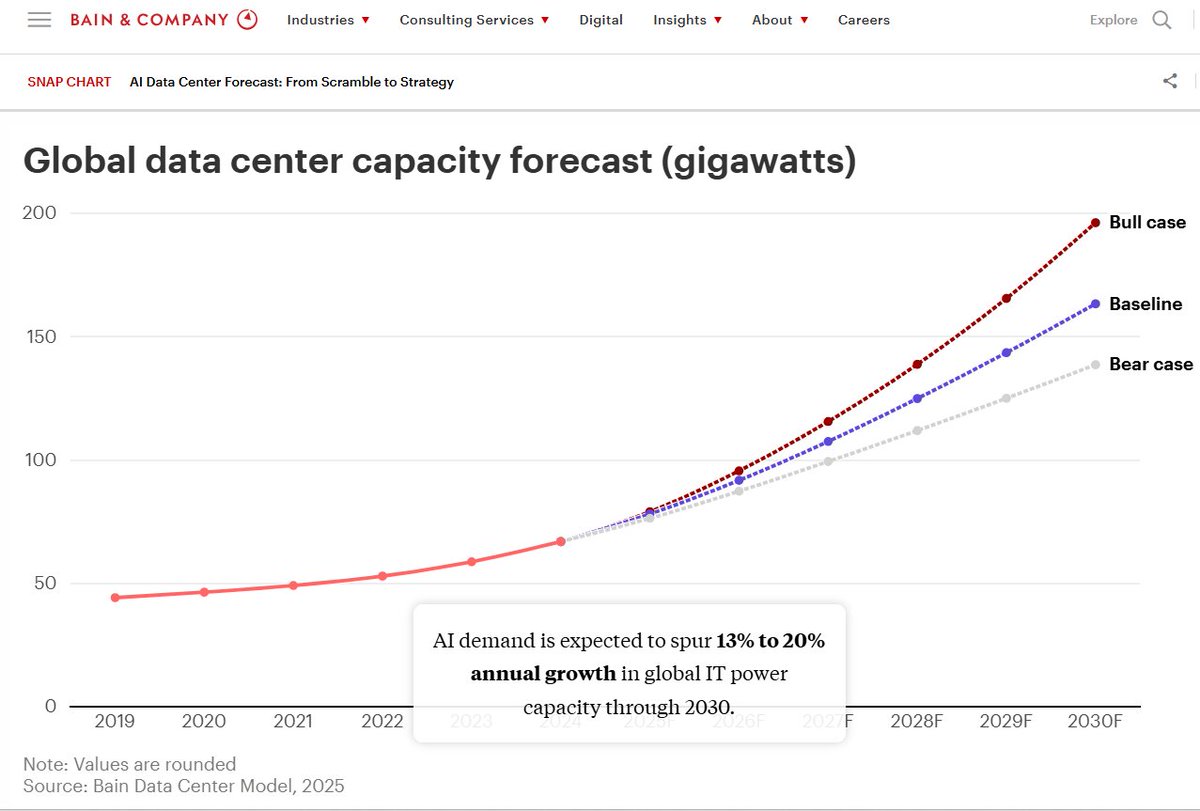
Bain AI data center forecast.

2019: 44GW
2024: 67GW (9% CAGR)

2030 Forecast:
Bear - 139 (13% CAGR)
Base - 163GW (16% CAGR)
Bull - 197GW (20% CAGR)Image 2020: 46GW
Hyperscaler self-build - 7 (15%)
Colocation (hyperscaler) - 7 (15%)
Colocation (non-hyperscaler) - 10 (22%)
Enterprise - 22 (48%)

2030: 163 GW
HSB - 69 (42%; 26% CAGR)
Colo (H) - 39 (24%; 19% CAGR)
Colocation (NH) - 24 (15%; 9% CAGR)
Enterprise - 31 (19%; 3% CAGR)Image
Sep 29, 2025 10 tweets 4 min read
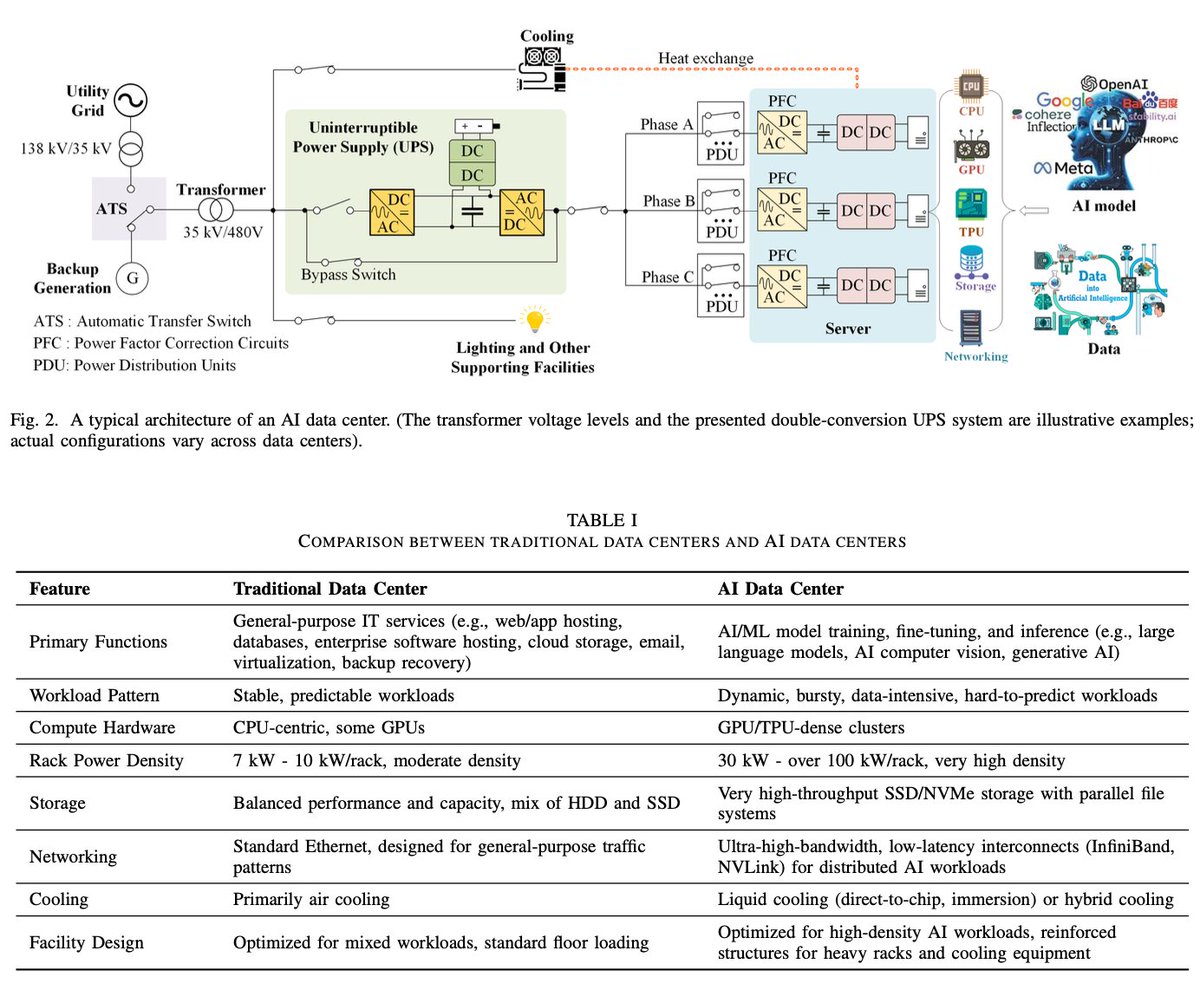
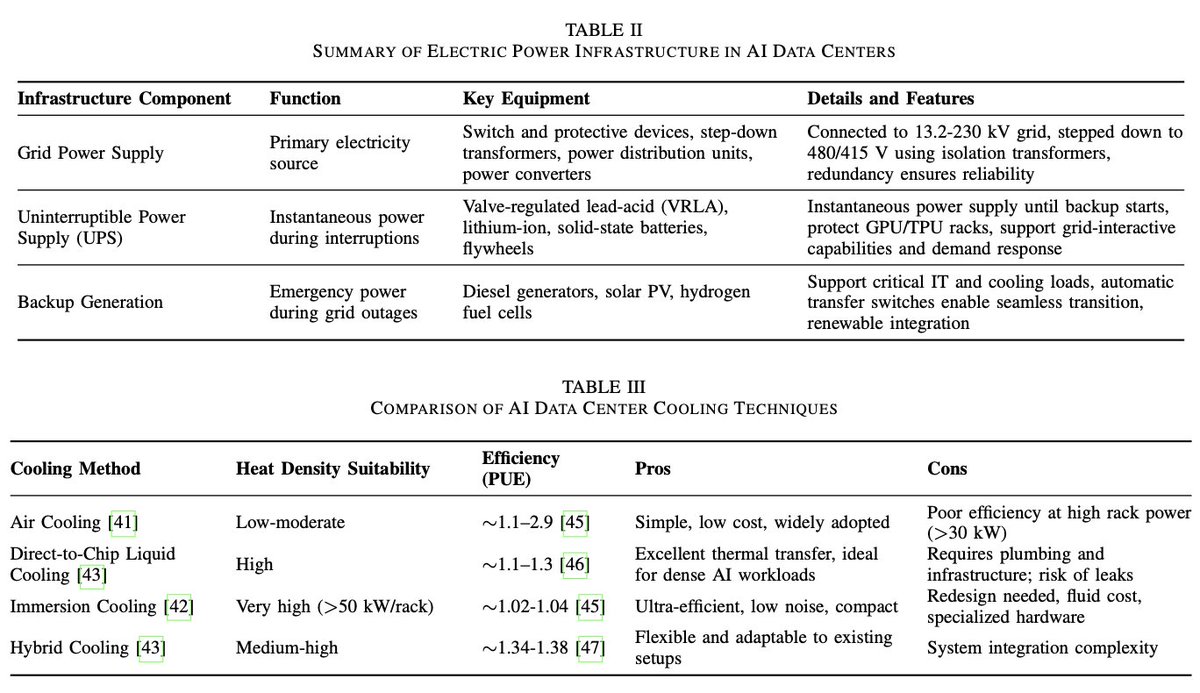
The typical architecture of an AI data center and comparison to traditional data centers Image Power infrastructure + cooling techniques Image
Jul 23, 2025 5 tweets 3 min read
Ignoring some choice verbiage (e.g., DE&I or Climate), the AI Action Plan doc focuses on some ambitious goals related to ensuring America remains an AI leader.

Pillars I, II, III summarized:
i) Unleash AI: roll back EO 14110 regs, back open‑source/open‑weight, fund R&D & compute markets, grow talent.
ii) Build the stack: chips, DCs & power via NEPA/FAST‑41 fast‑tracks, grid upgrades, and new dispatchable geo/nuclear/fusion.
iii) Secure & lead globally: lock down frontier model misuse (bio/cyber), harden DOD/IC compute, police chip/export leaks.

Notable text from each Pillar below...https://www.whitehouse.gov/wp-content/uploads/2025/07/Americas-AI-Action-Plan.pdf Pillar I: Accelerate AI Innovation

-Support Next-Generation Manufacturing: Invest in developing and scaling foundational and translational manufacturing technologies via DOD, DOC, DOE, NSF, and other Federal agencies using the Small Business Innovation Research program, the Small Business Technology Transfer program, research grants, CHIPS R&D programs, Stevenson-Wydler Technology Innovation Act authorities, Title III of the Defense Production Act, Other Transaction Authority, and other authorities

-Support Next-Generation Manufacturing: Through NSF, DOE, NIST at DOC, and other Federal partners, invest in automated cloud-enabled labs for a range of scientific fields, including engineering, materials science, chemistry, biology, and neuroscience, built by, as appropriate, the private sector, Federal agencies, and research institutions in coordination and collaboration with DOE National Laboratories.

-Build World-Class Scientific Datasets: Direct the National Science and Technology Council (NSTC) Machine Learning and AI Subcommittee to make recommendations on minimum data quality standards for the use of biological, materials science, chemical, physical, and other scientific data modalities in AI model training.
Dec 23, 2024 9 tweets 3 min read
(1/9) New @BerkeleyLab @ENERGY shows dramatic changes in U.S. data center energy use. In 2014-2016, consumption was stable at ~60 TWh/year. But by 2023, it reached 176 TWh - over 4% of total U.S. electricity use (+up to 6-12% by 2028). The culprit? The rise of AI computing.Image (2/9) Looking ahead to 2028, data centers could consume between 325-580 TWh annually - up to 12% of projected U.S. electricity use. This massive growth is primarily driven by AI workloads and GPU-accelerated computing.Image
Jun 14, 2024 6 tweets 4 min read
Incredible presentation. My favorite slides below. 🧵

Manufactured technologies (e.g., solar and wind) enjoy cost learning curves; (fossil) commodities don’t... which also means they grow faster. Even neutral actors modeled in linear terms. But change has been exponential.Image
Image
Image
Electricity is the largest supplier of useful* energy.

Useful energy is the total energy left after all processing and conversion losses.Image
Jun 29, 2023 5 tweets 4 min read
I wish everyone that spouted off on the ICE vs. EV debate had to simply acknowledge first that most of the energy you put into a gasoline car is wasted and EVs are far more efficient at converting energy to motion. This is a simple, objective fact. While we're at it, this is also true for all combustion of fossil fuels. Most of the energy burned becomes waste heat! I wish more people knew that when arguing this stuff. Imagine on a first principles basis arguing that the optimal state is one that wastes 2/3 of the output.
Feb 12, 2023 15 tweets 5 min read
This will be Decarbonization’s equivalent version of Mary Meeker’s landmark Internet Trends report. Incredible resource from one of the best minds on the topic. Check it out ⬇️ Some of the charts/visuals/points that stood out most to me.

The US uses 40% of its corn crop to meet 10% of its motor gasoline demand. Image
Nov 20, 2022 4 tweets 2 min read
Two great macro pods that I'd highly recommend

1) @LeitnerJim on @breaking_fever on the relationship between levels of democracy and market returns.

2) @BobEUnlimited on @joincolossus @InvestLikeBest masterclass on how to think about macro/economic cycles.

Incredible orators. Financial markets, democracy, and power with Jim Leitner open.spotify.com/episode/2hfy3c…
Nov 18, 2022 31 tweets 11 min read
Compiling some resources, charts, and company quotes on the impact the IRA is having on capital deployment, corporate strategy, and reshoring industries critical to our clean energy future. Let's visit all the announcements and commentary after 3Q/422 earnings season 🧵 First off, from a tends perspective, there were 2,500+ mentions in 3Q22 and 1800+ mentions of the Inflation Reduction Act for companies that reported in 3Q22 and 4Q22. Snapshot of the companies that mentioned it most - mix of clean energy, utilities, and auto companies. Image
Aug 11, 2022 40 tweets 11 min read
Have you ever been curious about how public asset managers are trying to figure out implementing Net Zero across portfolios? Bunch of approaches all with their own nuances and pros/cons. GFANZ portfolio alignment released updated guidance - 140 pages. Here are some highlights.🧵 4 categories of alignment metrics: In increasing complexity, they are 1) binary, 2) maturity scale alignment, 3) benchmark divergence, & 4) implied temperature rise (ITR)

Metrics should be simple, transparent, science-based, broadly applicable, aggregable, and incentive optimal Image
Jun 22, 2022 7 tweets 2 min read
I have been harping on Scope 3 a lot, but it's important and recent comments and research further push the issue(s) into the spotlight.

1) Unilever CEO says 'no idea' how they will meet Net Zero b/c of Scope 3
2) AlixPartners finds most food & bev. cos behind schedule on targets "[CEO] said it would require significant changes in consumer behavior & action from governments, including the adoption of much higher use of renewable energy worldwide. Unilever focuses on advocacy to help promote the changes needed as part of overall carbon reduction strategy"
May 30, 2022 12 tweets 4 min read
From @IEA Global EV Outlook: [Global] "Sales of electric vehicles (EVs) doubled in 2021 from the previous year to a new record of 6.6 million. Back in 2012, just 120 000 electric cars were sold worldwide. In 2021, more than that many are sold each week"

Driven by China per below More from executive summary: "The simultaneous electrification of road transport and the deployment of decentralised variable renewables such as rooftop solar will make power grid distribution more complex to manage."
Apr 18, 2022 7 tweets 3 min read
Some interesting facts/charts from the wonderful report by @energy_said @rob_by_robwest this AM:

Energy security: the return of long-term contracts?
thundersaidenergy.com/2022/04/14/ene… Commodity prices=inelastic "oil as an example, a price elasticity of -7% means that a doubling of oil prices is statistically associated with a 7% reduction in demand. Or stating it the other way around, a 1% loss of supply should increase prices by 15% (1 ÷ 7%) (15x multiplier)"
Apr 17, 2022 4 tweets 2 min read
Interesting data on consumers/sustainability from IBM and National Retail Federation that I'm seeing for the first time. Data from 2020 on 18,980 consumers in 28 countries.

ibm.com/downloads/cas/….

50% of consumers rank "brands that offer 'clean' products" as very important Of that subgroup of consumers that rank clean products as very important, ~77% of consumers are willing to pay a premium
Apr 4, 2022 15 tweets 3 min read
I think WG3 is interesting b/c of the breakdown of sources of emissions by sector and mitigation options by sector.

Some quotes/facts/charts that were worth looking at from my view 🧵 GHG emissions rose across all sectors and subsectors, and most rapidly in transport and industry. 2019 splits:
-34% Energy
-24% Industry (34% w/ indirect)
-22% from Agriculture, Forestry and other Land Use (AFOLU)
-15% from Transport and
-6% Buildings (17% w/ indirect)
Jan 26, 2022 15 tweets 5 min read
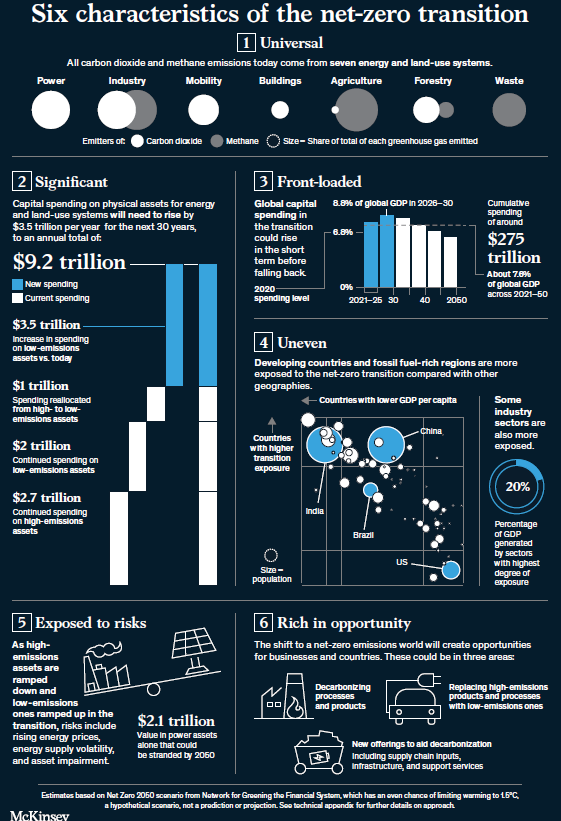
Got through the summary report of @McKinsey's Net Zero economy report.

Very well done. Read enough of these and you eventually get the same points (sectors, themes, everyone do their part, etc.) so will focus on some of the underappreciated/new points.

mckinsey.com/business-funct… Image Cumulative spending on physical assets for Net Zero between 2021 and 2050 would be about ~$275 trillion. Means it will rise from ~$5.7 trillion today to an annual average of $9.2 trillion through 2050, an increase of $3.5 trillion.

Substantially higher than other estimates. Image
Jan 25, 2022 6 tweets 3 min read
Some kind people pointed out typos so re-sharing to ensure the information shared reflects the article appropriately

Article's claim: Can get 70x the distance driven from one acre of solar vs. one acre of corn. Math here -freeingenergy.com/math/car-ev-dr…

Tried duplicating w/ recent data 1. Corn -> ethanol -> gasoline

USDA - 1 bushel of corn = 2.5 gallons of ethanol fsa.usda.gov/Internet/FSA_F…

174.6 bushels per acre - 2021 nass.usda.gov/Newsroom/2021/…

1 gallon ethanol = .66 gallon gasoline
ers.usda.gov/data-products/…

2.5*175*.66 = ~290 gallons of gas per acre of corn
Dec 17, 2019 17 tweets 3 min read
1/n
Fantastic post by @MLiebreich on Peak Emissions and the "Renewable Energy Singularity". He's always great at being an optimist and presenting research/predictions from a lens of growth & progress grounded in reality, which is refreshing compared to most writing on climate 2/n
-IPCC calls for 20% cut by 2030 to keep temperature rises <2C (45% for 1.5C); these are out of reach
-Over past decade, global emissions have risen by 15%
-From '13-'16: emissions flat for the first time ever outside recessions
- Since '17, emissions growing by ~1.2% per year