RosarySon Profile picture
Devoted to the Blessed Virgin Mary | Daily Prayers, Grace & Rosary Reflections | Join Our Faith Journey ✞ | Subscribe for more!
May 31 6 tweets 11 min read
THE STEWARDSHIP OF THE COSMOS

A CATHOLIC THEOLOGICAL EVALUATION OF HUMAN EXTRATERRESTRIAL EXPANSION

ABSTRACT

As humanity stands at the threshold of becoming an interplanetary species, the moral architecture of Catholic theology demands a reckoning that transcends aerospace engineering. This thesis argues that the expansion of human civilization to the Moon or Mars is neither inherently virtuous nor inherently sinful. Its moral character is determined entirely by the intention, interior formation, and theological foundation upon which it is built.

Drawing from Sacred Scripture, the Magisterium, the writings of Doctors of the Church, papal encyclicals, and the natural law tradition, this thesis establishes four propositions: first, that cosmic expansion is a legitimate exercise of the Imago Dei; second, that the sin of Babel, not the limitation of technology, is the primary existential threat to any off world civilization; third, that without the Gospel, a Martian colony is merely a high definition replica of earth’s fractures; and fourth, that authentic Catholic social principles, Solidarity, Subsidiarity, and the Universal Destination of Goods, constitute the only viable moral infrastructure for a civilization capable of surviving beyond Earth.

The stars do not save us. Only the Word made flesh saves. But the Word made flesh commands us to fill the earth and perhaps, in time, the cosmos.

I. THE MANDATE: EXPANSION AS AN ACT OF CO CREATION

1.1 THE IMAGO DEI AS COSMIC VOCATION

The foundational anthropological claim of Catholic theology is that the human person is created imago Dei, in the image and likeness of God (Genesis 1:26–27). This is not merely a statement about dignity. It is a statement about vocation. The God whose image we bear is a Creator. Therefore, to create, explore, build, and extend dominion over nature is not hubris. It is participation in the ongoing creative act of a God who declared His creation “very good” (Genesis 1:31).

Saint Thomas Aquinas, in the Summa Theologiae (I, Q.91, A.3), affirms that human reason (ratio) is the faculty by which we participate most directly in the lex aeterna, the eternal law of God. When applied to the natural world through science and ingenuity, this reason does not compete with God. It echoes Him.

The command of Genesis 1:28, “Fill the earth and subdue it,” uses the Hebrew kabash, meaning to bring under productive management. This is not a license for exploitation. It is a commission for responsible cultivation. If the cosmos is God’s creation, and humanity is His image bearers, then the question is not whether we may explore the cosmos, but how and for whom.

Pope Francis, in Laudato Si’ (2015, §83), writes that human beings “are not masters of the universe, but stewards.” This framing is decisive. Stewardship, not mastery, is the operative Catholic category for any engagement with the natural world, terrestrial or interplanetary.Image 1.2 THE COSMOS AS EXTENDED COMMON HOME

Laudato Si’ introduces the concept of our “common home,” a phrase that carries profound implications when extended cosmologically. If creation is a gift entrusted to humanity collectively, then the universe itself falls within the scope of that trust. This is not a speculative novelty. It is the logical extension of Catholic cosmology.

Saint Bonaventure, in his Itinerarium Mentis in Deum (1259), described creation as a “mirror of God,” every creature a footprint of the divine. If this is true of terrestrial creation, it is equally true of the lunar regolith, the Martian canyon systems, and the silences between galaxies. To explore them reverently is to read a book written by God in matter and light.

Father Georges Lemaître, the Belgian Catholic priest who first proposed what became known as the Big Bang theory in 1927, demonstrated that the Catholic intellect is not threatened by cosmic magnitude. He wrote: “There is no conflict between science and religion.” The priest who discovered the beginning of the universe saw its expansion as a revelation of divine generosity, not a challenge to faith.

A civilization that ventures to Mars with this theological consciousness, that it is exploring the work of a Creator, not conquering empty real estate, carries within itself the seeds of genuine stewardship.

II. THE DANGER: THE BABEL TRAP VERSUS THE ARK ARCHETYPE

2.1 THE THEOLOGICAL WARNING OF BABEL

The most consequential passage for any theology of space expansion is Genesis 11:1–9, the Tower of Babel. The text is architecturally precise in its theology. The builders say: “Come, let us build ourselves a city and a tower with its top in the heavens, and let us make a name for ourselves” (Genesis 11:4, RSV).

Three pathologies are present simultaneously.

First: Collective autonomy without reference to God. The builders do not ask. They declare. There is no prayer, no consecration, no acknowledgment of the source of their engineering capacity.

Second: The project of self glorification. The motive is explicitly reputational, “let us make a name.” This is the ancient sin of pride (superbia), the disordered desire to be one’s own ultimate reference point.

Third: The confusion of vertical ambition with spiritual ascent. The tower reaches toward heaven not in worship but in competition. Height is mistaken for holiness.

Saint Augustine, in The City of God (Book XVI, Ch. 4), identifies Babel as the paradigmatic moment of the civitas terrena, the earthly city built on self love, in direct contrast to the civitas Dei built on the love of God. The architectural failure of Babel is, for Augustine, a secondary consequence. The primary failure was interior.

Applied to space expansion: if humanity reaches Mars under the banner of national prestige, billionaire mythology, or species level narcissism, “we survived because we are great,” the colony will carry within it the same fragmentation that Babel produced. Different language, different atmosphere, identical sin.
Oct 13, 2023 13 tweets 3 min read
Litany of the Sacred Heart of Jesus:

Lord, have mercy.
Christ, have mercy.
Lord, have mercy.
Christ, hear us.
Christ, graciously hear us.

God the Father of Heaven,
Have mercy on us.
God the Son, Redeemer of the world,
Have mercy on us.
God the Holy Spirit,
Have mercy on us.

🧵
Image
Image
Holy Trinity, one God,
Have mercy on us.

Heart of Jesus, Son of the Eternal Father,
Have mercy on us.
Heart of Jesus, formed by the Holy Spirit in the womb of the Virgin Mother,
Have mercy on us.
Heart of Jesus, united substantially to the Word of God,
Have mercy on us.
Sep 30, 2023 15 tweets 3 min read
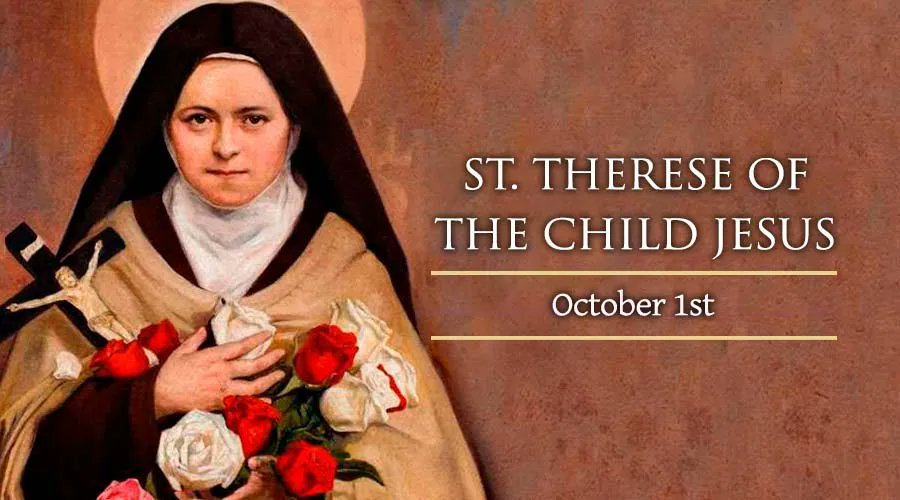
🌷THE LITTLE FLOWER🌷

Saint Therese of the Child Jesus, also known as St. Therese of Lisieux or The Little Flower, lived a life marked by extraordinary faith, simplicity, and love. She was born on January 2, 1873, in Alençon, France, into a devout Catholic family.

Thread 🧵 Image Therese entered a Carmelite monastery at the tender age of 15 and dedicated her life to serving God and others.

Despite her young age, Saint Therese possessed immense spiritual wisdom and a deep desire to give herself completely to God.