Abojani Investment 🇰🇪🇺🇬🇹🇿 Profile picture
Abojani for everyday investor. Empowering retail investors through investor education || Contact us: learning@abojani.com Telegram https://t.co/sK9t9VIeeL
4 subscribers
Mar 5 18 tweets 5 min read
Why SEZs, Why Now? 🧵🧵

The manufacturing sector in Kenya contributes approximately 7-8% of GDP, well below the 15% target envisioned under Kenya Vision 2030. This gap in industrialization, combined with the evolving global supply chains and Africa’s integration under the African Continental Free Trade Area (AfCFTA), has elevated Special Economic Zones (SEZs) from policy tools to strategic economic infrastructure.Image The framework that defines SEZs is governed by the Special Economic Zone Act and regulated by the Special Economic Zones Authority (SEZA). According to @SEZAuthority_ke Annual Report 2024, the authority noted cumulative investment commitments of approximately KES 91 billion across licensed SEZs. While commitments reflect investor confidence, actual capital deployment and operationalization remain the more critical long-term goal.
Mar 5 9 tweets 2 min read
#AbojaniTrueStorySeries

A GENZ WITH A 60K STOCKS PORTFOLIO. 🧵🧵

I started investing, seriously, in my last year of uni. And I saw dust.

It was a business my former classmate and I founded and poured every coin we had gathered in those 4 years at JKUAT selling electronics on commission, after classes. The business died a natural death, after precisely 12 months of making losses and eating into our pockets. So we chose our own sanity. To live to fight another day..... When I first gave employment a chance, my uncle who works in government, organized a pretty decent internship for me. It was a year-long routine of saving money in my bank account, all the while just scouting for investing opportunities. Deep down, I knew the world had a lot to offer me...
Mar 4 15 tweets 4 min read
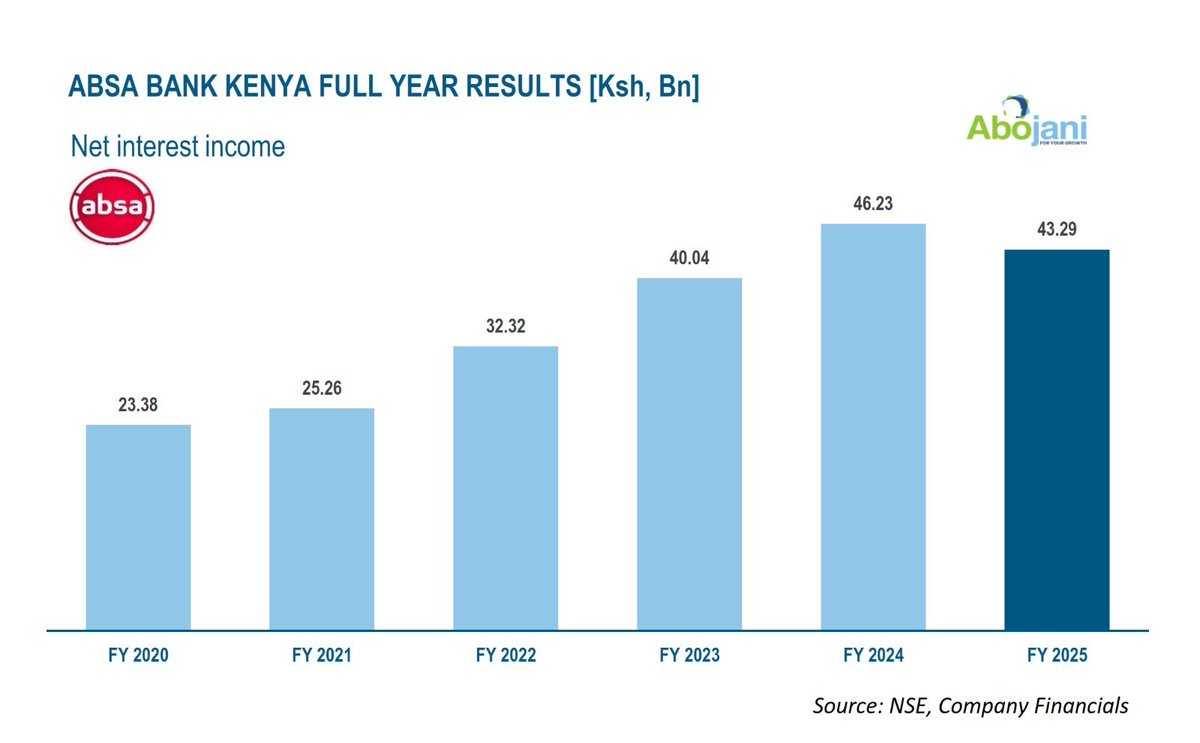
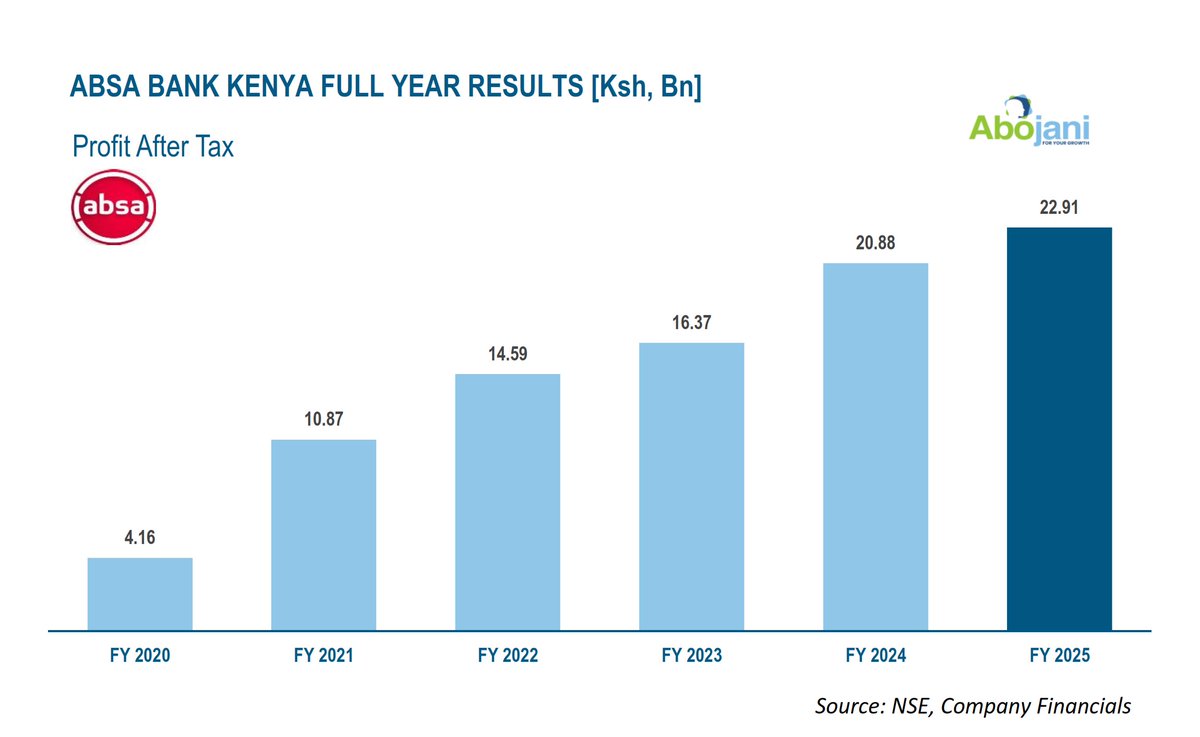
.@AbsaKenya Financial Performance Since 2020 in Charts 🧵

1⃣Profit After Tax

#AbsaFY2025Results Image 2⃣Net Interest Income Image
Feb 23 8 tweets 2 min read
7 HABITS OF PEOPLE WHO ACTUALLY BUILD WEALTH 🧵🧵

Building wealth isn’t about luck, flashy investments, or waiting for a windfall. It’s about the daily habits and choices that steadily grow your financial foundation.

Here are seven practices that set long-term wealth builders apart from everyone else..... 1. Pay Yourself First – Save or Invest 20% of Your Income

One of the most important habits of financially successful people is prioritizing themselves before anyone else. Instead of saving whatever is left at the end of the month, they set aside at least 20% of their income for saving or investing as soon as they are paid. This creates a disciplined approach that ensures your future is being funded, no matter how busy life gets or how tempting spending may be. Over time, this habit compounds into substantial financial security.
>>
Feb 22 5 tweets 2 min read
Retirement is not just about stepping away from work, it’s about ensuring that the life you’ve built can continue without the monthly paycheck. Planning for it requires more than just saving; it calls for foresight.

1️⃣ First, think about time. How many years do you realistically have before retirement, and how many years will you need to sustain yourself after? Longevity is increasing, which means your money must work longer than ever. 2️⃣ Second, factor in lifestyle. Retirement doesn’t automatically shrink your expenses. In fact, medical costs often rise with age, and leisure spending can too if you plan to travel or pursue hobbies. A clear view of the life you want helps define the resources required. Image
Feb 19 4 tweets 2 min read
#TBT

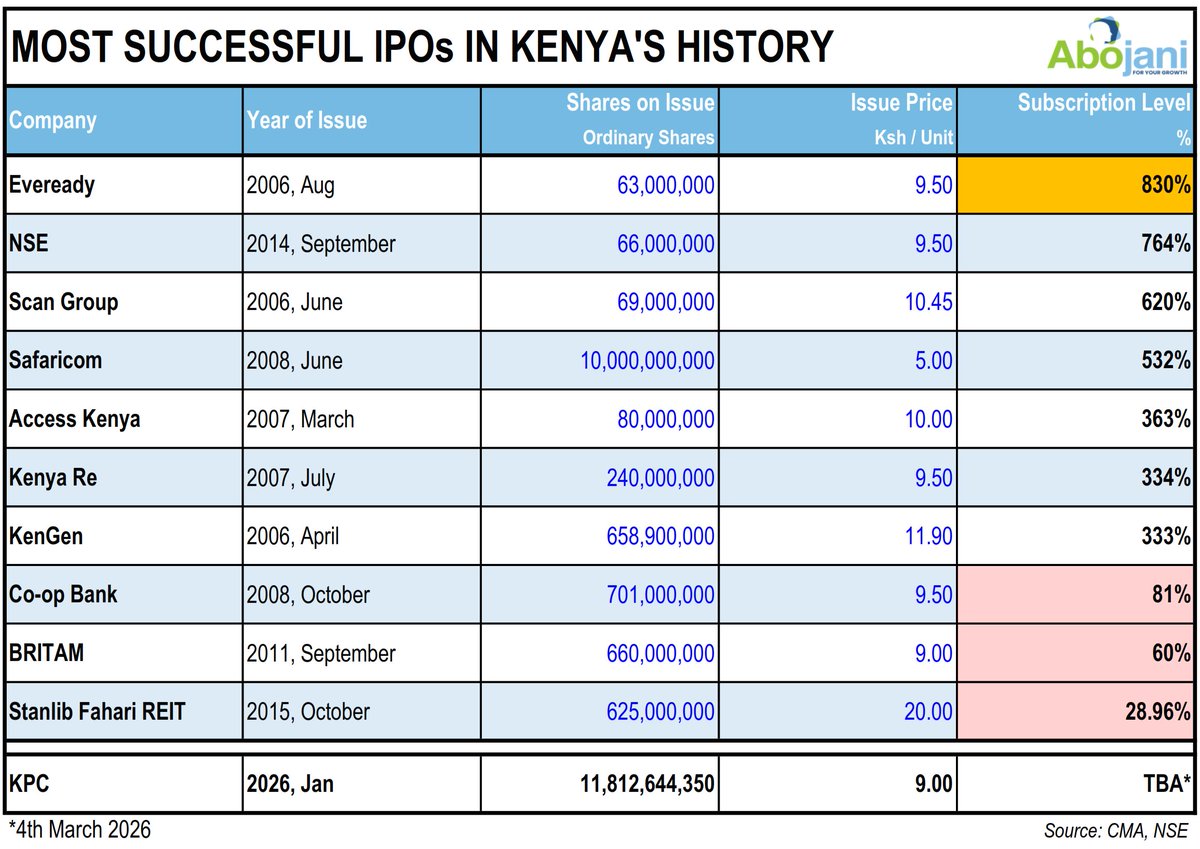
In August 1602, the Dutch East India Company (VOC) made history by launching the world’s first public offering (IPO).

The VOC aimed to raise 6.5 million guilders (equivalent to hundreds of millions of dollars today)

The IPO attracted 1,143 investors, ranging from wealthy merchants to ordinary citizens in the Dutch Republic.

That single decision in 1602 gave birth to the modern stock market.Image Back home, Kenya Commercial Bank was the first company to issue an IPO in Kenya, listing at Sh20.00 in 1988 at the Nairobi Securities Exchange.
Since then, several companies went public in the years that followed:

National Bank of Kenya (1994) at Sh10.00, Kenya Airways (1996) at Sh11.25, KenGen (April 2006) at Sh11.90, Scan Group (July 2006) at Sh10.45, Eveready (Aug 2006) at Sh9.50, Access Kenya (March 2007) at Sh10.00 and Kenya Re (July 2007) at Sh9.50.Image
Feb 18 8 tweets 4 min read
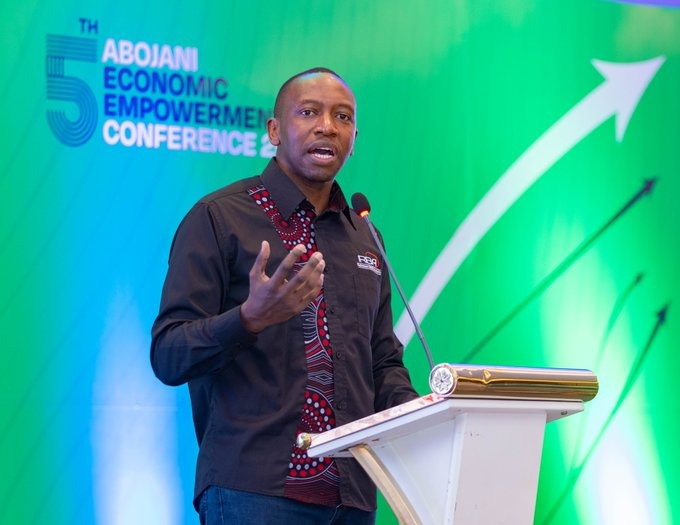
RETIREMENT PLANNING 101: Insights from John Keah of Retirement Benefits Authority.

After decades of working hard, many Kenyans retire with only Ksh 3 million that they expect to sustain them post age 60. Yet, many retirees live even upto 80s and 90s. That’s another 30 years. It is not shocking then, that over 80% of retirees still seek employment for survival.

The math is just not mathing!

Key insights on Retirement landscape in Kenya, by John Keah, Deputy Director, Market Conduct & Industry Development at @RBAKenyaImage The retirement industry in Kenya is regulated by the Retirement Benefits Authority which just celebrated its Silver Jubilee in 2025.
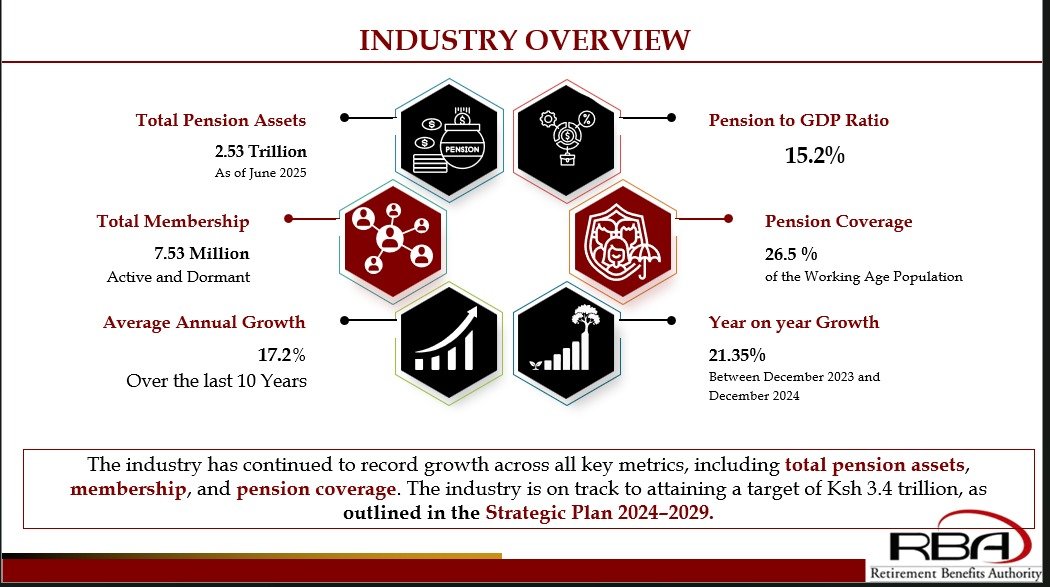
Overall, the RBA total assets under management stands at Ksh 2.5 Trillion with a total membership of only 7.5 million Kenyans, out of the about 30 million working population.Image
Feb 17 7 tweets 3 min read
TOP 10 MONEY MISTAKES PEOPLE MAKE IN THEIR 30s.... 🧵🧵

The 30s are economically decisive years.

For most people, this is the first decade where three forces converge: Income stabilizes or meaningfully increases, Responsibilities expand and Social expectations intensify.

Unlike your 20s, where experimentation is expected and mistakes are often forgiven, your 30s are structurally different.

In your 20s, you can attribute financial instability to background, lack of exposure, or early career limitations. But in your 30s, you begin to become the background.
>> Your habits now don’t just affect you. They affect your household, your parents, and potentially the next generation.

This is why mistakes in your 30s compound more severely than mistakes in your 20s.

Below are ten recurring financial errors that define whether this decade builds wealth or quietly erodes it.
>>
Feb 17 8 tweets 3 min read
THE 3 MOST IMPORTANT FUNDS EVERY INVESTOR SHOULD KNOW ABOUT

Most discussions about investing focus on returns, which stock to buy, which fund is outperforming, which asset class will rally next.

Very few discussions focus on liquidity structure.

Yet in practice, most investors fail because they lacked the financial structure to withstand normal life events.

Before building an investment portfolio, every serious investor should establish three distinct funds:
>>> 1⃣The Emergency Fund

An emergency fund is capital reserved strictly for unpredictable, high-impact events, including, Job loss or delayed salary, Medical emergencies, Sudden family obligations, Urgent repairs (vehicle, home), Temporary income disruption for business owners

The purpose here is capital preservation and psychological stability. When an investor lacks an emergency fund, the consequences are predictable. Long-term investments are liquidated prematurely, assets are sold during market downturns, SACCO deposits are broken, High-interest short-term debt is taken on and finally, compounding is interrupted.

In essence, the absence of an emergency fund forces the investor to convert long-term capital into short-term survival liquidity. And we all know that that destroys wealth.
>>
Feb 17 11 tweets 4 min read
UNDERSTANDING HOW PIPELINE COMPANIES ARE VALUED.....🧵🧵

Valuing pipeline companies falls under midstream valuation, a specialized area of infrastructure finance. Since pipelines are capital-intensive, long-life assets with relatively stable and regulated cash flows,analysts typically use three broad valuation approaches:Image 1⃣Income Approach

The income approach treats a pipeline as an asset that generates predictable cash flows over a long period (often 20–50 years). Analysts project future cash flows and discount them back to today using a required rate of return. This is commonly done using Discounted Cash Flow (DCF) analysis.
>>
Feb 5 6 tweets 2 min read
Stocks 101 🧵

For wealth creation, the best asset class arguably is stocks.

Consider this…

An investor who bought 30,000 $NSE shares (worth Sh180,000) last year walked away with about Sh427,500 in profit.

Share price:

31st Dec 2024: Sh6.00

31st Dec 2025: Sh20.25

Capital gain: Sh14.25

Impressive, right?

Clearly, investing in the right stocks can multiply your money, but to understand how, we first need to know what a share really is.

>> A share, in simple language, is just part ownership in a business. In modern language, it is used interchangeably with the word stock. So when we talk about NSE, Safaricom, or KCB, these are examples of businesses where you can be a part-owner by buying a share.
Feb 4 4 tweets 2 min read
5 Things You Don't Need to Be an Investor

1. You don't need a lot of money

With less than Sh100, you can invest in stocks

With Sh100, you can invest in MMFs

With 1k, you can invest in a bond fund

With less than 5k, you can save in a SACCO

With 50k, you can invest in T-Bills or bonds 2. You don't need a master’s degree in finance

You don’t need to understand complex financial models to start investing.

3. You don't need a license or certification
Jan 31 5 tweets 1 min read
Investing in stocks offers several advantages, especially for anyone thinking long term about growing their money.

1️⃣ Potential for higher growth
Stocks give your money the opportunity to grow faster than traditional saving or fixed-income options. Over time, well-performing companies can significantly increase the value of your investment.

1/5
2️⃣ A hedge against inflation
As prices rise, cash loses value. Stocks, especially those of strong businesses, tend to grow alongside the economy, helping protect your purchasing power.

2/5
Jan 29 12 tweets 4 min read
MODEL BUDGET SERIES....🧵🧵

70K Net Salary, Single Man in His Late 20s, No Kids.

There is a stage in life where money is not yet abundant, but time, energy, and potential are. Your late 20s sit squarely in that stage. You may not be earning millions yet, but the financial decisions you make now quietly determine whether your 30s feel constrained or full of options.

Here's how to manage a 70K Net salary...... From a Ksh 70,000 net salary and using the 50/30/20 budgeting rule, roughly half goes to necessities, 30% to lifestyle and personal enjoyment, and 20% to savings and investments. That 20% works out to Ksh 14,000 per month, and it is the most important part of this entire plan.

Many people rush to talk about investments without first acknowledging that you cannot invest confidently if one emergency can wipe you out. That is why the starting point here is cash‑like safety.
>>
Jan 15 8 tweets 4 min read
5 REASONS YOU SHOULD SERIOUSLY CONSIDER JOINING A SACCO THIS YEAR...🧵🧵

If you are just starting to take money seriously, chances are a SACCO is not the first place you think of. Most people associate SACCOs with parents, teachers, or those long-established institutions that feel a bit old-school.

But for millions of Kenyans, a SACCO is where real financial stability actually begins.

Below are five reasons why joining a SACCO this year might be one of the most practical financial decisions you make......Image 1. Your Money Works Harder Than It Does in a Bank

One of the biggest myths beginners carry is that all “safe” savings earn roughly the same. They don’t.

SACCOs are member-owned, meaning they don’t exist to maximize profits for external shareholders. They exist to benefit you, the member. That single difference changes everything.

At the end of every financial year, SACCOs distribute profits back to members through dividends and rebates. This is your share of the surplus you helped create. On top of that, SACCOs enjoy a tax advantage. In Kenya, dividends paid by SACCOs are subject to only 5% withholding tax, compared to 15% on interest from MMFs for example. Over time, that difference compounds quietly but powerfully.

For a beginner investor, this means you keep more of what your money earns.
Jan 6 11 tweets 3 min read
10 LESSONS NAIROBI WILL SOMEHOW TEACH YOU....🧵🧵

Nairobi is not a city you simply live in. It schools you. It humbles you. It invoices you for lessons you didn’t ask for.

You can come here hopeful, talented, educated, even prayerful and still get shocked by how fast the city strips you of naïveté. Nairobi does not care about your intentions. Only your positioning.....Image 1⃣ No One Cares About You

Not about your degree. Not about how hard you’re trying. Not about your potential. In Nairobi, everyone is busy surviving their own chaos. Miss rent? The landlord doesn’t care. Late on a deadline? The client doesn’t care. Burnt out? The city keeps moving.
It's a city of congested dreams, needs, ambitions, and pressure.

The sooner you learn to self-motivate without applause, the faster you grow.
Nov 27, 2025 8 tweets 5 min read
CORPORATE BONDS 1O1🧵🧵
A case study of Safaricom Medium Term Note.

Kenya’s investment landscape is changing quietly but powerfully.

For years, retail investors have leaned heavily toward money markets and infrastructure bonds since they are safe, familiar, even predictable.

But something interesting is happening, corporate bonds are slowly returning to the conversation, and Safaricom just became the newest signal that this market deserves another look.....Image What is a corporate Bond??

The textbook definition of a corporate bond says it is a fixed income instrument issued by a company in order to raise capital.

In simple terms, it is simply a loan from the public to a company.

✔️ You lend your money
✔️ The company pays you interest (a coupon)
✔️ You get your principal back at maturity
✔️ The bond is tradable on the NSE

Government bonds operate the same way. The only difference here is, you’re lending to a company, not the State.Image
Nov 19, 2025 6 tweets 2 min read
When choosing assets for retirement, it's crucial to consider several factors to ensure that your investment strategy aligns with your financial goals and needs.

Here are four key factors to keep in mind:👇 1⃣Risk Tolerance:
Assessing your risk tolerance is essential to determine how comfortable you are with the possibility of losing money on your investments.

Generally, younger investors may have a higher risk tolerance as they have more time to recover from market downturns, while those nearing retirement may prefer more conservative investments to protect their savings.
Nov 19, 2025 4 tweets 1 min read
Ages 40–50: The Pivot Years.🧵🧵

By the time you hit your forties, the noise settles. You are no longer competing, rushing, or trying to impress. Your financial choices slow down, not because you lack ambition, but because you understand that life is a long-term game.

These are the years you begin to pivot from consuming to preserving... Your children might be teenagers.

Your parents might need more care. Your career might be at its peak or starting to bend into something softer... consultancy, leadership, mentorship. Planning now means balancing three generations without losing yourself in the process.
Nov 19, 2025 6 tweets 2 min read
Each decade in your life presents unique opportunities and challenges….🧵🧵

✅Your 20s = Time to Lay the Foundation
Time to invest in education, gain valuable skills and experience, and explore different career paths. Focus on building a solid resume, networking, and finding mentors who can guide you along the way. Establishing good financial habits such as budgeting, saving, and investing early on will set you up for long-term success... ✅Your 30s = Time to Grow and Expand
As you enter your 30s, it's time to grow and expand upon the foundation you've built in your 20s. This may involve advancing in your career, pursuing higher education or professional certifications, and taking on more responsibilities.
It's also a time to focus on growing your income, building wealth through investments, and possibly starting a family. Balancing career aspirations with personal and financial goals becomes increasingly important during this decade.
Nov 19, 2025 6 tweets 2 min read
Don’t be asset-rich and cash-poor 🧵

A couple in their 50s wants to send their son abroad to study Business Management at the University of Toronto.

The first-year tuition alone is $61,720 (KES 7.96M)

They’ve worked hard all their lives and have what most people would consider wealth, but all of it is tied up in real estate.

When it’s time to pay, they only have two difficult options:

1) They could sell their entire property, but...

Selling takes time

There are transaction costs

Capital gains tax eats into the proceeds

And worst of all, because they’re under pressure, they may end up selling at a throw-away price.Image 2) They can borrow using the property as collateral.

It solves the cash problem quickly but...

Interest payments begin immediately

Their debt burden rises in their 50s

They are exposed to market-rate fluctuations

It introduces financial stress at an age where stability matters mostImage