Thomas F. Varley Profile picture
Dual PhD: Complex Systems & Neuroscience. Postdoc @ the University of Vermont. Writes at: https://t.co/AIpNhy7Jef. Connoisseur of collapse phenomena.
Jun 9 9 tweets 3 min read
New paper with @DoctorJosh @drmichaellevin and co-first author @pai_vaibhav! If you're interested in emergence, multicellularity, and information processing in living systems, this one is for you. (Link below). 1/N Image We have previously established that, despite their non-neural nature, Xenobots display sophisticated and non-trivial patterns of "information processing": information is stored, transferred, and integrated across cellular networks. 2/N Image
Nov 29, 2024 9 tweets 2 min read
This paper systematically fails to fully represent the large and growing prior literature on post-viral conditions, and in doing so, presents a grossly skewed picture of the current knowledge around disorders like Long COVID and ME/CFS.

It should not have passed peer review. For example, consider this section, which presents its claims as straightforward fact (with only two citations).
They utterly fail to give any indication that this is not actually universally agreed upon. No conflicting perspectives are given space. Image
Sep 4, 2024 7 tweets 2 min read
I was going to present this Lightning Talk at the Stanford ME/CFS research meeting tomorrow, but due to a last minute shake-up, I won't be able to.

So I'll present it here. @RenegadeRes
Credit to @tessfalor for slide template. 1/n Image This is the first time this data is seeing the light of day - it was created from 27 people w/ ME/CFS/Long COVID who have been tracking their symptoms, medications, sleep, mood, and more, every day, for months.
8000 days and 3113 unique symptoms over 27 people. 2/n
Jun 27, 2024 30 tweets 7 min read
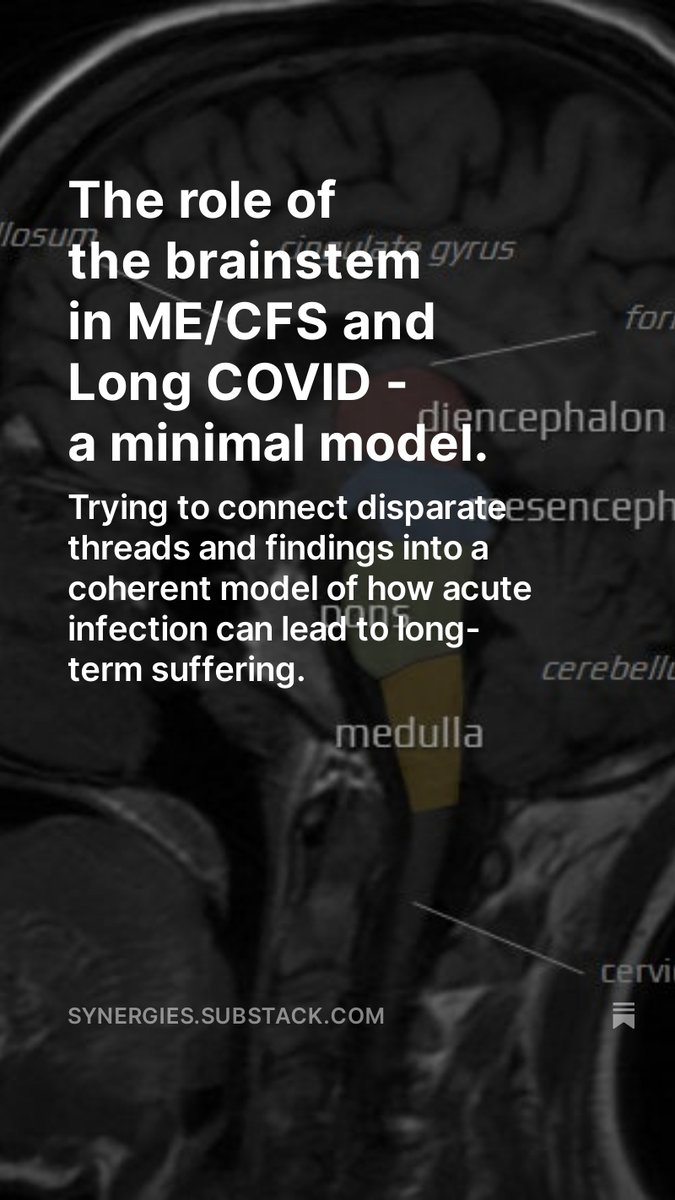
New blog post! What is the role of the brainstem in #MECFS and #LongCovid?

This is my attempt at a kind of minimal model of the central role that the brainstem plays in ME/CFS - tying together connective tissue, immune function, and patient experiences.

Link is in bio. 1/N Image The central motivator for this is the recognition that ME/CFS involves dysregulation to a ton of different systems: sleep/wake, immune function, energy, autonomic and central nervous systems, etc.

Imo, this suggests that some "central regulator" is implicated. 2/N
Apr 21, 2024 8 tweets 2 min read
Weird thread on logic gates:

We all know and love the XOR gate. Synergy! But here's a weird link to the AND gate.

Let's create a "meta gate" that describes whether we can compute the correct answer for the XOR gate given the inputs... 1/N In our meta-gate f(X0, X1) -> Y, we'll say that X0=0 means that we don't know X0, and if X0=1 then we do know it.

Similarly, Y=1, that means we can solve the gate.

It doesn't matter what the underlying states are. 0 and 1 refer to our knowledge or lack of knowledge.
2/N
Apr 26, 2023 9 tweets 3 min read
New preprint!

This is the last chapter for my PhD dissertation to see the light of day: I wrote it to be an accessible introduction to information theory explicitly written for the aspiring complex systems scientist. 1/n

arxiv.org/abs/2304.12482 During my PhD, I spent a *lot* of time essentially teaching myself information theory (since IU doesn't offer a class on it). One thing I found over and over again was that most treatments were written by (and for) people with backgrounds in: math, CS, or physics...
2/n
Apr 25, 2023 12 tweets 5 min read
Our paper on higher-order information-sharing in fMRI is out in Nature Communications Biology!

"Multivariate information theory uncovers synergistic subsystems of the human cerebral cortex"

W/ co-first author @MariaEPope1, @joshfasky, and @spornslab 1/n

nature.com/articles/s4200… In neuroscience, the functional connectivity network is a backbone of research, but it is limited by only representing pairwise dependencies between brain regions.

Higher-order interactions involving three or more brain regions are difficult to explore. 2/n