finance + economics major at NYU who shares papers from time to time
On a mission to revive the dormant Austrian School
“What would Hayek say?” is my motto
 More specifically, managers are observed to emphasize growth in total assets and sales, instead of purely targeting profit. Also they try to reduce cost and increase efficiency in response to demand falling; under wealth maximization this would be default. They also do things such as, say, buy more expensive computers that are not very conducive to profit maximization.
 We want to create a system of rational economic planning. Or, put more simply, we want to create institutions that can, when given certain information, preferences and knowledge of technological means, use these parameters to produce and allocate scarce goods. If all the information, all relevant preferences and all knowledge of the best means are given, then of course everything becomes easy. Then planning just becomes an optimisation problem.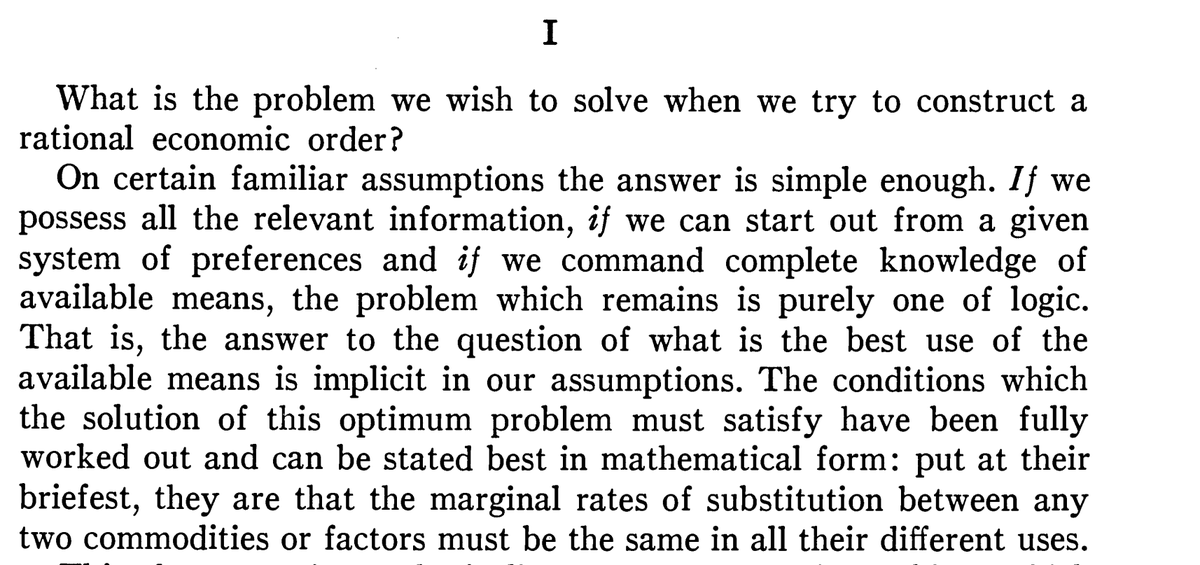
 Alchian proposes a framework where incomplete information and uncertainty in the Knightian sense is included and incorporated. In this framework, we would also not assume profit maximation and predictable behaviour, but this framework does not preclude economists from making prescriptions.


 These reforms were not all too comprehensive and were met with limiting conditions in nearly all aspects. This is because in Castro’s cabinet during this time there were a mixture of technocrats who had studied abroad, hardliners, military officials and loyal officials; Castro sided with the hardliners so it keep them in power and to reform with them more cautiously than needed.
 Organisation is scarcely talked about in economics. This is because in WIlliamson's view, it is much easier to say "organisation matters for economic transactions" than to detail why. Therefore, Williamson's ultimate goal is to apply the conclusions of organisation theory, but from the perspective of contract, and tie it back into the theory of the firm.
 Please note: although I'm pretty decent in Cantonese as it is one of my primary languages (我嘅廣東話一般般啦) I am mostly using Colonial-era Romanisation of certain location names. So don't take offence if you are one of the few people to be offended by that.
 The first is the idea that we can universalise all actions of government into a single "size". We can say that from government doing "X" and "Y" that it is a "big" government or "small" government. This is problematic for the following reasons; suppose that government increases defence funding whilst eliminating subsidies for certain manufacturing industries for the exact same amount. Suppose that government decreases zoning regulations (in the real estate sector) but increases excise duties at the same time.
 The following sections are mostly theoretical and provide for the reader a reason to believe the idea that regulation can be done for special interests, before actual empirical examples are given to bolster such an idea; if you are already well-versed in public choice theory, feel free to skip posts 3-8..)
 (Disclaimer: I am not trying to say life was universally poor or that certain aspects like spirituality did not factor in quality of life. I am merely trying to show how much famine and overall suffering ruined even affluent and privileged imperial societies, and not just in mass disasters like the Black Death or the Potato Famine)...
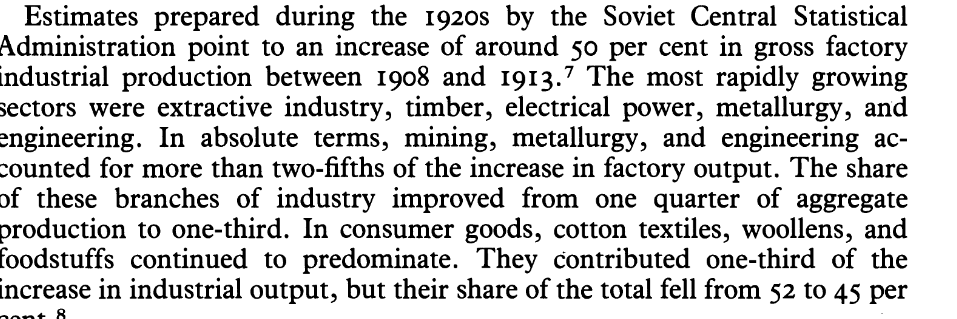
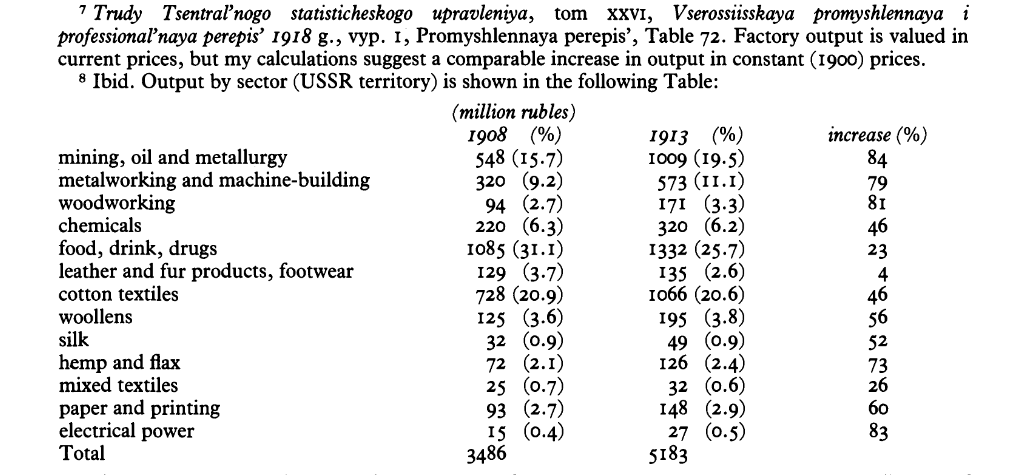
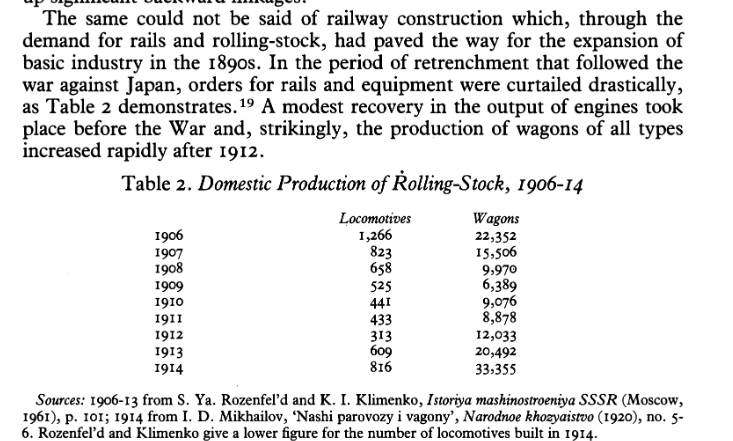
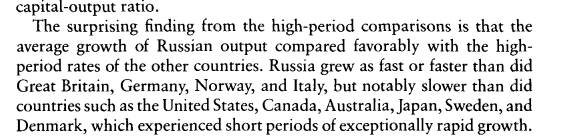
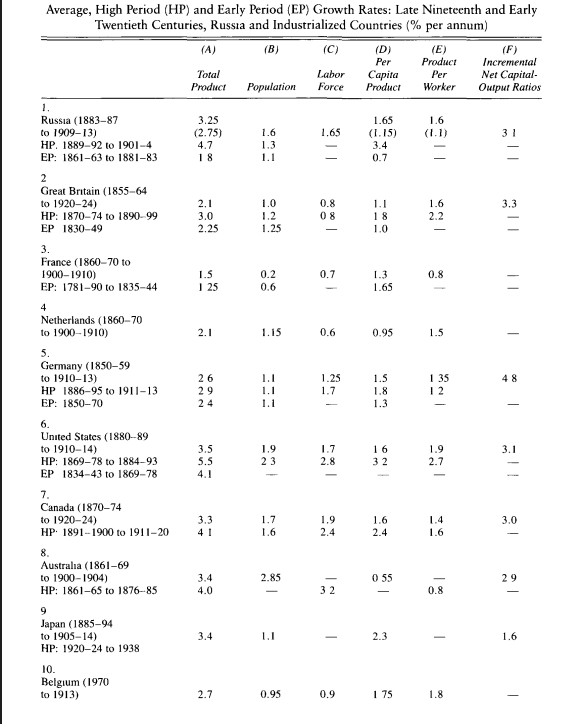
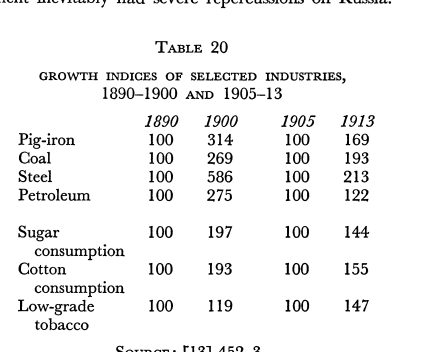 Output-wise Russia began at half the level of the US, 80% the UK and Germany, and only slightly below France. By 1913 output was well above France and comparable to Germany and the UK, and only really lagged behind the US. Overall growth levels were similar to the UK, Germany, Italy, etc. but slower than that of the US, Canada, Scandinavia etc. Per-capita product was comparable to Germany, the United States and Canada whom were mostly in the "late" stages of industrialisation.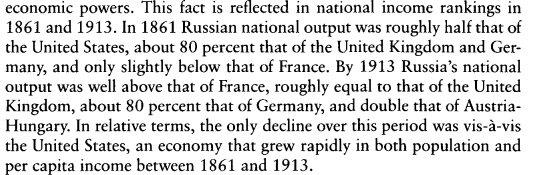


 A&D start with a basic definition of market capitalism: non-governmental control over the means of production. Corporations, households and so on own the goods and decide how they are allocated. They will inevitably seek cooperation and specialisation with other economic actors within this process, (take Adam Smith's famous pin example) which also increases the demand for institutions in which this cooperative specialisation is facilitated.
 Coase begins the paper very clearly: economists have failed to state and rationalise their assumptions.