Bearly AI Profile picture
Privacy-first AI research tool with access to ChatGPT, Grok, Claude, Gemini and DeepSeek in one app. Try it at https://t.co/7C2QxQNem1 (by @pnegahdar and @trungtphan)
Dec 31, 2025 5 tweets 3 min read
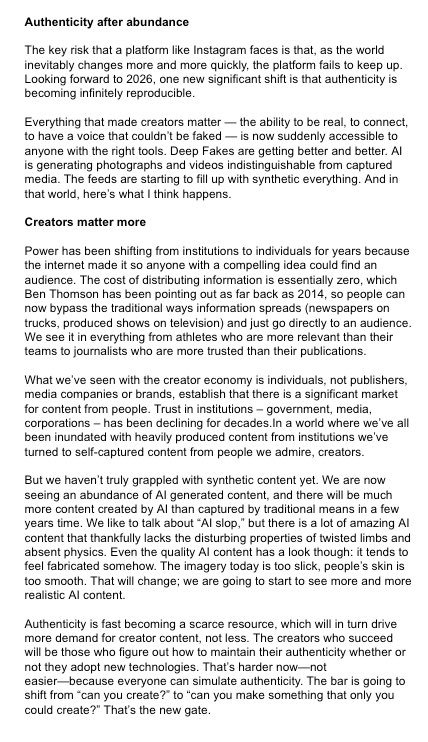
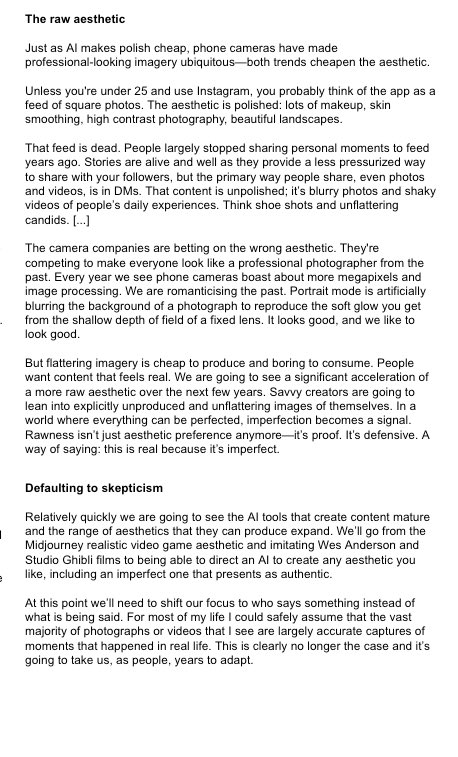
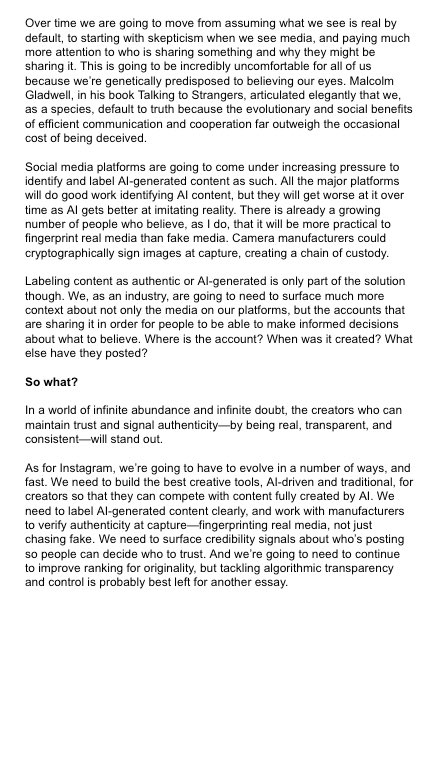
Instagram head Adam Mosseri just wrote 1,240 words on how AI will affect Instagram creators and social media.

Here are 9 takeaways:

1. By 2026, “authenticity” will be infinitely reproducible: deepfakes and AI media will look real.

2. The internet already shifted power from institutions to individuals; creators gained trust as institutions declined.

3. AI will produce far more content than humans capture, including high-quality “synthetic” media that soon feels real.
    
4. As synthetic content floods feeds, true authenticity becomes scarce, increasing demand for trusted creators.

5. The success bar moves from “can you create?” to “can you make something only YOU could make?”

6. Because polish is cheap (AI + phone cameras), a raw, imperfect aesthetic becomes a credibility signal (“proof”).

7. People will shift from assuming media is real to default skepticism, focusing more on who posted and why.

8. Platforms will be pressured to label AI content, but detection will get harder…a better approach may be fingerprinting real media at capture (cryptographic signing).

9. Instagram should evolve with better creator tools, clearer AI labeling, real-media verification, richer account context/credibility signals, and stronger ranking for originality.Image
Image
Image
The invention of the camera in the mid-1800s is a good related story on how new tech lead to the personalization of art.

This article details a throughline from camera to Van Gogh’s “Starry Night”: readtrung.com/p/the-camera-v…

See OP from Mosseri here: threads.com/@mosseri/post/…
Dec 6, 2025 12 tweets 5 min read
In 2010, Time Warner CEO said Netflix ($9B market cap) wasn’t a threat, calling it “the Albanian army”.

In 2025, Warner Bros sold to Netflix ($425B) for $83B.

How‘d NFLX do it? One reason was overpaying for 10x talent as explained in a 2009 Culture deck.

Here are 9 key slides: Image 1/ Netflix competes in media and tech (knowledge work that requires creativity). High-performers in these fields can be 10x better than the average.

In a "procedural" field (manufacturing), the best may only be 2x better (industries that deal with atoms are naturally capped). Image