Brandon Carl Profile picture
Markets, Macro, AI, Tech. Trying to make the world a better place.
Jun 2 21 tweets 8 min read
Documenting the headwinds I now see for AI.

It won't seem like it, but I love AI and am long-term positive. But when "math doesn't math" I take note.

1. The core thesis for foundation model lab investment has been high upfront investment made worthwhile by significant long-term profits.

2. These are capital intensive businesses and the compute commitments are very high relative to revenue and require strong growth over long time periods. The "leverage" (commitments versus revenue) is extremely high.

3. The fundamentals are not as positive as they previously were:
• Input costs are higher (commodities, chips, power)
• Interest rates are higher
• Competition is more intense
• Scaling Laws are now problematic: exponential costs/power cannot continue

4. Forecasting compute spend is challenging and high risk due to (a) revenue uncertainty and (b) algorithm uncertainty

5. Revenue growth appears to be slowing. The technology is valuable, but ROI is proving to be more expensive and take longer than anticipated.

6. The future is likely "different models for different use cases" with the lower end of the market being highly competitive.

7. Core use cases such as agentic software engineering are likely to need approaches beyond next-token prediction. They are Σ₂ᴾ complexity problems requiring multi-objective optimization and likely a combination of Transformers and other methods.

8. Current forecasts in memory makers are built largely on quadratic attention. That will not persist: we are already seeing work from DeepSeek, Minimax and Nvidia that can cut RAM needs by 80% or more.

9. This means semiconductor valuations are substantially overinflated and will go through the traditional glut versus shortage cycle.

10. For foundation model providers: lower costs with competitive differentiation is good. However, lower costs with a lack of differentiation would mean lower revenues. This makes it harder to (a) service commitments and (b) pay back investors.

11. Leverage is substantially higher than in previous cycles, evidenced by leveraged ETFs, call option activity and margin loans. Korea is particularly susceptible.

12. 0DTE options create a profile that has stronger parallels to portfolio insurance and 1987 than any other point I can remember.

13. The combination of exponential increases in call activity coupled with the ties of semiconductors to structured products means there is a non-trivial systemic risk to the financial system.

14. Implied earnings growth rates are inconsistent with other periods in history.

15. Macroeconomically we cannot and should not fund exponential cost increases. History has shown us repeatedly that there are better ways (see Quick Sort and Simplex).

16. Significant supply is hitting the market via IPOs.

––

Taken together: costs and competition are increasing while revenue growth is likely slowing. Valuations are fragile and prone to technology disruptions that are already here. Systemic financial market risk is extremely high. 1. The core thesis for foundation model lab investment has been high upfront investment made worthwhile by significant long-term profits. Image
May 1, 2023 5 tweets 2 min read
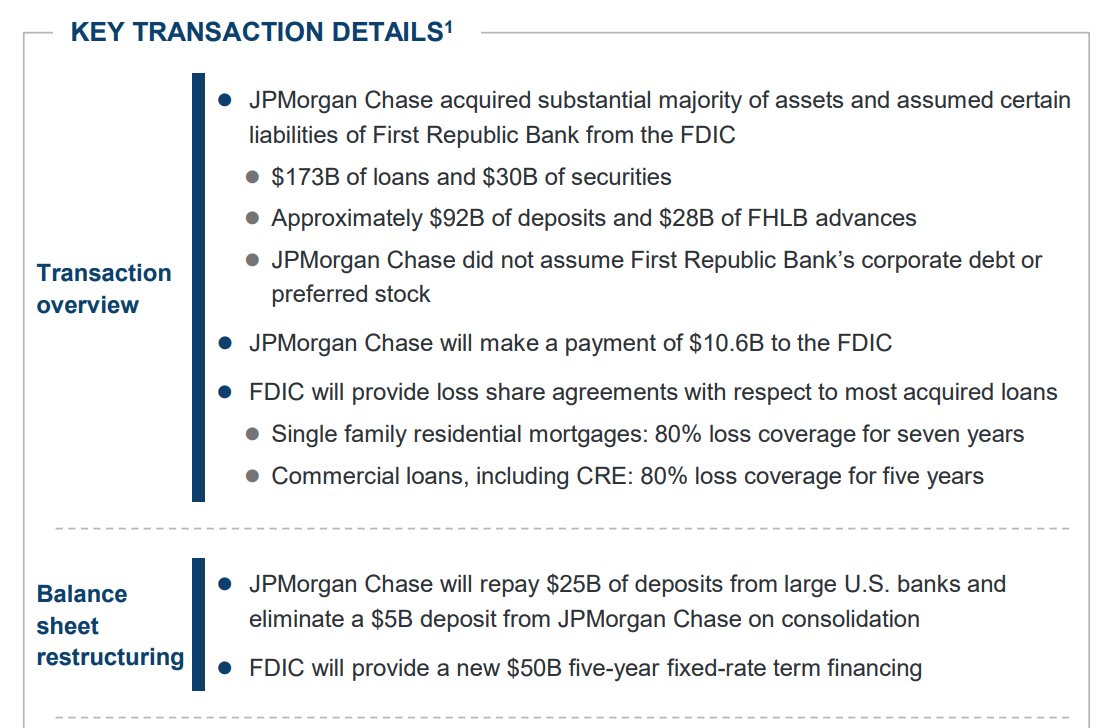
A few very interesting add-ons reading through the investor deck for JPM/FRC.

This deal appears to be a *fascinating* feat of financial engineering.

1/5 Image Feat 1: "Transforming" high risk, high funding to low risk, low funding.
The FDIC loss-share reduces risk-weighting on covered loans to 25% - *far* lower than typical for these assets.

The FDIC is also providing fixed-term financing of $50 billion.

2/5
May 1, 2023 7 tweets 3 min read
Post-mortem on First Republic:
- JPMorgan acquires/assumes all deposits
- Doesn't assume preferred/unsecured notes
- Loss-sharing w/FDIC (details below)
- Est. FDIC loss of $13 billion
- One-time gains of $2.6 billion for JPM

1/7
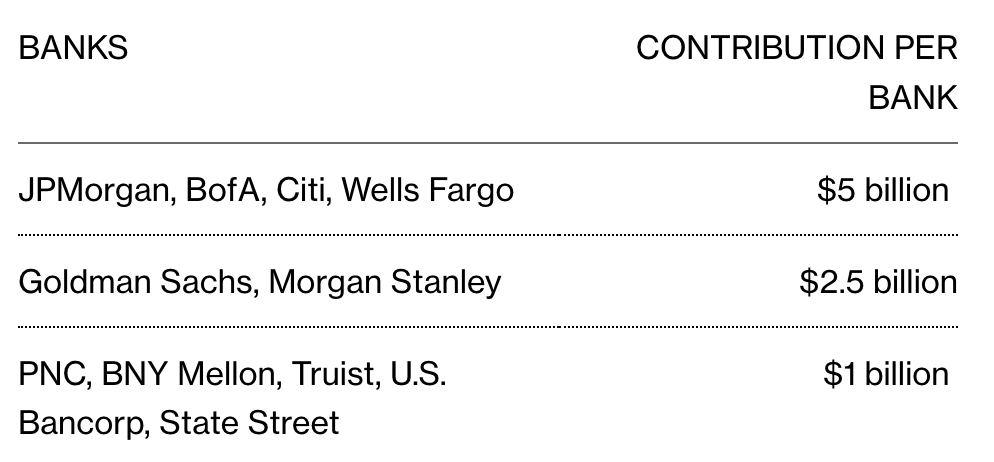
reuters.com/business/finan… Banks do ok, see table below.

Uninsured deposits should be made whole, "which will be repaid post-close or eliminated in consolidation"

Note that deposits had fallen from $104.5 billion to $92 billion over the last week, which likely came from cash/cash equivalents.

2/7 Image
Apr 27, 2023 12 tweets 3 min read
The game theory around First Republic, the FDIC, the banks and the White House is a bit crazy.

When you walk through it, today's announcements from the FDIC and the US Government make sense and may be an attempt to get the banks to recapitalize FRC.

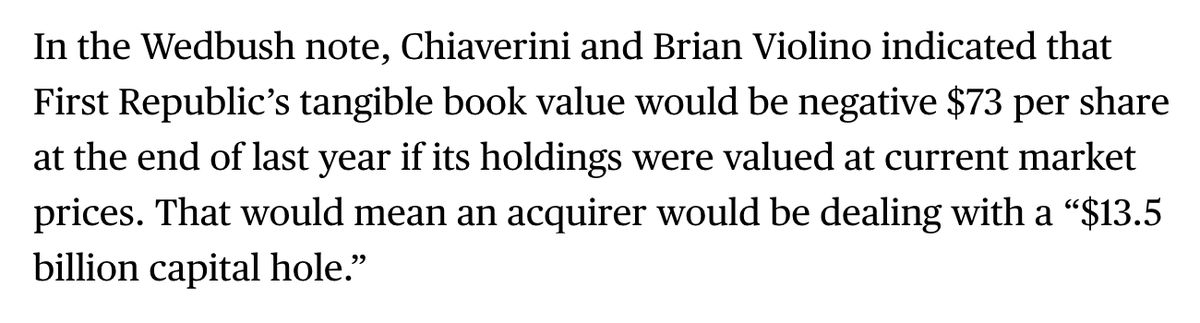
1/12 To begin: Wedbush had estimated that First Republic's tangible book value if marked fully to market would be negative $73/share.

If correct, the $13.5 billion capital hole is what creates an issue for any prospective buyer.

2/12 Image
Apr 25, 2023 15 tweets 6 min read
In this thread, I'll make a case for why the Fed should be done hiking, covering:

1. Importance of transmission mechanisms
2. A surprise reason Arthur Burns failed
3. The shift from fractional banking
4. How the bank runs unclogged policy
5. The danger of hiking more

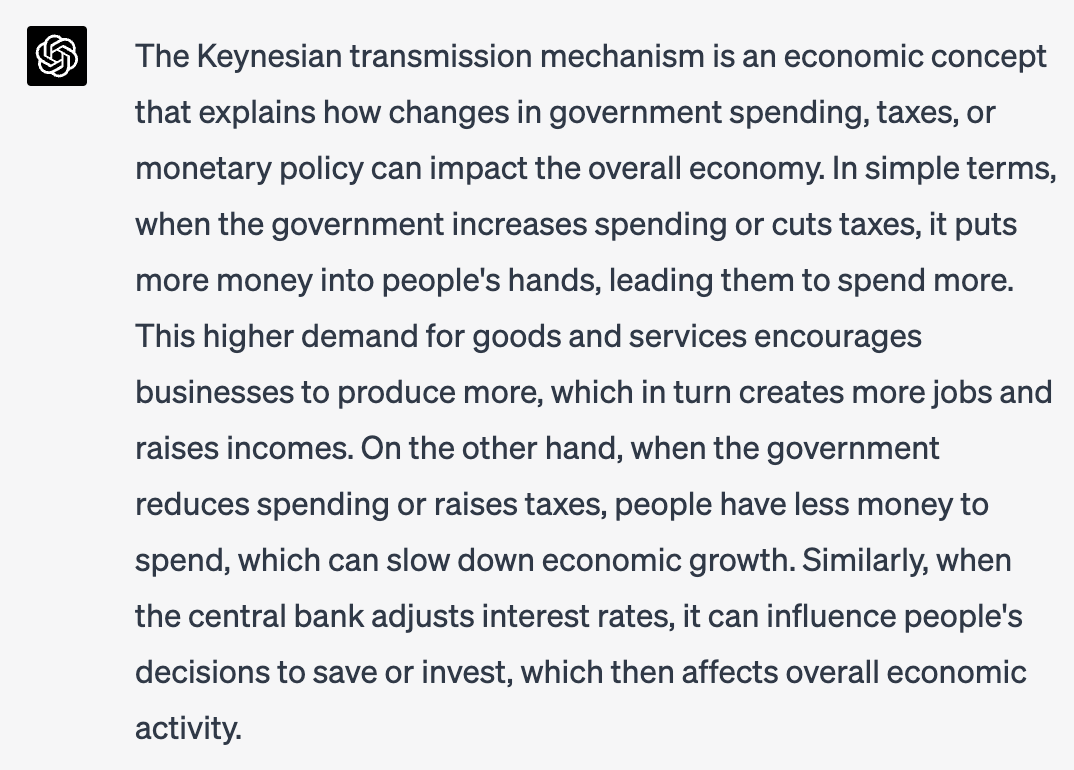
1/14 The transmission mechanism is the manner by which policy impacts the economy.

Think of it as the 1st derivative of inflation (or economic growth) to Fed Funds (dπ/dr).

For higher rates to impact the economy you need:
1. Big enough change
2. Unclogged transmission
3. Time

2/14 Image
Nov 2, 2022 6 tweets 2 min read
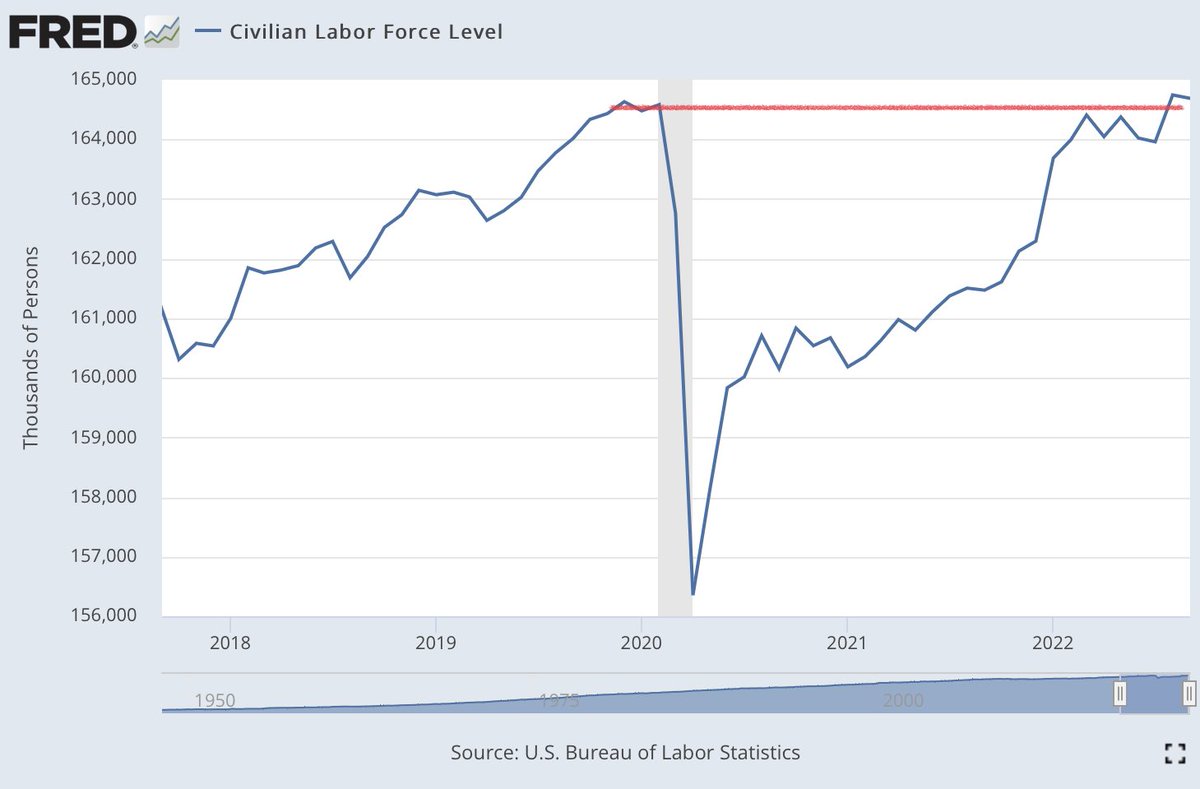
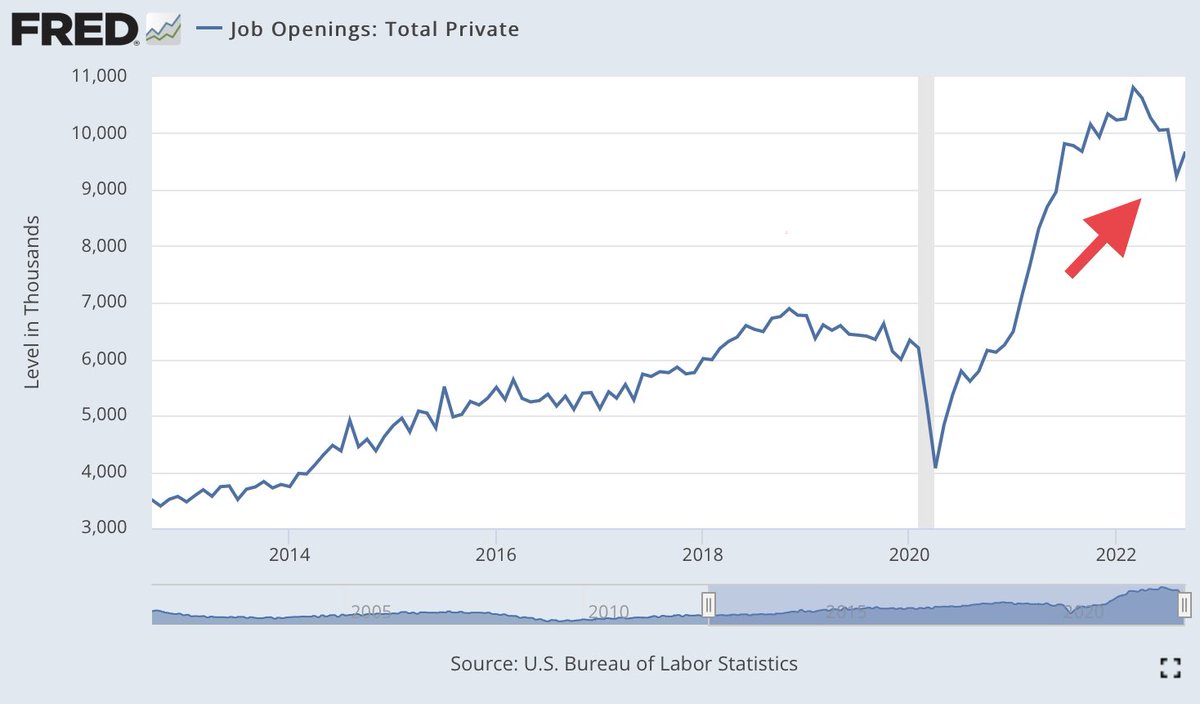
People that are laser focused on JOLTS misunderstand the economic situation. There are structural (vs business cycle) factors at play. Let me outline the specifics of why and what to do.

1. The Labor Force has returned to pre-pandemic levels. Image 2. And yet, in spite of Fed hikes, job openings are near cyclical highs. Demand for workers outstrips supply. Image
Jul 4, 2022 6 tweets 1 min read
People are expecting inflation in the real economy but deflation in the financial economy.

Thus the "real economy" is risking the 1970s while the "financial economy" is risking The Great Depression.

Let's see why and why "shock and awe" hiking fails. The Great Depression was one of the few times that both the money supply + the velocity of money contracted.

The velocity of money declines when fear increases + people anticipate deflation. They hoard cash + decrease borrowing.

This is happening now in the "financial economy".