Ninja Trader Live: Senior Macro Strategist, Cross-Asset Trader 20+ years, Ex-SAC, Ospraie, Graticule and Circle Lane Capital
Oct 29, 2025 • 5 tweets • 2 min read
The Fed’s Policy is Perfect for the Wrong Economy
The Fed isn’t running a neutral policy. It’s running two at once.
Too tight for the bottom half of America, too loose for the top.
And the reason is AI.
Two Economies, One Interest Rate
The lower half of the K-shaped economy—the wage earners, the renters, the credit-card borrowers—live in the real rate world. They feel 7% car loans, 8% mortgages, and $5,000 credit card balances compounding at 25%. Their consumption is slowing, their credit stress is rising, and their labor market is softening.
The upper half—the asset holders, the AI builders, the large-cap corporates—live in the liquidity world. They issue debt at tight spreads, sit on mountains of cash, and borrow to fund $100 billion data center buildouts. For them, rates aren’t restrictive. They’re background noise.
Oct 25, 2025 • 7 tweets • 2 min read
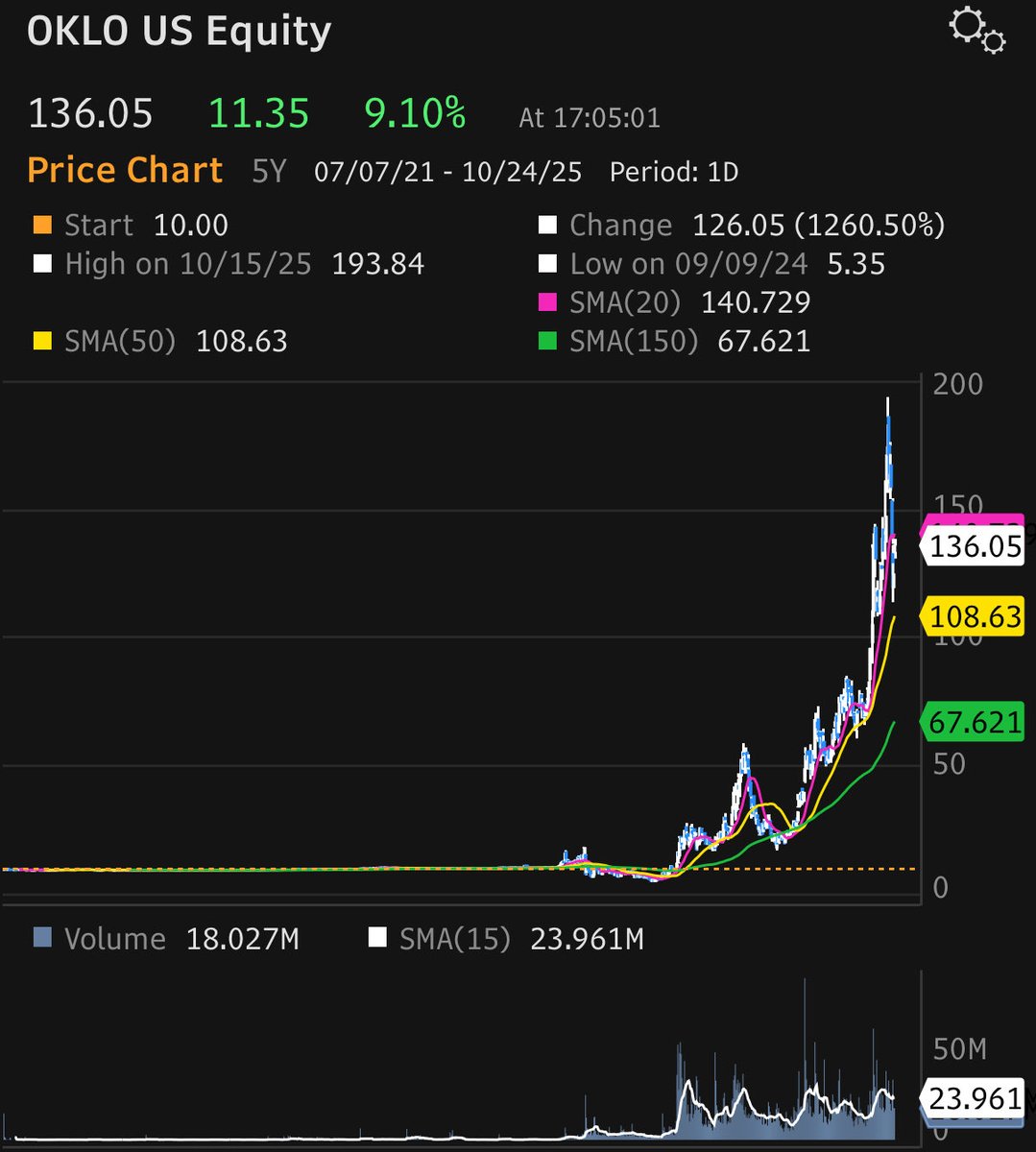
The blow off top patterns and bubbles have been in peripheral AI capex buildout sectors. Nuclear reactors, rare earths, crypto miners, quantum computing, silver, palladium, platinum, uranium. Maybe even gold. All the same chart pattern with classic blow off type structure.
As liquidity recedes, they are all popping together.
H/t @dampedspring
AI Power Infrastructure: OKLO
Sep 30, 2025 • 8 tweets • 2 min read
AI is driving one of the biggest capital cycles in modern history.
$350–400B in annualized capex.
S&P 500 margins at record highs.
Median wages growing <3% while household bills jump double digits.
The paradox is clear.
2/ The Fed is cutting rates to “support” labor.
But easier money accelerates capex into fabs, data centers, and GPUs.
Cheap credit goes to megacaps, not households.
Capital expands. Labor gets displaced.
Sep 15, 2025 • 8 tweets • 2 min read
The United States is in Cold War 2.0.
Not nukes this time—AI, semiconductors, and supply chains.
And here’s the uncomfortable truth: in this fight, Fed independence is a luxury the U.S. cannot afford.
New memo on my Substack 👇
2/ History shows Fed “independence” bends when survival is at stake.
WWII: Treasury pegged yields for nearly a decade.
Vietnam: deficits accommodated, inflation built.
Volcker: independence restored only after pain.
Sep 10, 2025 • 6 tweets • 1 min read
1/ The bond market is flashing a late-cycle warning. After last week’s payroll miss and today's softer than expected PPI release, we’re in the middle of a bull flattener.
2/ What does that mean? Both ends of the curve are rallying, but the long end is moving more. The 2s10s spread has dropped from +65 bps to +50 bps in the last few days.
Crises don’t always begin with recession. They begin when markets stop trusting the referee.
That’s what happened in 1987 — and the setup today looks worse. 🧵
In 1987, the U.S. economy was strong. Growth was solid, unemployment was falling, inflation looked tame.
But the bond market revolted.
The 10-year Treasury ripped from 7% to 10% in months. Equities cracked. Program trading turned it into a crash.
Aug 23, 2025 • 8 tweets • 2 min read
Powell caved at Jackson Hole.
The Fed is preparing to cut in September, prioritizing jobs over inflation.
Markets threw a party: stocks, gold, crypto up; dollar and yields down.
But the credibility risk is real.
🧵
This isn’t 2019’s “mid-cycle adjustment.”
Core PCE is still 2.9% y/y and moving higher.
Powell is easing with inflation above target and employment still very close to maximum.
That looks a lot more like the 1970s than the late 2010s.
Aug 19, 2025 • 11 tweets • 2 min read
America is spending on AI like Rome at its peak.
$155B next year — more than the entire U.S. education budget.
But instead of securing dominance, this AI arms race could set us up for strategic decline. 🧵
The Spending Trap
Wall Street cheers record capex. Washington calls it dominance.
But $400B+ by 2026 risks repeating the Soviet defense race, Japan’s tech bubble, and the dot-com bust: growth by brute force, followed by fragility.
Aug 6, 2025 • 8 tweets • 2 min read
The original thread hit a nerve.
Here’s what I didn’t say — but probably should have:
The 2025 consumer crisis is broader and more dangerous than it looks…
Rent, insurance, food, and utilities aren’t luxuries.
They’re non-negotiables.
And they’ve all reset permanently higher, not temporarily inflated.
Aug 5, 2025 • 10 tweets • 2 min read
The Fed says we’re in a soft landing.
But for millions of Americans, it already feels like a depression.
Not a crash — a slow suffocation.
🧵 Why this consumer squeeze is worse than 2008 or 2001:
This time, there’s no big event — no crash, no panic.
Just a grind:
Rents up 30%
Groceries + utilities up 20–25%
Insurance +40–60%
Credit card APRs above 22%
Costs are up — and nothing’s coming down.
Jul 21, 2025 • 11 tweets • 2 min read
The U.S. dollar built a global empire.
But that empire now feeds on its own people.
🧵 How dollar hegemony hollowed out America — and why the system is quietly collapsing:
The dollar gave the U.S. an unmatched privilege:
Borrow without limit
Fight wars without sacrifice
Consume more than it produces
Inflate assets for the rich
It worked brilliantly — until it didn’t.
Jul 18, 2025 • 13 tweets • 2 min read
Trump wants lower interest rates for a lot of reasons including to support the housing market which he reiterated this morning.
But will this actually happen if the Fed cuts ?
The short answer is NO
We tried to make housing more affordable.
What we created instead was a speculative vault, inflated by Fed policy and frozen by scarcity.
Here’s how the American Dream turned into a financial trap:
1/ 🏠 The biggest irony in American economic policy?
The more we tried to make housing affordable, the more unaffordable it became.
A thread on how the Fed, tax code, and decades of “ownership-at-all-costs” policy created a speculative trap:
Jul 15, 2025 • 12 tweets • 2 min read
1/ It looks like China just won this round of the trade war.
They withheld rare earth exports, and now they’re getting NVIDIA chips again.
In return, the U.S. is easing tech export restrictions.
Let’s dive into the backchannel deals making this swap possible.
2/ 📍 Geneva, May 2025: A symbolic tariff truce.
The U.S. agreed to pause new tariffs and lower existing levies.
China committed to resuming rare earth export licenses.
But implementation stalled as China slow-walked paperwork and the U.S. tightened chip controls.
Jul 10, 2025 • 16 tweets • 2 min read
🧵 THREAD: The economy is booming but most Americans don’t feel it. Why? Because we’ve built a system that’s strong on paper, but hollow at its core. This is the K-shaped economy: a structure that works for fewer people, even as markets soar. A deep dive
1. On the surface, things look great:
•Stocks at all-time highs
•Unemployment near record lows
•Corporate profits surging
But look closer: Wages are stagnant. Housing is unaffordable. White-collar layoffs are rising.
Jul 7, 2025 • 11 tweets • 2 min read
Trump isn’t fighting inflation with traditional tools.
He’s managing it like a boss running a protection racket.
Welcome to the Boss Economy: a world where prices are controlled by fear, favor, and direct intervention from the top. 🧵
2/ Inflation is the linchpin of MAGA 2.0.
Trump won in 2024 because people felt crushed by prices and he promised to fix it with strength.
If inflation returns, the illusion shatters. His mandate collapses.
Jul 5, 2025 • 11 tweets • 2 min read
Earlier this week there was discussion on FinTwit about how great of a Fed Chair Jerome Powell has been.
I would like to respectfully and wholeheartedly disagree.
The Powell Fed has proven that it no longer serves the public.
It has stopped fighting inflation, deepened inequality, and quietly handed monetary control back to the U.S. Treasury — all without saying a word.
That’s what Powell’s Fed has done.
A thread 🧵
2/ Under Jerome Powell, the Fed has adopted an unofficial third mandate:
Inflation targeting and full employment now come second — or not at all.
Jul 3, 2025 • 12 tweets • 2 min read
🧵 The Great Transfer:
Bitcoin isn’t just an asset. It’s about to absorb trillions in monetary premium from U.S. housing.
Why? Because homes aren’t acting like shelter anymore. They’re acting like vaults—and bad ones. Here’s how it ends 🧵
2/ For decades, Americans used homes as their default savings vehicle.
🚨 The Trump–Bessent team is preparing a yield curve control regime without saying the words.
No coordination.
No inflation anchor.
Just bill issuance + Fed pressure + threats to producers.
This is Activist Treasury 2.0 — and it’s dangerous.
🧵
2/ The strategy under consideration:
– Starve the long end of Treasury supply
– Flood the short end with T-bills
– Pressure the Fed to cut
– Yell at companies not to raise prices
No spending. No hikes. Just optics.
It worked in 1971… until it didn’t.
Jun 29, 2025 • 10 tweets • 2 min read
I put together a long form post this morning on housing this morning on my substack (link in bio)
Here are the highlights
🏡 The housing market isn’t just broken — it’s rigged.
It’s time we talk about the most over-subsidized, under-scrutinized asset class in America.
Here’s why the Great Housing Reset is coming — and why it’ll be good for the country. 🧵
2/ For decades, America has treated housing not as shelter — but as a get-rich-slow scheme.
📈 Since 2000:
• Home prices ↑ 170%
• CPI ↑ 67%
• Median incomes ↑ ~70%
That 100-point gap? It’s the monetary premium — and it’s policy-driven.