Cole McFaul Profile picture
China S&T + Asia-Pacific tech competition | Research Analyst @CSETGeorgetown & Non-resident Fellow @ACGlobalChina | 陈华中
Apr 20 13 tweets 4 min read
NEW @CSETGeorgetown + @emergingtechobs piece!

Does China's access to US semiconductor technology help the PLA develop and deploy military AI?

After 3 years reading thousands of PLA procurement docs, @sambresnick and I say yes.

Here’s how, and why it matters:

🧵/13 Image In the piece, we identify two mechanisms through which US compute can enable the PLA’s adoption of AI systems:

1. The PLA is procuring AI models trained on U.S. compute or distilled from U.S. models.
2. The PLA is acquiring advanced U.S. chips.

As @HouseForeignGOP and @HouseForeign debate 20 measures related to restrictions on China’s ability to access US compute and AI tech on Wednesday, we offer three key takeaways for US policymakers from our research:

1. Greater access to advanced U.S. compute will likely strengthen China’s military AI capabilities.
2. The PLA will benefit from advances in China’s civilian technology sector, including in AI.
3. The PLA’s adoption of advanced AI capabilities may be used to undermine U.S. military advantages.

2/13
Oct 30, 2025 13 tweets 3 min read
Looks like Trump is considering allowing exports of advanced semis to China.

Nvidia argues that its chips won’t enable PRC military modernization. So @SamBresnick and I dug through hundreds of PLA procurement documents yesterday.

We find evidence of the opposite. 🧵 Image There are three stages in China’s military modernization:

Mechanization → Informatization → Intelligentization

Intelligentization refers to the embedding of AI-enabled technologies within military system. Beijing thinks this could shift US-PRC power dynamics.
2/12
Sep 3, 2025 19 tweets 7 min read
🚨 NEW REPORT! 🚨

After 2 (!!) years working on a new dataset of thousands of PLA contracts, I’m very excited to share a new report, featured in today’s @WSJ!

We ask: Who are the PLA’s AI suppliers?

The answer: an unexpected, emerging class of firms and universities.
🧵/15 Image
Image
Historically, China’s defense sector has been unwieldy and technologically lagging.
Beijing’s MCF strategy addresses this, channeling civilian sector progress into military capabilities

The results are on display today! But we wanted a closer look⬇️
1/15
May 27, 2025 43 tweets 14 min read
The White House just paused ALL visa interviews for foreign students.

A disaster for longterm US competitiveness in emerging techs.

Five months in, and the damage is adding up. A detailed account of the disruptions to US science, by month. 🧵
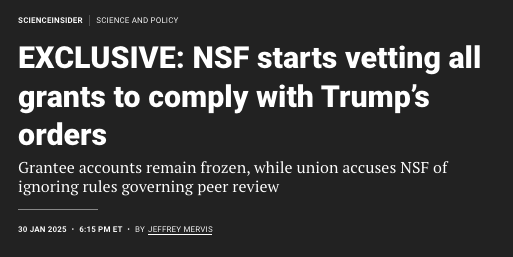
/40 In January, the Trump administration froze all new and ongoing National Science Foundation grant payments nationwide. The agency began compliance reviews while researchers scrambled for interim funding.
1/40 Image
Apr 1, 2025 25 tweets 9 min read
The US basic R&D ecosystem is our top advantage in sustained US-PRC tech competition. And Xi agrees!

Xi Jinping just published his thoughts on S&T in Qiushi.

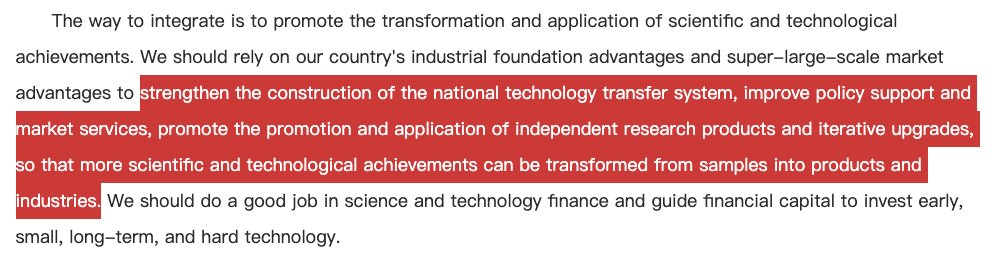
He sees US strengths in 'original innovation' as a critical vulnerability. Here's why, from Xi’s point of view 🧵 Image What are Xi’s worries?
1⃣ China lacks top-tier STEM talent
2⃣ Weakness in “original innovation”
3⃣ China can’t commercialize nor diffuse tech effectively
2/25 Image
Image
Jan 29, 2025 14 tweets 4 min read
My main takeaway from all the DeepSeek discourse is that it’s too early for most takeaways.

That said, I think DeepSeek compels us to think harder about AI adoption, not just model capabilities. Some thoughts below (and yes, the cost comparison below is hyperbolic) 🧵[1/14] Image
Image
First, what DeepSeek has done is impressive. Many threads on this already. Yes, they have access to significant compute, but their CEO has previously cited export controls as a significant obstacle – I take him at face value (per @jordanschnyc in Nov). (2/14) Image