Social & Economic Justice | Migration | ESG | Where rights, mobility, and accountability converge
May 5 • 19 tweets • 11 min read
TEASER
THREAD: SCANDALS SERIES VIII: THE DRC – WHEN ZIMBABWE EXPORTED ITS LOOTING MODEL ABROAD, BUILT A CORPORATE EMPIRE ON SOLDIERS' LIVES, AND THE UN NAMED NAMES
In August 1998, Zimbabwe sent its army to the Democratic Republic of Congo.
What it sent was remarkable.
A professional fighting force, SAS, Commandos, Paras, combined arms units, BAE Hawks and Hawker Hunters that military analysts described as the most capable in the region. They held Kinshasa when rebel columns were at the city's gates. They recaptured the Inga Dam and restored electricity to the Congolese capital. They did their job with distinction.
While they were doing it, their commanders were doing something else.
Today at 3PM, we thread the complete picture of what Zimbabwe's generals built in the DRC: the corporate vehicles, the mineral concessions, the cash flights from London to Kinshasa, the cobalt stockpiled in South Africa, the 33 million hectares of timber rights, and the commissions paid to the man who is now President of Zimbabwe.
We name the full command structure. We document what each of them went on to become.
We show you how the network that ran COSLEG in 1998 sent tanks into Harare in 2017 – and why the constitutional amendment currently before Zimbabwe's courts is that same network's attempt to ensure it never has to leave.
The UN Security Council named them in 2002 and recommended travel bans.
The Security Council did not act.
Today, we explain what that non-response cost is and is still costing Zimbabwe.
The thread drops at 3PM.
1/Before we thread the looting, we must state something plainly.
The Zimbabwean soldiers who went to the DRC in 1998 were professionals.
Zimbabwe was the only major player in the conflict with a reasonably modern and experienced air force.
Its military was regarded as one of the better-equipped and more professional forces in the region, and it was the decisive factor in the outcome of the war.
They held Kinshasa. They recaptured the Inga Dam intact, restoring electricity to the Congolese capital. Their BAE Hawks and Hawker Hunters stopped rebel columns that had reached the outskirts of the city.
They did their job with distinction.
Their commanders were doing something else entirely.
In August 1998, Zimbabwe deployed troops to the DRC.
The official justification: defending Laurent Kabila's government against a rebel incursion backed by Rwanda and Uganda. A SADC mutual defence obligation.
Robert Mugabe was the most ardent supporter of intervention on Kabila's behalf. Zimbabwe's military, which included SAS, Commandos, Paras, and combined arms forces, was the decisive factor in the war's outcome.
Angola and Zimbabwe fought for the DRC in exchange for access to copper and diamond concessions. Kabila and Mugabe had signed a US$200 million contract involving corporations owned by Zimbabwean elites.
Zimbabwe's soldiers were not deployed to defend Congolese sovereignty.
They were deployed to secure the elite's mining concessions.
May 4 • 19 tweets • 9 min read
Every time you fill up in Zimbabwe, you pay a man the president calls his closest ally. You have no choice. It is the law.
Ever wondered why Zimbabwe's blended fuel costs more per litre than importing pure, unblended petrol?
Ever wondered why there is only one company licensed to supply the ethanol that every fuel retailer in the country is legally required to buy?
Did you know it is now a criminal offence to sell pure petrol in Zimbabwe and that a single man's company is the only legal beneficiary of that ban?
Did you know that ARDA, a state authority, your authority, handed over more than 20,000 hectares of public land and received just 10% of the resulting company?
Did you know the man who took the other 90% has 326 fraud charges to his name, a UN Security Council citation, and a history of US and EU sanctions?
Did you know that the land reform programme took farms from white owners to resettle Black Zimbabweans, and that those same Black Zimbabweans are now being evicted to grow sugarcane for one man's monopoly?
And did you know his name has appeared beside Emmerson Mnangagwa's since 1998 through the DRC, through sanctions, through a R40 million plea deal?
This is the Rautenbach Files. This is Green Fuel.
A statutory monopoly. A criminal ban on competition. Six land allocations. One relationship. And a price every Zimbabwean motorist pays at every pump, every time.
🧵 16 posts. The full story follows. ↓👇
1/The man at the centre of everything
Billy Rautenbach is one of Zimbabwe's most consequential businessmen.
Former fugitive from South African justice. 326 counts of fraud. Plea bargain: R40 million fine. Named in the UN Security Council report on DRC mineral extraction. Previously sanctioned by the US and EU.
His closest political ally has always been Emmerson Mnangagwa.
That relationship – tested in the DRC in 1998 and deepened through two decades of business dealings – explains everything that follows.
Green Fuel is where it pays most visibly in 2026.
Apr 19 • 15 tweets • 5 min read
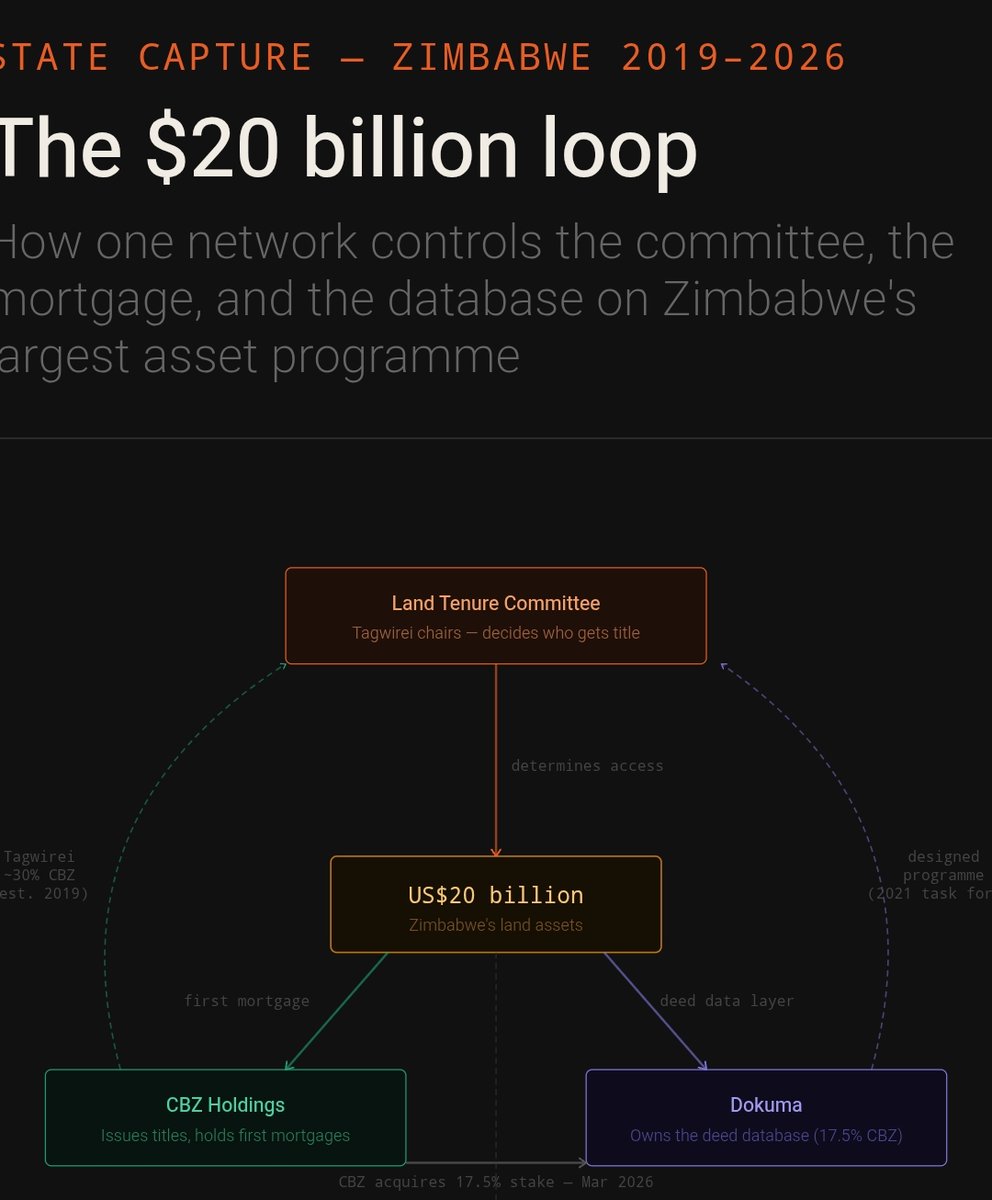
🧵THREAD: The $20 billion loop Tagwirei, CBZ, Dokuma, and the architecture of Zimbabwe's biggest asset capture
1/Hook
Zimbabwe's land reform created roughly US$20 billion in agricultural assets.
For two decades those assets were frozen – no title deeds, no collateral, no formal ownership structure.
Farmers could neither sell nor borrow against the land they occupied.
Then a programme was designed to unlock them.
What was built instead is something else entirely.
2/The sanctioned chairman
In late 2024, President Mnangagwa launched a land tenure policy allowing resettled farmers to receive title deeds, use land as collateral, and formally enter the property economy.
He announced a technical committee to spearhead the rollout.
He appointed Kudakwashe Tagwirei to chair it.
Tagwirei is under active sanctions from both the United States and the United Kingdom for state capture and misappropriation of public funds. He is not a civil servant. He holds no constitutional office.
He now chairs the body determining which farmers receive title to US$20 billion in land.
Apr 12 • 20 tweets • 4 min read
1/ Zimbabwe's civil service has a spine.
It runs through the Office of the President & Cabinet, the nerve centre that coordinates every ministry, every policy and every arm of the state.
Who sits at its apex tells you everything about what a government values.
2/ In 1980 Mugabe inherited a British-style Cabinet Office.
Its first head was George Smith, a white Rhodesian lawyer, LLB University of Rhodesia.
Mugabe kept him. Pragmatism over ideology. The new Zimbabwe needed the machine to keep running while the architects drew new plans.
Apr 11 • 28 tweets • 5 min read
1/ The removal/reassignment of Dr Fulton Mangwanya as CIO Director General this week has fascinated me.
Full disclosure: I have a long-standing obsession with intelligence, security & the hidden architecture of state power.
So let's talk about ALL the CIO DGs since independence. 2/ First, what is the CIO?
Zimbabwe's civilian intelligence agency. Internal security. Counterintelligence. Political intelligence. Executive protection.
It reports directly to President. Not Parliament. Not Cabinet. President alone. DG is his most intimate institutional weapon.