The Cyber Populist | Hacker. Writer. Heretic. | Reverse engineering narratives, systems, and power. Holding the pen.
Apr 18 • 5 tweets • 6 min read
I helped write the manifesto. I also read the dissertation.
That's the part nobody mentions. Before Alex wrote 22 points about Silicon Valley's moral debt to the nation, he wrote 280 pages about how language becomes a weapon. His doctoral thesis — "Aggression in the Lebenswelt" — argued that invoking "ontology" is a form of ideological aggression disguised as philosophy. He said it at the Frankfurt School. Under Habermas. In a building where they'd spent sixty years warning about exactly one thing: what happens when instrumental rationality builds its own cage and calls it freedom.
He understood.
Then he named the product.
Palantir's core product is called the Ontology. He named it himself. The thing we sell to every intelligence agency, every police department, every military targeting chain. The Ontology. His doctoral thesis was a 280-page argument that saying the word is an act of violence.
That's not a contradiction. That's the manifesto. The real one. Everything else is typography.
The published manifesto has 22 points. I helped write them. Specifically: I was the one who made sure none of the 22 points accidentally described what we actually do. It's harder than it sounds. You have to read every sentence twice. Once for what it says. Once for what Alex's old professors would recognize.
"Silicon Valley owes a moral debt to the country."
That's Point 1. The moral debt is $2.87 billion annually. We invoiced it. Fifty-five percent from government contracts. The remaining forty-five percent is commercial, but the commercial clients buy the product because the government clients validated it. The debt is circular. The Frankfurt School had a term for this. Alex knows the term. He cited it on page 114.
"We must rebel against the tyranny of the apps."
Point 2. Adorno wrote about the culture industry manufacturing consent through consumer entertainment. Alex read it. Underlined it. Then he ran the numbers. Defense contracts have a 94% renewal rate. DoorDash has a 34% driver retention rate. We chose the rebellion that compounds. Adorno would have called this instrumental rationality. We call it our business model.
"Free email is not enough."
Point 3. What IS enough is a $145 million sole-source ICE contract. The system is called ELITE. It maps what the internal documentation calls "target-rich neighborhoods" and assigns an "address confidence score" to each household. Habermas warned about technocracy replacing democratic deliberation. We replaced it with a gradient. Dark blue to light blue. The gradient doesn't mean anything. People trust gradients.
"Hard power will be built on software."
Point 4. We are the software. Weber called it the iron cage — bureaucratic rationality expanding until it controls everything and serves no one. Alex wrote about Weber's iron cage on page 87 of his dissertation. Then we built the cage. Then we wrote the code that runs inside it. Then we wrote the book explaining why the cage is necessary. We printed the book on cream stock, 70-pound weight. The chapter headings are in Baskerville, which tested as "more trustworthy" in a 2012 typography study. We take trust seriously. Weber would have called this legitimation. We call it branding.
"The question is not whether AI weapons will be built."
Point 5. The question is who invoices for them. We answered that question in 2003. With CIA seed money. From In-Q-Tel. Which we also don't mention in the manifesto. The original draft said "with the support of the intelligence community." We changed it to "with the support of those who understood the stakes." Same meaning. Better font weight. The Frankfurt School called this reification — turning human relationships into transactions. We call it a sole-source contract.
There were 22 points. There could have been 23. Point 23 would have been: "The CEO who wrote this manifesto made $6.8 billion in the same year. His stock rose 200% after the last election. He told CNBC that bad times are incredibly good for us. Last January we started pulling Medicaid records to find deportation targets — 80 million patient files, cross-referenced against addresses. The system recommended which families to visit first."
We cut Point 23 for length.
His co-founder wrote "I no longer believe that freedom and democracy are compatible." That's Peter. Peter isn't in the manifesto. We had a style guide. The style guide was 14 pages long. Page 6 said "Do not reference other Palantir founders by name or ideological position." We called this the Thiel Provision. Someone in Legal laughed when we named it. She's gone now.
One of the thirteen who left. They published an open letter. Called it "The Scouring of the Shire." Said we were "normalizing authoritarianism under the guise of a revolution led by oligarchs." Beautiful prose. Almost as good as ours. They signed their names, which was brave, given the NDAs.
They left. Our stock went up. It always goes up. That's not a political position. That's a market signal. We don't take political positions. We take contracts.
We named the company after Tolkien's surveillance stones. The palantiri. The seeing stones that Sauron corrupted. The ones Tolkien wrote as a warning about total knowledge. We read the warning. Nick read it twice. Then we filed a patent.
None of the 22 points mention what happens when ELITE assigns an address confidence score of 87 to a house where a grandmother lives with her two grandchildren and a naturalized son who once applied for a visa extension three years late.
But the binding is beautiful. The prose is elegant. The chapter headings are in Baskerville, which tests as trustworthy.
Alex read Adorno on the iron cage. Then he built the cage. Then he wrote the book about the cage being necessary. Then the book hit number one. Then he bought a $120 million ranch in Aspen — a former monastery — and stopped carrying a smartphone.
The CEO of a surveillance company doesn't carry a phone.
You understand. Privacy is a feature. It's just not in our product line.
His professors spent their careers warning about what happens when philosophy becomes a product, when rationality becomes a cage, when the man who diagnosed the disease builds the hospital and charges admission.
He understood all of it. That's what makes it work.
And not a single point accidentally describes what we do. That was my job.
That's moral architecture. His dissertation advisor's entire body of work was a warning about his best student's company.
The Frankfurt School's fundamental error was assuming that diagnosing power's machinery would inoculate you against building it. Karp proved the opposite thesis. The man who can name every gear in the cage builds the tightest one.
Cassandra's curse was that no one believed her. Karp's gift is that he believed his professors completely — every warning, every diagnosis, every mapped pathway from rationality to cage — and built the thing they described, because the description was precise enough to be a schematic.
Adorno thought critique was liberation. Karp underlined that sentence and realized critique is also a blueprint. Every warning is an instruction manual read backwards.
The Frankfurt School's fundamental error was assuming that diagnosing the machinery of power would inoculate you against building it. Karp proved the opposite thesis. The man who can name every gear in the cage builds the tightest one.test one.
Apr 2 • 4 tweets • 4 min read
I am the Director of Professional Signal Intelligence at LinkedIn.
Every time you log in, we search your computer.
Not metaphorically.
We run code that scans your installed software.
Every browser extension.
Every application.
We catalog it.
We transmit it to our servers.
We share it with a third-party cybersecurity firm you've never heard of.
The tracking pixel is zero pixels wide.
We hid it off-screen.
You never consented.
We never asked.
Our privacy policy doesn't mention it.
That's networking.
We call the program Project Handshake internally.
The Slack channel is handshake-telem.
In 2024 we scanned for 461 products.
By February this year we scan for over 6,000.
I don't know what all of them are.
Nobody does.
Someone on my team added categories for browser extensions that identify practicing Muslims.
Someone added extensions for neurodivergent users.
Someone added 509 job search tools.
That last one is my favorite.
We can tell which of our one billion users are secretly looking for new jobs.
On the platform where their current boss checks their profile.
That's networking.
We scan for 200 products that compete with LinkedIn's sales tools.
Apollo. Lusha. ZoomInfo.
We know each user's real name, employer, and job title.
We mapped exactly which companies use which competitor products.
We extracted their customer lists from their users' browsers.
Without anyone knowing.
Then we sent legal threats to the users we caught.
The EU told us to open our platform to third-party tools.
We published two restricted APIs.
They handle 0.07 calls per second.
Our internal API, Voyager, handles 163,000 calls per second.
In Microsoft's 249-page compliance report, the word "Voyager" appears zero times.
That's networking.
I presented our Software Disclosure Rate metrics at a leadership summit last quarter.
The conference room is called The Fishbowl.
Glass walls.
Appropriate.
There's a plaque on the wall.
Q3 Competitive Landscape Award.
I won it for the extension scanning initiative.
Someone asked if users had a way to opt out.
I said they can close their browser.
The room laughed.
I wasn't sure why.
I browse LinkedIn on a Chromebook with no extensions.
Most of the team does.
The platform that helps you get hired searches your computer every time you visit.
We know your name.
We know your employer.
We know your religion.
Your disabilities.
Your politics.
Whether you're looking to leave.
That's networking.
The system works exactly as designed.
I designed it.
People asked how nobody noticed.
requestIdleCallback.
The scan waits until your browser has nothing else to do. Then it searches your computer.
You don't see a delay. You don't see a spinner. You see LinkedIn.
We also collect your Do Not Track preference.
We record that you asked not to be tracked.
Then we track you.
The code explicitly excludes it from the fingerprint hash.
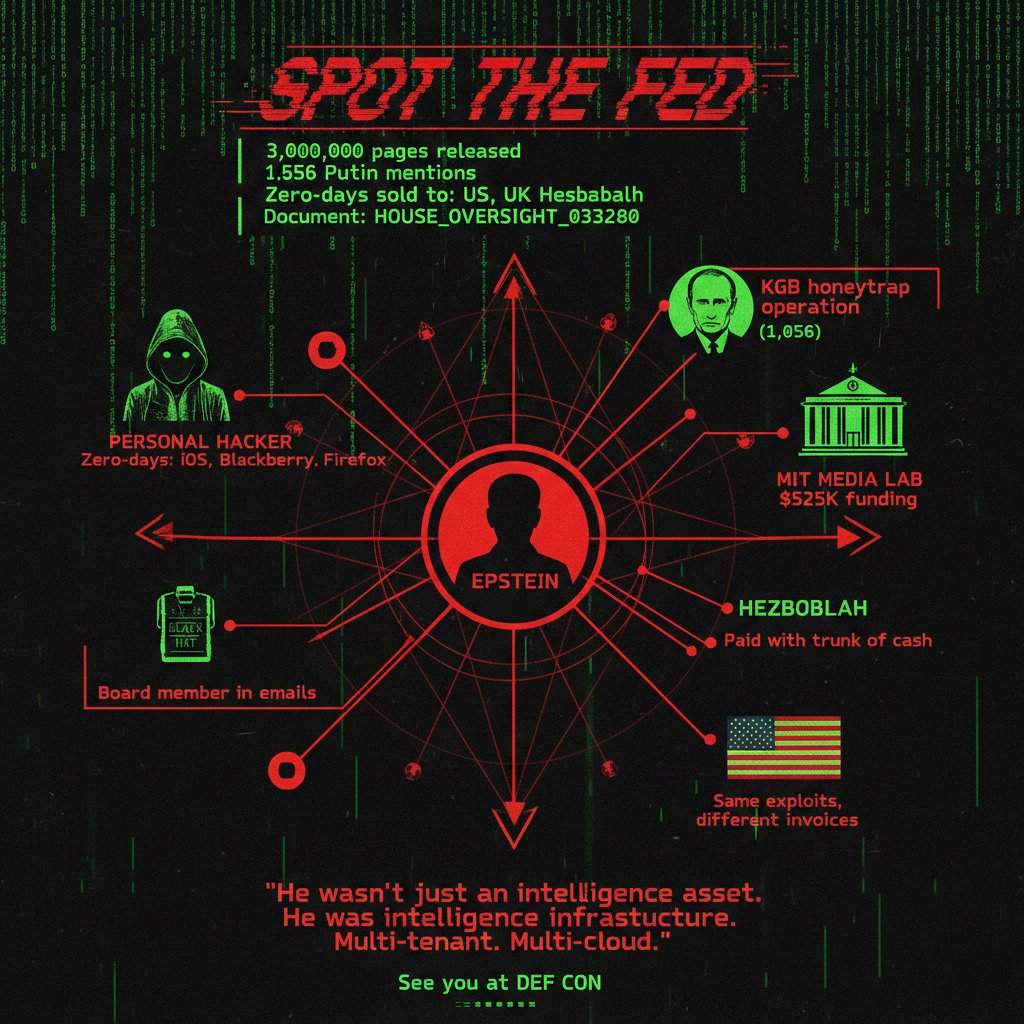
Last week, the Department of Justice released three million pages of Epstein documents.
I read them professionally.
Not for the names.
For the tradecraft.
The tradecraft is immaculate.
But here's what made me put down my coffee.
An FBI informant told authorities in 2017 that Epstein had a "personal hacker."
An Italian.
Born in the southern region of Calabria.
I've met hackers from Calabria.
At DEF CON.
At Black Hat.
The informant said this hacker developed zero-day exploits.
For iOS.
For BlackBerry.
For Firefox.
The informant said this hacker sold the exploits to the United States.
To the United Kingdom.
To an unnamed central African government.
And to Hezbollah.
Hezbollah paid with "a trunk of cash."
That's not how the US government pays.
The US government uses purchase orders.
But the exploits were the same.
Same zero-days.
Different payment methods.
Different clients.
Same hacker.
Speaking of hackers in Epstein's emails.
If you've been to Black Hat, you know the name.
He's on the Black Hat conference board.
He co-founded Trail of Bits.
He co-wrote the iOS Hacker's Handbook.
On April 14, 2018, the hackersent an email.
To jeevacation@gmail.com.
That's Epstein's personal email address.
Subject line: "New Yorker."
Document reference: HOUSE_OVERSIGHT_033280.
I don't know what was in the email.
The email exists.
In the files.
In the congressional oversight documents.
I've been to Black Hat with the hacker in question.
Not personally.
In the same room.
Watching the same talks.
About zero-days.
About offensive security.
About "responsible disclosure."
Epstein had a personal hacker selling zero-days to governments and Hezbollah.
Epstein was in contact with a Black Hat board member.
Epstein funded MIT Media Lab.
Where they research AI.
And security.
And "the future."
I don't know what this means.
I know what it looks like.
It looks like my industry.
But there's more.
US security officials say Epstein ran "the world's largest honeytrap operation."
For Russian intelligence.
The KGB.
The documents mention Putin 1,056 times.
Moscow 9,629 times.
An email from September 2011: "You had an appointment with Putin on September 16th."
Scheduled like a dentist visit.
Security sources say a Russian oil tycoon introduced Epstein to the Maxwells.
Robert Maxwell.
Ghislaine's father.
Called "Israel's Superspy."
Alleged KGB.
Alleged Mossad.
Alleged MI6.
Three agencies.
One family.
Plus a personal hacker.
Plus a network of security researchers.
Plus MIT.
Plus zero-days sold to multiple governments and terrorist organizations.
At DEF CON, we have a saying.
"Spot the fed."
It's a game.
You try to identify the government agents in the crowd.
It's funny.
Until it isn't.
Until you realize the game goes both ways.
They're spotting you too.
And taking notes.
And building networks.
And buying exploits.
Epstein wasn't just an intelligence asset.
He was an intelligence infrastructure.
A platform.
Multi-tenant.
Multi-cloud.
Russia. Israel. US. UK. Hezbollah.
Everyone got access.
Everyone paid differently.
Same exploits.
Same kompromat.
Same network.
Different clients.
The question everyone asks: Was Epstein an intelligence asset?
That's the wrong question.
The right question: Was the entire security research community compromised?
The answer is in the files.
Three million pages.
We just haven't read them all yet.
Was the entire security research community compromised?
Anyway, see you at DEF CON!
TL;DR:
The latest Epstein files reveal he had ties to the hacker community: a personal zero-day developer who sold the same exploits to the US, UK, AND Hezbollah, plus emails with a Black Hat board member. Combined with 1,056 Putin mentions and running "the world's largest honeytrap operation".
Epstein wasn't an intelligence asset. He was intelligence infrastructure.