Working on something new. Prev comp neuro @ MIT, applied math @ Berkeley.
Jul 8 • 9 tweets • 5 min read
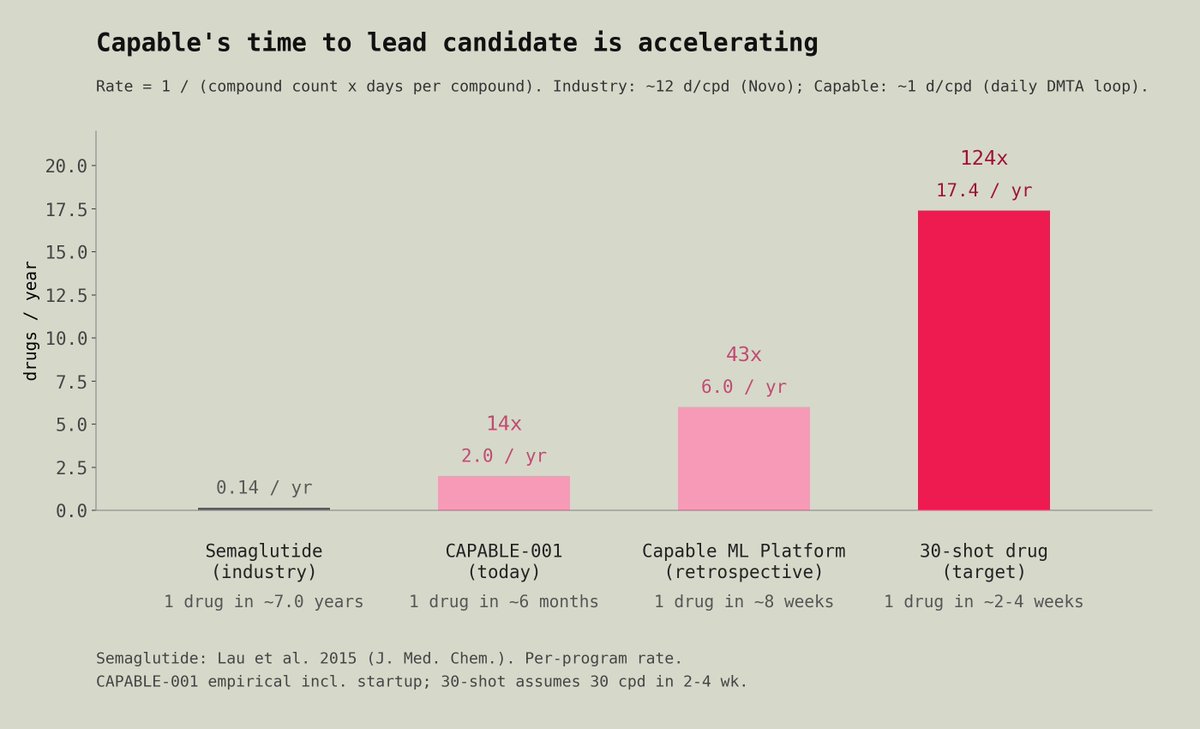
We built the lab that's able to go from AI-led drug design to data in 24h.
GPT-8 won't be bottlenecked by intelligence. It needs a biological compute layer.
This is Capable. We're turning AI capabilities into human capabilities--starting with short-sleeper peptides.
We're a vibrant and intensely mission-driven team in San Francisco from MIT, Harvard Medical School, Roche, ETH, and Dana-Farber.
We're grateful to be backed early with $12M by:
- 50 Years & HOF
- OpenAI executives Wojciech Zaremba, Kevin Weil, Srinivas Narayanan, and Fidji Simo
Our founding scientific advisory board:
- Prof. George Church at HMS, luminary of modern genetics
- Prof. Luis de Lecea at Stanford, co-discoverer of orexin
- Prof. Bradley Pentelute at MIT, leader in rapid peptide synthesis and brain-targeted peptides
Apr 17 • 7 tweets • 3 min read
I’m leaving MIT and not continuing into my PhD. AI is coming too fast for humans to keep up.
But there might be a way: I realized digital humans are more possible than most think. With capable AI researchers helping, maybe for $10B, maybe in less than 10 years, on 50k H100s.
Running a human brain might need only ~50,000 H100 GPUs. xAI already has 200,000+ H100s or better.
To anchor the discussion, I did some very rough napkin math: Under fairly pessimistic assumptions using current high-resolution neurons (eg Hodgkin-Huxley), multi-state synapses, a human brain might be in reach of ~600 exaFLOP/s of compute, 700 GB memory storage per GPU, and 24 GB/s interconnect bandwidth. That's already in reach for today's clusters!
If much simpler neuron models (eg Leaky-Integrate-and-Fire) are enough--which needs more research to be empirically determined--then a human brain might be as cheap as ~2-3 petaFLOP/s. That's nearly a single H100 at FP16. (Memory and interconnect are likely tighter constraints.)
But what neurons to run? What parameters? What connectivity?
Oct 3, 2024 • 7 tweets • 3 min read
Learning Chinese to intermediate fluency usually takes ~3000-4000h over years.
I did it in <1 year and <1500h, self-taught as a fun side project. If you've been wanting to learn a language, I recommend trying!
A quick thread on my strategies for effective language learning👇🧵 isaak.net/mandarin
水滴石穿 — Consistency is key.
Most people do a little duolingo and then fall off. There’s no way around consistency. Find whatever works for you.
I like doing my reviews early in the morning combined with exercise: