Monitor Imigracji Profile picture
Monitoring the demographic transformation of Poland. Documenting the reality of mass immigration. Demographics is destiny. 🇵🇱
Jun 14 6 tweets 4 min read
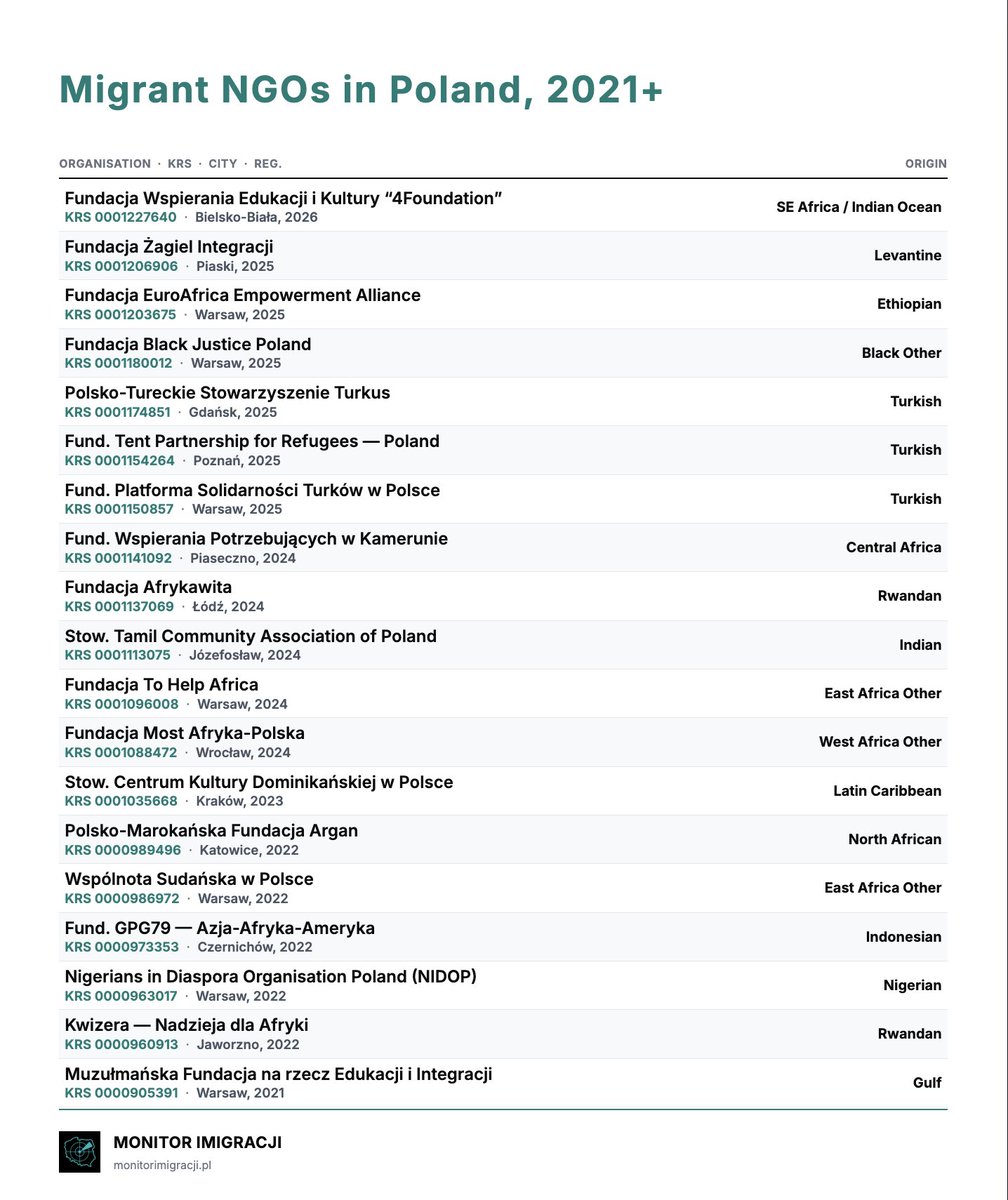
You’ve heard of “Black Justice Poland,” the activist foundation providing a support network for African migrants and black queer communities in Poland.

But this isn’t an isolated case.

NGOs like this are popping up across Poland like mushrooms after rain.

A new, permanent layer of cultural, legal, religious, and business infrastructure is being laid down. It’s time we investigated these networks. 🧵Image Muzułmańska Fundacja na rzecz Edukacji i Integracji
KRS 0000905391, Warsaw

Their mission is explicit: an education and integration center, preschool, school, Quran recitation, Arabic teaching, and halal certification.

The core objective is the integration and adaptation of Muslims choosing Poland as a permanent base.

Funding is already being crowdsourced on Zrzutka to build their Muslim Education and Integration Center in Warsaw.

They were also part of a Warsaw property dispute involving a religious-discrimination complaint and RPO proceedings.
Jun 5 6 tweets 3 min read
Poland’s migration debate focuses on border walls, Belarus, and “control.”

But away from the border, a quieter pathway is expanding: legal migration that turns students into workers, residents, and long-term settlers.

⬇️Let's look at the India-to-Poland pathway 🇮🇳🇵🇱

The clearest indicators are ZUS and work permits.
ZUS is Poland’s social insurance system.

Indian citizens registered in Poland’s pension/disability insurance system rose from 5,931 at end-2018 to 25,144 at end-2025.

Over the same period, work permits issued to Indian citizens rose from 8,362 to 29,524.

That is 4.2x growth in ZUS and 3.5x growth in work permits. 🧵Image The two datasets show different parts of the same pipeline.

Work permits show the legal labour channel being opened.

ZUS shows how much of that channel is turning into declared work inside Poland.

A permit is paperwork.

ZUS registration is presence in the Polish labour system.

When both rise together, the story is no longer theoretical.

It is migration moving from application forms into the real economy.
Jun 2 4 tweets 4 min read
A new foundation registered in Warsaw shows how globalist social engineering enters Poland through the NGO sector.

What many Poles once watched from afar during the BLM era in the West is now being institutionalized right here at home: race-based activism, black liberation rhetoric, intersectional feminism, and foreign-funded identity politics.

Meet FUNDACJA BLACK JUSTICE POLAND
KRS 0001180012

Its own site describes BJP as a black-led foundation advancing the rights, dignity, and wellbeing of black, African, and Afro-descendant communities in Poland.

Its stated mission? “Supporting the process of settling in Poland.”

This is not just a cultural club. It is an African activist foundation openly building settlement and identity-politics infrastructure in Poland.Image The political layer is just as explicit.

Black Justice Poland’s statute says it works for black people of African descent in Poland, against “root causes of inequality and oppression,” and against discrimination based on skin color, sex, sexual orientation, and gender identity.

Its own materials promote “black liberation,” “intersectional feminism,” and centering black women and LGBTQ+ communities.

Its events include Afro-queer organizing, BIPOC spaces, and a “Parenting Mixed Children with Confidence” workshop.

So the package is clear:

Black liberation.
Intersectional feminism.
Race-based activism.
Afro-queer organizing.
Mixed-race family programming.

The same ideological vocabulary that spread through Western institutions after George Floyd and BLM now has a Polish foundation, Polish registration, Polish events, and a place in Polish public life.

And the Lublin connection appears immediately on BJP’s own “Who We Are” page.

The first executive board profile is Margaret Amaka Ohia-Nowak, listed as an Assistant Professor at Maria Curie-Skłodowska University in Lublin, a lecturer in Women’s and Gender Studies at the University of Łódź, and a faculty member of the Black Europe Summer School in Amsterdam.

So this is not separate from the Lublin story. The same city already appearing in Poland’s African migration and integration pipeline also shows up here, inside the leadership network of Black Justice Poland.Image
Image
Image
Image
May 26 11 tweets 9 min read
INVESTIGATION: LUBLIN’S AFRICAN MIGRATION PIPELINE

Lublin is handing free public space to the Africa Day Festival (29–30 May), officially “Powered by Ria,” the remittance giant that moves migrant wages back to Africa.

Behind the festival: 72× surge in Zimbabwean work permits in 3 years + 1,560 Zimbabwean students + 24 KRS entities.

These aren’t random dots. This is one coordinated pipeline. 🧵Image
Image
Image
FESTIVAL OR INFRASTRUCTURE?

Africa Day is not being held in some private hall.

It is being placed in Lublin’s public and academic center:

• Plac Litewski, the city’s main square
• Chatka Żaka, UMCS student culture center
• Other university-linked spaces

The Medical University of Lublin’s own event page says:

“Lublin will become the capital of Africa in the heart of Europe.”

Its Rector granted honorary patronage personally.

UMCS, Lublin's largest public university, opens the festival at Chatka Żaka. Its Rector delivers the opening address. The festival's program PDF is hosted on the City of Lublin's official website.

Headline sponsor: Ria, branded across the festival as “Powered by Ria.”

Ria is a cross-border remittance company. Its principal product is moving money from migrant workers in Europe to recipient households outside Europe.

Africa is a core target corridor.

A remittance company has a direct, ongoing financial interest in keeping the migrant cohort large and earning Polish wages.

Their sponsorship is not philanthropy. It is customer acquisition.

The music is not the story. The numbers are.Image
May 22 9 tweets 2 min read
THE MYTH OF IMMIGRATION FOR COMPETITIVENESS

Poles are told non-White mass migration is “essential” for competitiveness. Without it, the story goes, the economy collapses.

Polish public data tells a different story. The “shortage” is manufactured. The growth is parallel.

Here is the reality. 🧵 The “shortage” is a fabrication

Non-White-owned food businesses in the Polish corporate register (KRS), 2020 → 2026:

• Bangladeshi: 116 → 643 (5.5×)
• Indian: 114 → 475 (4.2×)
• Asian Other: 54 → 419 (7.8×)
• Turkish: 72 → 388 (5.4×)
• Pakistani: 16 → 76 (4.8×)

This isn’t “filling” a vacancy; it’s sector creation. They aren’t serving Poles. They are building ethnic enclaves.
May 16 5 tweets 2 min read
Poland, 2018 → 2026

Each dot is a business with at least one Indian, Pakistani, or Bangladeshi owner.

Indian: 279 → 2,275
Pakistani: 67 → 469
Bangladeshi: 51 → 786

Indians are now concentrated in major Polish city clusters. Bangladeshis show the clearest spread into smaller towns and peripheral Poland. Pakistanis are growing across both cities and regional areas.

Public KRS data. monitorimigracji.plImage
Image
This is how migration networks become permanent: first big cities, then logistics corridors, county towns, service economies, and rural nodes.

Poland is sleepwalking into the same trap that destabilized much of the West.