Nāvalaṃ Profile picture
stories from nāvalaṃ
Apr 6 9 tweets 5 min read
People keep saying "Tamil is 60% Sanskrit," or "Malayalam is 80% Sanskrit," or "Kannada is 80% Sanskrit," as if it means something. This is clearly not linguistics, but mere vibes with percentages.

Let's see why. 🧵

English vocabulary is 60% French and Latin. Does anyone call English a Romance language? No, because that's not how language classification works. You classify by grammar, not by how many fancy words you borrowed from your neighbor. Grammar is the DNA of a language.

Japanese has 40-60% Chinese-origin words. Persian is stuffed with Arabic. Nobody calls Japanese "Sino-Tibetan" or Persian "Semitic." Because borrowing words is like borrowing clothes, you're still you underneath.

The attached GIF, IYKYKImage The gold standard textbook on language contact made this crystal clear: lexical borrowing is easy and casual. Structural borrowing is rare and requires deep, prolonged, intense contact.
When you find borrowed grammar, something serious has happened. Everyone talks about Sanskrit words going into Tamil, Malayalam, or Kannada. But no one talks about what Dravidians contributed to Sanskrit.

If we do a quick research from an academic perspective on what Dravidian has given to Sanskrit, or should we call it Prakrit? It's not merely words; it's the grammar, the skeleton of the spoken avrieties of Prakrit languages.
Mar 9, 2025 7 tweets 5 min read
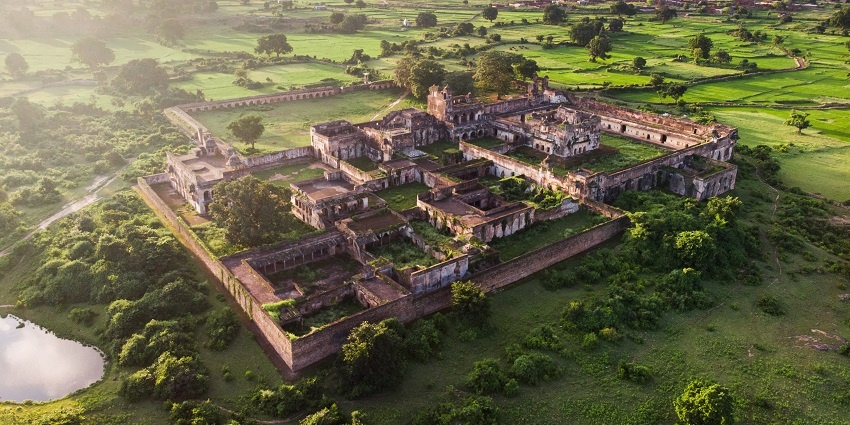
🧵Rohatash Gadh: A Historic Citadel in the Heart of Bihar

Perched atop the Kaimur Hills, Rohatash Gadh is located in the Rohtas district of southwestern Bihar, approximately 1,500 feet above the surrounding plains.

Tribal folklore recounts how the Oraons (Kurux) occupied Rohtasgarh after they left Sindhu Ghati, constructing stories of confrontation with rivals, possibly the Cheros.

In medieval times, Rohatash Gadh and the surrounding regions, including Jāpila, were ruled by a tribal kingdom called the Khayaravāla dynasty. About six inscriptions that exist today provide reliable information about this kingdom.

Phulwaria inscription of Prādabadavala
Tutrahi Falls inscription of Prādabadavala (1214 CE)
Phulwaria inscription of Prādabadavala (1225 CE)
Tārācaṇdī rock inscription of Prādabadavala (1225 CE)
Son-East bank copper plates of Udayarāja and Indravala (1254)
Rohatash Gadh inscription of Śri-Pratāba (1279 CE)

Nāyaka, or Mahānāyaka Pratāba-dhavala, was the first notable member of this family and the overlord of Jāpila, now known as Japla in the Palamau district.Image A place in Sahabad district called Khārgaḍh or Khayaragaḍh (fortress of Khayara) is presumed to be the place where the Khayaravāla dynasty was founded.
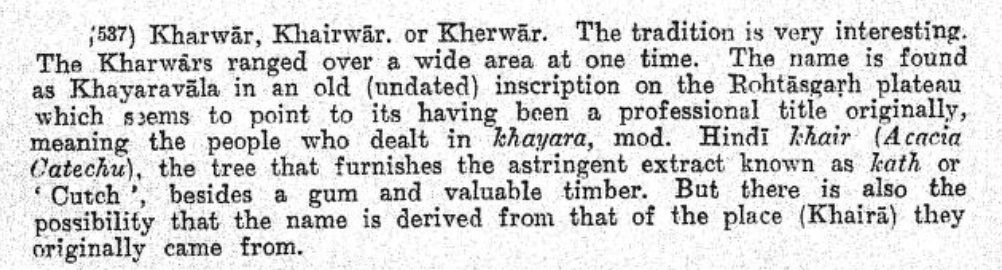
Francis Buchanan-Hamilton was a Scottish surgeon, surveyor, and botanist who made significant contributions as a geographer and zoologist living in India during British colonization. He documented that Khārgaḍh, or Khayaragaḍh (fortress of Khayara), is presumed to be the birthplace of the Khayaravāla dynasty, an agricultural tribe who were the inhabitants of Khārgaḍh or Khayaragaḍh.

Lorenz Kielhorn, a German Indologist, based on the Phulwaria rock inscriptions, linked Kharwārs as the descendants of Khayaravāla. These records show that a family of Khayaravāla, very likely from the Kharwār tribe, came to control parts of Rohtas while serving as nāyakas (subordinate rulers) under the Gāhaḍvalas based at Kānyakubja (Kanauj). The dynasty is named “Kharyaravālavaṃśa” in the Phulwaria rock inscription, and Khadirapalā was documented as the founder. They have claimed Sūryavaṃśa lineage.Image