James Barnes MSc., MA Profile picture
Psychotherapist/counsellor (MBACP)⎮Lecturer & Faculty. Relational Psychotherapy. Lived Experience. Views My Own. https://t.co/Ti00ew7W08
Aug 24, 2024 8 tweets 1 min read
An analogy of modern psychiatry:

Knives flood a small town that is collapsing economically, morally & spiritually. Fighting soars & stabbings proliferate.

It is decided that because injuries appear at the doctor's door, it must be a medical issue. (1/7) Biopsychosocial model employed. They set to work.

Questions such as, why do some people get in fights but not get stabbed? Why do some people's stab wounds heal quicker than others?, are focused on.

'Social determinants' are recognised but biology is looked to for the answers
Feb 3, 2024 5 tweets 2 min read
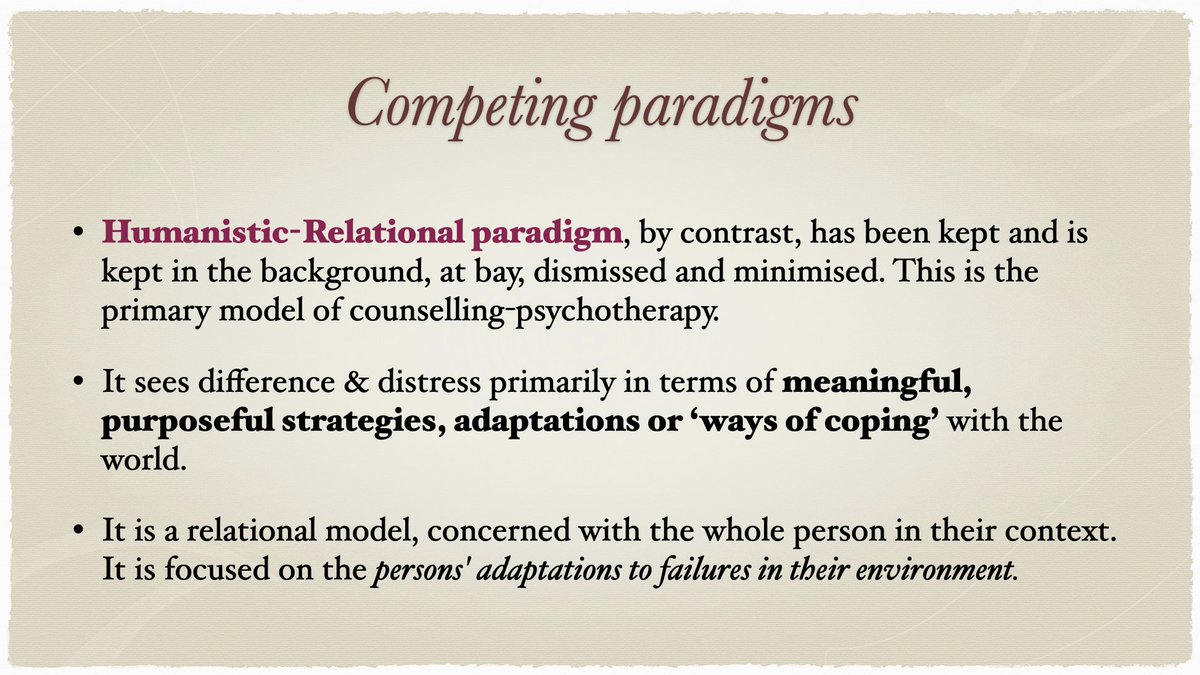
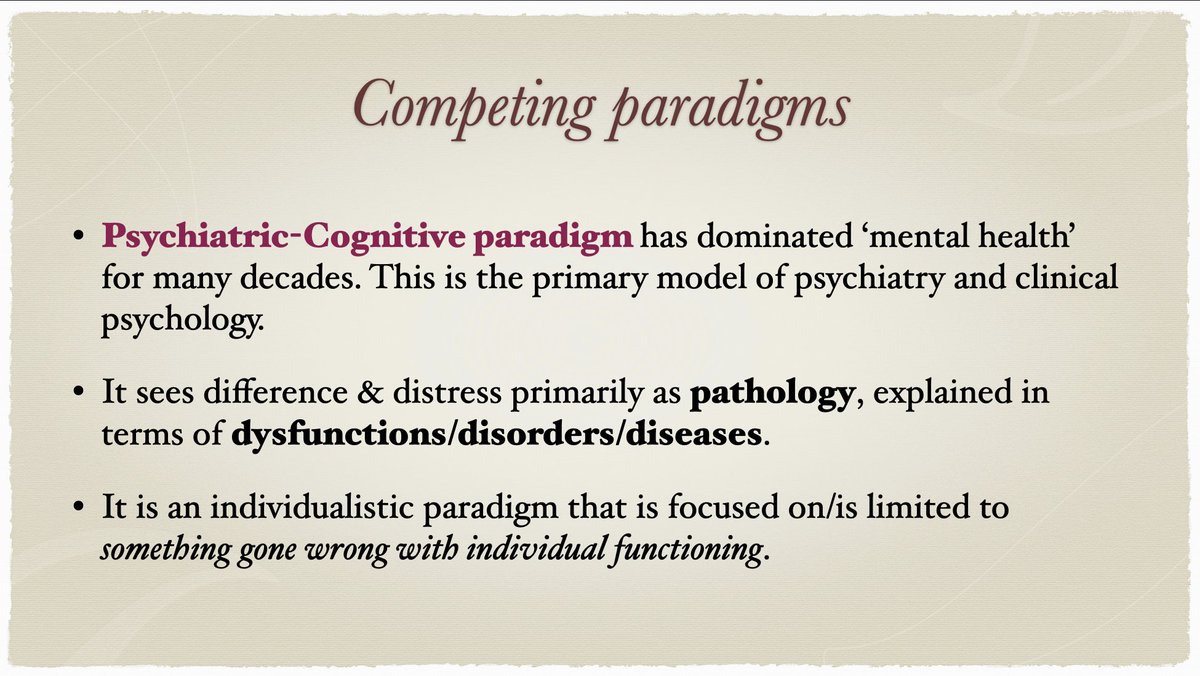
I wanted to share a few slides from my talk @dropthedisorder on Wednesday.

These give definition to what I call the 'Psychiatric-Cognitive' paradigm of psychiatry & cognitive clinical psychology, and the 'Humanistic-Relational' one of counselling-psychotherapy (1/5) Image Image
Nov 25, 2023 5 tweets 1 min read
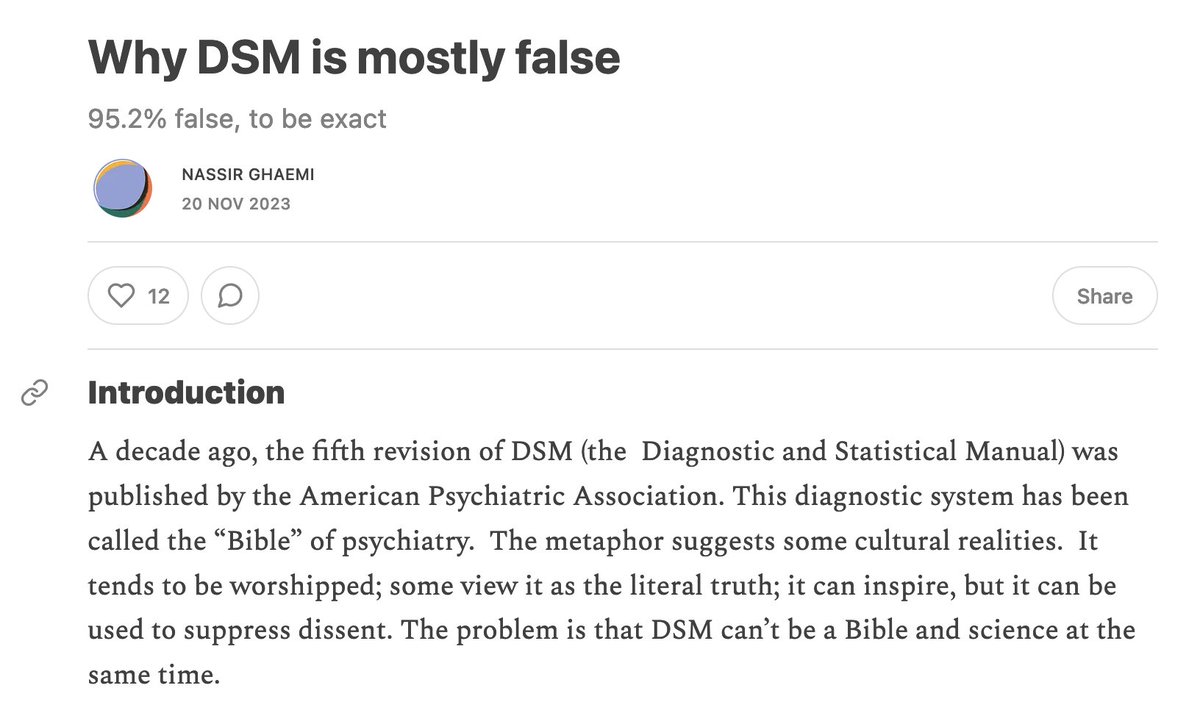
1/5 "What mattered wasn’t what was true based on scientific research, but what was useful, based on the pragmatic beliefs of DSM-IV leaders & APA activists."

If you don't believe 'critics' about the DSM, maybe you'll believe Tufts professor of psychiatry, @nassirghaemia? Image 2/5 "We have to accept DSM-5 definitions from a legal and practical perspective. We have to use them for insurance forms, and to protect ourselves against lawsuits.  But we don't have to believe in them."
Dec 2, 2022 8 tweets 2 min read
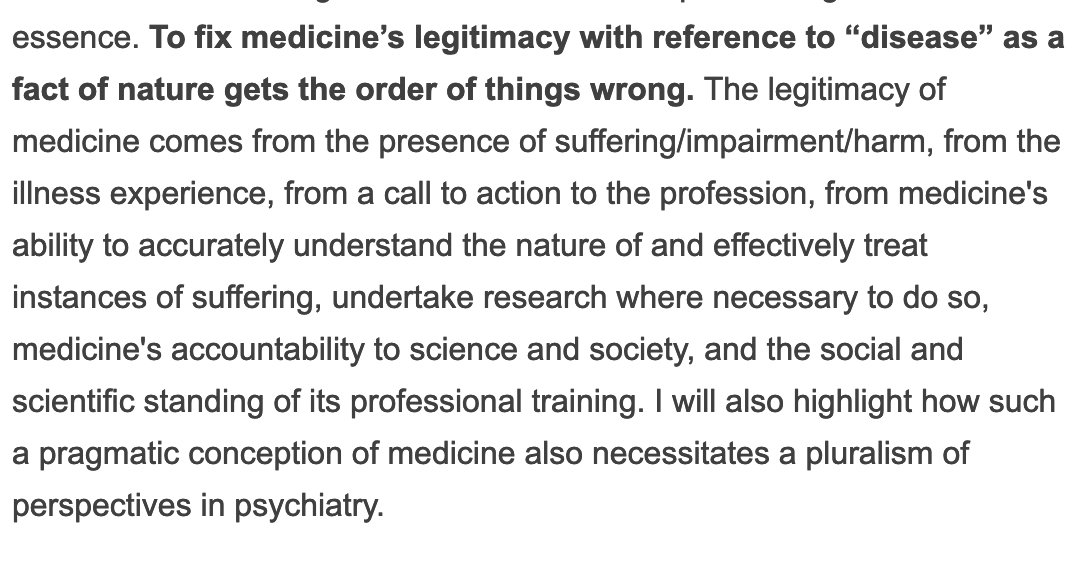
I've had conversations with @awaisaftab on his definition of what makes psychological & emotional distress medical, which he has put in print in response to @justin_garson.

My comments :

1. 'There is suffering/impairment/harm.' True of things that should not be medical.. Image 2. For example, those oppressed by a society often experience these things, but being oppressed is not a medical problem. It iw a socio-political one. If it can't distinguish between the two, that's a serious issue.
Sep 19, 2022 8 tweets 2 min read
From "we never said there was a "chemical imbalance"" to "psychiaitrists have always been psychotherapists." A thread 🧵1/ 2/ Firstly, it's simply a matter of historical fact that psychiatry divorced itself from psychotherapy.
Previous to the 1980s US psychiatry was all about (Freudian) psychoanalysis. Psychiatrists were psychoanalysts. Since then psychiatrists have been biomedical practitioners.
Jul 21, 2022 8 tweets 2 min read
1/ I just want to offer my own elaboration on this point in @markhoro excellent thread on the recent 'chemical imbalance' research

The real problem is not about serotonin levels but about how and why such throughly reductive & flimsy explanations got/get so widely disseminated🧵 2/ What was so compelling for drug companies—and practically irresistible to psychiatry—was the notion that depression could be explained (and sold) as something that was effectively independent of the person's (adverse) social situations, life events & relationships.
May 11, 2022 15 tweets 3 min read
1/2 This latest @PsychTimes article from @MarkLRuffalo (and Daniel Morehead) "Psychotherapy: A Core Psychiatric Treatment" deserves some comment, as its very misleading.

Do psychiatrists practise psychotherapy? 🧵

psychiatrictimes.com/view/psychothe… 2/ Firstly, they conclude that "the claim that psychiatrists do not learn psychotherapy is false."

Technically true, but the best I've heard of in the training is seeing 2 clients (1 CBT and 1 psychodynamic) over two years.

That *is* learning psychotherapy, but not to...
Mar 10, 2022 11 tweets 2 min read
1/ You wouldn’t know it, but there has been an explosion of ‘relational’ and ‘intersubjective’ theory and practice in psychotherapy and related disciplines over the past few decades.

A few thoughts on it from something I'm writing at that moment 👇 2/ Relational thinking has largely been pushed into the background by academic and institutional psychology & psychiatry because of the ideological dominance and entrenchment of cognitive and biomedical thinking.

Relationally is not something that fits well with the status quo.
Feb 5, 2022 8 tweets 3 min read
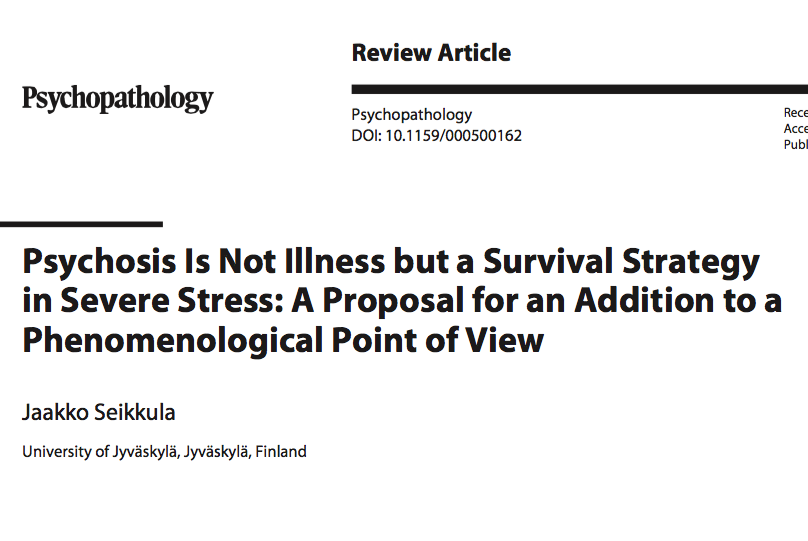
(1/5) This is a recent article by one of the leaders of the Open Dialogue approach. Key quotes:

"Instead of looking at psychotic behavior as a deviance in the (brain) structure, it can be seen as an active attempt of the embodied mind to survive extreme stress in one’s life” (2/5) "Hallucinations and delusions are expressions of our human emotional system adjusting to extreme stress and not symptoms of some biological illness, although there surely exist biological correlates of these emotional reactions."
Dec 20, 2021 11 tweets 2 min read
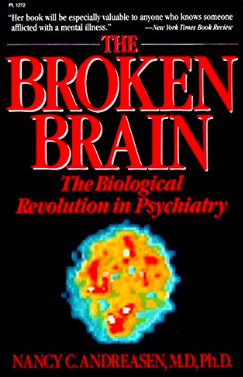
(1/11) Finally got round to reading this best-selling psychiatry book from 1983. A thread:

"Psychiatry now recognises that the serious mental illnesses are *diseases* in the same sense as cancer or high blood pressure..[people] suffer from a *sick or broken brain.*" (2/11) "The somatic therapies used most frequently are medications and electroconvulsive therapy (ECT). Because these diseases are considered to be biological in origin, the therapy is seen as corrected a biological imbalance."
Boom. Right from the outset.
Aug 2, 2021 6 tweets 2 min read
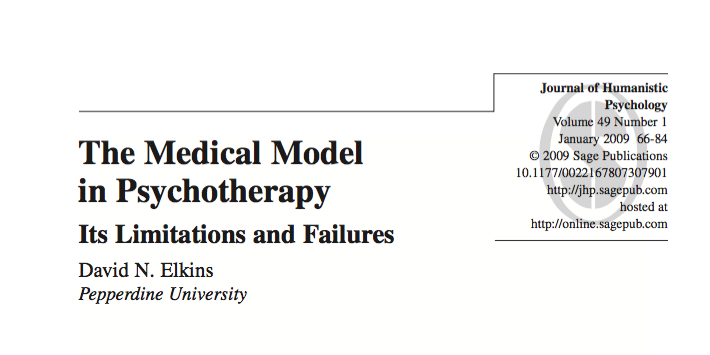
1/Psychotherapists need to think clearly about this👇

"[The language of diagnosis/symptoms/illness] is superimposing a medical schema on psychotherapy..to describe what is essentially an interpersonal process that has almost nothing to do with medicine"

journals.sagepub.com/doi/10.1177/00… 2/"(a) The [medical] model fails to describe accurately what actually occurs in therapy;

(b) the model continues to dominate the field not because of its accuracy but rather because of its questionable ties with medicine, science, and the health insurance industry"
Jun 15, 2021 6 tweets 2 min read
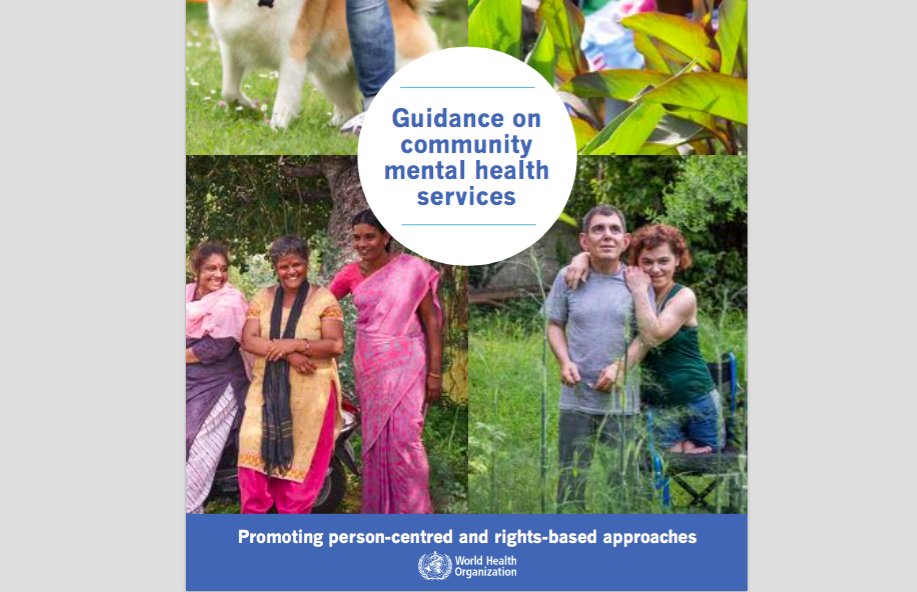
1/ What happens when WHO says almost identical things to the supposed 'anti-psychiatrists'? 🤔

"The predominant focus..continues to be on diagnosis, medication and symptom reduction. Critical social determinants..are often overlooked or excluded from..concepts and practice" 2/ "This leads to an over-diagnosis of human distress and over-reliance on psychotropic drugs to the detriment of psychosocial interventions – a phenomenon which has been well documented, particularly in high-income countries.."
May 10, 2021 4 tweets 6 min read
(1/2) Why Winnicott's model is so important —

• 'Disorders' are interruptions in the continuity of being; not things 'in' or 'of' the self

• They result from *failures of the world* to provide requisite care, and only secondarily from (individual) reactions to these failures (2/2)

• The individual reactions (i.e. symptoms, defences) are creative/productive attempts to find wholeness, not negative consequences of a 'disorder process.'

• 'The cure' is not to try to change the person's functioning, but to try to 'repair' the failures of the world.
Mar 29, 2021 7 tweets 2 min read
(1/6) For the past 18 months, I've worked in a psychiatric hospital.

I'm want to briefly describe 'psychiatric care,' as I have observed it.

Firstly, the psychiatrists are *not* actively involved in the day-to-day of the patients. (2/6) The vast majority of their interaction with the patients come in monthly 30 mins-long MDT meetings, which the psychiatrists chair

They request feedback from all the other roles (nurses, OTs, ward managers, etc)—who *have* had sustained involvement with them in that period.
Jul 9, 2020 14 tweets 3 min read
Thread on "The digital future of mental
healthcare and its workforce" NHS report.

Makes for VERY disturbing reading.

topol.hee.nhs.uk/wp-content/upl… "Current mental healthcare is largely concerned with
the face-to-face interaction between a person and a professional. Within a ‘digital medicine’ approach this interaction can be mediated by technology and the human- computer interface becomes increasingly important."