I help people print $10k per month with Faceless YouTube. Join my private community below.
4 subscribers
Jan 13 • 26 tweets • 6 min read
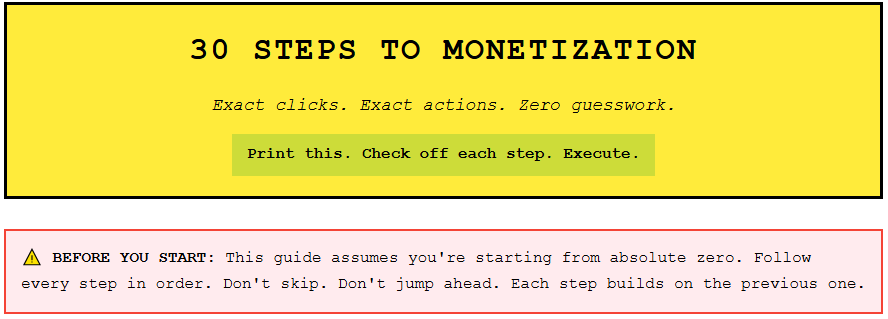
yt automation in 30 steps, easy to follow
1:1
Jan 3 • 4 tweets • 3 min read
10 step youtube automation FREE GUIDE 🧵
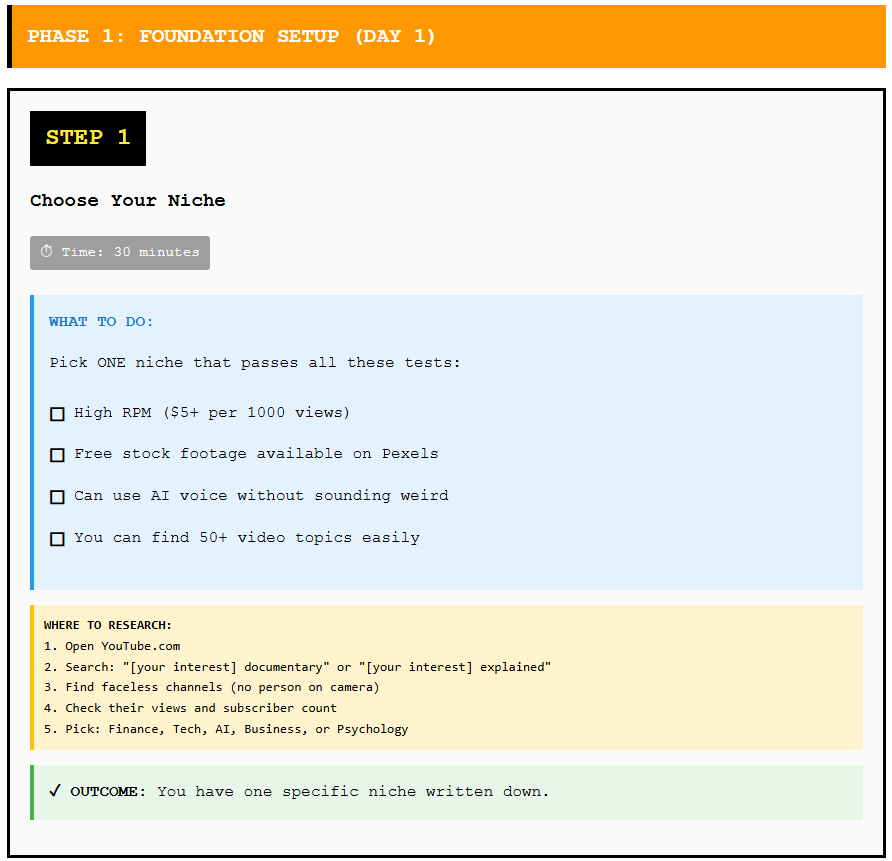
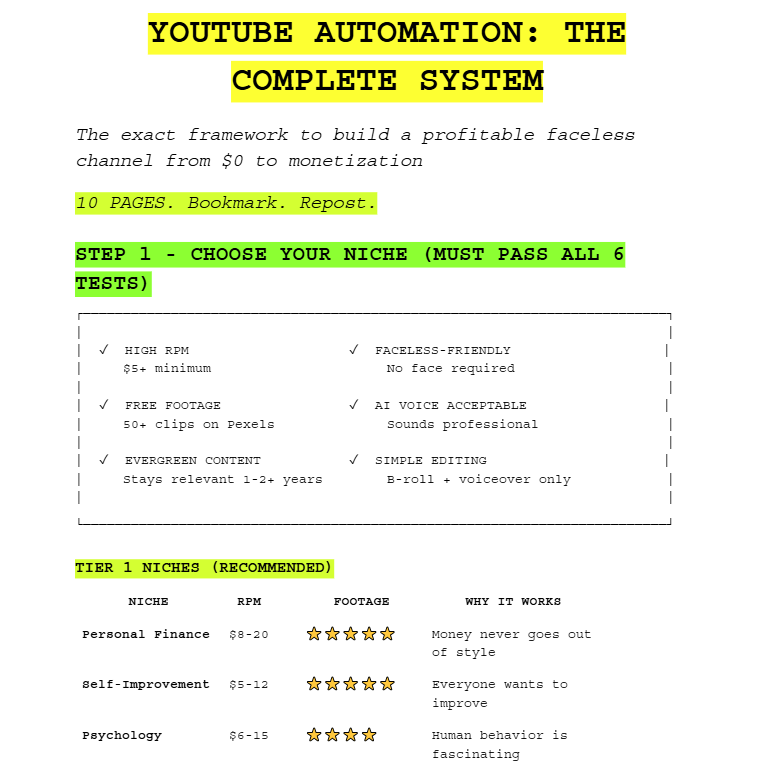
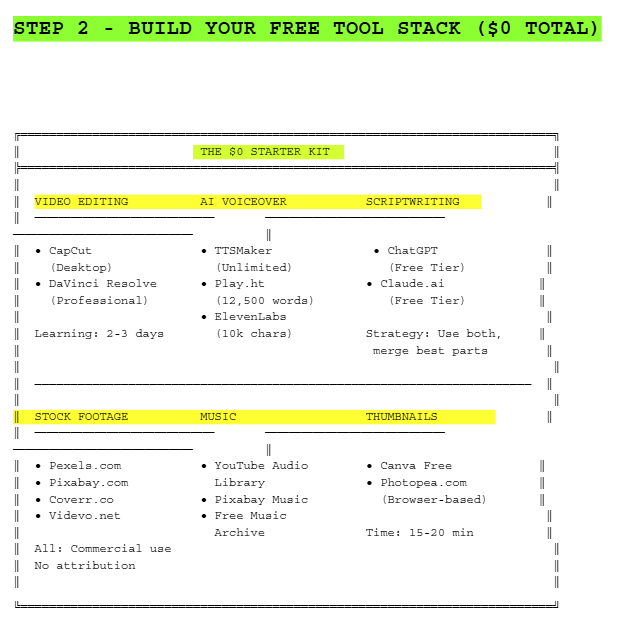
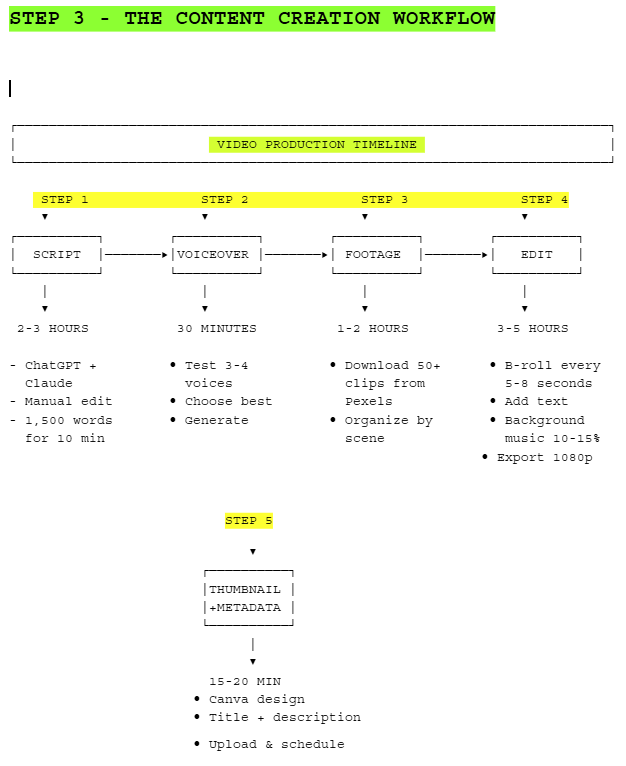
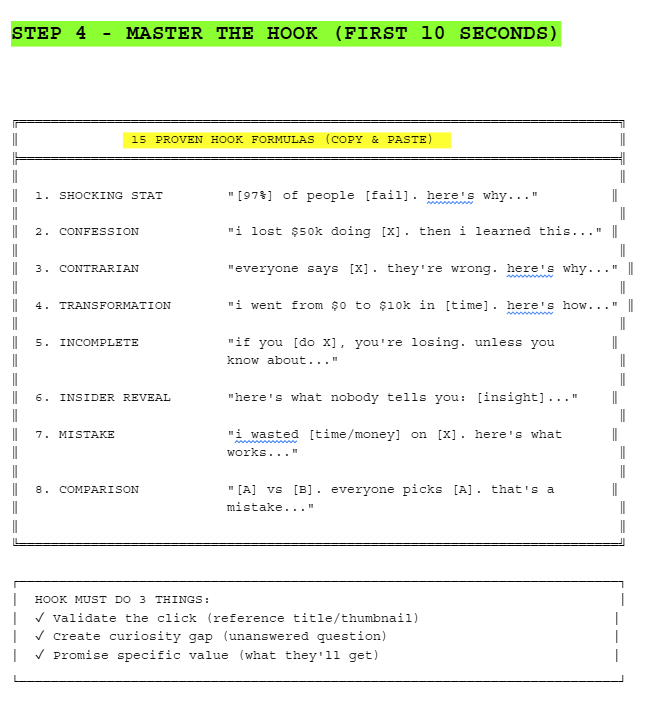
open the thread for the complete guide (step 1-4 here)
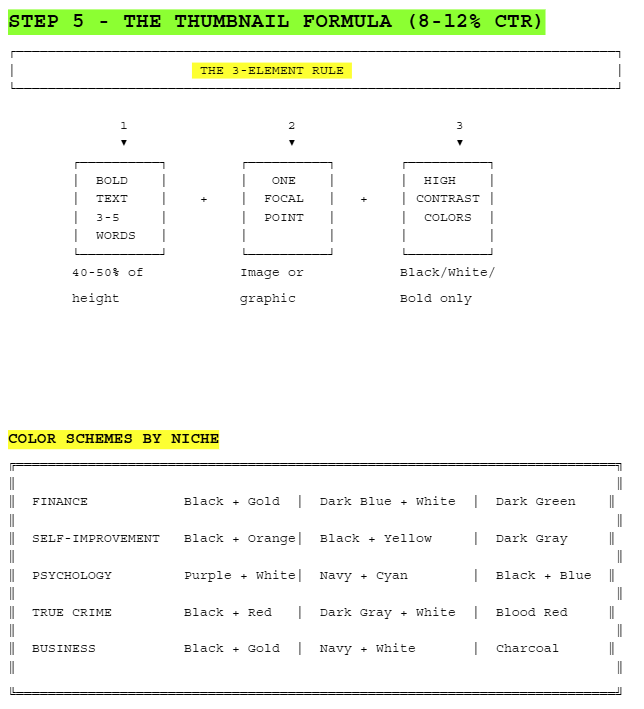
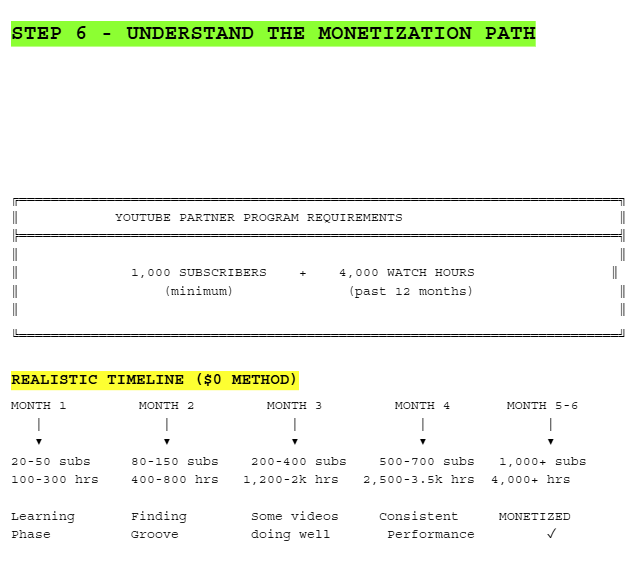
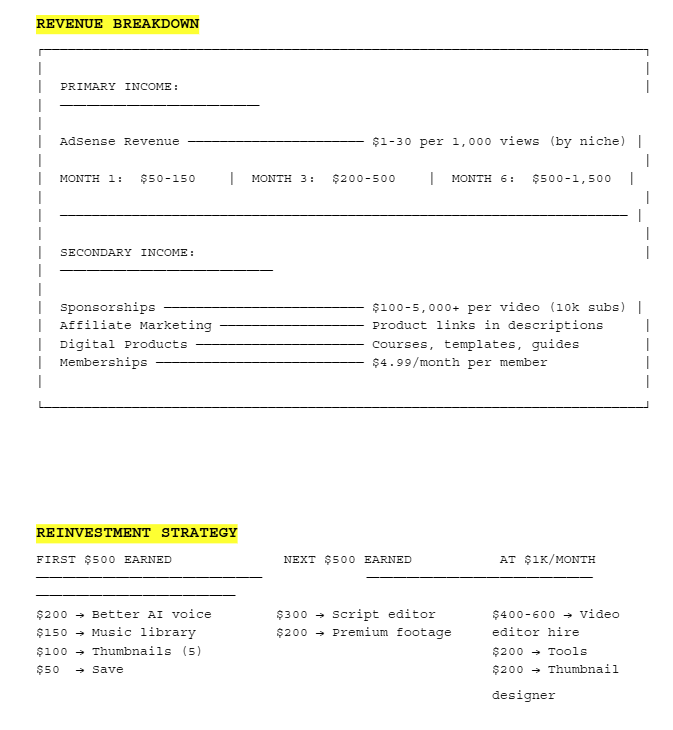
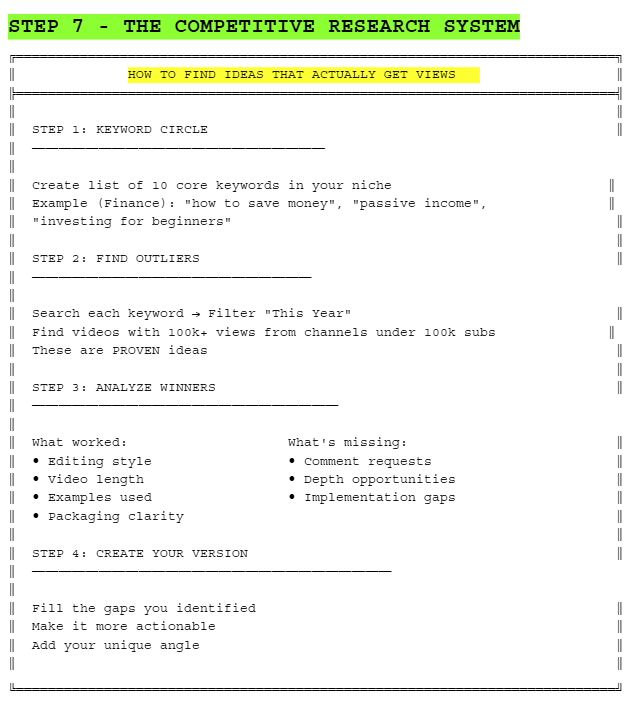
Step 5-7
Jan 2 • 10 tweets • 3 min read
fuck it, script templates that work for almost all faceless niches
if you're still broke and following all my posts, you need someone to hold ur hand through it (me) 👇
🧵15 hook types that force people to keep watching + templates for different niches:
Before we begin, check out Faceless Success Discord: discord.gg/wBgdqRygKH
How I trained ChatGPT to write $500 YouTube scripts in 2 minutes
breakdown with prompt stacks, system setup, and quality control🧵
Step 1
Before you even ask for a script, you need to train ChatGPT on YOUR voice
I create a custom instruction that includes:
My target audience (e.g., "20-35 year old entrepreneurs")
My tone (conversational etc)
Forbidden words (never say "delve", "dive into", "unlock", etc.)
Sentence structure rules (short punchy sentences, max 15 words)
Save this as your system prompt. Now ChatGPT writes like YOU
Nov 18, 2025 • 9 tweets • 2 min read
docuseries are the heaviest format in faceless YT
when you get it right, you print
this is the blueprint for it 🧵
docuseries work because they follow one psychological pattern:
unraveling something bigger than the viewer expected
small event → larger force → hidden mechanism → final revelation
this is why docuseries hit harder than explainers, they promise escalation
so your job is to find topics with expanding layers
Nov 18, 2025 • 10 tweets • 2 min read
entire explanation video format blueprint for faceless youtube channels 🧵
they win because they hit a bunch of algorithm incentives:
long watch time
low stress pacing
tv friendly visuals
adult-skewed audience
multitasking structure
winning explainer formats follow the same hidden demand patterns:
Finish with a short list of ‘invisible causes people never notice.’”
2. EVIDENCE-BASED LIFE HACK DISCOVERY PROMPT
“Generate a list of [NUMBER] evidence-based life hacks for [TASK/PROBLEM] supported by:
behavioral science
habit studies
cognitive load research
environmental design
productivity science
human decision-making
For each hack, include:
– the mechanism behind why it works
– the failure mode (when it stops working)
– what 95% of people do wrong
– a stronger alternative hack”
3. MICRO-SYSTEM CREATION PROMPT
“Design a repeatable micro-system for [TASK] that includes:
trigger/cue
environment setup
step-by-step loop
built-in friction reduction
built-in accountability
optimization for low-energy days
a 3-level version (bare minimum → normal → max mode)
Explain why this structure works psychologically.”
4. MYTH-BREAKER ANALYSIS PROMPT
“List the most common myths about [TOPIC], and for each:
explain where the myth came from
explain why it’s wrong
provide a correct, science-backed alternative
show who benefits from the myth staying alive
give a hack that replaces the myth”
5. FAILURE CASE DECONSTRUCTION PROMPT
“People try to improve [TOPIC] and fail. Break down:
the #1 misunderstanding
5 predictable failure patterns
emotional traps
cognitive miscalculations
environmental sabotage
social pressures
hacks that fix each failure point
Include 3 ‘blind spots’ most people never realize.”
Nov 16, 2025 • 5 tweets • 3 min read
sports niche prompt library
this thread can make you $2k in revenue if you do it right 🧵
RESEARCH PHASE PROMPTS (FOR CHATGPT)
hard data, timelines, mechanical accuracy
1. FULL EVOLUTION TIMELINE OF A SPORT / TECHNIQUE / POSITION
“Create a detailed chronological evolution of [SPORT / POSITION / TECHNIQUE], including:
decade/year markers
the innovators and pioneers (full names + teams)
rule changes that altered the sport
shifts in training, biomechanics, and strategy
cultural or technological breakthroughs (equipment, analytics, etc.)
one unexpected or controversial moment per era
Include at least 15 milestones, arranged strictly earliest → latest.”
2. ATHLETE / COACH ULTRA-DOSSIER PROMPT
“Build a comprehensive dossier on [ATHLETE/COACH], covering:
FOUNDATION
– birthplace, early environment, early influences
– youth leagues, scouts, or mentors
CAREER TIMELINE
– every major team, season-by-season roles
– record-breaking stats
– injuries, setbacks, comebacks
Bookmark it and repost 📌
RESEARCH PHASE PROMPTS
PHILOSOPHICAL FOUNDATION RESEARCH PROMPT
Create a comprehensive philosophical foundation for [PHILOSOPHICAL TOPIC/QUESTION/THINKER] structured for 2-3 hour deep exploration:
HISTORICAL DEVELOPMENT:
Ancient origins of the philosophical question or concept
Medieval and scholastic interpretations
Early modern transformations and debates
19th and 20th century developments
Contemporary philosophical landscape
Evolution of terminology and conceptual frameworks
CORE ARGUMENTS AND POSITIONS:
Classical formulations of major positions
Key arguments supporting each view
Objections and counter-arguments
Dialectical development of ideas
Synthesis attempts and their success/failure
Contemporary refinements and variations
MAJOR THINKERS AND CONTRIBUTIONS:
Foundational philosophers who established the debate
Key figures advancing or challenging positions
Revolutionary thinkers who shifted paradigms
Contemporary philosophers working on the topic
Interdisciplinary contributors (scientists, theologians, etc.)
Biographical context affecting their philosophical work
TECHNICAL TERMINOLOGY:
Precise definitions of key philosophical terms
Etymology and conceptual evolution
Distinguishing closely related concepts
Technical vs. colloquial usage
Translation issues across languages
Neologisms and their justification
LOGICAL STRUCTURE:
Formal argument structures when applicable
Logical validity vs. soundness assessment
Common logical fallacies in the debate
Modal logic considerations (possibility, necessity)
Conditional reasoning patterns
Reductio ad absurdum arguments
INTERDISCIPLINARY CONNECTIONS:
Scientific findings relevant to philosophical debate
Theological or religious dimensions
Psychological and cognitive science insights
Sociological and anthropological considerations
Literary and artistic explorations
Political and ethical implications
SCHOOLS OF THOUGHT:
Analytic vs. continental approaches
Rationalist vs. empiricist traditions
Pragmatist perspectives
Phenomenological approaches
Process philosophy contributions
Eastern philosophical perspectives
PRIMARY SOURCE DOCUMENTATION:
Key texts with specific passages
Original language quotations with translation
Context of writing and historical situation
Intended audience and rhetorical strategy
Interpretive debates about meaning
Secondary literature and scholarly consensus
Focus on peer-reviewed philosophy journals, established philosophical texts, Stanford Encyclopedia of Philosophy, and recognized philosophical authorities. Note areas of consensus vs. live debate.
🧵📌bookmark and rt this
RESEARCH PHASE PROMPTS
FINANCIAL TOPIC FOUNDATION PROMPT
Create a comprehensive research foundation for [FINANCIAL TOPIC/STRATEGY/CRISIS] structured for 2-3 hour deep exploration:
THEORETICAL FRAMEWORK:
Core financial principles and concepts involved
Economic theory underpinning the topic
Mathematical models and formulas (with intuitive explanations)
Historical development of these financial concepts
Academic vs. practical perspectives on the topic
Competing schools of thought (Keynesian, Austrian, Chicago School, etc.)
EMPIRICAL DATA COMPILATION:
Historical performance data and statistics
Market data across different time periods and conditions
Comparative analysis across markets/countries
Backtesting results and methodology
Real-world case studies with documented outcomes
Peer-reviewed research findings and meta-analyses
REGULATORY AND LEGAL LANDSCAPE:
Current regulatory framework affecting the topic
Historical regulatory changes and their impacts
Geographic variations in regulation
Legal precedents and court cases
Compliance requirements and considerations
Pending legislative changes and their potential effects
MARKET MECHANICS:
How specific markets or instruments function
Key players and their roles (institutions, retail, regulators)
Price discovery mechanisms
Liquidity considerations and constraints
Transaction costs and practical frictions
Market microstructure relevant to topic
RISK ANALYSIS FRAMEWORK:
Specific risks associated with the topic
Historical risk manifestations and outcomes
Risk measurement methodologies
Risk mitigation strategies and their effectiveness
Tail risks and black swan considerations
Behavioral risks and psychological factors
PRACTICAL IMPLEMENTATION:
Step-by-step execution requirements
Technology and platforms needed
Cost structures and fee considerations
Tax implications (with jurisdiction notes)
Time commitments and skill requirements
Common implementation mistakes and solutions
Focus on verifiable data from reputable sources: academic journals, regulatory filings, established financial institutions, and recognized financial data providers. Clearly distinguish between theoretical models and practical reality.
type your niche + sort by most popular
your goal is to find a repeatable format that got numbers multiple times
if one channel has 3–4 videos with 1M+ views using the same structure, pacing, and packaging, that’s your outlier
that’s what you copy
Nov 7, 2025 • 10 tweets • 2 min read
the broke guy’s guide to building a faceless channel
you have $0, no team, and no clue
here’s how you still win in 2025 and 2026 🧵
first rule of being broke:
you have time
so instead of complaining, you trade time for leverage
that means doing every single role yourself once so you understand the system before automating it later
Nov 6, 2025 • 15 tweets • 2 min read
YouTube automation for clueless people
i’m writing this so even if you’re “i don’t know how to copypaste” dumb, you can’t mess it up
this will be long and tactical 🧵
1. what youtube automation actually is
you don’t need to show your face
you don’t need to talk
you don’t even need to touch the video if you don’t want to
it’s just systems:
someone finds the idea → someone writes it → someone edits it → someone uploads it → you collect the revenue
Nov 6, 2025 • 11 tweets • 3 min read
🧵how to master YouTube in 30 days (more technical edition):
people love to say “you can’t learn youtube in 30 days” and they’re right
you can’t master the algorithm, you can’t master editing, you can’t master thumbnails in a month
but you can master the foundation that makes the algorithm feed you forever
Nov 5, 2025 • 12 tweets • 2 min read
10 visual contrast tricks that make your videos addictive
(psychology-based editing guide) 🧵
1. light vs dark
our eyes are wired to notice luminance change faster than color
cut from bright → dim or dim → bright every 5–10 seconds
it resets visual fatigue
the brain interprets brightness shifts as new information
Nov 4, 2025 • 9 tweets • 2 min read
the 7 storytelling sins that kill your videos
📌bookmark this
1. fact-dumping [aka info without emotion]
no one remembers data, they remember meaning
a fact is disposable
a story embeds it
a viewer can retain 7 facts, but they can remember 1 story forever
to stand out → wrap every fact in conflict, curiosity, or transformation
Nov 3, 2025 • 12 tweets • 3 min read
10 visual storytelling tricks for faceless editing
(how to make viewers feel like they’re watching a story even when they’re just watching footage) 🧵
1. the metaphor frame [show what it feels like, not what it is]
your visuals don’t need to match the line
they need to match the emotion behind it
this makes the story feel cinematic, not literal
works best for: narration-heavy channels, abstract storytelling
Nov 3, 2025 • 12 tweets • 2 min read
10 editing structures that work in any niche
(use these to make faceless videos feel alive even without a face) 🧵
1. the heartbeat cut [micro-movement pacing]
cut every 1.5 to 3 seconds, even during calm narration
each cut acts like a pulse that keeps the brain awake
alternate between static visuals, small camera pans, and text hits
viewers don’t consciously notice it, but their dopamine system does
works best for: commentary, explainers, storytelling

 Step 5-7