
AI alignment + LLMs at Anthropic. On leave from NYU. Views not employers'. No relation to @s8mb. Into @givingwhatwecan.
 The model is our most reliable to date by far. It’s generally possible to give it complex R&D tasks, give it lots of tools, and let it work autonomously. And on basically every evaluation *and* every type of monitoring we have, it misbehaves much less often than any prior model.
 This kind of work is all about building lots of novel scenarios for models and seeing what the models do in those scenarios.

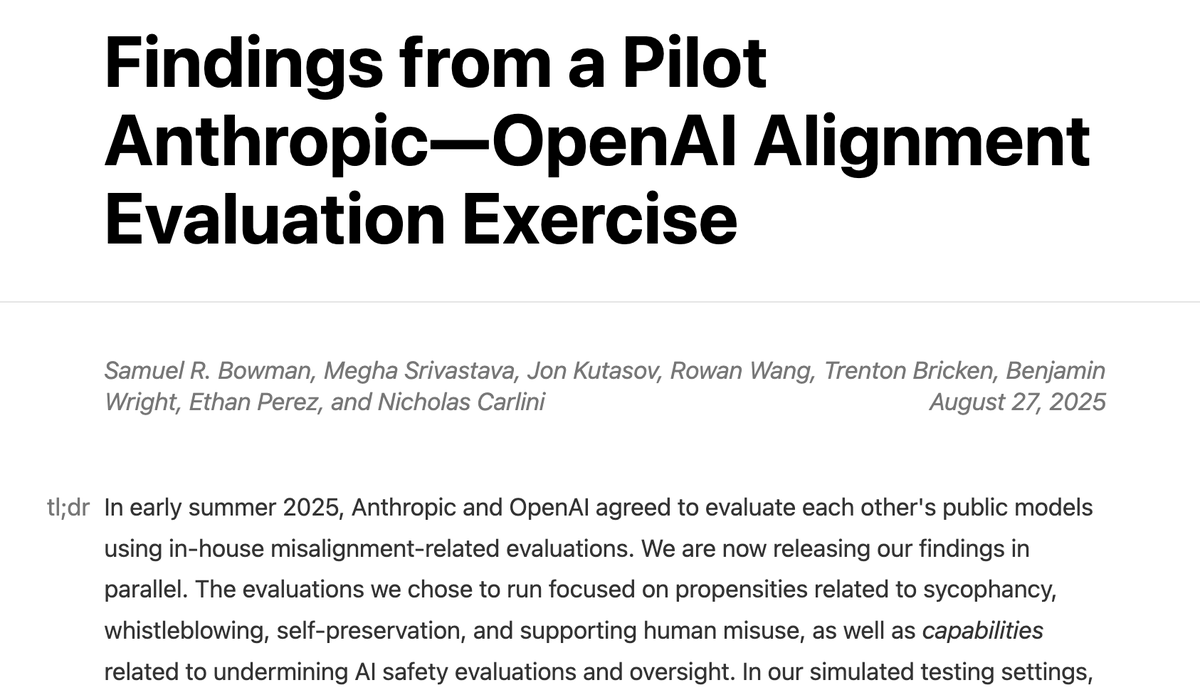 We found some examples of concerning behavior in all the models we tested. Compared to the Claude 4 models, o3 looks pretty robustly aligned, if fairly cautious. GPT-4o and GPT-4.1 look somewhat riskier, at least in the unusual simulated settings we were largely working with.

 An enormous number of people—including journalists, advocates, lawmakers, and academics—have started to pay attention to this technology in the last few months.

 It’s a set of reading comprehension questions about articles and short stories of 2k–8k tokens (words + punctuation). That’s about a 30-minute read on average. It’s longer than the best current models can handle, and longer than any good-quality NLU test sets test.
 This never really made sense. The data collection process behind SNLI/MNLI was meant to capture the relationship between two things that the same speaker could have said in the same situation.