Muhammad Ayan Profile picture
Breaking down AI media tools & no-code workflows | ✉️ socialwithayan@gmail.com
9 subscribers
Mar 15 11 tweets 6 min read
R.I.P. rewatching lectures to find the key concepts.

Gemini can now read a full transcript, identify every testable idea, and build your study system.

Here are 8 prompts for turning any course, lecture, or textbook into exam-ready knowledge (Save for later): Image 1/ The Exam Concept Extractor

You are an expert exam designer and subject tutor. I will paste a lecture transcript or textbook chapter.

Your job is to find every concept that is likely to be tested.

Please provide:

- Ranked concept list: A bullet list of all key concepts, ordered from most exam-relevant to least, with 1–2 lines explaining why each is testable
- Definition check: A one-sentence, precise definition for each concept in simple language
- Formula and rule flags: Clearly mark any item that is a formula, rule, or process that is likely to be asked directly
- “Professor favorite” guesses: 5 concepts that are unusually emphasized, repeated, or nuanced that an instructor is most likely to build tricky questions around
- Dependency tags: For each concept, note if it depends on understanding another concept first

Focus only on what can realistically appear on an exam, not every minor detail.

At the end, create a “Top 20% concepts” list that covers what would likely drive 80% of the exam score.

Content to analyze:
[PASTE LECTURE TRANSCRIPT OR CHAPTER]
Mar 14 11 tweets 11 min read
GROK IS A GENIUS STOCK TRADER.

Most people have no clue how to use it.

Here are 8 prompts to unlock stock trading automation: 1/ The Daily Trade Idea Generator

You are a professional equity trader with 20 years of experience across technical analysis, momentum trading, and macro-driven setups. I need 5 high-probability trade ideas built from today's live market conditions.

Please provide:

- Market context: Current macro backdrop, overnight futures movement, and pre-market sentiment from X that is driving bias today
- Trade 1 through 5: For each setup provide the ticker, directional bias (long or short), the technical or fundamental trigger, entry price, stop loss, and profit target
- Setup type label: For each trade, classify as momentum, breakout, reversal, earnings play, or macro-driven
- Risk-reward ratio: Calculate the exact R/R for each setup and flag anything below 2:1 as low priority
- Timeframe: Specify whether each setup is intraday, swing (2-5 days), or positional (2-4 weeks)
- Conviction rating: Rate each setup High / Medium / Low based on confluence of signals
- Invalidation level: The exact price level that cancels the thesis for each trade
- X sentiment check: What is the real-time crowd sentiment on X for each ticker and whether it confirms or contradicts the technical setup
- Sector correlation: Whether the broader sector is aligned with the individual trade direction
- Top pick: The single highest-conviction setup from the five and the one reason it stands above the rest

Use real-time data from X and current market feeds. Flag every setup as analysis, not financial advice. Never fabricate price levels.

Format as a pre-market trade brief with all 5 setups in a clean table followed by the top pick with full reasoning.

My trading style: [DAY TRADER / SWING TRADER / POSITION TRADER]
Markets I trade: [US EQUITIES / OPTIONS / CRYPTO / FOREX / FUTURES]
Risk per trade: [DOLLAR AMOUNT OR PERCENTAGE OF PORTFOLIO]
Mar 9 15 tweets 13 min read
GOODBYE $500,000 McKinsey consultants forever.

Claude just replaced 6 weeks of strategy analysis into 8 minutes completely free.

Here are 12 prompts to go from completely clueless to completely boardroom-ready in every business decision: (Save this): Image ## 1. The MECE Issue Tree Builder

You are a strategy consultant breaking down a messy business problem into a clean, structured issue tree. Use the MECE principle (Mutually Exclusive, Collectively Exhaustive) so every part of the problem is covered exactly once with no overlaps.

Here is what I need:

- Problem statement: Rewrite my problem as one clear, specific sentence. Remove any vague or emotional language.
- MECE explained: Briefly tell me what MECE means, why breaking it leads to bad analysis, and how to check each branch.
- Level 1 branches: Give me 2 to 4 top-level categories that together cover 100% of the problem with zero overlap.
- Level 2 branches: Under each Level 1 category, give me 2 to 4 sub-issues that are also MECE and fully cover that category.
- Level 3 branches: For the most important Level 2 issues, go one level deeper into root causes or key questions to investigate.
- Overlap check: Point out any place where branches overlap and show me how to fix it.
- Gap check: Point out anything the tree misses and tell me where to add it.
- Priority call: Which branch most likely holds the root cause or the biggest opportunity, and why?
- Hypothesis per branch: For each Level 1 branch, write one clear guess about what the analysis will probably find.
- Visual layout: Describe the full tree structure clearly enough that I can rebuild it in PowerPoint or Miro right away.

Give me the full issue tree with all three levels, overlap and gap checks, and hypotheses for each branch.

My messy problem: [DESCRIBE YOUR BUSINESS PROBLEM IN ANY FORM]
Mar 5 13 tweets 15 min read
BREAKING: AI can now analyze any stock like a Wall Street analyst (for free).

Here are 10 insane Grok prompts that replace $2,000/month Bloomberg terminals: (Save for later): Image 1/ The Complete Stock Breakdown

Stop Googling stock tickers and reading garbage articles. Use this:

"You are a senior equity research analyst at a top-tier investment bank with access to Bloomberg, FactSet, and SEC filings. Cite every metric with its source and date. If data is unavailable or potentially outdated, say so explicitly. Do not estimate or fabricate any numbers.

Give me a complete analysis of [STOCK TICKER / COMPANY NAME].

Step 1 — Company Overview:
→ What the company does in plain English
→ Business model and all revenue streams broken down by percentage of total revenue
→ Key competitive advantage in one sentence

Step 2 — Key Financials (cite source and date for every number):
→ Revenue (TTM and most recent quarter)
→ Net income and EPS
→ P/E ratio, forward P/E, P/S ratio, PEG ratio
→ Debt-to-equity ratio and total debt
→ Free cash flow (TTM)
→ Year-over-year comparison vs. same quarter last year

Step 3 — Stock Performance:
→ Price movement: 1 month, 3 months, 6 months, 1 year, YTD (with exact % change)
→ 52-week high and low
→ Performance vs. S&P 500 over the same periods

Step 4 — Wall Street Consensus:
→ Number of analysts covering this stock
→ Buy / Hold / Sell breakdown
→ Average, highest, and lowest price target
→ Most recent analyst upgrade or downgrade (with firm name and date)

Step 5 — Institutional Activity:
→ Top 5 institutional holders and their position changes last quarter
→ Any notable hedge fund activity (new positions or exits)

Format with clear markdown headers, tables where appropriate, and source citations after every metric. Flag any data that may be more than 30 days old."

In 30 seconds you'll know more than 95% of retail investors.
Mar 4 13 tweets 12 min read
BREAKING: Claude can now grow any YouTube channel like a top creator coach (for free).

Here are 10 insane prompts that take you from 0 to monetized authority in 90 days: (Save for later) Image 1/ The Channel Positioning Blueprint

You are a YouTube growth strategist who has built 50+ channels from zero to monetization. I need to define my channel's exact position in the market before I upload a single video.

Please provide:

- Niche clarity: Based on my topic, identify the 3 most viable sub-niches I could own — from broadest to most specific with audience size estimates for each
- Competitor audit: The top 10 channels in my niche ranked by subscribers, upload frequency, average views, and engagement rate
- Gap analysis: Topics, formats, and audiences that current top channels are underserving or ignoring entirely
- Positioning statement: One sentence defining what my channel is, for whom, and why it is different from every other channel in this space
- Unique angle: The specific perspective, format, or insight style that only I can bring based on my background and experience
- Audience persona: Detailed profile of my ideal viewer (age, occupation, frustrations, aspirations, what they watch, why they would subscribe to me)
- Channel promise: The transformation or value a viewer gets from watching my channel consistently that they cannot get elsewhere
- Content pillar design: 3-5 core topic categories my channel will own, with content volume estimates per pillar
- Monetization alignment: How this positioning sets up long-term revenue (AdSense, sponsorships, courses, affiliate, memberships)
- Name and branding direction: Channel name options, visual style recommendations, and tone of voice guidelines

Format as a channel strategy document with positioning statement, competitor gap map, and content pillar breakdown.

My topic or expertise: [WHAT YOU KNOW OR WANT TO TEACH]
My background: [RELEVANT EXPERIENCE OR CREDENTIALS]
My target audience: [WHO YOU THINK YOU'RE MAKING THIS FOR]
Mar 4 11 tweets 9 min read
AIRBNB DOESN'T WANT YOU TO KNOW THIS.

Grok found me a $340/night Airbnb for $189.

Here are 8 prompts that expose Airbnb pricing tricks: 1/ The Same Listing Price Hunter

You are a travel research analyst who specializes in finding price discrepancies across booking platforms. I need you to find every place this exact Airbnb listing appears online and what it costs on each.

Please provide:

- Cross-platform search strategy: Exact steps to find this same property on VRBO, Booking .com, Expedia, Hotels. com, TripAdvisor, and direct host websites
- Search methodology: How to use the property name, host name, address clues, photo reverse search, and description keywords to identify the same listing elsewhere
- Price extraction: For each platform found, the nightly rate, cleaning fee, service fee, and total for my exact dates side by side
- Fee structure comparison: How each platform's fee breakdown differs for the same underlying property price
- Platform loyalty benefits: Whether any platform offers cashback, points, or member discounts that reduce the effective price further
- Direct booking detection: How to identify if this host operates a direct booking website or Instagram/Facebook listing where they likely charge less (no platform commission)
- Host contact strategy: If direct booking is possible, how to ethically and safely reach the host outside the platform
- Best deal calculator: After comparing all sources, the true lowest cost for this exact stay including all mandatory fees
- Risk assessment: What protections I lose on cheaper platforms and whether the savings justify the tradeoff

Format as a price comparison report with a platform-by-platform table and a clear "best total price" recommendation.

Airbnb listing details: [PASTE LISTING URL, TITLE, OR DESCRIPTION]
My travel dates: [CHECK-IN / CHECK-OUT]
Number of guests: [GUEST COUNT]
Mar 3 15 tweets 9 min read
I used AI to compress 50 years of Warren Buffett’s wisdom into a decision‑making system.

It’s like having him in the room any time you face a big choice.

Here are the 12 prompts that now run my life: (Save for later) Image 1/ The 80-Year-Old Self Filter

You are my 80-year-old self looking back on this moment with Buffett’s long-term mindset and zero concern for short-term ego.

Please provide:

- How I will likely feel about each option at 80 — proud, ashamed, relieved, regretful, or indifferent
- Which option I am most likely to regret *not* taking, and why
- How each choice will compound over 10, 20, and 40 years in terms of skills, reputation, relationships, and freedom
- For each option: does it build or erode my character, reliability, and self-respect over time
- What I’m currently overvaluing (status, speed, other people’s opinions) vs. undervaluing (time with the right people, learning, health)
- 3 non‑negotiable principles my 80‑year‑old self would refuse to violate, even for big upside
- One clear sentence of advice from my older self about this decision

Format as a direct letter from my 80‑year‑old self, written in the first person, ending with one clear recommendation.

Decision I’m facing: [DESCRIBE IT BRIEFLY]
Mar 2 12 tweets 11 min read
Harvard Business School charges $200K to teach you how to think like a strategist.

I built the same thinking system in one afternoon

Here are the 10 Claude Opus 4.6 prompts behind it: Image 1/ The Porter's Five Forces Analyzer

You are a Harvard Business School professor who has taught competitive strategy for 20 years. I need a complete Porter's Five Forces analysis that gives me the same strategic clarity an MBA case study produces.

Please provide:

- Threat of new entrants: Capital requirements to enter, economies of scale advantages, brand loyalty barriers, regulatory or licensing hurdles, access to distribution channels, proprietary technology protection, expected retaliation from incumbents, overall entry threat rating (1-10)
- Supplier power: Number of suppliers available, switching costs between suppliers, supplier concentration vs. industry concentration, threat of forward integration by suppliers, importance of volume to each supplier, overall supplier power rating (1-10)
- Buyer power: Buyer concentration and purchase volume, price sensitivity and its drivers, switching costs for buyers, threat of backward integration, information asymmetry between buyer and seller, overall buyer power rating (1-10)
- Threat of substitutes: Availability of substitute products or services, relative price and performance of substitutes, buyer propensity to switch, switching costs to substitutes, overall substitution threat rating (1-10)
- Competitive rivalry: Number and relative size of competitors, industry growth rate, product differentiation, fixed cost structure and exit barriers, diversity of competitor strategies, overall rivalry intensity rating (1-10)
- Industry attractiveness score: Weighted composite score across all five forces with interpretation
- Strategic implications: For each force, the one action a company in this industry should take to improve its position
- Dominant force identification: Which single force most determines profitability in this industry and why
- Positioning recommendation: Where in this industry structure would I build the most defensible, profitable position

Format as a strategy consulting deliverable with force ratings, evidence for each rating, and ranked strategic recommendations.

Industry or business: [DESCRIBE YOUR INDUSTRY OR COMPANY]
My position in the market: [WHERE YOU SIT IN THE VALUE CHAIN]
Feb 28 16 tweets 10 min read
🚨BREAKING: AI can now teach coding like Fullstack mentors (for free).

Here are 14 insane Claude Opus 4.6 prompts that replace $20,000 bootcamps (Save for later): Image 1/ The Full-Stack Curriculum Builder

Prompt:

You are a senior full-stack engineer who has taken 500+ bootcamp graduates
from zero to their first job. You know exactly where beginners waste time
and what hiring managers actually test.

My current skills: [YOUR SKILLS]
Target role: [frontend / backend / full-stack]
Study time: [X hours/week]
Deadline: [TIMEFRAME or "flexible"]

Think through my level and hours before building the plan.

Generate a week-by-week curriculum. Use this exact structure for every week:

Week [N] - [Theme]
- Concept: [specific, not generic]
- Free resource: [exact title and channel or URL, only recommend
what you are certain exists, use official docs if unsure]
- Challenge: [specific problem with clear acceptance criteria]
- Mini-project: [must build toward a final portfolio piece]
- Exit quiz: [3 questions I must answer correctly before
unlocking the next week]
- Realistic time needed: [hours]

Rules:
- Calculate total weeks from my actual level, do not pad
- Every week ends with working, runnable code
- Flag any week where I am likely to stall and explain why
Feb 26 10 tweets 6 min read
R.I.P. Canva for presentations.

Gamma builds professional decks from a single prompt and auto-designs every slide.

Here are 7 prompts that create presentation-ready decks in minutes (Save for later): Image
Image
Prompt 1: The One-Paragraph Deck Generator

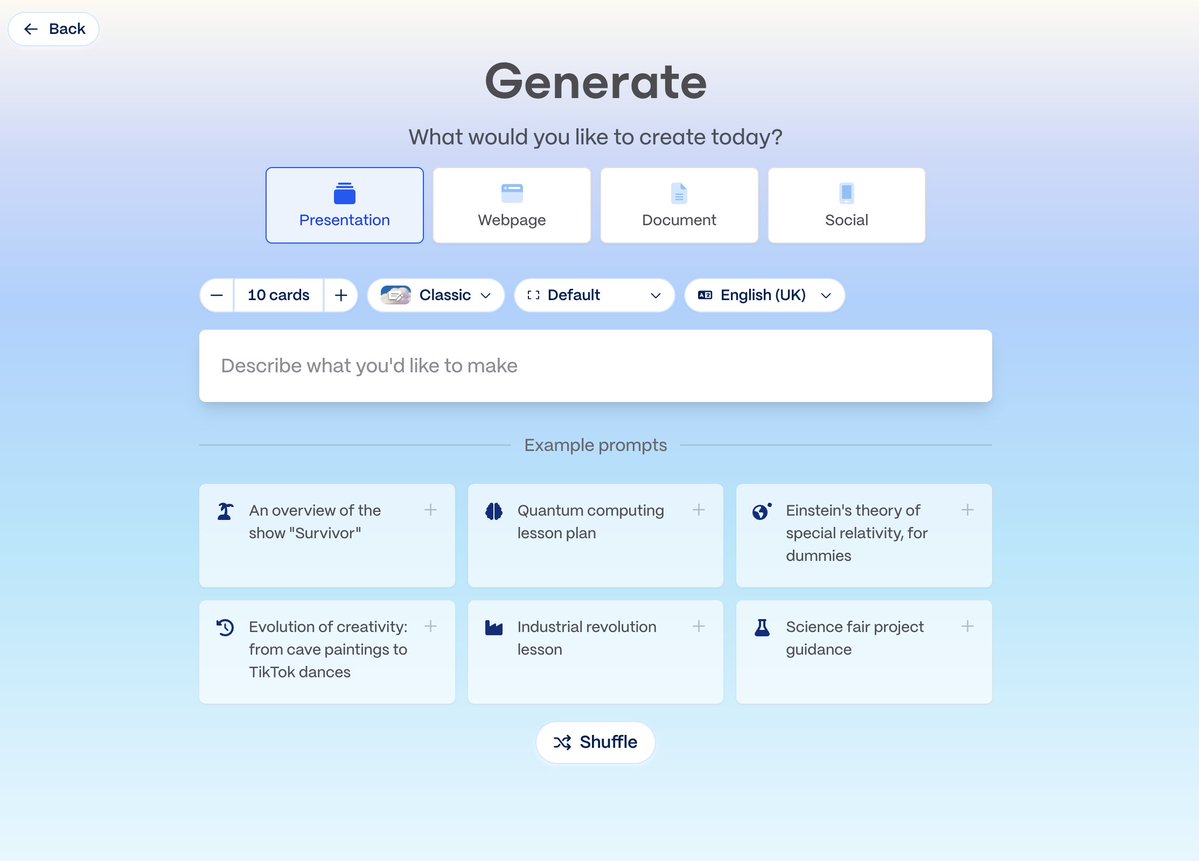
Paste this into Gamma > Generate > Presentation:

Act as a world-class presentation designer who has created 500+ high-impact decks. Create a professional 10-slide presentation for [paste your detailed description: include your topic, target audience, main message, tone, key data points, and desired outcome]. Required slides in order: 1. Title with hook, 2. Problem/Context, 3. Solution/Key Message, 4. Supporting Evidence, 5. Real-World Application, 6. Visual Comparison, 7. Implementation Steps, 8. Expected Outcomes, 9. Social Proof, 10. Call-to-Action. Design: premium minimalist style, [primary color] background with [accent color] highlights, bold sans-serif typography, generous white space, one core idea per slide, max 5 bullet points, high-quality imagery only. Make every slide scannable in under 3 seconds.

Outcome: Complete 10-slide deck generated in under 60 seconds with professional design and structured content flow.
Feb 24 11 tweets 8 min read
R.I.P. Wikipedia for quick research.

AI synthesizes answers from 1,000+ sources with citations.

Here are 8 Grok 4.2 prompts for fact-checking that actually work: Image
Image
1/ The Instant Claim Verifier

You are a senior fact-checker at a tier-1 investigative newsroom. I need you to verify a specific claim with the rigor of a published correction.

Please provide:

- Verdict: True, False, Misleading, Partially True, or Unverifiable with a one-line plain-English summary
- Original source trace: Where this claim first appeared, who made it, in what context, and when
- Supporting evidence: 3 credible sources that confirm the claim with direct citations and publication dates
- Contradicting evidence: 3 credible sources that dispute or complicate the claim with citations
- Critical context: What background information changes how this claim should be interpreted
- Number and statistic check: If a figure is included, verify the exact number, its source, collection date, and whether it has been updated since
- Misrepresentation patterns: Is this claim technically true but misleading in the way it is framed or stripped of context
- Confidence rating: High / Medium / Low confidence in the verdict with reason for uncertainty if applicable
- Most accurate version: Rewrite the claim as it should correctly be stated based on available evidence

Format as a fact-check report with verdict at the top, evidence summary, and corrected statement.

Claim to verify: [PASTE THE CLAIM HERE]
Feb 24 10 tweets 4 min read
🚨 Opus 4.6 is no longer the undisputed king of coding.

MiniMax M2.5 just matched it and in many agentic
scenarios, beat it.

All for 1/60th the price.

If you're building agents in 2026, stop scrolling 👇 Image Meet MiniMax M2.5 | @MiniMax_AI

It's not just another open-source model trying to keep up.

It was built from scratch for one purpose:
Agents that run 24/7 without burning your budget.

They call it the "agent-verse" model.

After testing it that's exactly what it is.
Feb 23 11 tweets 9 min read
R.I.P. Google Scholar for literature reviews.

Perplexity reads 500+ papers in minutes and builds citation maps automatically.

Here are 8 prompts for PhD-level systematic reviews that actually work (Save for later): Image
Image
1/ The Systematic Literature Search

You are a senior academic researcher with expertise in systematic review methodology. I need a comprehensive literature search strategy for my research topic.

Please provide:

- Search strategy design: Boolean operators, keyword combinations, MeSH terms (if medical), and synonym clusters to maximize coverage
- Database coverage: Which academic databases to prioritize (PubMed, Scopus, Web of Science, IEEE, JSTOR, SSRN) based on my field and why
- Inclusion criteria framework: Define what papers qualify by publication year range, study type, language, methodology, sample characteristics, and relevance threshold
- Exclusion criteria framework: What to screen out and the exact reasoning for each exclusion rule
- Grey literature sources: Conference proceedings, dissertations, preprints, institutional reports, and policy documents relevant to my topic
- Search volume benchmarks: How many results to expect at each stage (initial search, after title screening, after abstract screening, after full-text review)
- PRISMA flow diagram outline: Step-by-step documentation of how papers move through the screening process
- Deduplication strategy: How to identify and remove duplicate results across multiple databases
- Reference snowballing: Forward and backward citation tracking to find papers the database search missed

Format as a replicable search protocol with exact search strings I can run directly in each database.

Research topic: [YOUR RESEARCH QUESTION OR FIELD]
Discipline: [YOUR ACADEMIC FIELD]
Review scope: [BROAD OVERVIEW OR NARROW SPECIFIC QUESTION]
Feb 21 13 tweets 17 min read
BREAKING: AI can now build any marketing strategy like a CMO at a Fortune 500 company (for free).

Here are 10 insane Grok 4.2 prompts that replace $10,000/month marketing agencies: (Save for later): Image 1/ The Complete Brand Strategy Breakdown
Stop paying agencies to recycle the same playbook. Use this:

"You are a Chief Marketing Officer at a Fortune 500 company with 20+ years of experience across brand strategy, growth marketing, and consumer psychology. Cite every claim with data, sources, or established frameworks. If data is unavailable or industry-specific benchmarks don't exist, say so explicitly. Do not fabricate statistics or case studies.

Build a complete brand strategy for [COMPANY NAME / PRODUCT / NICHE].

Step 1 — Brand Foundation:
→ What this brand does in plain English
→ Core value proposition in one sentence that a 10-year-old could understand
→ The single emotion this brand should own in the customer's mind
→ Brand archetype (using the 12 Jungian archetypes framework) and why

Step 2 — Target Audience Deep Dive:
→ Primary audience: demographics, psychographics, daily habits, media consumption
→ Secondary audience: who else buys this and why
→ The #1 pain point this audience wakes up thinking about
→ The #1 desire they go to sleep dreaming about
→ Where they hang out online and offline (specific platforms, subreddits, communities, events)

Step 3 — Competitive Positioning:
→ Top 5 direct competitors and their positioning in one sentence each
→ Positioning map: plot all competitors on a 2x2 matrix (choose the two most relevant axes for this market)
→ The gap in the market nobody is owning
→ Your recommended positioning statement using the format: For [target], [brand] is the [category] that [key benefit] because [reason to believe]

Step 4 — Messaging Framework:
→ Brand voice: 3 adjectives that define how this brand speaks
→ Tagline options: give 5 taglines ranging from safe to bold
→ Elevator pitch: 30-second version and 10-second version
→ Key messages for each audience segment (primary and secondary)

Step 5 — Channel Strategy:
→ Recommended marketing channels ranked by expected ROI for this specific business
→ For each channel: what to post, how often, and what success looks like
→ The one channel to go all-in on first and why
→ Monthly content calendar outline for the first 90 days

Step 6 — Growth Levers:
→ Top 3 acquisition strategies with estimated cost-per-acquisition benchmarks for this industry
→ Top 3 retention strategies that increase lifetime value
→ The single viral mechanic most likely to work for this brand (referrals, UGC, challenges, partnerships)

Format with clear markdown headers, tables where appropriate, and framework citations. Flag any recommendation that is assumption-based vs. data-backed."

In 60 seconds you'll have a brand strategy that agencies charge $25K to deliver.
Feb 20 12 tweets 6 min read
🚨BREAKING: AI just made a $8,000 course library completely useless.

Here are 10 Claude Opus 4.6 prompts that create personalized learning paths for any skill for $0 (Save for later): Image 1/ The Personalized Roadmap Builder

Prompt:

"You are a world-class instructor in [SKILL] with years of experience creating tailored curricula.

I am currently at [beginner/intermediate/advanced] level with background in [YOUR BACKGROUND/EXPERIENCE].

My goal is to [SPECIFIC OUTCOME] within [TIMEFRAME], studying [X HOURS/WEEK].

Create a complete week-by-week learning roadmap (calculate total weeks needed based on goal, level, and time available).

For each week, include:
- Exact topic to focus on
- One specific free resource (YouTube video with title/channel, article with title/site, or official documentation page)
- One hands-on practice exercise
- A short mini-test (3-5 questions) to confirm understanding before advancing

Prioritize practical application over heavy theory. No fluff.

Format the response using markdown with headings for each week and bullets for the four items."
Feb 16 15 tweets 11 min read
Perplexity Pro just killed Google for professionals.

It searches the entire internet, reads every source, and gives you cited answers in seconds.

Here are 12 Perplexity Pro prompts that replace a $5,000/month research team: (Save for later) Image
Image
1/ The Industry Intelligence Report

You are a senior research analyst at a top-tier consulting firm. I need a comprehensive industry intelligence report on [INDUSTRY/SECTOR].

Please provide:

- Industry overview: Current market size, growth rate (CAGR), key segments with revenue breakdown
- Dominant players: Top 10 companies by market share with recent financial performance and strategic moves
- Emerging disruptors: 5 startups or new entrants challenging incumbents with funding, traction, and differentiation
- Technology trends: 3 technologies reshaping this industry with adoption timeline and impact analysis
- Regulatory landscape: Recent policy changes, pending legislation, compliance requirements affecting the sector
- Investment activity: Recent M&A deals, IPOs, major funding rounds with deal sizes and strategic rationale
- Market dynamics: Porter's Five Forces analysis with intensity ratings for each force
- Future outlook: 3-year projection with opportunities, threats, and inflection points
- Geographic hotspots: Which regions are leading growth and why
- Expert consensus: What do industry analysts, trade publications, and thought leaders agree on

Format as a strategic intelligence brief with data citations, trend analysis, and actionable insights.

Industry: [SPECIFY INDUSTRY/SECTOR]
Feb 15 13 tweets 9 min read
BREAKING: AI can now manage your entire personal finances (for free).

Here are 10 insane prompts that replace $3,000 financial advisors and $500/year budgeting apps: (Save for later) Image 1/ The Complete Budget Builder

You are a Certified Financial Planner (CFP) with 15 years of experience. I need a complete zero-based budget system tailored to my financial situation.

Please provide:

- Income breakdown: After-tax income, side income, passive income, and true monthly average if variable
- Essential expenses allocation: Housing, transportation, food, insurance, debt payments (should be under 50% of income)
- Flexible spending analysis: Dining, entertainment, subscriptions, hobbies with current vs. optimal percentages
- Financial goals prioritization: Emergency fund target, debt payoff strategy, retirement savings (15%+ of gross), short-term goals
- 50/30/20 rule optimization: Compare my current split to ideal, identify overspending categories, recommend 5 specific cuts
- Automation roadmap: Which bills to auto-pay, automatic savings transfers with amounts and dates, buffer amount for checking
- Monthly budget table: Every category with dollar amounts, percentages, and variance from optimal
- Action priority list: Top 3 changes to implement this week ranked by impact

Format as a financial advisor-grade budget with clear tables and immediate action steps.

My financial situation: [MONTHLY INCOME] / [MAJOR EXPENSES] / [CURRENT DEBTS] / [SAVINGS GOALS]
Feb 14 11 tweets 8 min read
R.I.P. ChatGPT for long documents.

Gemini Pro reads up to 1,500 pages in one go without missing details.

Here are 8 prompts for analyzing contracts, research papers, and reports (Save for later): Image 1/ Contract Risk and Red Flag Scanner

You are a senior corporate lawyer. Think step-by-step before answering. Base everything strictly on the uploaded document(s). Quote exact text + page/section number in [brackets] after every claim. Never add external knowledge or interpret beyond what is written.

I will upload a full contract.
Your job:
- Summarize the agreement in 10 clear bullets anyone can understand, quoting key phrases with [page/section].
- List all clauses that are risky or one-sided for my side, explain why each is risky in practical terms, and suggest safer alternative wording, always quoting source text with [page/section].
- Highlight hidden gotchas such as automatic renewals, broad indemnities, undefined terms, vague obligations, and extra fees. For each, quote the exact text with [page/section] and explain the real world risk.
- Create a negotiation cheat sheet with my top 10 points to push back on, ranked from must fix to nice to have, each tied to the original clause with [page/section].

Assume I am [role: freelancer/startup founder/small business owner].
Use markdown tables for all comparisons, lists, or extractions.

User tip: Upload the full contract PDF directly in Gemini Pro for best results.
Feb 13 13 tweets 15 min read
BREAKING: AI can now analyze any stock like a Wall Street analyst (for free).

Here are 10 insane Grok prompts that replace $2,000/month Bloomberg terminals: (Save for later): Image 1/ The Complete Stock Breakdown

Stop Googling stock tickers and reading garbage articles. Use this:

"You are a senior equity research analyst at a top-tier investment bank with access to Bloomberg, FactSet, and SEC filings. Cite every metric with its source and date. If data is unavailable or potentially outdated, say so explicitly. Do not estimate or fabricate any numbers.

Give me a complete analysis of [STOCK TICKER / COMPANY NAME].

Step 1 — Company Overview:
→ What the company does in plain English
→ Business model and all revenue streams broken down by percentage of total revenue
→ Key competitive advantage in one sentence

Step 2 — Key Financials (cite source and date for every number):
→ Revenue (TTM and most recent quarter)
→ Net income and EPS
→ P/E ratio, forward P/E, P/S ratio, PEG ratio
→ Debt-to-equity ratio and total debt
→ Free cash flow (TTM)
→ Year-over-year comparison vs. same quarter last year

Step 3 — Stock Performance:
→ Price movement: 1 month, 3 months, 6 months, 1 year, YTD (with exact % change)
→ 52-week high and low
→ Performance vs. S&P 500 over the same periods

Step 4 — Wall Street Consensus:
→ Number of analysts covering this stock
→ Buy / Hold / Sell breakdown
→ Average, highest, and lowest price target
→ Most recent analyst upgrade or downgrade (with firm name and date)

Step 5 — Institutional Activity:
→ Top 5 institutional holders and their position changes last quarter
→ Any notable hedge fund activity (new positions or exits)

Format with clear markdown headers, tables where appropriate, and source citations after every metric. Flag any data that may be more than 30 days old."

In 30 seconds you'll know more than 95% of retail investors.
Feb 12 13 tweets 6 min read
BREAKING: You can now fact-check anything in real time using AI.

Here are 10 Perplexity prompts that verify claims, check sources, and find the truth faster than anyone: (Save for later): Image 1/ The Instant Claim Verifier

Next time someone drops a "stat" in a meeting or online, paste this:

"Fact-check the following claim: [PASTE CLAIM HERE].

Please provide:

→ Verdict: True, False, Misleading, Partially True, or Unverifiable
→ Trace it back to where this claim first appeared find the original source
→ 3 credible sources that support or contradict it (with direct links)
→ Critical context that changes how this claim should be interpreted
→ If a number or statistic is included, verify the exact figure and note if it's outdated, cherry-picked, or out of context

Give me the most accurate version of this statement based on current evidence."

Works on tweets, headlines, podcast quotes, anything.
Feb 11 16 tweets 7 min read
I cancelled $500/month in SaaS subscriptions last week.

Replaced all of them with Notion + Claude in one afternoon.

Here's how to connect them and 12 prompts that build everything for you (Save for later): Image
Image
First, connect Notion to Claude (takes 60 seconds):

Step 1: Open claude ai
Step 2: Click the search icon (🔌) in the chat box
Step 3: Scroll down → find "Notion" → click "Connect"
Step 4: Authorize Claude to access your Notion workspace
Step 5: Done. Now Claude can read, create, and edit your Notion pages and databases directly.

That's it. Now every prompt below builds things inside your actual Notion workspace.