tom cunningham Profile picture
Economics & AI @ @METR_Evals (ex-openai) https://t.co/FZobuYjdOc
Jul 13 7 tweets 3 min read
Very happy to share the first paper from @ElasticityInst: The Economics of Recursive Self-Improvement. Two parts:

(1) a graphical representation of feedback loops, to formalize a variety of RSI-related arguments, where each arrow represents responsiveness (elasticity);

(2) a survey of existing evidence with a loose calibration & a “wish list” of evidence that would help us calibrate better.Image Elasticity is the name for our new collective working on Econ of AI: @andrewjkoh @arjun_ramani3 @BasilHalperin @brian_jabarian @cherylwoooo @AlthoffLukas @whitfill_parker @pawtrammell & myself.
May 29 5 tweets 1 min read
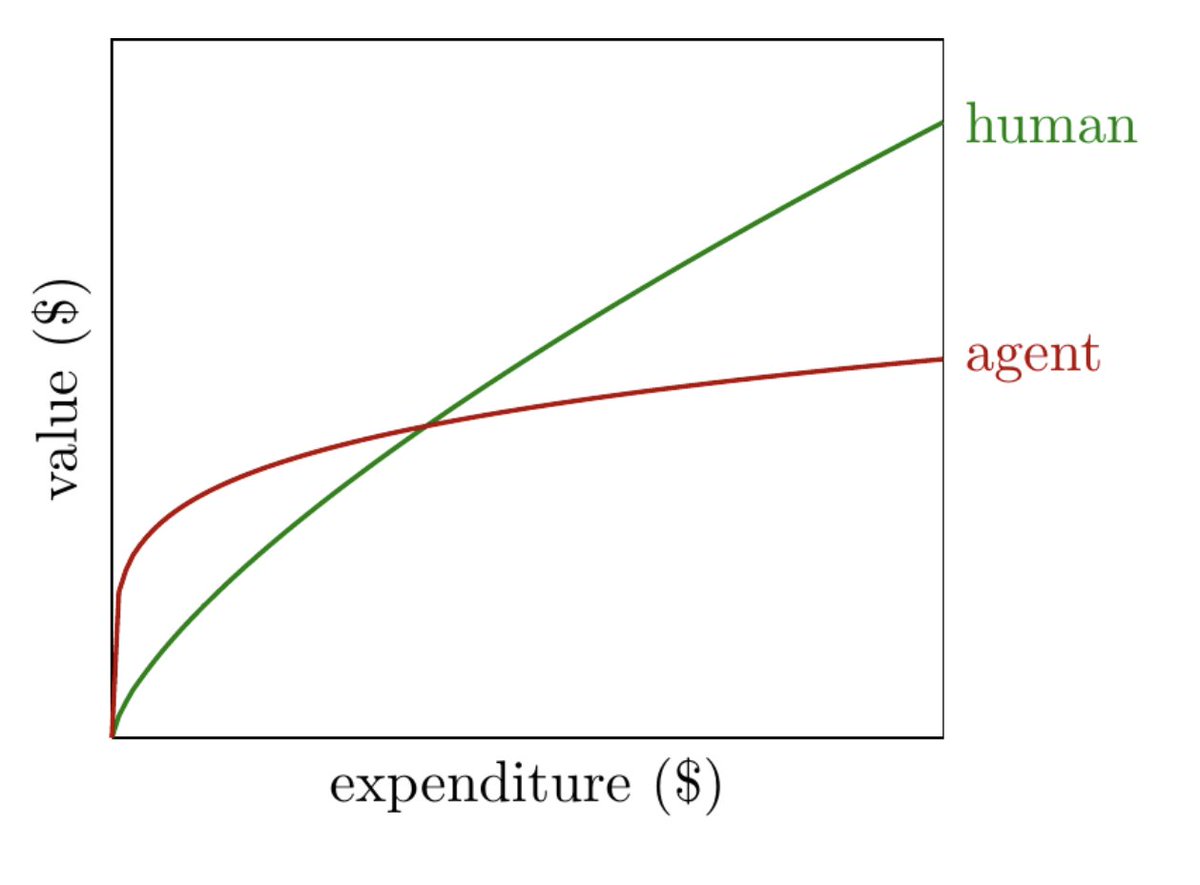
I think most domains look like this at the moment: the returns to expenditure on agents diminish much more quickly than the returns to expenditure on human labor: (1/n) Image Corollary: for most quality levels, either an agent can do it much cheaper than a human, or it can't do it at all.
Jan 22 5 tweets 1 min read
Cadillac tasks: I believe many estimates of LLM productivity boosts are over-estimates because people are using them for cadillac tasks: things that would take you a long time unaided, but have only marginal additional value. E.g.:
- "write tests for this whole codebase"
- "identify this species of finch"
- "write a literature review on this topic I'm marginally interested in"
- "fact check this long document"

I can do 80 hours of work in an 8-hour workday, but this isn't a true 10X boost.
Nov 6, 2025 7 tweets 2 min read
I made a list of forecasts of the impact of AI on economic growth over the next decade.

A few observations... (🧵):

tecunningham.github.io/posts/2025-10-…Image 1. Economists and AI people disagree: most economists expect 0.1--1.5%/year ; most AI-people expect 3--30%/year.

Economists have often assumed that generative AI is a one-time technology shock, and so they only forecast its diffusion, without forecasting AI improvement.
Oct 2, 2025 6 tweets 2 min read
I wrote a long blot post on the economics of AI, prompted by two great workshops (Windfall and NBER), and me leaving OpenAI for METR:

TLDR: we driving in the fog.

1. There is no standard model of AI’s economic impact. Economists have been using a wide range of assumptions to model AI’s impact, there is no standard framework. There seems to me an opportunity for ambitious economists to propose deep models of AI’s impact. A promising line would concentrate on AI’s ability to find low-dimensional representations of the world. 2. GDP will be a poor proxy for AI’s impact. AI’s benefits are likely to elude GDP for two reasons: (1) it will reduce the necessity for exchange (and GDP measures exchange); (2) it will lower the labor required for services, and the value-added from services are typically imputed from the wage-bill.