The Dossier Profile picture
India’s chronicle of politics, society, religion, culture and law — rooted in truth. Email pitches to editor@thedossier.in.
Jul 20 8 tweets 6 min read
On 10 July 2026, the Catholic Bishops’ Conference of India (CBCI) walked into Home Minister Amit Shah’s office and asked him to withdraw the very bill this piece is about. Cardinal Anthony Poola and Archbishop Anil Couto handed the Home Minister a memorandum arguing the FCRA amendments would cripple charitable institutions built over decades.

However, Shah’s reported reply is worth sitting with before I make my own argument, because he made it for me. He told the delegation the amendments “should not be viewed as being directed against the Christian community,” and that donations to Christian organisations amount to only a fraction of what the law actually regulates.

I didn’t say that line. The Home Minister of our nation did, in a private meeting. It is the same claim I’m about to spend several thousand words defending.

By A Shaw

thedossier.in/2026-fcra-amen…Image “It may be dangerous to be America’s enemy, but to be America’s friend is fatal.”
The remark, widely attributed to Henry Kissinger, stayed with me long after I first encountered it. I had been reading about the making of the United States: how Native American societies were ethnically cleansed, displaced, converted and, ultimately, swallowed one treaty at a time, into an expanding republic that regarded its own civilisation as both inevitable and benevolent.

thedossier.in/2026-fcra-amen…
May 27 5 tweets 6 min read
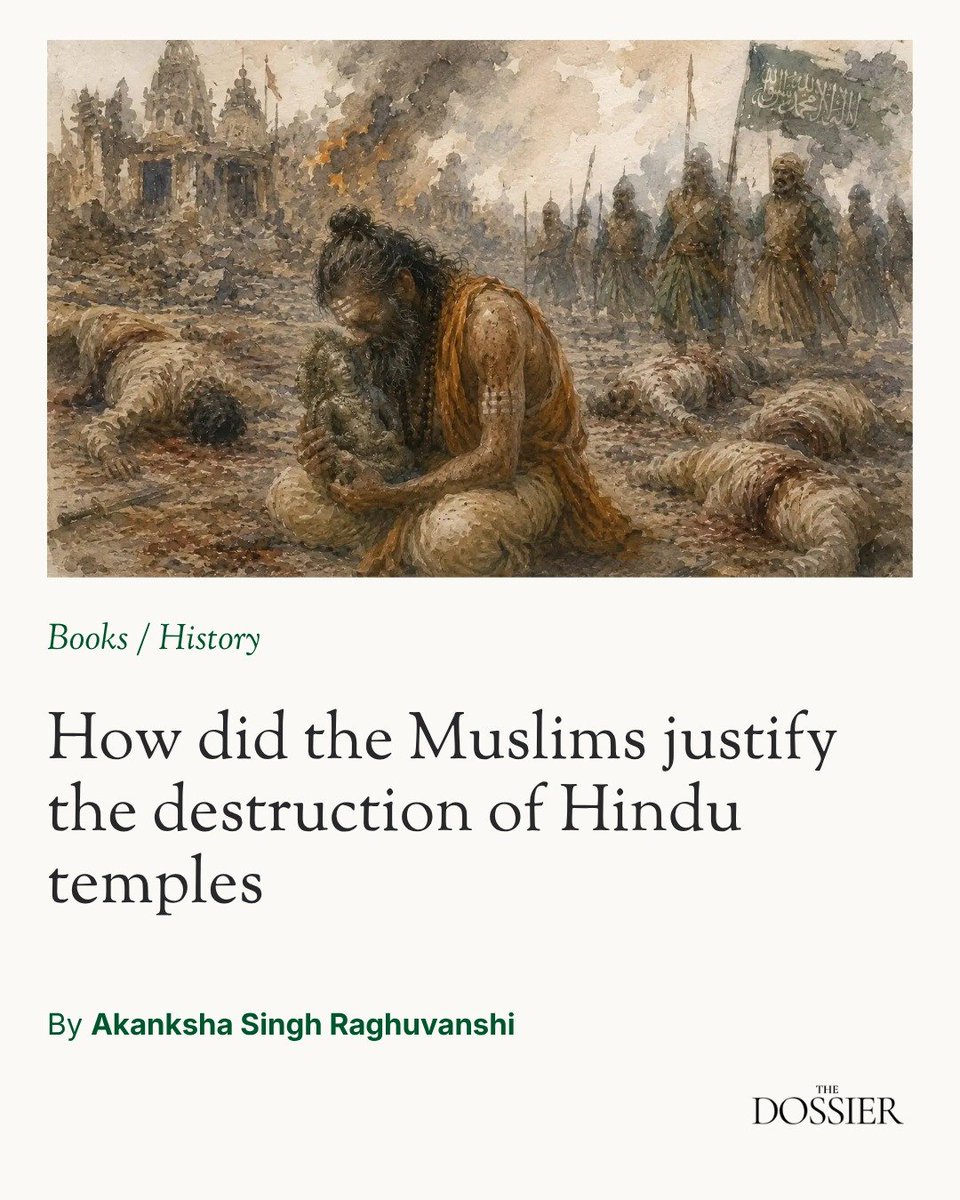
In his celebrated historical work Kitab al-Yamini, Abu Nasr Muhammad ibn Muhammad al Jabbarul-Utbi, who served as the secretary to Mahmud of Ghazni, provides a vivid and detailed account of the conquest of Thaneshwar (present-day Thanesar in Haryana). Al-Utbi writes: ‘The blood of the infidels flowed so copiously that the stream was discoloured, not withstanding its purity, and people were unable to drink it… The victory was gained by God’s grace, who has established Islam for ever as the best of religions, notwithstanding that idolaters revolt against it… Praise be to God, the protector of the world, for the honour he bestows upon Islām and Musulmans.’

What does this quote do? At least, for me, it celebrates the killing of the infidels, a religion, its God and Muslims for a victory. History is not merely a collection of dates, dynasties, and battles. It is the collective memory of a civilization—its triumphs, its wounds, its moments of glory, and its deepest traumas. Some chapters inspire pride; others demand solemn reflection. Among the most painful and transformative periods in the history of Bharat is the long era of Islamic invasions.

By Akanksha Singh Raghuvanshi (@singhhakanksha_)

thedossier.in/muslims-justif…Image Spanning over a millennium, this era commenced with the Arab conquest of Sindh under Muhammad bin Qasim and extended through the relentless raids of the Ghaznavid dynasty under Mahmud of Ghazni, the decisive campaigns of the Ghurid forces led by Muhammad of Ghor, the establishment and relentless expansion of the Delhi Sultanate with its five successive dynasties—the Mamluk (Slave) Dynasty, the Khalji Dynasty, the Tughlaq Dynasty, the Sayyid Dynasty, and the Lodi Dynasty and ultimately culminated in the founding of the Mughal Empire by Babur which endured in various forms until its eventual decline.

Babur was not an exception, but the norm. And here we have writers like Parvati Sharma, trying to repaint Babur, as sensitive poet-gardener who also wished to transform Hindustan and his one of the deepest contribution to Hindustan was flowers, melons, and charbaghs — as if aesthetic taste somehow washes away conquest and bloodshed. Babur himself never hid who he was. After capturing Chanderi in 1528, he wrote: ‘I attacked Chanderī and, by the grace of Allah, captured it in a few hours… We got the infidels slaughtered and the place which had been a dāru’l-harb for years, was made into a dāru’l-Islām.’

thedossier.in/muslims-justif…