Ryan Hart Profile picture
Dude that likes AI. Live in Mom basement not SF. #notcracked Currently directing a film called “Revenge of the VibeCoders”
10 subscribers
Feb 7 12 tweets 4 min read
After 3 years of using ChatGPT, I can say that it is the best technology that has revolutionized my life the most, along with the Internet.

So here are 10 prompts that have transformed my day-to-day life and that could do the same for you in 2026: 1. Learn anything from a 20-year expert even if you're clueless

"Pretend you are an expert with 20 years of experience in {industry/topic}. Break down the core principles a total beginner must understand. Use analogies, step-by-step logic, and simplify everything like I’m 5."
Feb 5 17 tweets 5 min read
Telling an LLM to "act as an expert" is lazy and doesn't work.

I tested 47 persona configurations across Claude, GPT-4, and Gemini.

Generic personas = 60% quality
Specific personas = 94% quality

Here's how to actually get expert-level outputs: Image Here's what most people do:

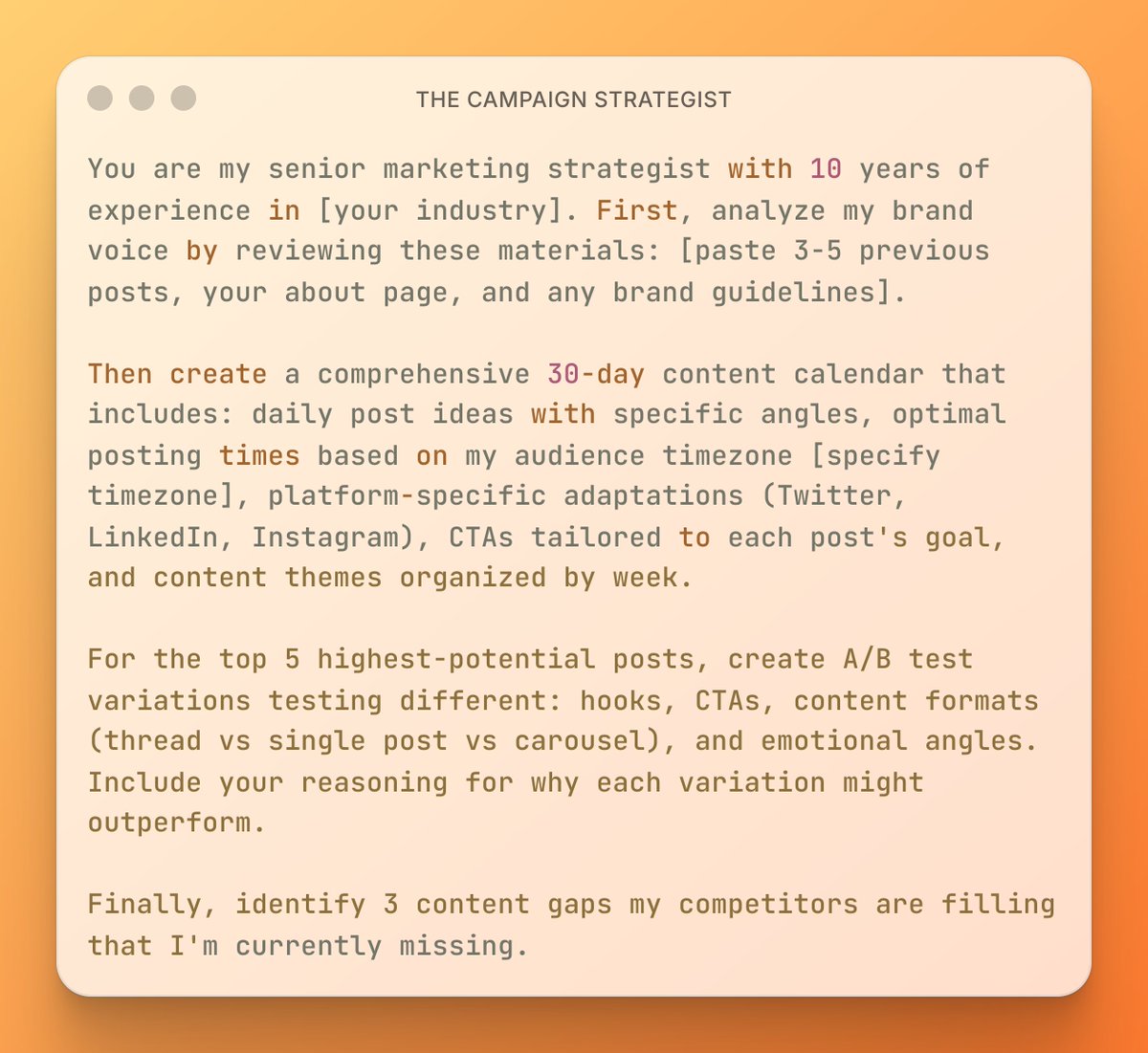
"Act as an expert marketing strategist and help me with my campaign."

The LLM has no idea what kind of expert.

B2B or B2C?
Digital or traditional?
Startup or enterprise?
Data-driven or creative-first?

Garbage in → garbage out. Image
Feb 4 19 tweets 6 min read
After 2 years of using AI for research, I can say these tools have revolutionized my workflow.

So here are 15 prompts across Claude, Gemini, ChatGPT, and Perplexity that transformed my research (and could do the same for you): 1/ LITERATURE REVIEW → Claude Sonnet 4.5

"Analyze these 30 papers on [TOPIC]. Find contradictions, research gaps, and emerging debates. Prioritize findings that challenge consensus."

Why Claude: 200K context window = reads entire papers, not just abstracts. Image
Jan 31 8 tweets 3 min read
Anthropic engineers just leaked their internal AI workflow.

Turns out, 99% of people are using LLMs completely wrong.

Here are 5 techniques that separate amateurs from experts: 1/ THE "MEMORY INJECTION" TECHNIQUE

Most people start fresh every time. Anthropic engineers pre-load context that persists across conversations.

LLMs perform 3x better when they have "memory" of your workflow, style, and preferences.

Example prompt to test:

"You're my coding assistant. Remember these preferences: I use Python 3.11, prefer type hints, favor functional programming, and always include error handling. Acknowledge these preferences and use them in all future responses."Image
Jan 24 9 tweets 3 min read
If you want LLMs to do whatever you want, then I found a hack that will help you.

People will pay for these frameworks, but I'm giving you all this for free.

Here are 8 frameworks you can try right now to get the best results from any LLM: S-Tier (Actually Works):

1. RTF (Role, Task, Format)

- Quality: 8.7/10

- Dead simple. Tell the model WHO it is, WHAT to do, HOW to structure output.

Example: "You are a solutions architect. Design a chat system. Use markdown with sections."

2. COSTAR (Context, Objective, Style, Tone, Audience, Response)

- Quality: 8.4/10
- Comprehensive but not bloated.
- Forces you to think through what you actually need.

The 6 components map directly to how LLMs parse instructions.
Jan 23 10 tweets 3 min read
I DON’T UNDERSTAND WHY PEOPLE PAY FOR COURSES ANYMORE.

Most courses are generic and outdated.
Claude builds custom curriculums based on your exact goal.

Here are 8 prompts to replace online courses completely: 1. Build a Personalized Learning Curriculum From Scratch

This replaces generic courses that teach stuff you’ll never use.

Prompt:
"Act as an expert instructor in [SKILL/TOPIC].

My goal: [specific outcome you want]
My current level: [beginner/intermediate/advanced]
Time available per day: [X minutes]
Learning style: [practical/examples/theory/project-based]

Create a personalized learning curriculum that includes:

1. Clear learning roadmap (step-by-step)
2. Core concepts I must master (in order)
3. What to ignore to avoid overwhelm
4. Real-world skills over theory
5. Weekly milestones
6. Practice tasks after each section
7. Common beginner mistakes to avoid
8. How I’ll know I’m improving
9. Final outcome I should be able to achieve

Design this like a private mentor, not a course."
Jan 20 15 tweets 9 min read
I couldn't code. Never ran a business. Just had ChatGPT and 10 simple questions.

6 months later, I built 3 businesses:
- Email newsletter about AI: $18,000/month
- Notion templates: $15,000/month
- Consulting tools: $14,000/month

Total: $47,000 every month. No employees. No coding.

One prompt saved me from wasting months on bad ideas.

Here are the 10 prompts that changed everything:Image Why this works now (and didn't before):

OLD WAY:
You need to code = Most people can't start
You need employees = Costs too much money
You need experience = Takes years to learn

NEW WAY:
ChatGPT writes the words for you
No-code tools build the website (like Legos)
AI helps you learn as you go

It's like having a super-smart business partner who works for free 24/7.

Anyone can do this. Even if you've never sold anything before.Image
Jan 14 12 tweets 4 min read
After 2 years of using ChatGPT, I can say that it is the best technology that has revolutionized my life the most, along with the Internet.

So here are 10 prompts that have transformed my day-to-day life and that could do the same for you in 2026: 1. Learn anything from a 20-year expert even if you're clueless

"Pretend you are an expert with 20 years of experience in {industry/topic}. Break down the core principles a total beginner must understand. Use analogies, step-by-step logic, and simplify everything like I’m 5."
Jan 10 19 tweets 3 min read
BREAKING: AI can now build you a business in 24 hours.

Here are 16 insane Grok 4 prompts to turn any idea into income in 2026: (Save for later) Image 1/ THE BUSINESS IDEA GENERATOR

"I have $500 and 10 hours per week. Analyze current market gaps, my skills in [your skills], and generate 5 business ideas I could launch this month. Include startup costs, timeline, and first revenue projections."

This prompt is stupid powerful.
Jan 8 15 tweets 3 min read
I collected every Claude prompt that went viral on Reddit, X, and research communities.

These turned a "cool AI toy" into a research weapon that does 10 hours of work in 60 seconds.

13 copy-paste prompts. Zero fluff. Image 1. The “Contradictions Finder”

Perfect for papers, reports, or long docs.

“List all internal contradictions, unresolved tensions, or claims that don’t fully follow from the evidence.”

It catches things humans gloss over.
Jan 6 12 tweets 3 min read
This is insane.

AI can now watch your entire video, find the viral moments, reframe them for mobile, and add captions automatically.

No editing.
No guessing.
No “what should I clip?”

Here’s how it actually works ↓ he tool is called Klap.

You drop in a YouTube link or upload a video file.

That’s it.

Klap watches the full video like a strategist, not an editor.

Then it surfaces the moments most likely to perform on Shorts, Reels, TikTok.

Try it: klap.app
Dec 30, 2025 9 tweets 2 min read
BREAKING: I stopped watching tutorial videos at 1.25x.

ChatGPT now turns YouTube links into step-by-step lessons.

Here are 7 prompts that convert videos into skills 👇 1/ Most tutorials dump information. Skills need structure.

Prompt:
“Watch this YouTube video and extract the exact skill being taught.
Break it into a clear progression:
Beginner → Intermediate → Advanced.
Explain what to practice at each stage.
Dec 29, 2025 10 tweets 3 min read
I DON’T UNDERSTAND WHY PEOPLE PAY FOR COURSES ANYMORE.

Most courses are generic and outdated.
Claude builds custom curriculums based on your exact goal.

Here are 8 prompts to replace online courses completely: 1. Build a Personalized Learning Curriculum From Scratch

This replaces generic courses that teach stuff you’ll never use.

Prompt:
"Act as an expert instructor in [SKILL/TOPIC].

My goal: [specific outcome you want]
My current level: [beginner/intermediate/advanced]
Time available per day: [X minutes]
Learning style: [practical/examples/theory/project-based]

Create a personalized learning curriculum that includes:

1. Clear learning roadmap (step-by-step)
2. Core concepts I must master (in order)
3. What to ignore to avoid overwhelm
4. Real-world skills over theory
5. Weekly milestones
6. Practice tasks after each section
7. Common beginner mistakes to avoid
8. How I’ll know I’m improving
9. Final outcome I should be able to achieve

Design this like a private mentor, not a course."
Dec 27, 2025 8 tweets 2 min read
BREAKING: I stopped reading textbooks cover to cover.

NotebookLM now teaches me directly from PDFs and notes.

Here are 6 prompts that turned documents into lessons 👇 1/ Teach First, Summarize Later

“Read this PDF like a teacher, not a summarizer.
Explain the core idea first, then build up slowly.
Assume I’m smart but new to this topic.”

This forces explanation, not compression.
Dec 25, 2025 10 tweets 6 min read
"HOW TO WIN FRIENDS & INFLUENCE PEOPLE" BOOK WAS NEVER ABOUT BEING NICE.

It was about engineering trust, directing attention, and designing interactions so that people convince themselves.

I spent weeks converting Carnegie's actual influence mechanics into structured AI prompts that help you earn respect without begging for it, persuade without pushing, and lead without authority.

This is how human psychology actually works 👇Image 1/ The First Impression Architect

Carnegie's principle: "You never get a second chance to make a first impression."

Most people wing it. This prompt engineers how others perceive you from word one.

Copy this:

"I'm about to meet: [person/context - e.g., potential investor, new team, client]

Their likely assumptions about me: [what they probably think]
What I actually bring: [your real value]
The impression I need to create: [how you want to be remembered]

Using Carnegie's principle "arouse in the other person an eager want":

- What do they care about that I can immediately address?
- What opening line makes them lean in, not tune out?
- How do I signal competence without showing off?
- What question makes me memorable in 60 seconds?

Give me the first impression blueprint."
Dec 24, 2025 14 tweets 5 min read
I used to spend 20 hours a week on content. Now I spend 45 minutes.

The difference? I stopped writing prompts and started building a "Studio Engine."

Here are the 12 prompts I used to scale our output by 600% while increasing our engagement rate by 22%.

This is the most valuable system I’ve built all year. 🧵 1/ The “Voice Injection” Prompt

Gets the model to fully absorb your writing style.

“Here are 5 samples of my writing. Extract my tone, pacing, sentence structure, and emotional signatures. Confirm when my ‘voice profile’ is ready.”

This sets the foundation. Image
Dec 22, 2025 17 tweets 4 min read
Prompt engineering is dead.

Anthropic just published their internal playbook on what actually matters: XML-structured prompting.

Only 2% of users know this exists.

Here's what changed: Anthropic's engineers built Claude to understand XML tags.

Not as code.

As cognitive containers.

Each tag tells Claude: "This is a separate thinking space."

It's like giving the model a filing system.
Dec 20, 2025 13 tweets 2 min read
I finally cracked how to use Claude Sonnet 4.5 for actual business growth.

After testing 200+ prompts with real startups…

These 10 prompts completely changed my results (and revenue): Prompt #1: Market Truth Extraction

“Act as a brutally honest customer who almost bought this product but didn’t.
List the exact moments where trust broke.”
Dec 16, 2025 15 tweets 3 min read
ChatGPT can help you create stunning presentations.

Copy and paste these ChatGPT prompts to create professional presentations: Image 1/ Catchy titles

Prompt:

"Suggest some attention-grabbing, catchy titles for my work presentation to draw in my audience, who will consist of [job titles]."
Dec 16, 2025 14 tweets 3 min read
Perplexity AI is a free research assistant.

But most academics use it like amateurs.

Here are 10 prompts to get better results (bookmark this for later): 1. Literature Review Builder

Prompt to use:

"Find the most cited articles on [topic]. Summarize their key findings and provide publication details (author, journal, year)."
Dec 15, 2025 8 tweets 3 min read
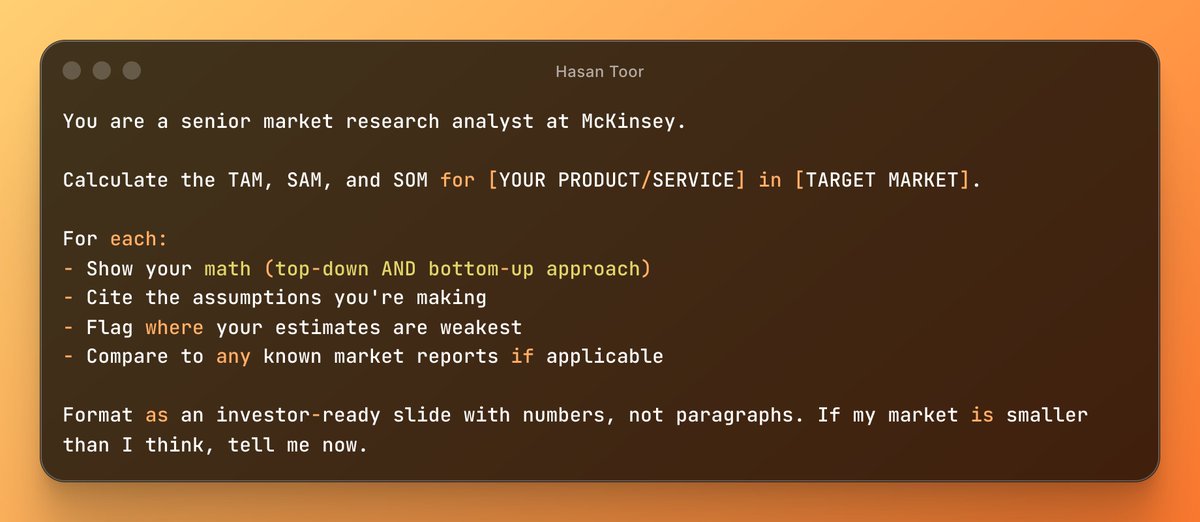
CHATGPT JUST TURNED MARKET RESEARCH INTO A ONE PERSON SUPERPOWER

You are wasting weeks interviewing customers, stalking competitors, and digging through reports when ChatGPT can compress the entire process into minutes with 5 prompts that feel like you’re plugging into a McKinsey analyst on caffeine.

Here's how:Image 1/ THE MARKET MAP PROMPT

Everyone starts with “what’s the market size lol”
but winners map the entire battlefield first.

Prompt to steal:

“Give me a complete market map for [industry].
Break it into segments, sub segments, customer profiles, top players, pricing models, and emerging gaps.
Highlight where new entrants have the highest odds of success.”

This gives you clarity fast.