Fermion Profile picture
If your enemy is superior, evade him. If angry, irritate him. If equally matched, fight, and if not split and reevaluate.
Dec 22, 2025 5 tweets 7 min read
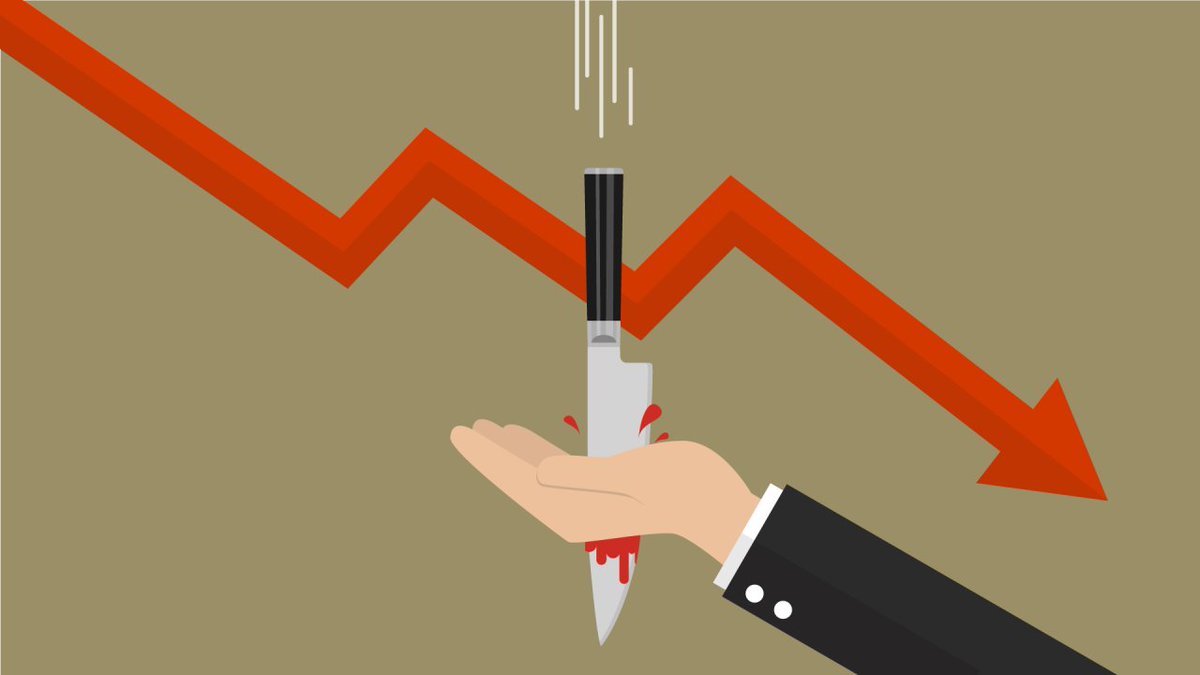
1/ Why I’m investing in $ORCL, despite it being called a “falling knife” 🧵

Buying falling knives is risky. It’s volatile, uncomfortable, and forces you to tolerate sharp drawdowns while everyone around you tells you that you’re early, the narrative turns against you, that you are wrong, or both. I fully agree with that framing. Where I strongly disagree is the idea that all falling stocks are the same, or that buying into weakness is inherently reckless.

What I do not do is buy companies simply because they are falling. Most stocks in free fall deserve it. There is usually no structural reason to build conviction, no clarity on why fundamentals will improve, and no justification for sizing up when the pain increases. In those cases, volatility is a warning sign, not an opportunity. I avoid those almost entirely.

Once every few years, however, something different happens. A company sells off aggressively while the market is misreading a deeper technological or structural transition underneath, similarly to what happened to $VRT a few years ago. In those rare situations, the volatility is not signaling decay; it’s signaling confusion and short-term thinking. That’s when I pay attention, and that’s when I’m willing to act before the narrative turns.

$ORCL is one of those rare cases for me.

This isn’t about valuation tricks, short-term mean reversion, or blind faith in a turnaround. It’s about a long-term bet on where durable AI value actually accrues, and why the market is currently focused on the wrong layers of the stack. To explain that, I need to talk about something that sounds technical, but is actually the core of the entire thesis: RAG.Image 2/ RAG and why it changes where AI value accrues ⚙️
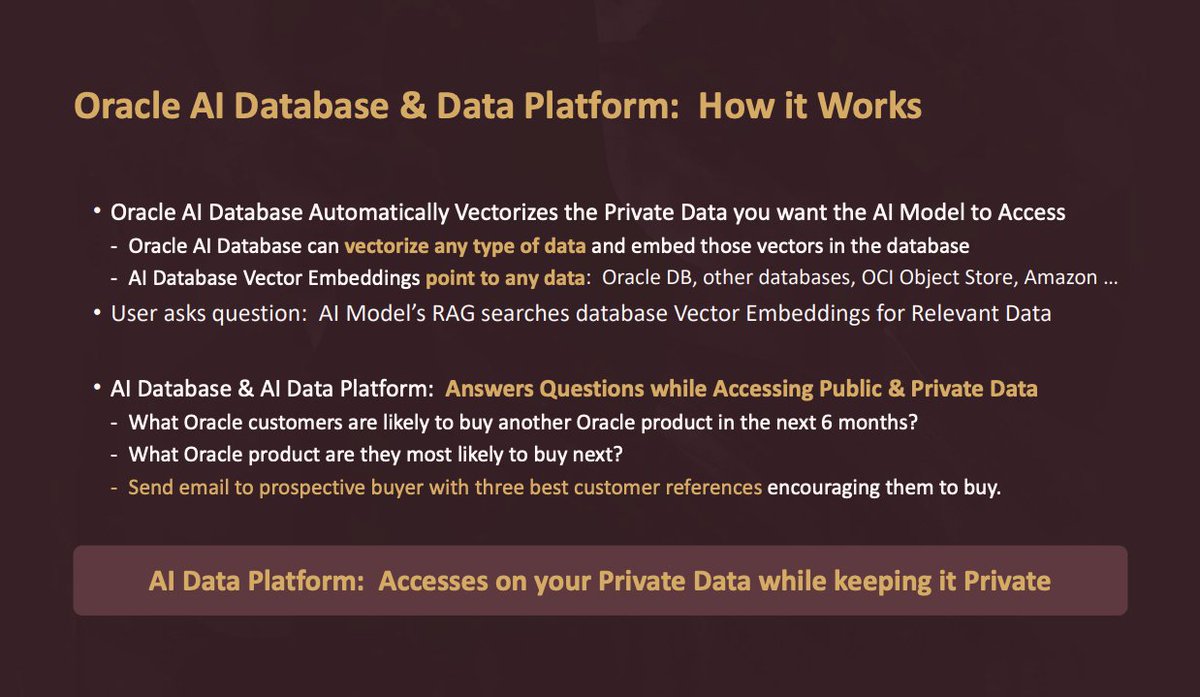
Over the past year I’ve been studying several AI-adjacent themes in depth:

agentic AI in enterprises (e.g. $PATH),
healthcare systems and insurers like $OSCR and $UNH,
and mRNA biotechnology, particularly $BNTX, which were hard to grasp.

All of these areas are transformative. And all of them are extremely hard to invest in cleanly. I could clearly see the end-state - AI agents running enterprises, healthcare systems becoming continuously adaptive, biology becoming programmable - but I couldn’t find a stable place in the value chain where returns wouldn’t be competed away or derailed by regulation, execution risk, or timing.

The breakthrough came when I reframed the problem.
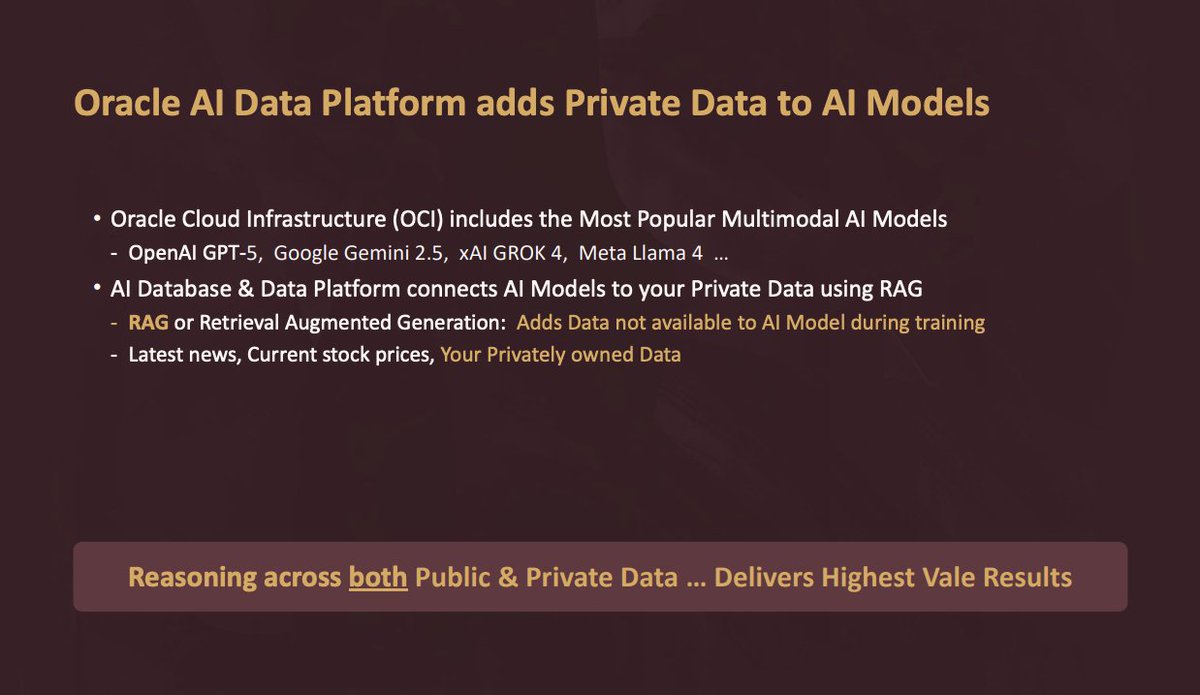
If AI truly transforms enterprises, healthcare, finance, law, logistics, and biotech, the value will not accrue primarily to the models themselves, nor to GPUs or TPU's, nor to flashy demos or bullshit benchmarks. The real leverage sits at the intersection of private data, institutional/governmental workflows, and AI systems that can reason across both. This is where Retrieval Augmented Generation (RAG) becomes foundational.

RAG is often misunderstood as a feature. It isn’t. Large language models are powerful, but they are fundamentally blind to your private data. They don’t know your databases, contracts, patient records, balance sheets, lab results, or internal processes. RAG allows models to retrieve and reason over vectorized private data they were never trained on - securely, in real time, and contextually. That includes proprietary enterprise data, regulated datasets, and constantly changing information.

This is the unifying thread across everything I studied.
Agentic AI needs deep workflow context.
Healthcare AI needs access to regulated patient data.
Biotech AI needs structured experimental and genomic databases.

And that leads to the key insight:

AI value does not come from knowing the internet - which is already public. It comes from knowing your company, your hospital, your lab, your government system.

Once you understand that, the next question becomes obvious: who actually owns, secures, and structures the world’s private data?

The answer is not startups or model providers.
It’s databases.

That realization is what led me to Oracle 🏎️.
Image
Image
Dec 22, 2025 5 tweets 7 min read
1/ Why I’m investing in $ORCL, despite it being called a “falling knife” 🧵

Buying falling knives is risky. It’s volatile, uncomfortable, and forces you to tolerate sharp drawdowns while everyone around you tells you that you’re early, the narrative turns against you, that you are wrong, or both. I fully agree with that framing. Where I strongly disagree is the idea that all falling stocks are the same, or that buying into weakness is inherently reckless.

What I do not do is buy companies simply because they are falling. Most stocks in free fall deserve it. There is usually no structural reason to build conviction, no clarity on why fundamentals will improve, and no justification for sizing up when the pain increases. In those cases, volatility is a warning sign, not an opportunity. I avoid those almost entirely.

Once every few years, however, something different happens. A company sells off aggressively while the market is misreading a deeper technological or structural transition underneath, similarly to what happened to $VRT a few years ago. In those rare situations, the volatility is not signaling decay; it’s signaling confusion and short-term thinking. That’s when I pay attention, and that’s when I’m willing to act before the narrative turns.

$ORCL is one of those rare cases for me.

This isn’t about valuation tricks, short-term mean reversion, or blind faith in a turnaround. It’s about a long-term bet on where durable AI value actually accrues, and why the market is currently focused on the wrong layers of the stack. To explain that, I need to talk about something that sounds technical, but is actually the core of the entire thesis: RAG.Image 2/ RAG and why it changes where AI value accrues ⚙️

Over the past year I’ve been studying several AI-adjacent themes in depth:

agentic AI in enterprises (e.g. $PATH),
healthcare systems and insurers like $OSCR and $UNH,
and mRNA biotechnology, particularly $BNTX, which were hard to grasp.

All of these areas are transformative. And all of them are extremely hard to invest in cleanly. I could clearly see the end-state - AI agents running enterprises, healthcare systems becoming continuously adaptive, biology becoming programmable - but I couldn’t find a stable place in the value chain where returns wouldn’t be competed away or derailed by regulation, execution risk, or timing.

The breakthrough came when I reframed the problem.
If AI truly transforms enterprises, healthcare, finance, law, logistics, and biotech, the value will not accrue primarily to the models themselves, nor to GPUs or TPU's, nor to flashy demos or bullshit benchmarks. The real leverage sits at the intersection of private data, institutional/governmental workflows, and AI systems that can reason across both. This is where Retrieval Augmented Generation (RAG) becomes foundational.

RAG is often misunderstood as a feature. It isn’t. Large language models are powerful, but they are fundamentally blind to your private data. They don’t know your databases, contracts, patient records, balance sheets, lab results, or internal processes. RAG allows models to retrieve and reason over vectorized private data they were never trained on - securely, in real time, and contextually. That includes proprietary enterprise data, regulated datasets, and constantly changing information.

This is the unifying thread across everything I studied.
Agentic AI needs deep workflow context.
Healthcare AI needs access to regulated patient data.
Biotech AI needs structured experimental and genomic databases.

And that leads to the key insight:

AI value does not come from knowing the internet - which is already public. It comes from knowing your company, your hospital, your lab, your government system.

Once you understand that, the next question becomes obvious: who actually owns, secures, and structures the world’s private data?

The answer is not startups or model providers.
It’s databases.

That realization is what led me to Oracle 🏎️.Image
Image
Image
Dec 14, 2025 8 tweets 5 min read
Two Forces Colliding in Markets: Fear of Technology vs Fear of Not Owning It 🧵

Over the next five years, markets will be shaped less by traditional valuation debates and more by a deep psychological and generational clash.

Not bulls vs bears.
Not growth vs value.

But two fundamentally different fears - embodied by two types of investors. 👇Image Investor Type I: Fear of Technology
The first group is older, experienced, and scarred.

They’ve lived through:

The dot-com crash
The GFC
Countless “this time is different” narratives

Their risk framework is shaped by bubble trauma.
To them, any company heavily leveraging a new technology is immediately suspect:

“Too much CAPEX”
“Too high multiples”
“Unproven returns”
“This reminds me of 1999”

They seek confirmation, not understanding.

So when:
Michael Burry expresses skepticism
Bloomberg runs a fear-heavy headline
CDS spreads widen on an AI-exposed company
They react defensively. They sell. They de-risk. They label it “prudence.”

This investor isn’t stupid.
They’re protecting themselves from repeating history.

But here’s the problem:
They’re fighting the last war.Image
Image
Jul 1, 2025 26 tweets 17 min read
🧵 Why I’m long ADTRAN Holdings $ADTN 📶: A deeply undervalued, misunderstood fiber-optic pure-play, positioned at the heart of global infrastructure, 5G, and AI data transport. Here’s the full 3–5 year thesis. 🌐📡 Image 1/ 📡 Snapshot – What is $ADTN?

ADTRAN Holdings ($ADTN) is a global telecom infrastructure provider with a vertically integrated fiber networking portfolio:

• Fiber Access (FTTH, Combo-PON)

youtube.com/watch?v=-HmgoB…

youtube.com/watch?v=y5G_Pc…

• Optical Transport (metro/core DWDM)

youtube.com/watch?v=qHTWpd…

youtube.com/watch?v=CP1gXO…

• Network Synchronization (Oscilloquartz for 5G/utilities)

youtube.com/watch?v=iljKbY…

• Software Automation (Mosaic One SDN orchestration)

youtube.com/watch?v=kHhDoS…

youtube.com/watch?v=2S5icF…

Post-ADVA merger, it’s the only pure-play fiber, sync, software vendor worldwide. 🌎Image
Image
Image
Jun 17, 2025 17 tweets 14 min read
🧵 Why I'm long FMC Corporation $FMC : a contrarian deep-dive into a misunderstood agricultural innovator facing temporary headwinds. 🌾📊 Image 1/ 🌱 Snapshot: $FMC is a global leader in crop protection, offering:

🐜 Insecticides: ~56% (Diamides, e.g., Rynaxypyr®)

🌿 Herbicides: ~30% (Authority®, historically paraquat distribution)

🍄 Fungicides: ~8% (Rapidly expanding via novel active ingredients)

Despite recent market challenges, its fundamental strengths remain overlooked. 📈Image
Image
Image
May 25, 2025 19 tweets 12 min read
🧵 Nuclear is priced in — here's why I exited all my positions in $URNM, $CCJ, and $CEG after years of holding since December 2022:


I was deep in uranium before most investors even knew what an SMR was.

Now that AI hype is shoving weak hands into nuclear tickers ( $OKLO, $SMR, $NNE )…

…I’m out.

Here’s why: 🧵👇Image 1️⃣ Let’s start with uranium.

You can’t make uranium in a lab. This isn’t a resource we can manufacture in labs or create in CERN.

Uranium came to Earth from supernovae and kilonovae collisions of neutron stars. It’s rare. And it’s finite.

Kazakhstan holds the bulk—and it’s politically unstable. That's not a "risk." It’s a structural limit.Image
May 17, 2025 31 tweets 9 min read
🧵 Why I bought $RIG: the deepwater comeback story 🌊🛢️
A full breakdown of the bull thesis on Transocean (RIG).

Let’s dive in 👇 Image 1/
The world still runs on oil.

But the big, long-life barrels aren't coming from shale anymore...

They're coming from 🌎 deepwater:
🇧🇷 Brazil
🇬🇾 Guyana
🇺🇸 Gulf of Mexico
🌍 West Africa Image