Love the Gamma Land. Only post what I see. My tweets are not trading advice. Do your own DD. G.D Arch. B. Arch., M.S. Arch., & M. S. Business, Corp Finance.
Mar 29 • 9 tweets • 6 min read
Is this a Global Reset in Motion? What should traders do?
In this environment, success does not come from prediction but from readiness—the ability to react quickly, to harvest liquidity when markets dislocate and deploy capital when conditions realign.
OR
One can sideline and get ready once a new earnings cycle begins. The companies will guide you towards the upcoming structural environment.
Timestamp: 2026-03-28 | 14:12
There are periods in history when the world appears to move, yet nothing truly advances. Conversations take place, but they do not resolve anything. Conflicts continue, but they do not escalate decisively. Markets fluctuate, but do not commit to direction.
To the casual observer, this may look like indecision or randomness. In reality, it is something far more structured. It is a phase of compression—a condition where pressure accumulates beneath the surface, waiting for a release that has not yet been triggered.
We are currently living inside that compression.
Across the geopolitical landscape, the dominant tone is one of restrained tension. Nations are engaged, but not concluding. Alliances are shifting, but not formally realigning. There is a sense that decisions are being deferred rather than avoided, as though the system itself is holding back from making irreversible moves. Financial markets reflect this same hesitation. Price action lacks conviction, trends fail to extend, and liquidity flows in and out without anchoring into sustained positioning. Participants are active, but are not committed.
This environment is deceptive. It creates the illusion that risks are diminishing, when in fact they are being stored. Like a tightly wound spring, the system is absorbing energy. The longer this phase persists, the greater the eventual release tends to be.
What makes the current moment particularly significant is that this compression has a defined endpoint. Around the middle of April, specifically in the window between the 14th and the 17th, the underlying structure of the system shifts. This is not a gradual transition. It is a phase change—an abrupt movement from passive accumulation into active expression. The forces that have been building quietly begin to operate simultaneously, and when they do, the system no longer behaves in a linear or predictable manner.
At that point, leadership decisions, public sentiment, financial liquidity, and disruptive forces all converge in timing. Each of these elements plays a distinct role. Leadership defines direction, sentiment amplifies reaction, liquidity determines the scale of movement, and disruption introduces unpredictability. Individually, they influence outcomes. Together, they create ignition.
This is why the coming period cannot be understood through conventional labels like bullish or bearish. It is not primarily about direction. It is about transition. Specifically, the transition from a state in which instability is hidden to one in which it becomes visible and actionable.
In geopolitical terms, this transition tends to manifest as decisive movement. The current preference for negotiation and delay gives way to action. Developments that seemed unlikely or distant can emerge suddenly, not because they were unanticipated, but because they were unresolved for too long. A single decision, announcement, or event can shift expectations across regions almost instantly. The system, which previously absorbed tension, begins to release it.
This release often takes the form of what can best be described as shock events. These are not necessarily large-scale disruptions in isolation, but they are impactful because of their timing and interconnectedness. A cyber incident, an infrastructure failure, or an energy-related disruption can propagate rapidly through global systems, influencing markets, policy responses, and sentiment simultaneously. In such environments, cause and effect compress into a much shorter timeframe. Reactions follow events almost immediately, and secondary consequences emerge before primary ones are fully understood.
Oct 25, 2025 • 5 tweets • 2 min read
$ES for the Week
🧠 /ES OPTIONS FLOW — AT-2.7 STRICT (WEEKLY STRUCTURE)
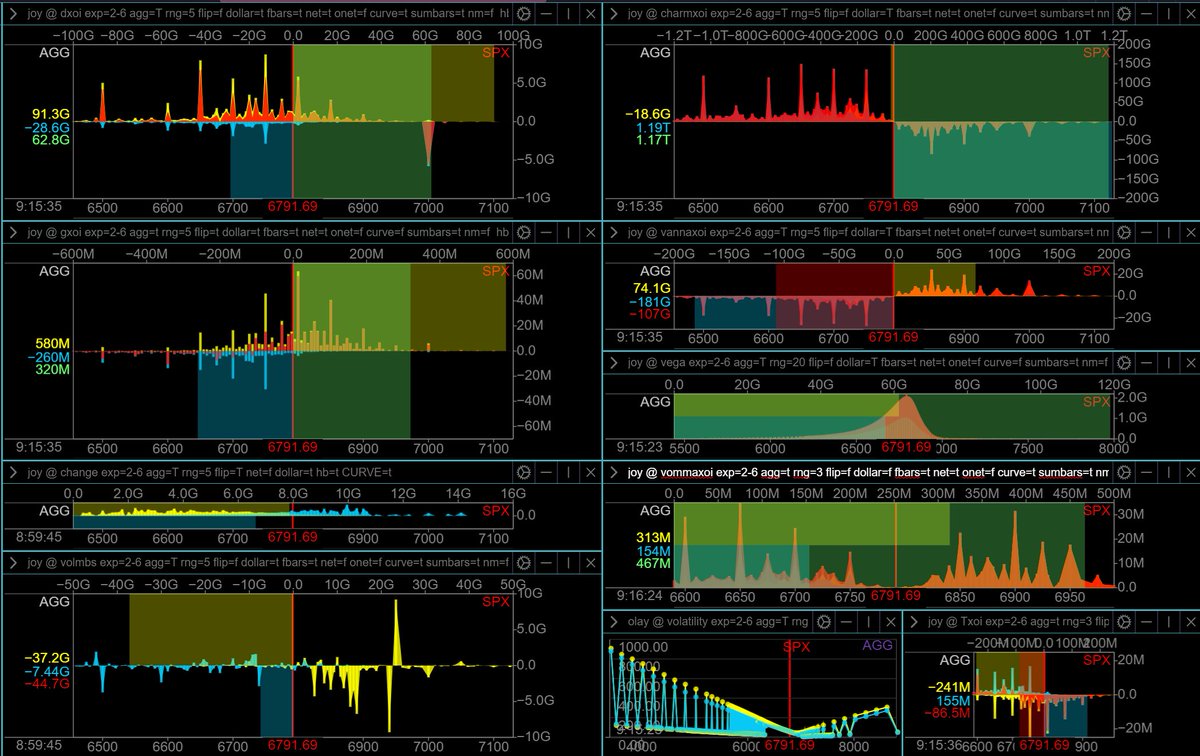
🧩 Summary:
Dealer books remain in a net long delta with put-charm dominance, offset by call-decay Theta.
Gamma stabilizes around 6790–6810; Vanna slips negative → IV rise could flip dealers to sell hedges.
Overall bias = grind up while vol steady ≤ 13 %, but fragile if vol spikes > 2 pts.
📦 Confluence Zone: 6,720–6,780
🧠 Implication: Gamma and Charm reinforce pin ≈ 6,750; only if Vanna/Vomma activate below 6,720 does reflexivity flip bearish.
Read the details beyond this part of the thread to better understandsubsequent.
BOTTOM LINE — FULL SYNTHESIS
SPX remains structurally pinned inside a dealer-controlled carry zone.
Positive Charm (+1.15 T) and strong Gamma (+260 M) keep the tape orderly, while Vanna/Vomma form a reflexive minefield under 6,720.
Liquidity absorption is healthy; sentiment is greedy but not euphoric.
Unless volatility surges, the subsequent few sessions should oscillate within the pin band (6,730 – 6,810).