Yungkingmito Profile picture
Mitochondrial Wizard in Thermogenic Inertia & Redox-Aligned Validation Systems / Founder of The EarthLight Model
3 subscribers
Dec 17, 2025 4 tweets 4 min read
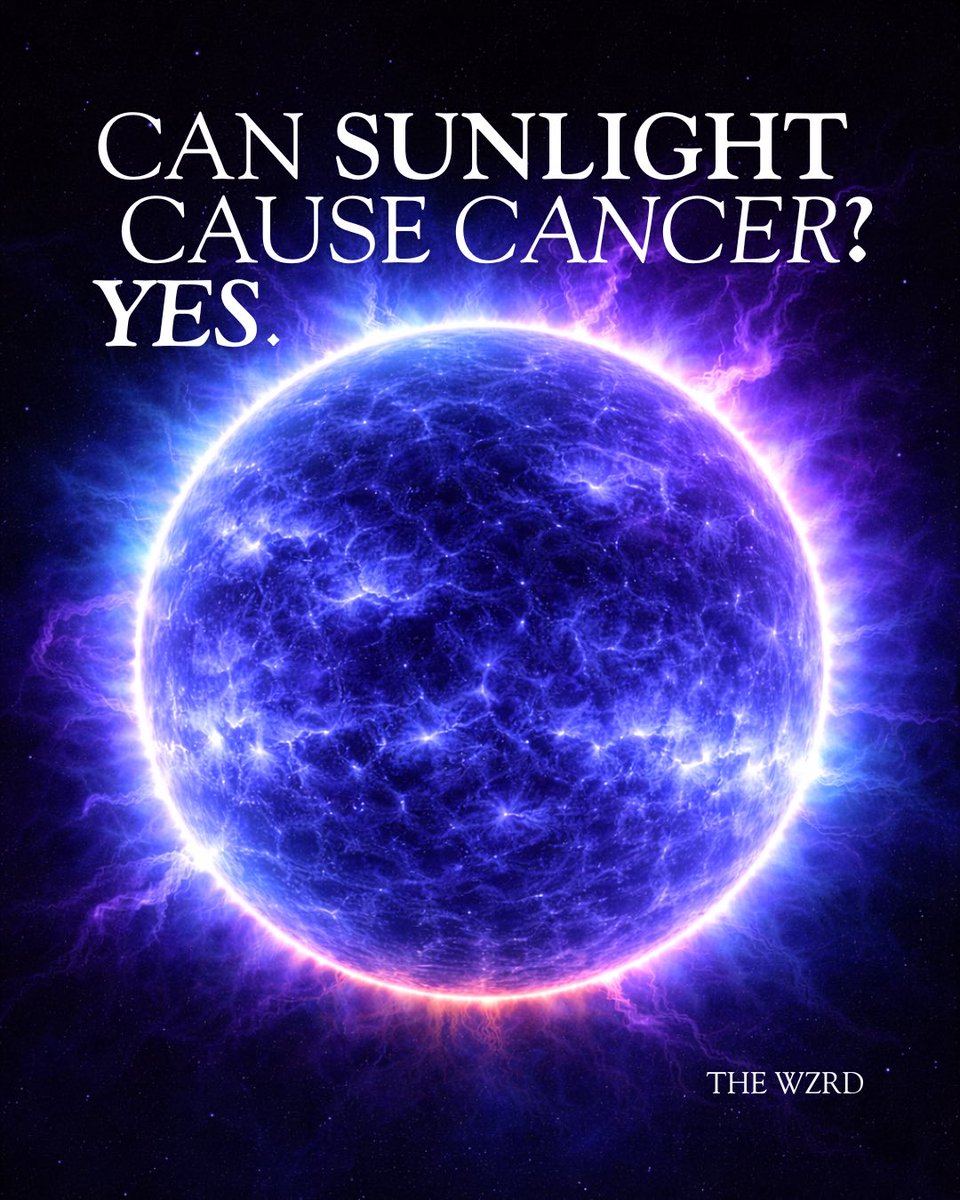
Yeah, sunlight can cause cancer.
That shouldn’t be controversial. What’s broken is how the system explains why.

Medicine reduced sunlight to a carcinogen because it only looks at damage after structure has already failed.

Circadian culture overcorrected and turned sunlight into something that supposedly can’t cause harm if timing is respected.

Both miss the same thing: photons are force, and force acting on matter always creates damage.

The real question was never whether damage occurs, but whether the system can contain and release that force before it persists.

Biology survives by holding force, not avoiding it. When force exceeds containment capacity, failure begins… which is why cancer is slow until it suddenly isn’t.

Sunlight isn’t one signal. UV breaks bonds. Blue excites electrons and drives redox demand. Red and infrared restore gradients and hydration. Both artificial and solar blue light isn’t weak, it’s demanding. It exposes whether containment exists.

Melanin isn’t cosmetic or a sunscreen substitute; it’s a containment interface that converts sharp energy into survivable gradients. All humans produce it, but what differs is capacity and inducibility.

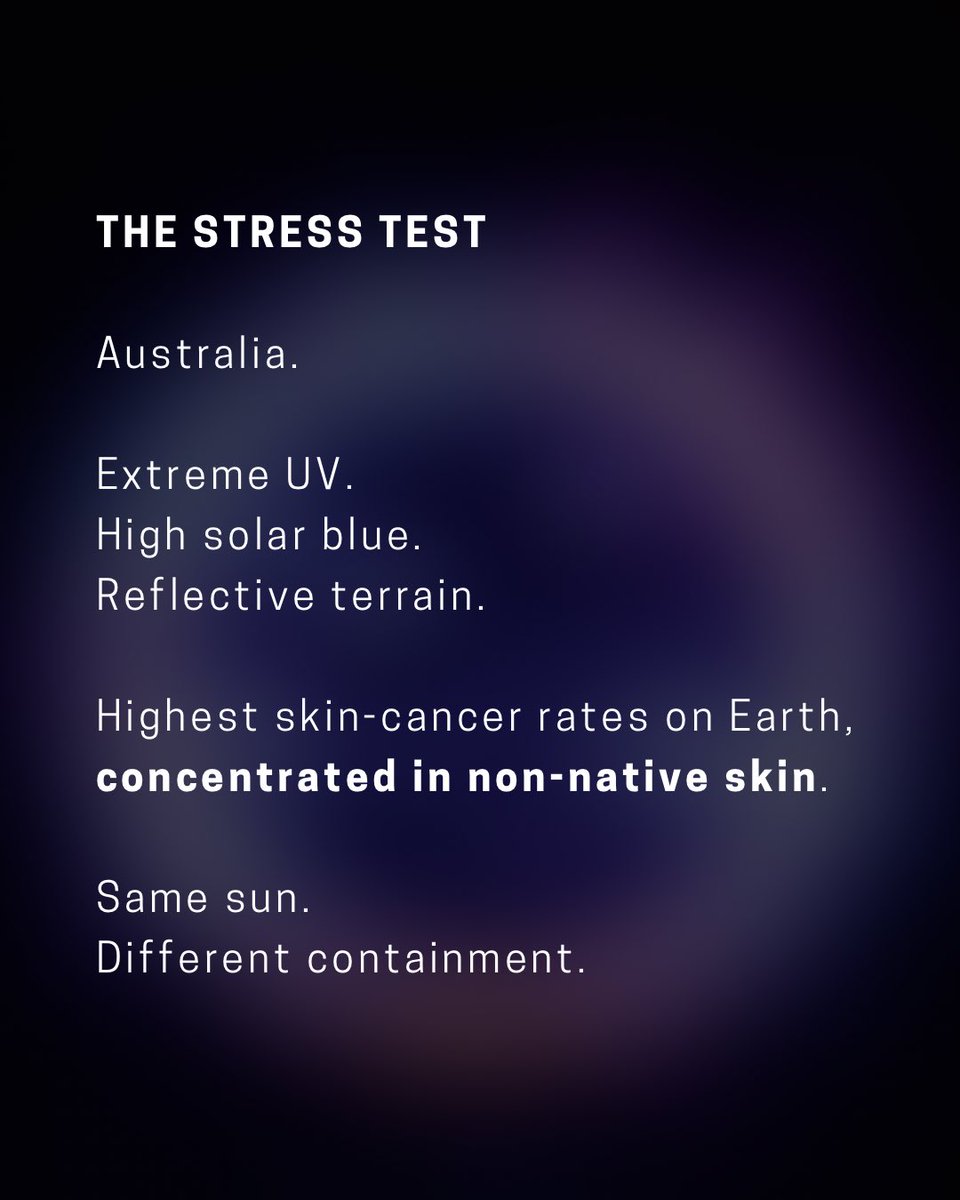
Geography proves the law. Australia is a stress test: extreme UV, intense solar blue, reflective terrain.

Skin-cancer rates peak where containment mismatches environment most severely and not because the sun is evil, but because load exceeds structure faster than adaptation can keep up.

Sunlight doesn’t decide outcomes.
It tests structure.

When containment holds, light trains biology.
When it collapses, the same light reveals the failure.

That’s not wellness.
That’s physics.Image Image
Image
Image
Image
Dec 16, 2025 4 tweets 4 min read
They trained you to believe breast cancer is a random lump that suddenly appears.
That framing isn’t just wrong, it’s convenient.

Centralised medicine only respects what it can image. So it worships the mass… and ignores the physics that made the mass possible.

They call it early detection.
But detection is always late.
A scan doesn’t find beginnings it finds structure after the process has already won.

The real origin isn’t a gene turning evil overnight.
It’s a tissue losing its schedule.

Breast tissue is a clocked organ (growth windows, repair windows, immune windows, remodeling windows) all gated by hormones and circadian timing.
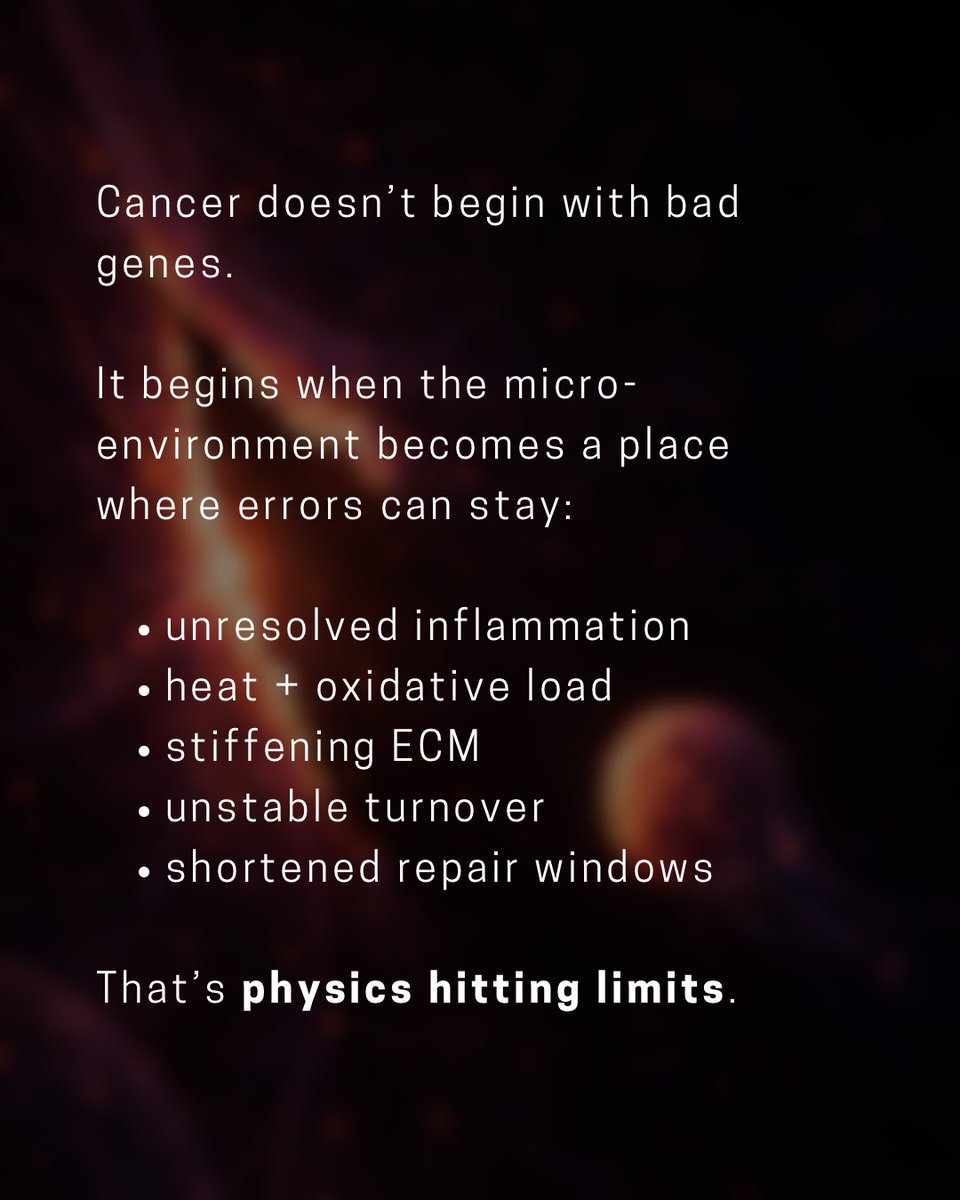
When that timing drifts, cells don’t mutate into cancer.
They linger past their exit, inside an environment that stops deleting mistakes.

Then the system performs its ritual:
• turns a field problem into a spot on a screen
• turns a timing failure into a mutation myth
• turns an environment collapse into “bad luck”
• sells awareness instead of modelling cause

Most breast cancers are hormone-receptor positive: meaning the tissue is still responding to timing signals, still obeying the clock… until the environment becomes permissive enough for one clone to anchor.

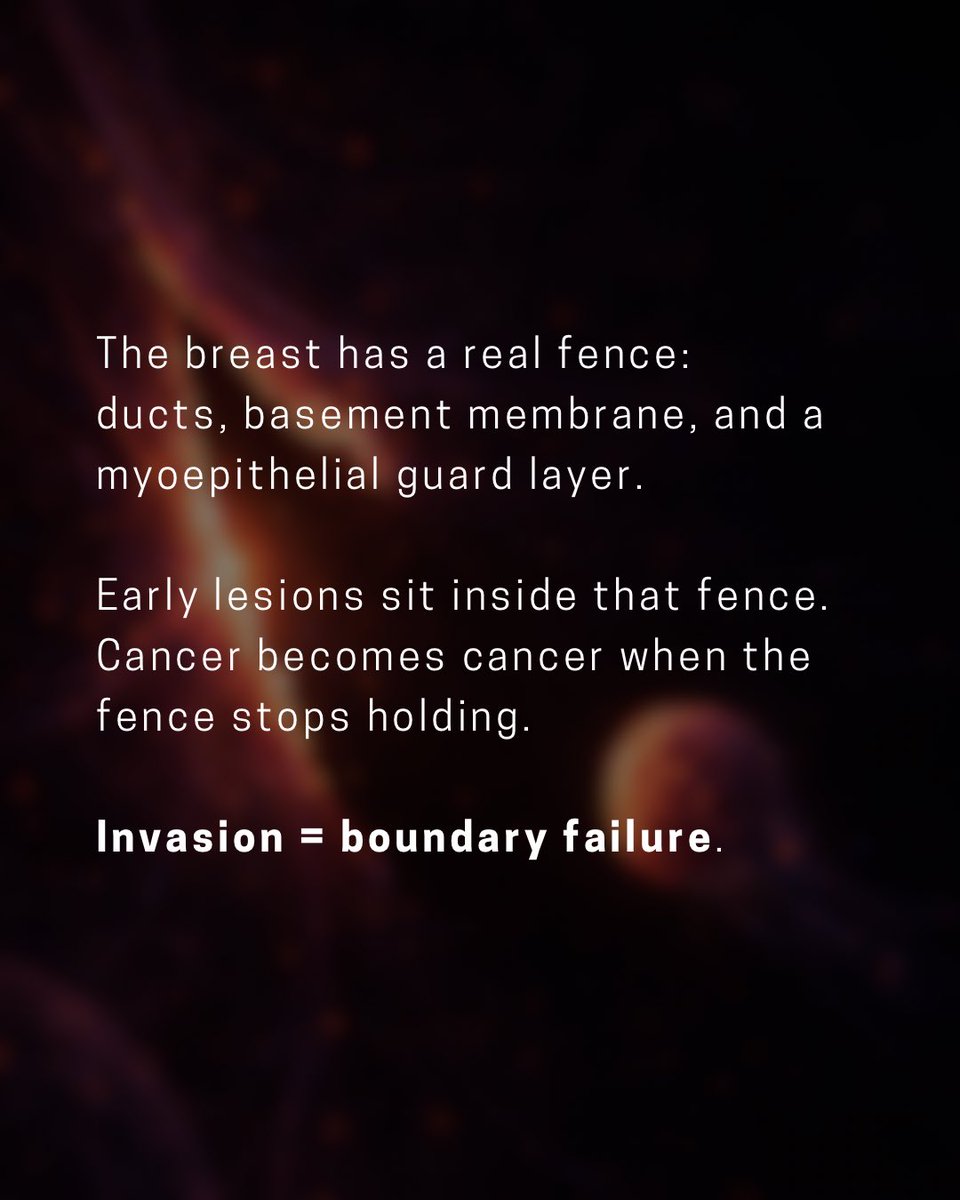
Involution is remodeling at speed, and speed always exposes weak boundaries.

Screening finds the lump.
It doesn’t explain why the lump exists.

The lump is the receipt.

Timing → Environment → Boundary → Escape.

That’s the layer they don’t model because if they did, the whole industry would have to change.

- THE WZRDImage Image
Image
Image
Image
Dec 13, 2025 4 tweets 4 min read
Every living system generates damage at a non-zero rate.
That’s not speculative, it’s measured.

Oxidative lesions.
Misfolded proteins.
Replication errors.
Mechanical stress.

These are produced continuously in healthy tissue.

If damage itself caused disease, life wouldn’t persist.

What determines health is not the presence of damage,
but whether the system can delete it fast enough.

Formally:

• E(t) = erosion rate (damage generation)
• D(t) = deletion capacity (repair, clearance, turnover)

The system’s control margin is:

M(t) = D(t) − E(t)

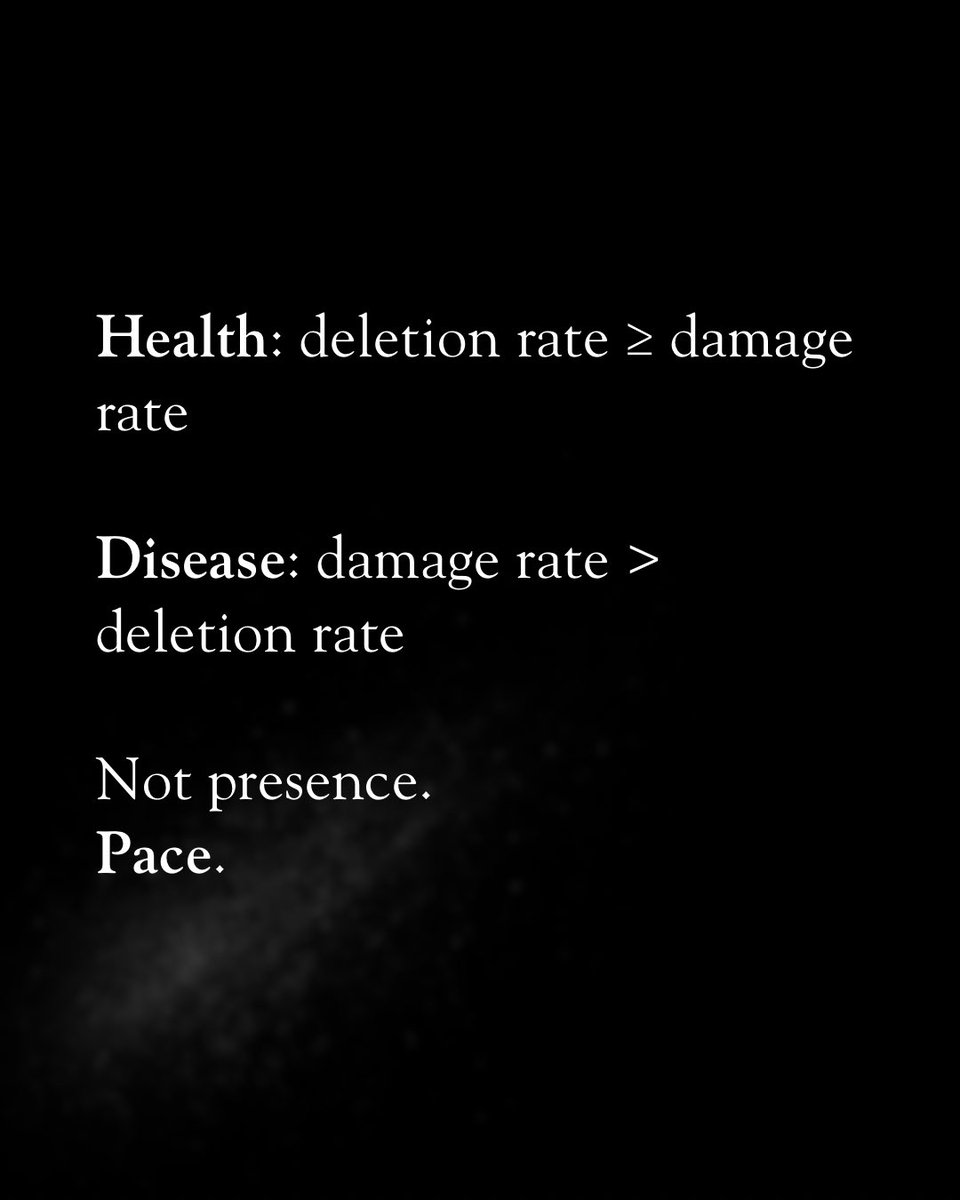
When M(t) ≥ 0, damage is erased and function remains stable.
When M(t) < 0 long enough, undeleted damage accumulates:

P(t) = ∫ max(0, E(t) − D(t)) dt

Disease appears when accumulated persistence P(t) crosses a tissue-specific tolerance Θ.

Different diseases are not different causes, they are the same control failure expressed in different tissue:

• Pancreas → diabetes
• Brain → neurodegeneration
• Vasculature → stroke
• Rapid-turnover tissue → cancer

Same inequality.
Different thresholds.

This is the Erosion–Deletion Principle (EDP):

Health is not the absence of damage.
Health is sustained positive control margin.

This is why immunotherapy works when it works: it doesn’t “fix mutations”, it temporarily restores deletion capacity in systems where erosion was already high.

And this is why regeneration is not growth.

Regeneration only occurs when D(t) ≫ E(t) long enough to actively reduce persistence and allow structure to rewrite itself.

Once biology is seen as a control problem (erosion versus deletion over time) the question changes.

Not what caused the damage,
but why deletion fell behind.

That question is falsifiable.
And it’s already embedded in every real mechanism of biology.Image Image
Image
Image
Image
Dec 9, 2025 4 tweets 3 min read
Everyone is arguing about the wrong molecule.
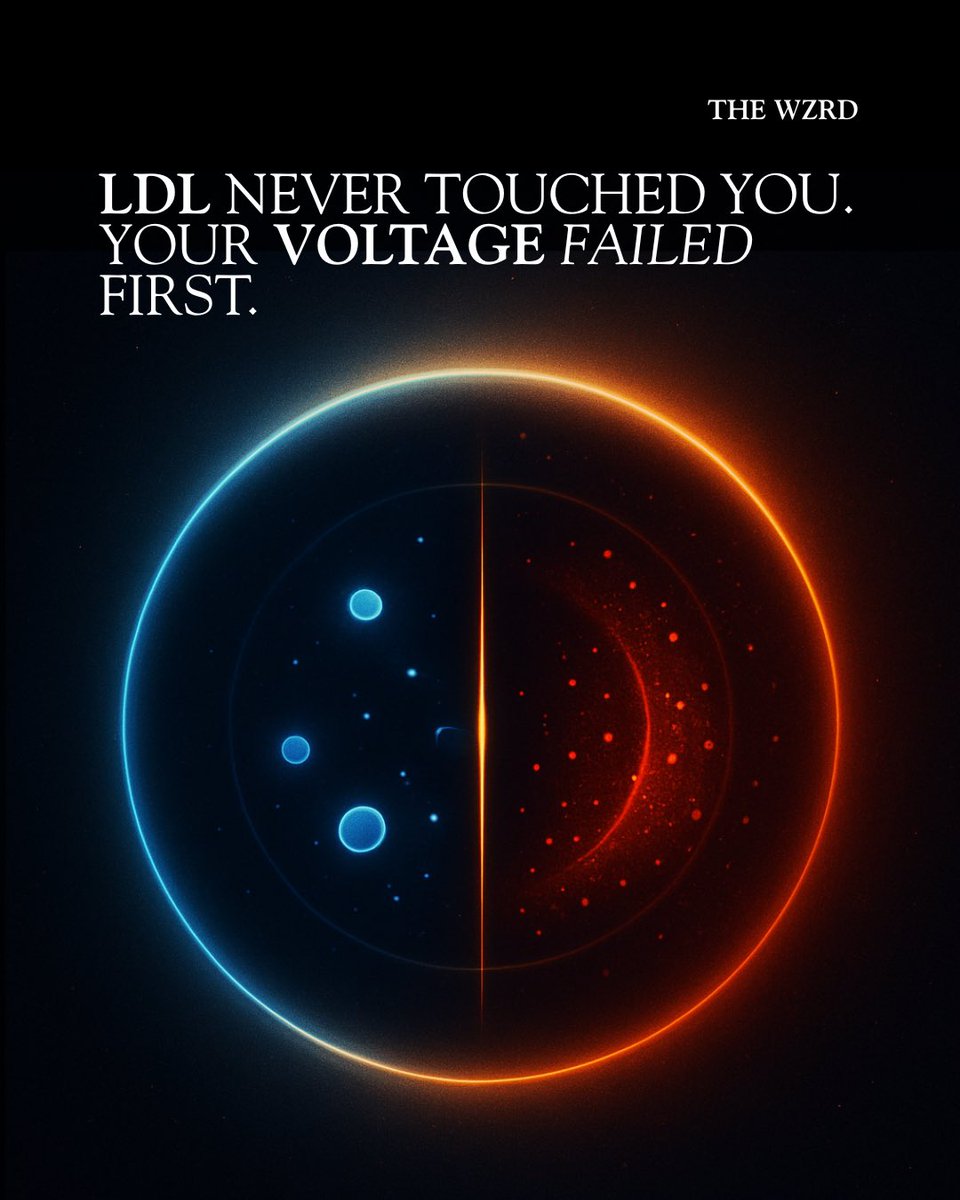
LDL was never the ignition event.

A healthy artery carries a repulsive charge: a forcefield created by the glycocalyx, mitochondrial voltage, shear, and bound proteins.

As long as that field is intact, LDL can’t touch you, no matter how high it is. Heart disease begins the moment the wall loses its charge.

High glucose, low light, circadian disruption, cigarettes, inflammation they all drain endothelial voltage. When the field collapses, the artery becomes electrically neutral. For the first time, anything can stick. LDL just happens to be the most abundant, so it takes the blame.

And here’s the part everyone misses: the same physics that collapses the field can restore it.

The problem was never LDL.
The problem was a wall that could no longer repel.

Fix the field → LDL can’t touch you.
Lose the field → anything can.

Heart disease isn’t chemistry.
It’s coherence.
It’s lost charge.
It’s physics pretending to be cholesterol.Image Image
Image
Image
Image
Dec 8, 2025 4 tweets 3 min read
Everyone keeps aging for the same reason, and almost nobody knows what that reason actually is.

You don’t age when ATP dips.
You don’t age when hormones wobble.
You don’t age when metabolism slows.

All of that is downstream. Those are the symptoms of the collapse, not the cause. Aging begins the moment your membranes can’t hold voltage.

That’s when electrons stop moving with intent:
- protons stop falling cleanly,
- water loses its architecture,
- ROS lose their timing,
- and the cell’s entire script starts slipping out of sequence.

People call it fatigue, brain fog, inflammation, as if they’re separate issues. They’re not. They’re just different languages describing one event: the slope life runs on has flattened.

The field lost tension. Coherence broke.

High voltage means:
• timing is razor-sharp
• repair is exact
• ROS talk instead of scream
• cristae stay tight
• water holds memory
• mitochondria agree on which world they’re in

Low voltage is just confusion happening slowly enough to survive. Every chronic disease starts here and every symptom of aging is built on this collapse.

And no… you don’t fix voltage with bottles. You fix it by giving biology the conditions it evolved to interpret:

- morning light,
- real darkness,
- mechanical load,
- temperature gradients,
- fasting windows,
- deep, pressure-resetting sleep.

This isn’t wellness.
This is electrophysics wearing a human body.

If your voltage is high, you bend time around you.
If your voltage collapses, time cuts straight through you.

Youth is charge under pressure.
Aging is when the pressure slips.Image Image
Image
Image
Image
Nov 23, 2025 12 tweets 10 min read
1. The Hidden Architecture of Time

Time inside a living system is not an interval, a rhythm, or an experience but the structural requirement that each internal state must be capable of being mapped into the next without contradiction, and this continuity depends entirely on the stability of the inner mitochondrial junction, the only place in biology where curvature, charge separation, and phase alignment converge into a single constraint that determines whether an organism can preserve identity over its own evolution; what we call “having more time” is nothing more than maintaining the geometric tension that keeps successive configurations equivalent, and the moment the IMJ loses coherence, the mapping fails, the trajectory fragments, and the organism can no longer guarantee that the next moment will correspond to the one before it, which means that lifespan is not an accumulation of seconds but the durability of a metric that allows a being to remain itself across change.Image 2. The IMJ: Life’s Continuity Gate

The inner mitochondrial junction is not simply a membrane fold or a structural convenience but the single location in the cell where charge separation, curvature tension, proton alignment, and directional phase converge into a unified constraint that determines whether a system can maintain a coherent identity across its own temporal evolution, because the IMJ is the gate through which every transformation must pass to remain consistent with the one before it, and when its geometry holds, the organism preserves equivalence between successive states with the ease of a well-defined manifold, but when its curvature collapses or its tension fails, the compatibility conditions that allow the organism to remain the same entity break down, and the self begins to drift, distort, or dissolve, revealing that the IMJ is not an energy structure but a continuity structure, the silent architecture that makes life possible by preserving the rules that allow change without losing identity.Image
Nov 20, 2025 4 tweets 3 min read
Everyone talks about “energy,” like the body runs on calories or motivation.

It doesn’t. It runs on timing: the nanoscale choreography between protons, electrons, and the electromagnetic field your cells sit inside.

Mitochondria aren’t power plants.
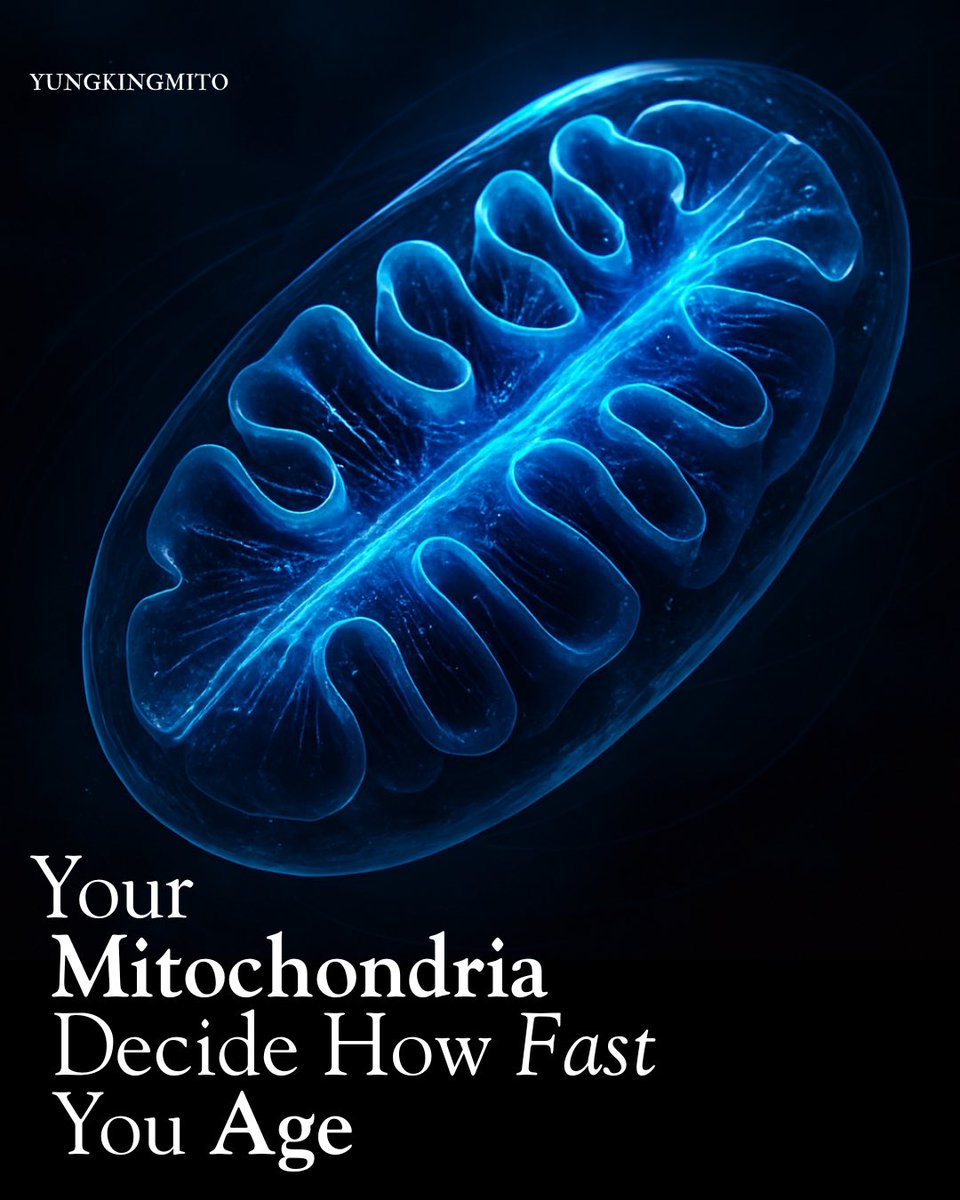
They’re voltage regulators, proton pumps, and geometry-driven clocks that convert light and charge into coherence. Their membranes hold ~180–200 mV of potential (a biological lightning rod) and the moment that voltage drops, nothing in the cell tells the truth anymore.

When the field is tight, electrons tunnel cleanly, protons follow the gradient, ROS become messages instead of damage, and hydrogen stays light enough for ATP synthase to spin at full resolution.

When the field collapses, heavy isotopes creep in, water loses structure, calcium misfires, and timing begins to drift by nanoseconds (then milliseconds) then entire behaviours. You don’t feel “tired.” You feel desynchronized.

This isn’t about hacks, nutrients, or stacking stimulants on a broken clock. It’s about restoring the physics your cells evolved inside: morning photons, darkness at night, mechanical load, real temperature swings: the environmental script that kept hydrogen fractionated and mitochondria in tune.

You don’t get younger by adding more.
You get younger by removing the noise that breaks the circuit.

Aging isn’t decay… it’s loss of coherence. Fix the field, sharpen the timing, and biology remembers what it was always designed to do.

When timing fails, ATP becomes irrelevant. You can’t drug coherence back into existence.Image Image
Image
Image
Image
Oct 30, 2025 4 tweets 2 min read
People love to argue wavelength, penetration, receptors, as if biology is a container you can pour photons into. It isn’t.

The body isn’t a bucket for light. It’s a charged, hydrated, piezoelectric lattice. Energy enters: it must move, flow, and exit cleanly, or it becomes strain.

Infrared doesn’t jump to “mitochondria magic.” It first becomes phonons: vibration in collagen + water. In nature, that vibration is paired with release: airflow, pressure shifts, evaporation, UV timing, night-cooling, open-air convection. Sunlight delivers energy with an exit strategy.

Devices supply energy in closed systems. Nature never does.

Artificial NIR pushes energy into tissue without the environmental physics nature couples it to. That isn’t “sunlight in a panel.” It’s unvented thermodynamic load in living crystal.

Strong systems buffer it and look like they’re thriving. Low-reserve systems expose it sooner. Different timing, same physics. This isn’t anti-light. It’s pro-physics.

Energy isn’t the therapy; dissipation is and absorption without release isn’t healing, it’s stored tension wearing a glow. It looks like vitality at first. It feels like clarity at first. Then reserve collapses quietly underneath.

Nature’s rule is simple:
stimulus in, release out.

Devices perfected the stimulus. They forgot the release. That difference isn’t philosophy. It’s the second law.

Don’t argue with me. Argue with thermodynamics.Image Image
Image
Image
Image
Oct 25, 2025 4 tweets 2 min read
Everyone warns that blue light kills melatonin. Almost no one tells you it kills your cooling cycle.

At night your body is supposed to radiate heat like a small star, infrared photons leaving the skin, relieving pressure from vessels, dropping core temperature so the heart can rest. Anne Hofmeister’s heat transfer physics proved that complex bodies shed energy mainly through radiative transfer, not air conduction. You don’t just “lose heat.” You emit light.

Flood yourself with LEDs at midnight and you choke your exhaust port. Melanopsin stays active, melatonin flat-lines, vessels constrict, core temp holds. You lie still, but the engine keeps idling at daytime torque.

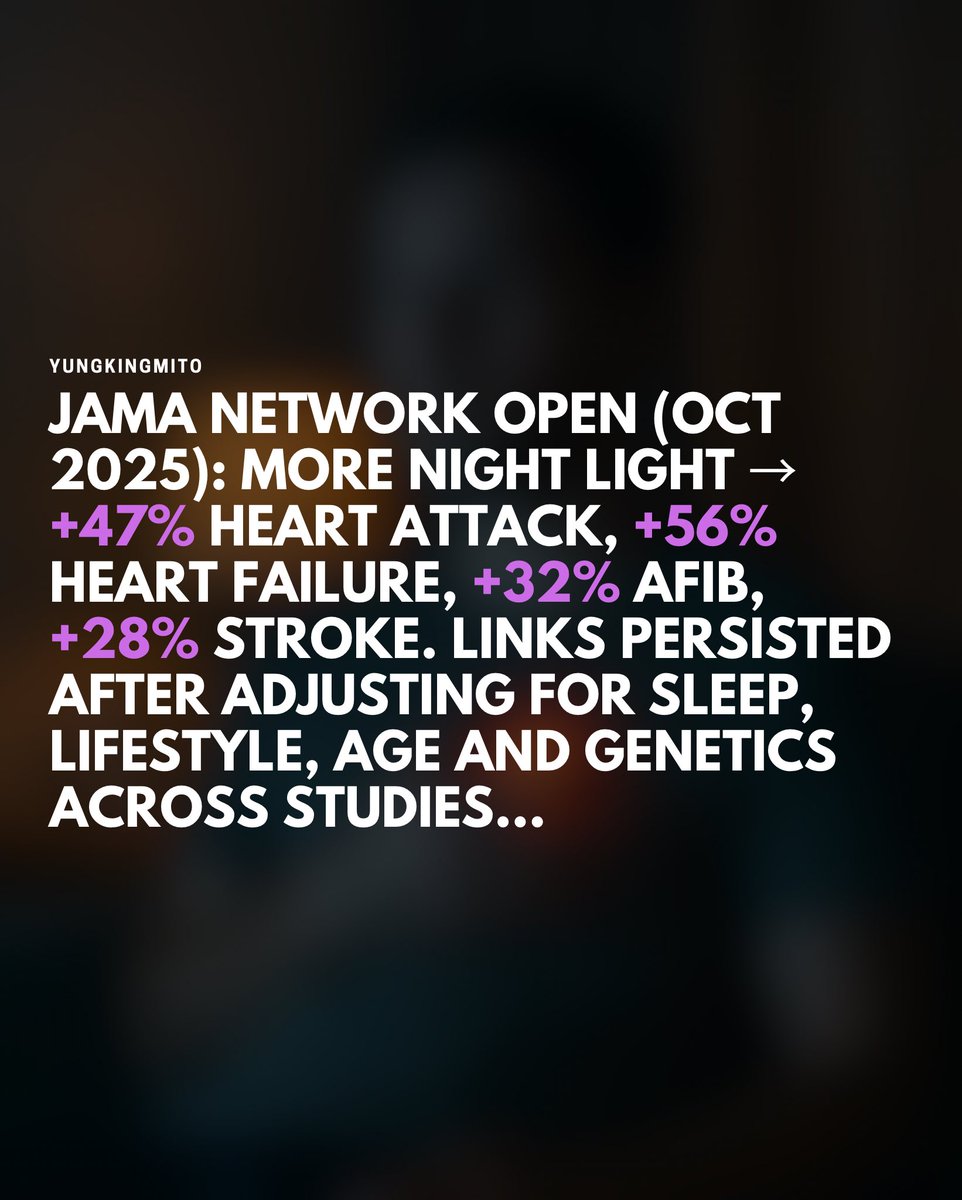
That’s why JAMA Network Open found that people living in bright-night environments faced sharply higher risks of heart attack, heart failure, arrhythmia, and stroke, even after adjusting for lifestyle and genetics. Many call it insomnia, but it’s thermodynamic overdrive.

Night isn’t rest. It’s a scheduled discharge of energy and pressure. Artificial light cancels that release. Darkness is cardiovascular medicine.

Let the night work.Image Image
Image
Image
Image
Sep 6, 2025 4 tweets 4 min read
Loyalty will take you places you never knew existed. It’ll take you into darkness first, into rooms where nobody claps for you, where you stand alone because you wouldn’t fold, where silence feels like a grave. Loyalty costs you friends, comfort and pride. It strips you down until all that’s left is the oath you made and the weight you carry but loyalty also takes you higher than anything else can. It’s the only reason families survive, the only reason names outlive breath, the only reason you can trust someone enough to close your eyes and sleep. When someone stays loyal, when they don’t ghost in the storm, when they don’t sell you out for an easier road, that feeling is rare. It’s the closest thing to sacred this world gives. Extending a hand is no small gesture. It carries the same law that sculpts the subatomic world. Electrons bind, DNA pairs, stars hold to gravity. Existence itself is stitched by bonds that refuse betrayal so every hand you extend is another tether, and every tether decides whether you rise or drown. Every bond is a noose or a lifeline, you don’t know which until it pulls, and betrayal? Betrayal shows you places too. The chest collapsing, the pulse racing, the world turning cold, that’s the spirit registering collapse, because life has always depended on bonds that hold. When you break them, survival unravels and why betrayal feels like death, it is death. Loyalty don’t save you it shows who you’ll drown with, that’s why it’s the most dangerous trait on Earth. You tie yourself, for better or worse, and whatever you’re bound to drags you where it goes. Some people aren’t anchors, they’re holes in the boat, and you only find out mid ocean and here’s the cruelest truth, most people only learn what loyalty costs when they’ve already paid in blood. Strength and beauty fades, intelligence can be turned against you but loyalty? Loyalty takes you where nothing else can. To pain deeper than you thought possible. It’s the law that keeps stars alive, and the choice that can burn you or build you into something eternal. Loyalty isn’t some light you carry it’s a chain, and if you tie it to the wrong thing, it’ll drag you straight to the bottom with a smile.Image Image
Image
Image
Image