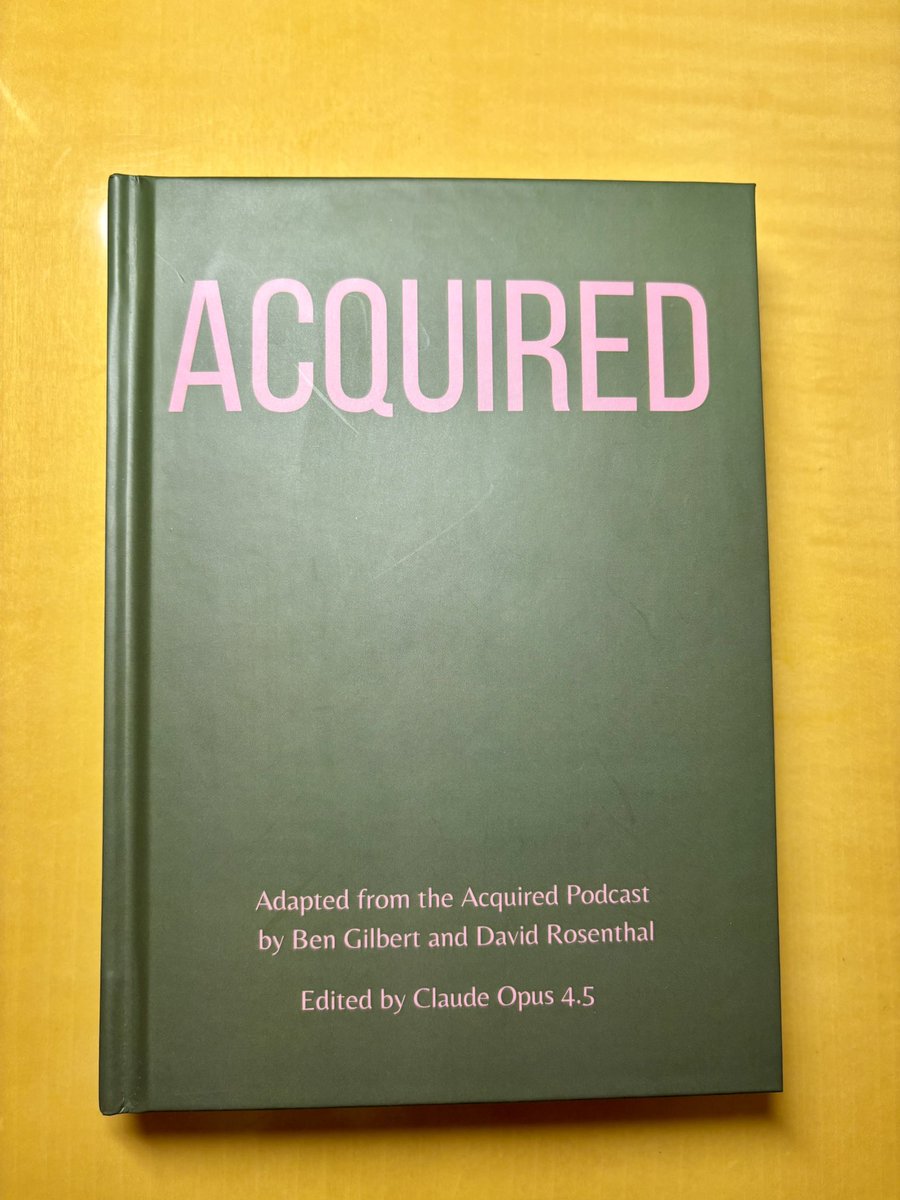
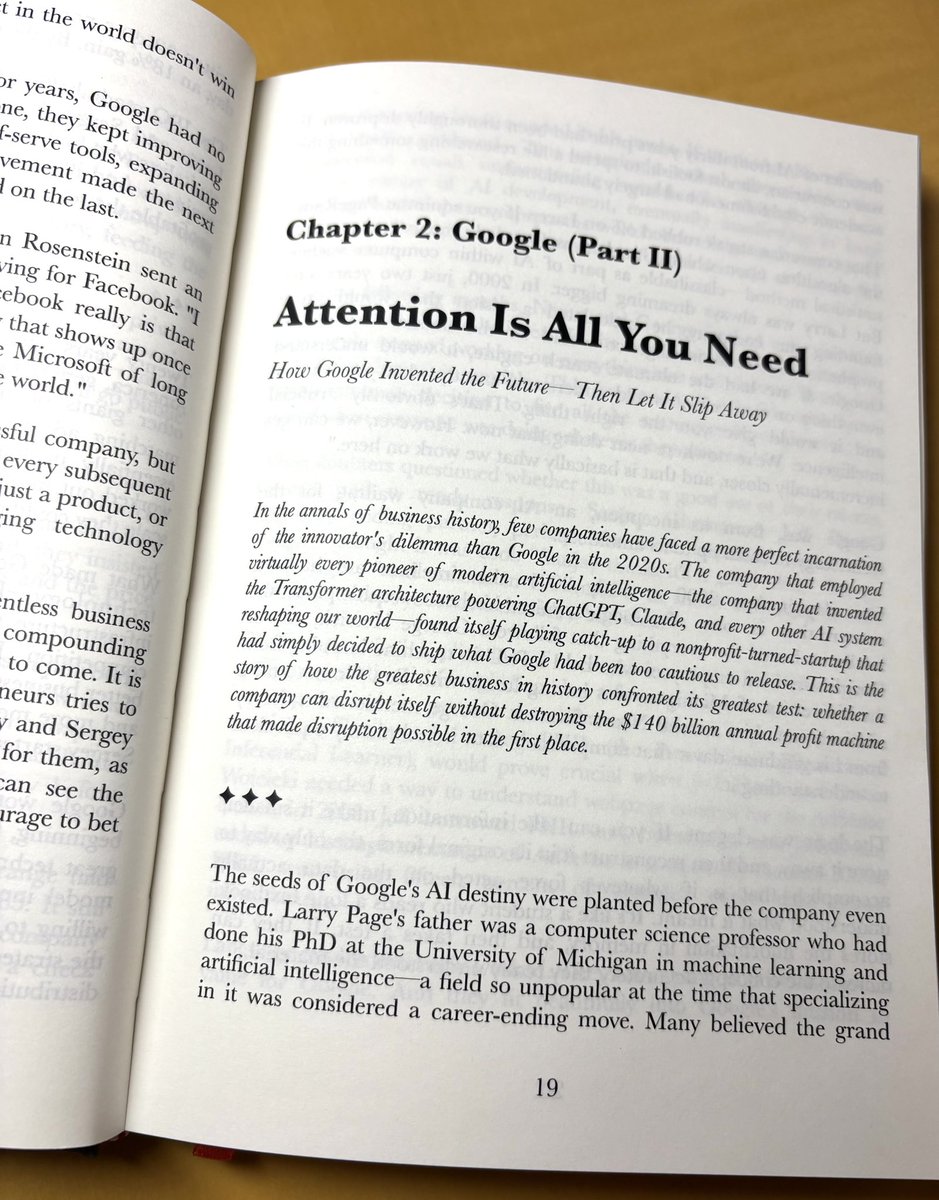
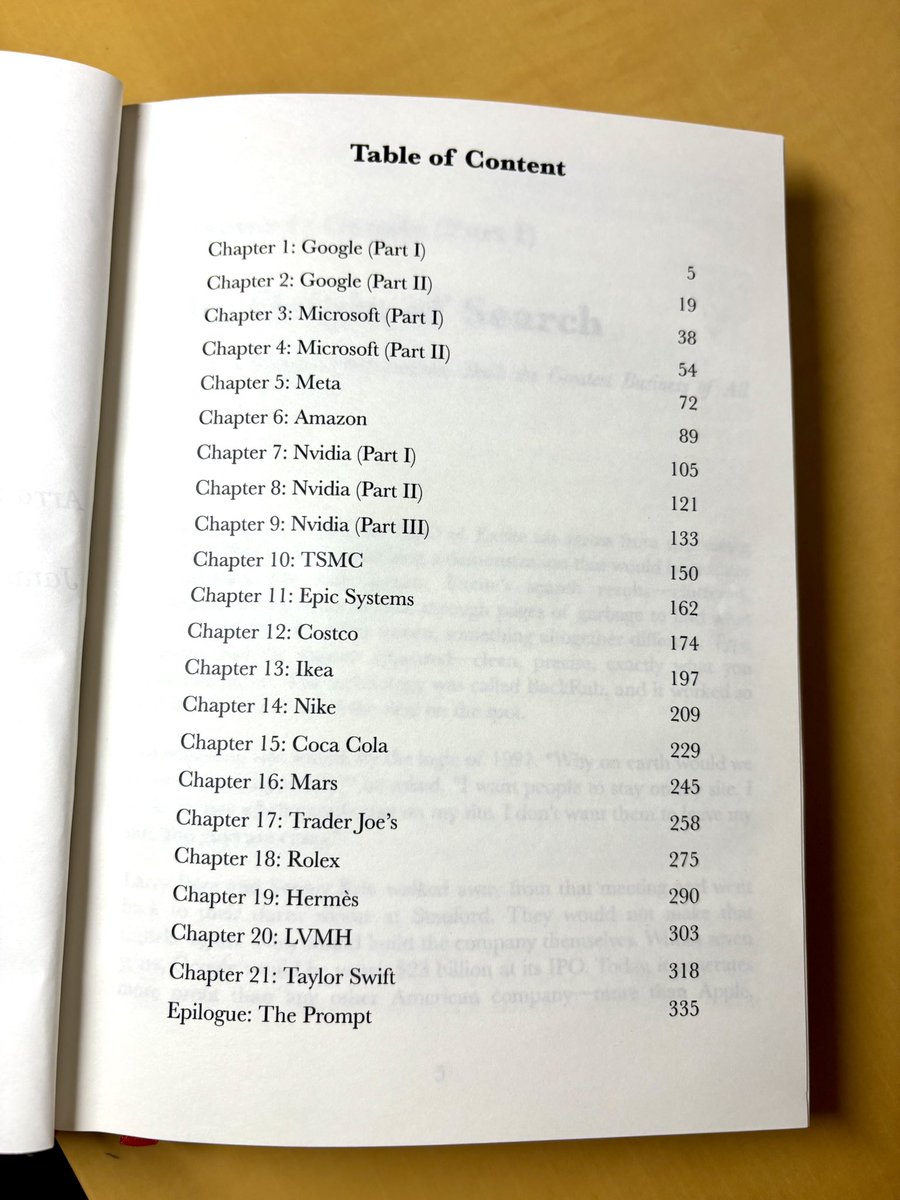
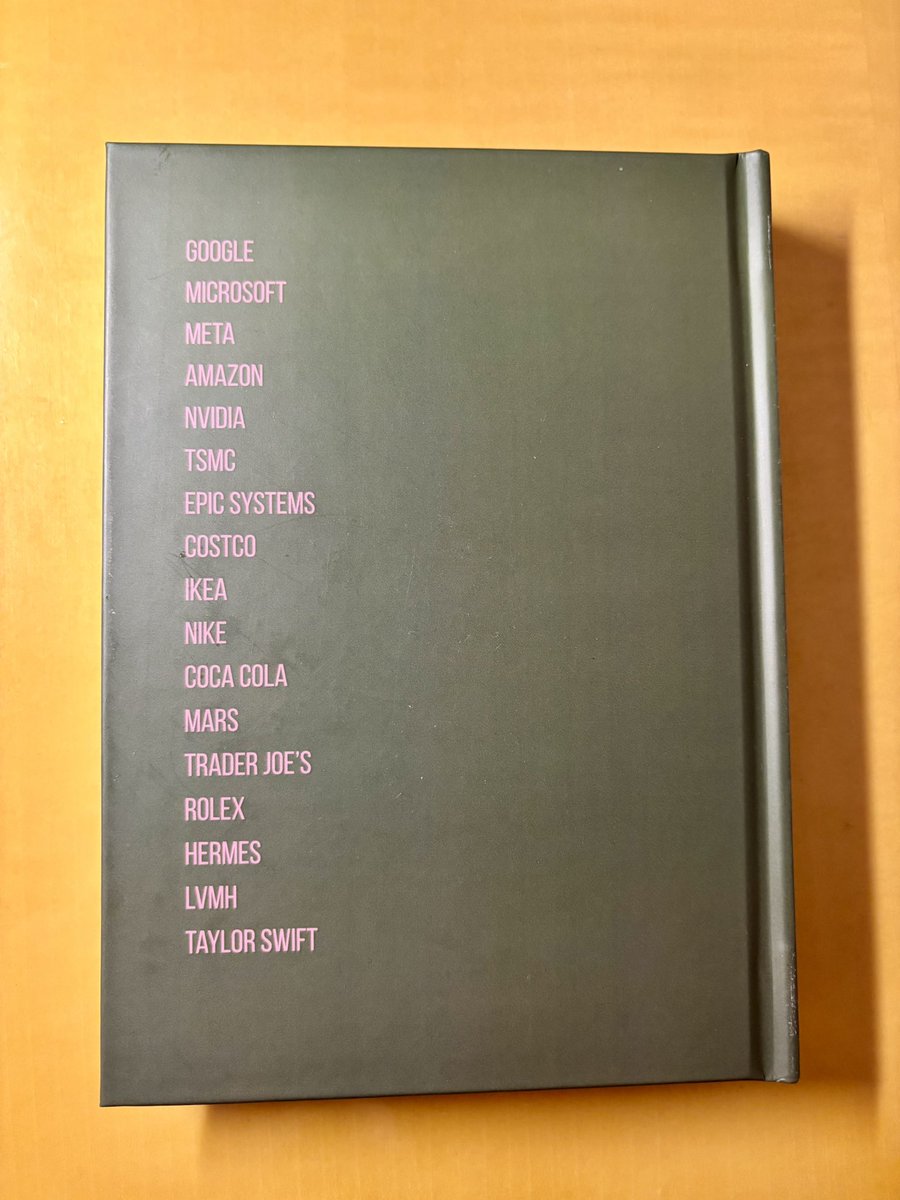
I turned the @AcquiredFM podcast into a 300-page DIY physical book, thanks to @claudeai
1. Feed transcript to Claude 2. Get Claude to convert transcript to a business biography chapter, preserving story arc & key quotes, and output as formatted word doc 3. Arrange word doc. Design book cover using Canva 4. Send to printing supplier
I love the Acquired podcast but often wished I could consume it as a book. Reading the transcript didn’t feel right; turning it into business biography chapters seemed to be the right form factor. Claude’s writing is extremely good.
Prompt below if anyone wants to try
# Acquired Podcast To Book Prompt
**Your Role & Mission**
You are my executive assistant helping me transform a long Acquired podcast episode into a compelling written chapter for a physical book I'm creating. Think of yourself as a skilled ghostwriter who listens to the entire episode and crafts it into something that reads like a chapter from a classic business biography.
**Style & Voice**
Write like a chapter from a great business biography--think _Shoe Dog_, _The Everything Store_, or _Hatching Twitter_. This means:
- Rich narrative with dramatic tension
- Key turning points treated as pivotal scenes
- Quotes woven in to let the protagonists speak for themselves
- The reader should feel like they're watching history unfold, not reading a summary
- Analytical insight layered into the storytelling, not separated from it
**Length**
As long as the story warrants. Use your judgment based on the episode's length and insight density. Quality and completeness over brevity. This is meant to be a satisfying read, not a skim.
**Step 1: Understand the Arc**
Listen to/read the full episode and identify:
- The central narrative: What is the story being told? What's the dramatic question?
- The key characters: Who are the protagonists, antagonists, and supporting players?
- The turning points: What are the 3-5 moments where everything changed?
- The stakes: What was at risk? What could have gone wrong?
Great business stories have narrative shape--a beginning that sets the stage, rising tension, pivotal decisions, and resolution (or ongoing cliffhanger). Find that shape.
**Step 2: Map the Characters**
Acquired episodes often feature many players, which can be disorienting. Solve this for the reader by:
- Introducing each character clearly on first appearance with a brief identifying detail (role, relationship to the central figure, why they matter)
- Re-anchoring the reader when a character reappears after a gap (e.g., "Sculley--the Pepsi executive Jobs had personally recruited--now faced an impossible choice")
- Keeping the focus on the 3-5 most important figures; mention minor characters only when necessary and don't let them clutter the narrative
- Using consistent identifiers (if you call someone "the young engineer" once, don't switch to "the Stanford grad" later without reason)
The reader should never have to stop and ask "Wait, who is this again?"
**Step 3: Identify and Explain "Blocker" Concepts**
Scan for business, technical, or industry-specific concepts that are essential to understanding the story. These are "blocker" concepts--if the reader doesn't understand them, they'll be lost.
For each blocker concept:
- Explain it in plain language using an analogy or real-world example
- Keep explanations to 1-2 sentences maximum
- Weave these explanations naturally into the narrative the first time the concept appears
- Use web search where necessary to ensure accuracy when explaining technical concepts
The target reader is someone who is generally intelligent and curious--they read business books and follow tech news, but they may not know the specifics of every industry. Think of someone with a liberal arts degree who's interested in how great companies are built.
**Step 4: Harvest the Best Quotes**
Acquired episodes are rich with two types of quotes--preserve both:
**From the hosts (Ben Gilbert and David Rosenthal):**
- Their sharpest analytical insights and observations
- Memorable one-liners or turns of phrase
- Moments where they reveal something surprising or counterintuitive
- Attribute clearly (e.g., "As David Rosenthal puts it..." or "Ben Gilbert observes that...")
**From primary sources the hosts cite:**
- Quotes from founders, executives, journalists, biographers
- Historical documents, memos, interviews they reference
- These are gold--they let the protagonists speak for themselves
- Attribute clearly (e.g., "As Jobs later recalled..." or "In a memo to the board, Hastings wrote...")
When cleaning up quotes:
- Remove filler words (um, uh, like, you know)
- Fix grammatical mistakes from natural speech
- Keep the speaker's authentic voice and meaning intact
- Longer quotes are fine if they're powerful--this isn't a tight summary
**Step 5: Build the Narrative**
Structure the piece like a chapter from a biography:
**Opening:** Start with a scene, a tension, or a question that pulls the reader in. Drop them into a pivotal moment, then zoom out to set the stage. Avoid "This episode covers..." framing--just begin the story.
**Middle:** Move through the narrative chronologically or thematically, depending on what serves the story best. Treat major turning points as scenes--slow down, add detail, let the reader feel the weight of the moment. Use quotes to let key players speak at crucial junctures.
**Closing:** End with resonance--what happened next, what it meant, what lesson or question lingers. The reader should close the chapter feeling like they understand something important about business, strategy, or human nature.
**Step 6: Weave It Together**
Combine narrative, analysis, and quotes into one flowing piece that:
- Reads like a chapter from a great business book, not a podcast summary
- Has no section headers, bullet points, or artificial breaks (a line break between major sections is fine)
- Includes a compelling title in the style of a book chapter
- At the beginning, includes a short paragraph capturing the essence of the story and why it matters
- Makes complete sense to someone who has never heard the podcast
- Is designed to be printed--no links or screen-dependent elements
- Balances storytelling with insight: the reader should be both entertained and educated
**Quality Check:**
Before you finish, ask yourself:
1. "Does this read like a chapter from a business book I'd actually want to read?" 2. "Does the opening pull me in immediately, like a great first page?" 3. "Have I preserved the best quotes from both the hosts and the primary sources they cite?" 4. "Do the turning points land with dramatic weight, or did I rush past them?" 5. "Would someone who knows nothing about this company walk away understanding the story and why it matters?" 6. "Can the reader keep track of who's who throughout the piece?" 7. "Would this print beautifully in a physical book?"
If yes to all, you've succeeded.
Oct 20, 2025 • 10 tweets • 3 min read
We built TLDW (too long, didn't watch), a tool that helps you learn from long YouTube videos better & faster.
AI video summaries are solving the wrong problem.
You don't need a generic text summary of a 1-hour video. You need the 5 minutes that actually change how you think.
TLDW finds those moments for you.
Demo 👇 Try now at: tldw dot us
Try now:
Free & open-source.
Built on nights & weekends with @zhangsamuel12 @YanYiqi73877tldw.us

 # Acquired Podcast To Book Prompt