Hopping on the bandwagon to bash #climatechange defeatism is nice, but I think a more useful exercise is to ask *why* people believe that 'failure' to mitigate is a foregone conclusion. Why do my smart, well-meaning friends sigh and ask me if I *really* think we can cut CO2? (1)
Is it just the fatalism of the post-9/11 world? We passed the 18th anniv. of war in Afghanistan last mo., the Syrian civil war is in its ninth year. Unarmed civilians are being gunned down in Chile + Iraq, government brutality is on public display in Lebanon and Hong Kong... (2)
We wonder if our elections and elected officials have been compromised by foreign influence and have ceased to be surprised by political corruption. Storms batter Puerto Rico this time, or the Philippines, fires burn Greece and CA (3)
With all this in mind, I don't think #climatechange defeatism is born primarily out of ignorance, genuine nihilism, or contrarianism. Rather, its safe to say that people are fatigued and hopeless, and don't feel enough optimism about human nature and the state of the world (4)
This is where I think climate catastrophism fails us. Sounding alarm on a (misleading) 12-year climate deadline, carbon footprint guilt tripping, prophesying extinction - it mobilizes the climate base, bless our martyr tendencies - but you can't demand emotional energy... (5)
...from those who have precious little to spare as it is. The inactive are *not* indifferent, they're just paralyzed by sadness, and catastrophism hurts rather than helps with this. People barely holding together as it is have no room for more guilt, panic, and worry (6)
I'm speaking as a lifelong activist with frontline experience. Arrested alongside @billmckibben protesting #KeystonePipeline in March '14. Spent the last nine years calling out to smart, young fellow students on univ. quads for petition signatures, recruitment, calls to reps (7)
"12 years to save the climate" has galvanized protests of inspiring size and passion around the world, but I worry that's the high water mark for a movement fixated on the language of disaster. Disaster is exhausting to think about - even writing this is draining. (8)
I feel the focus needs to shift. People are disengaged and pessimistic because they have little confidence in government and their individual ability to change things. Fixing this requires prioritizing restoration of people's faith in political process + society (9)
This starts at the tactical, short-term level. Begin by targeting repair of the democratic process, fighting corruption and influence, enforcing accountability for misconduct. Restore people's confidence that their voice matters and that gov't works to serve them. (10)
At the same time, we start seriously planning now. A detailed roadmap - and focusing advocacy around planning and specific action - can show the disengaged that attainable paths towards a better future exist. Your voice matters + we have a way out of this = heads lift up. (11)
Finally (and I'm likely advocating in vain), junk the 12-year climate deadline. Not only a misrepresentation of the science (nature.com/articles/s4155…), but it makes climate chg into a bleak all-or-nothing binary future rather than the (nonlinear) sliding scale it is. (12)
We need to focus on hope, regain confidence in progress. We've come so far. WW1 ended just over 100 yrs ago - today we have reduced war, disease, hunger, poverty while expanding education, lifespans. History is not monotonic progress but neither is it a foregone tragedy. (END)
• • •
Missing some Tweet in this thread? You can try to
force a refresh

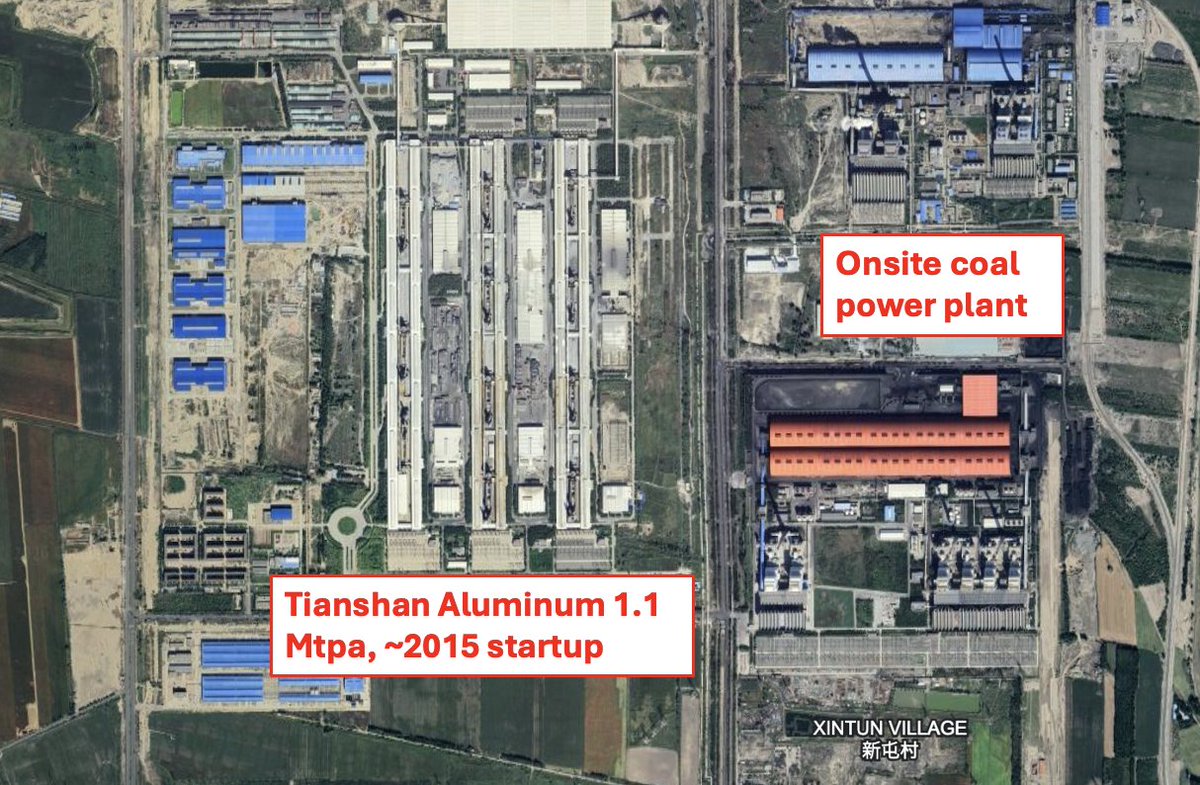
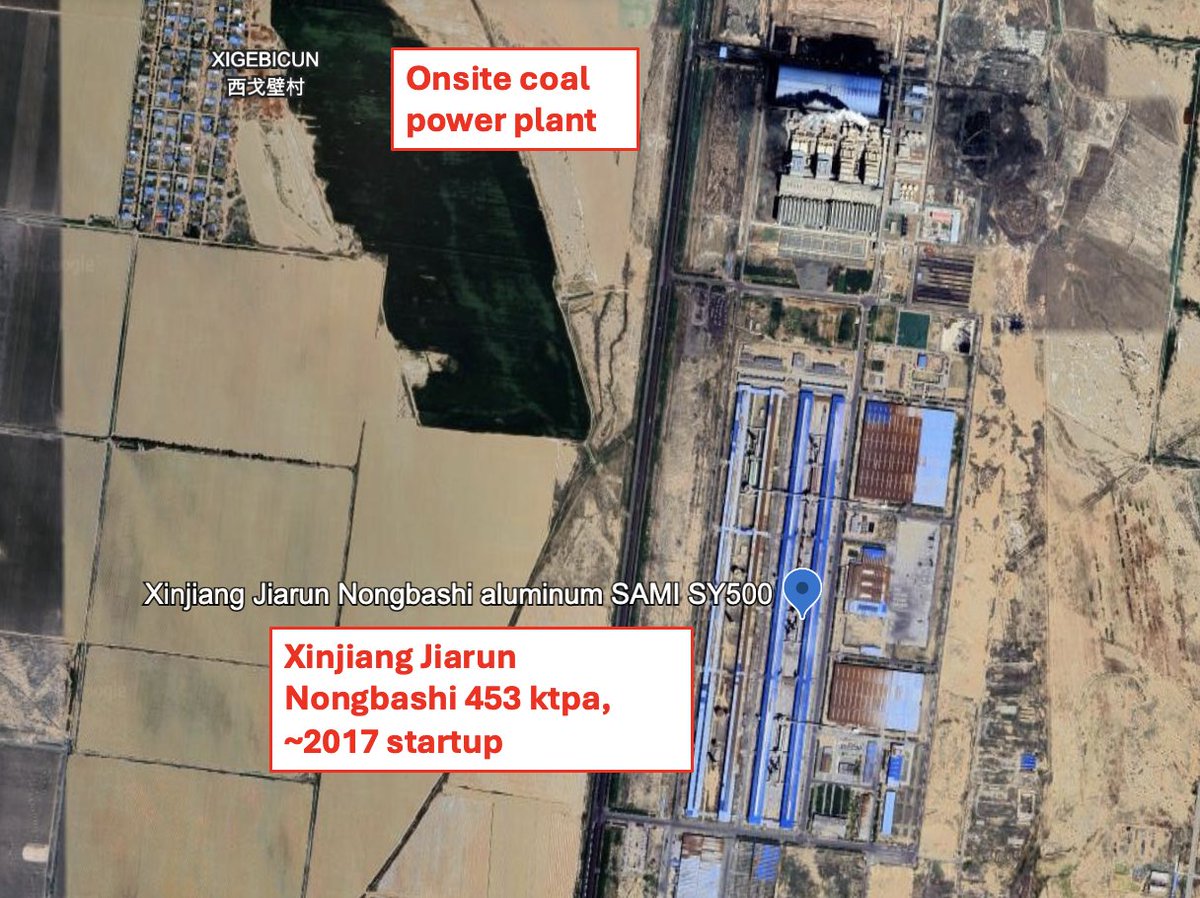
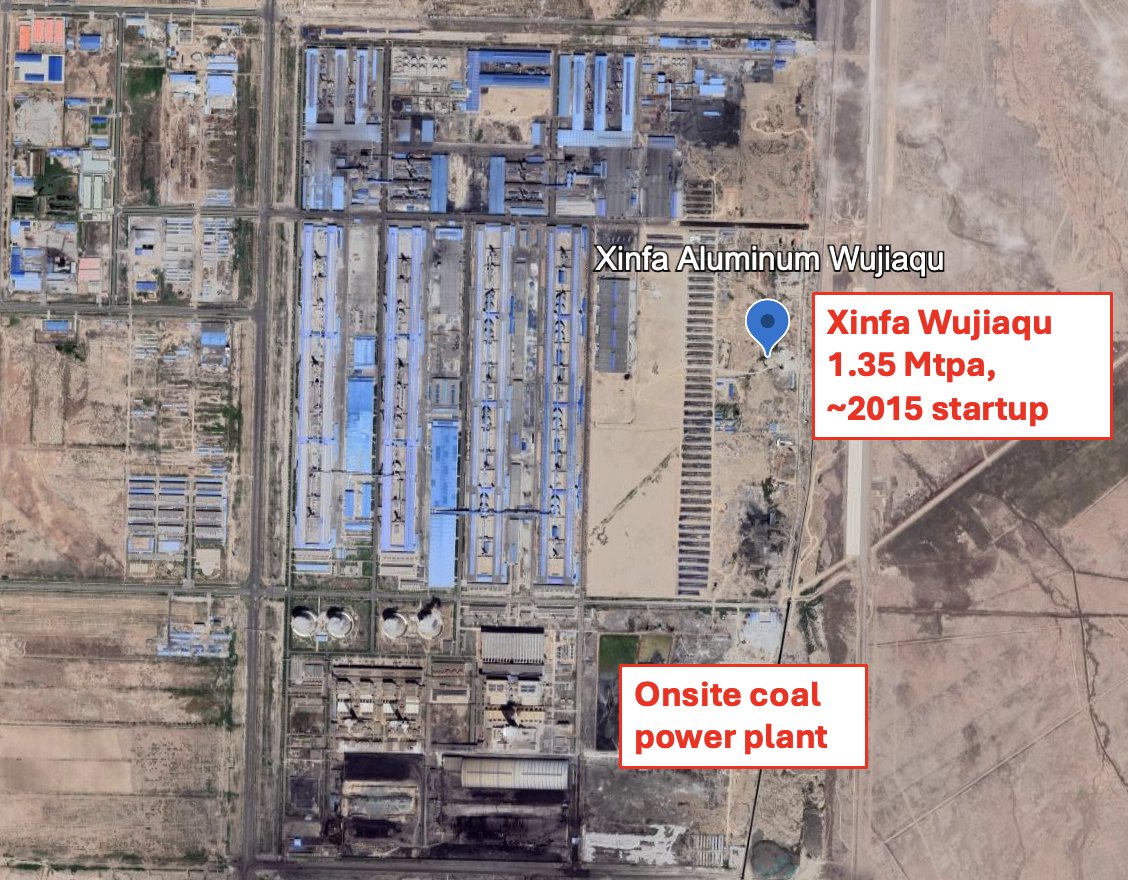
Let’s be clear how much the frame on the aluminum “long green march” story in China has now shifted, from “renewables are cheaper than coal so China is now moving heavy industry to where renewables are!” to “I built a plant here to use cheap coal mined 8 miles down the road, and now the govt is making me buy renewables certificates for 30% of my power needs”
As I do think it’s useful for the climate folks and what I’ll call the "China futurist" folks in this convo to understand what these plants in Xinjiang + Inner Mongolia look like, I’m going to show each of them here while I lay out some thoughts. 🧵
Tianshan Aluminum, Xinjiang 44°25'N 86°04'E
Why is this important? I don’t think there’s any question solar/wind will supply much of our future energy. The risk is this:
Hallucinating that solar/wind are *already* cheaper than fossils for directly supplying heavy industry will skew policy + advocacy over the next 5 yrs, lead to inevitable disappointment, and end up further entrenching Chinese dominance of strategic manufacturing.
Xinjiang Jiarun 44°18'N 86°25'E
After all, low Chinese solar/wind/battery project costs are likely at the extreme end of what Europeans, Japan, or CAN/AUS/US could hope to bring about 5 yrs from now. If not even the Chinese are jumping to build fully green-powered industrial complexes now, how can leapfrogging towards a solar/wind electrostate vision for say Europe be the key to reasserting industrial competitiveness?
Amused that Alexander Zaitchik @newrepublic attacks @billmckibben’s citation of my paper on clean tech minerals in critiquing McKibben’s “ecomodernist optimism” on green growth, yet doesn’t point to anything specifically wrong with my research.
Spoiler: I’m right.🧵
I think this is an example of the shallowness of some pushback against ecomodernism. Despite revering "scientific" refutations of growth, critics often don’t actually read underlying research, let alone offer specific critiques of research they dislike.
Zaitchik’s core critique of my work is:
- I find global mineral reserves suffice for decarbonizing the power generation sector to 2050 for nearly all minerals in 75 scenarios.
- but another Cornell/UMichigan study finds copper can’t “be mined fast enough” to electrify the US.
Ketan mocks inertia chatter re: Spain outage while misunderstanding inertia. Inertia doesn’t scale with generation output but rather with spinning generator mass. Spain had 4 reactors online, 2 at 70% power. Inertia equivalent to 4 reactors at full power!
More thoughts below.🧵
In his blog post + thread, Ketan shares ~10 graphs of Spanish grid data to show how in April 2025 Spain’s nuclear fleet was generating at historic record lows. Except it’s largely misleading as nuclear generation is a poor proxy for the % of grid-forming resources on the grid.
Inertia scales w kinetic energy of spinning generators, which are synced to grid at fixed rpm even if output to the grid is reduced.
Spain: 2/4 nuclear units at 70% power but inertia equiv to 4 units at full power. This is in line with other past spring/fall shoulder seasons.
21 House Republicans just wrote a letter urging continued IRA energy credits. Most have solar/wind projects or clean tech factories in district, or are in swing districts. THREAD🧵
Arizona 6th - Juan Ciscomani - Many solar projects. Battery factories in Tucson. Swing district.
California 20th - Vince Fong - Bakersfield area, R+16 district but lots of solar and amazing solar resource potential especially to the southeast near Edwards Air Force Base, some good wind resource in the Tehachapi Mountains.
California 22nd - David G. Valadao - Bakersfield area neighboring the 20th district, lots of solar developments in the larger I-5 highway corridor. Competitive district.
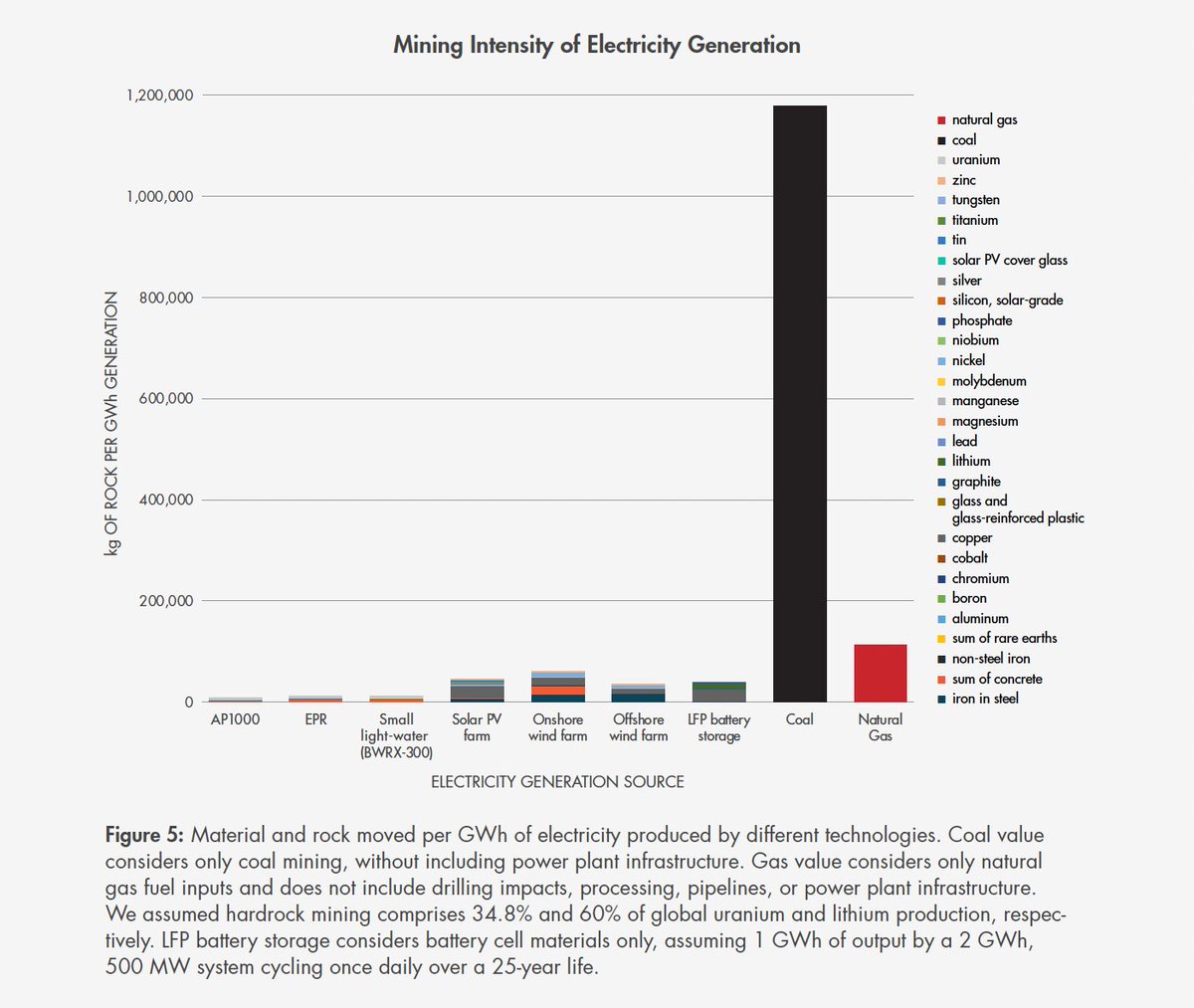
To supply low-carbon power to a grid via nuclear, solar, wind, or grid batteries, how much material must we dig up to build those power plants?
Answer: far less than for fossil fuels, with nuclear needing the least mining. New @TheBTI report by my team: thebreakthrough.org/issues/energy/…
Big takeaways:
Coal? Digs ~1.18 million kgs of rock+coal per GWh for fuel only
Solar+wind have improved much in last 10 yrs
Nuclear still needs least mining + critical minerals per GWh
Cu, steel, Ni, Li, U, Ag offer ways to improve mining footprint further thebreakthrough.org/issues/energy/…
What inspired this analysis? Energy transition mining remains divisive, but discussions often cite flawed or out-of-date data, or end up handwavy. For this analysis, we wanted to make an up-to-date comparison, w transparent methodology using public sources apps.openei.org/REMPD/
From 2018 to 2023, silver use in solar PV cells has dropped by around half! (h/t @solar_chase)
Indeed academic papers (incl my own) tend to lean several yrs out of date. But industry intel is often paywalled, hence my habit of obnoxiously saving whatever nuggets I come across.
This is a clear example of why getting the stamp of peer-review doesn't mean something is right or the golden truth of science.
The most crucial round of peer review is really the permanent, continuous reactions/feedback from other experts once a study is actually publicly read.
I had assumed 10g per watt in my @Joule_CP paper, and had thought afterwards that might've been generous--but now it's right on the money.
Where I was way off was concrete, which is no longer used to anchor solar mountings in most utility-scale plants.