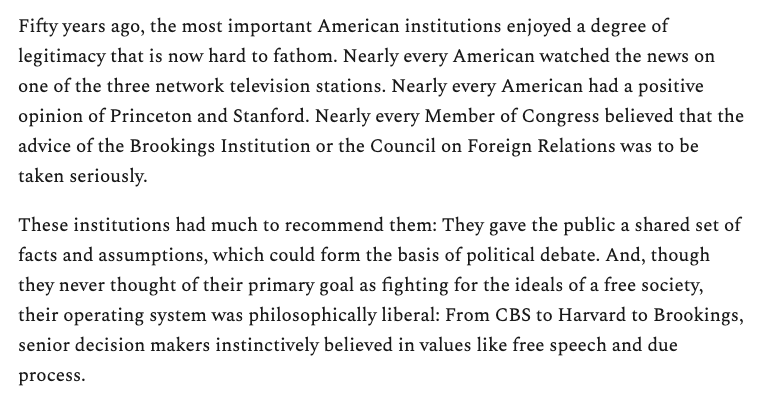
Now I understand why @Yascha_Mounk believes the populist right is a greater threat to free speech than the woke left. It's because his narrative of the last 50 years (which I assume represents the elite conventional wisdom) is, with all due respect, nuts. persuasion.community/p/the-purpose-…
Yes, the decline of institutions is the big story of our era — but are Princeton and Brookings really the institutions whose decline has hurt Americans most? Not the Protestant Mainline and civic groups, but the Council on Foreign Relations?
Did universities and the mainstream media lose legitimacy — so much that Donald Trump was elected president — because they weren't feminist, anti-racist, and pro-gay **enough**?
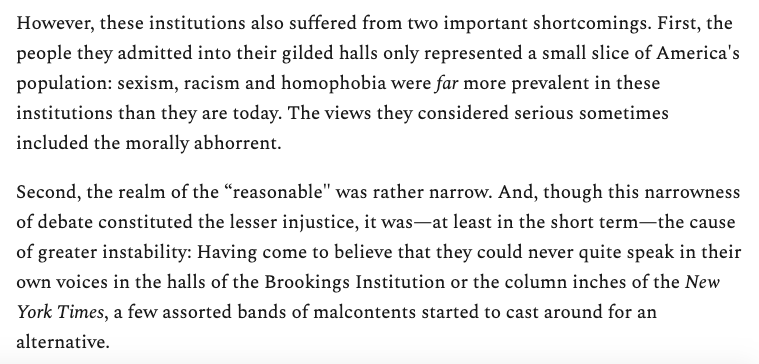
The truth is that Mounk and his friends in elite institutions produced bad outcomes when they were in power, and that's why people stopped trusting them. I see no trace of self-reflection here that they made any mistakes at all—which, looking at some of these names, is odd!
Mounk blames "minoritarian" "malcontents" in the conservative movement, and now Trumpists, for elite institutions losing legitimacy. Personally I would advise him to consider whether maybe elites contributed to their own decline. Admitting a single error would be a good start.
• • •
Missing some Tweet in this thread? You can try to
force a refresh

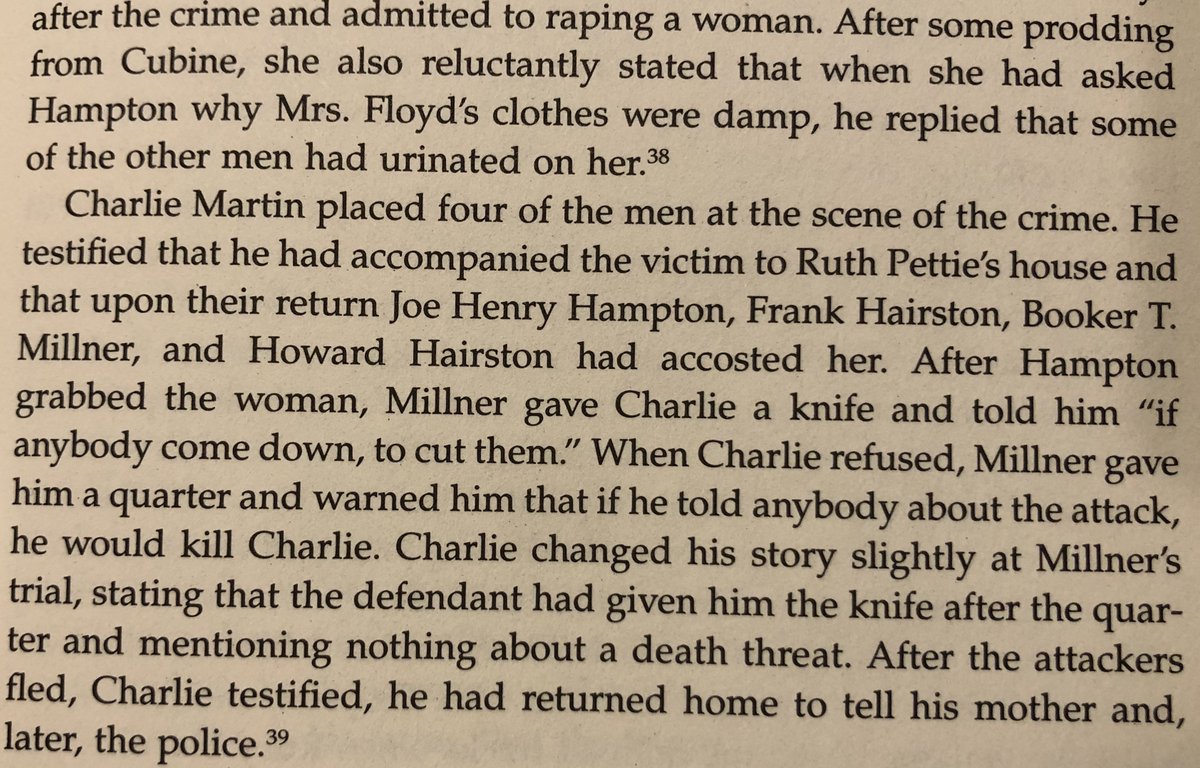
Virginia is erecting a memorial plaque to the Martinsville 7, who were posthumously pardoned by Gov. Northam earlier this year. Only one problem: They were guilty. Definitely & unquestionably. They gang-raped Ruby Floyd for hours and left her in a ditch. cardinalnews.org/2021/12/22/sta…
There were eyewitnesses. Ruby Floyd managed to break away from her attackers at one point and ran to the road to beg passersby for help. They brushed her off, but later identified the men who dragged her back into the woods.
An 11-year-old boy, Charlie Martin, was with Ruby giving her directions to the house she wanted to visit when four men grabbed her off the sidewalk. He later identified them to police.
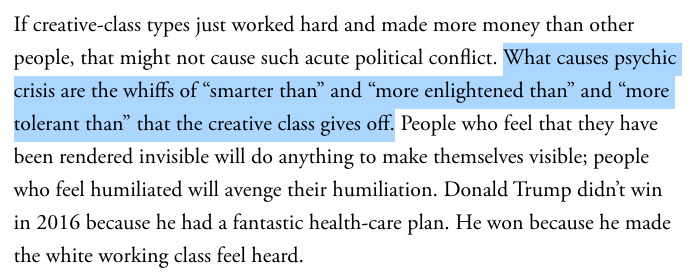
I am begging Atlantic writers to consider another explanation for populism besides that the 21st century has had winners & losers and the winners pulled too far ahead. Trump voters don't resent your success. They resent the ways you actively harm them. theatlantic.com/magazine/archi…
Believe me, populists aren't bothered by how bobos feel about them. It's what bobos do to them.
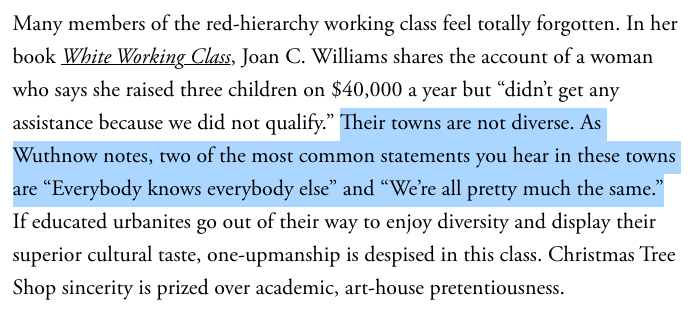
Brooks cites Robert Wuthnow’s “The Left Behind: Decline & Rage in Small Town America,” mainly to show that small towns are “not diverse” and don’t share bobos’ values of openness. But is that really the biggest takeaway from Wuthnow’s book? amazon.com/Left-Behind-De…
Have you ever dealt with a serious hypochondriac? I have. I’m not going to tell that personal story, but I will share some lessons I’ve learned, because I keep seeing the same behaviors among the covid-conscious.
IT'S SERIOUS. Hypochondria is a real disease (ironically). It can make someone blow their life savings or turn into a recluse. Think of it like compulsive gambling or any addiction. It can take over a person's life. /2
IT STARTS SMALL. Maybe a chemical sensitivity or a food allergy. If you humor them, thinking the accommodations are too small to object to, the requests will escalate. There is no limiting principle. Their health trumps your minor inconvenience every time. /3
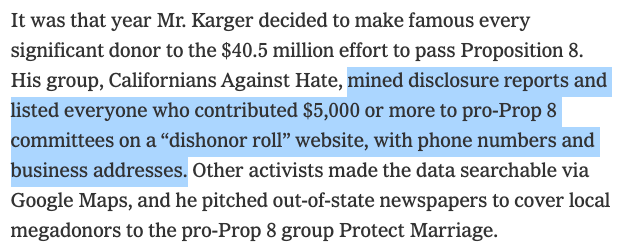
Interesting essay arguing that “cancel culture" was invented by gay marriage activists, which, as a matter of history, I think is correct. nytimes.com/2021/06/05/opi…
One definition of “cancel culture” is that it's regular politics minus any respect for basic ground rules. For example, the basic ground rule that you don't go after ordinary private citizens the way you do public figures.
Or the basic ground rule that you never attack a lawyer for taking a client, because everyone is entitled to a defense. Ask Paul Clement how the gay marriage movement felt about that one.
The Winter 2020 Claremont Review of Books is now online, featuring my review of Christopher Caldwell's "Age of Entitlement," as well as Amy Wax on RBG, Conrad Black on the Kavanaugh confirmation, and Adam Rowe on the anti-Federalists. claremontreviewofbooks.com/issue/winter-2…
Whatever your view of the argument over the long-term effects of civil rights law, I hope we can all agree that, as a matter of history, these people lied. claremontreviewofbooks.com/the-law-that-a…
Speaking of that congressional debate, Barry Goldwater was famously mocked for his speech against the 1964 law, with its overblown fears of an "informer psychology" and "neighbors spying on neighbors."
Three books to read in addition to Christopher Caldwell's, especially if his thesis about the sweeping effects of civil rights law seems exaggerated to you: amazon.com/Age-Entitlemen… 1/6
For anti-discrimination law as a threat to free speech, David Bernstein's "You Can't Say That." amazon.com/You-Cant-Say-T… 2/6
The single best book on how civil rights law came to pervade the American workplace is Frank Dobbin's "Inventing Equal Opportunity." amazon.com/Inventing-Equa… 3/6