
Most stories of women in Genesis (and possibly much of the Hebrew Bible) appear to adhere to a single pattern. At the center of each iteration of the pattern, the woman responds to the actions of the serpent/seed of the serpent, then God responds.
In the variations in the pattern, we find emphasis, narrative progression, and meaning. Seeing it may help us perceive a narrative rhythm that, combined with other patterns in the text, yields a compelling narrative of profound emotional, intellectual, and spiritual depth.
Proposed standard form:
Character
A-Man’s action/inaction
B-Seed of the serpent’s action
C-Woman’s response/plight
D-God’s response
E-Adjudication
F-Disposition regarding the land
Character
A-Man’s action/inaction
B-Seed of the serpent’s action
C-Woman’s response/plight
D-God’s response
E-Adjudication
F-Disposition regarding the land
Eve's is a good intro, though Adam doesn't have much to say.
The daughters of men introduce an element of complexity that will recur: one narrative where women are taken advantage of and a following where they get theirs.
The daughters of men introduce an element of complexity that will recur: one narrative where women are taken advantage of and a following where they get theirs.
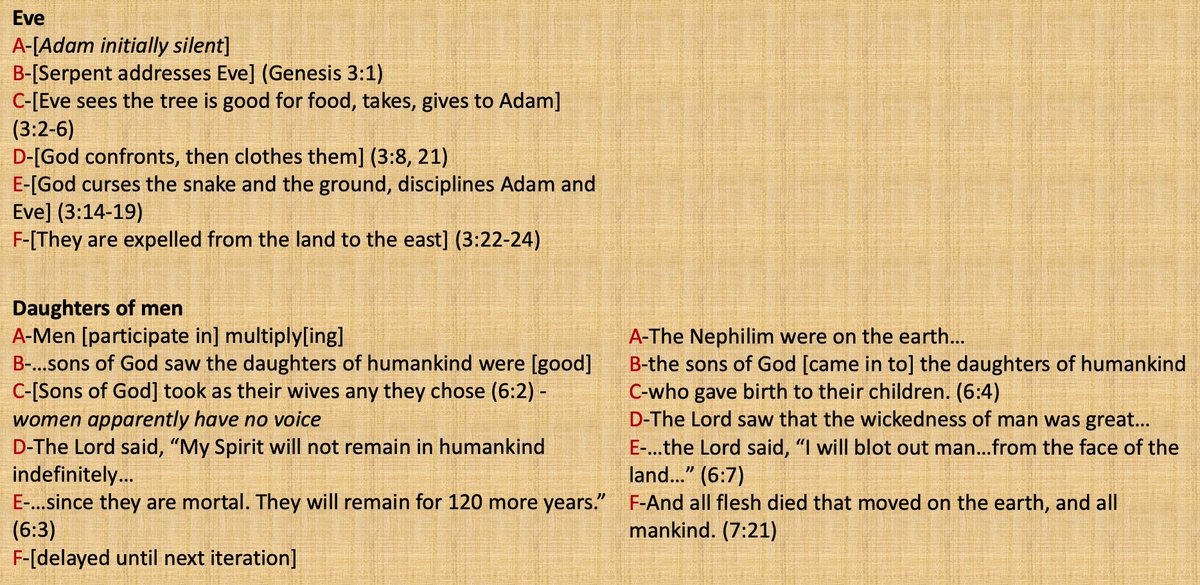
In their 1st iteration, the term ‘take’, which we see as Eve takes the fruit, and ‘any they chose’ suggest rape. In the 2nd, ‘would sleep with’ and ‘gave birth to’ may indicate a relationship. There is a possible reason – 'They were the mighty heroes of old, the famous men.' –
-viewed with the Nimrod/Babel story (10:8-9, 11:4) in which post-flood people desire these same qualities, it's possible women cooperated to produce desirable-to-them (though not to God) offspring. Comparison to later iterations suggest possibly as response to failed protectors.
This one I hold loosely. The pattern is dependent on interpreting Ham’s actions as maternal incest. The possibility of maternal incest is supported by similarities in the language used here and in Leviticus 18:7-8.
See also bit.ly/3edjgEp
See also bit.ly/3edjgEp
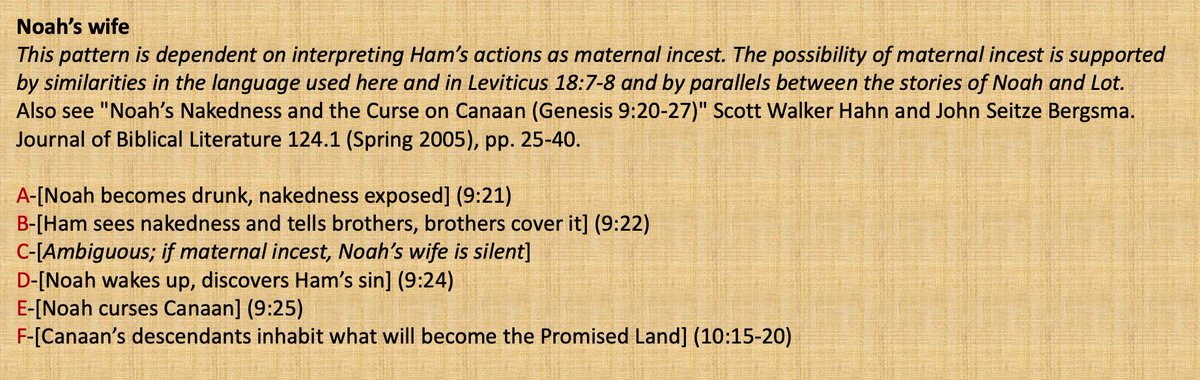
In this iteration, Noah acts in the place we would expect God to, either because he is ruling in God’s image or he is usurping God’s position as Ham did his. Given his earlier failing, the latter seems likely.
In the end, a cursed people inhabit a land intended for blessing.
In the end, a cursed people inhabit a land intended for blessing.
Sarai and Hagar follow the 'daughters of men' pattern - mistreatment and reversal.
In the first, Abram places his trust in the pharaoh rather than God, so in this iteration, the pharaoh’s actions are in the place of God’s.
In the first, Abram places his trust in the pharaoh rather than God, so in this iteration, the pharaoh’s actions are in the place of God’s.
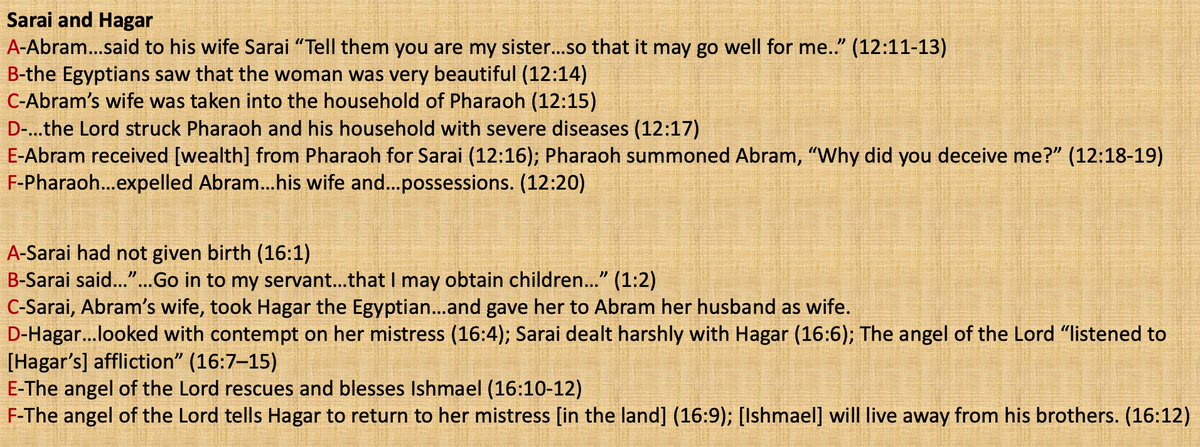
Here, Sarai takes charge. There is a role reversal between her and Abram, her and the seed of the serpent. In frustration, possibly also anger and revenge, she takes on both roles.
At the same time, Hagar the servant girl gets more attention from the angel of the Lord,-
At the same time, Hagar the servant girl gets more attention from the angel of the Lord,-
-regarding the future of her offspring, than Sarai ever will.
The sexual language progression echoes the daughters of men narrative. The Egyptians saw and took Sarai, Abram ‘go[es] in to’ Hagar.
The Egyptians took Sarai; Sarai takes Hagar.
Sarai did not see Hagar, but God does.
The sexual language progression echoes the daughters of men narrative. The Egyptians saw and took Sarai, Abram ‘go[es] in to’ Hagar.
The Egyptians took Sarai; Sarai takes Hagar.
Sarai did not see Hagar, but God does.
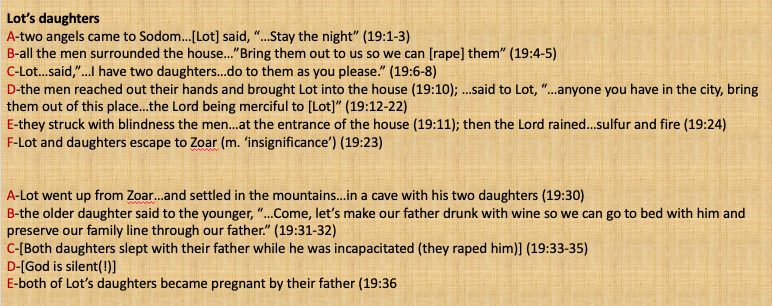
Like Sarai, after being mistreated, Lot’s daughters subvert the pattern.
Lot had offered his daughters to the mob to be raped, echoed in an appalling episode in Judges 19. Here, they take advantage of him.
Lot had offered his daughters to the mob to be raped, echoed in an appalling episode in Judges 19. Here, they take advantage of him.
Abraham again uses Sarah, Sarah again has a reversed role narrative. In the second panel, she takes on the roles normally held by the man and the serpent, while Abraham is in the role normally held by the woman.
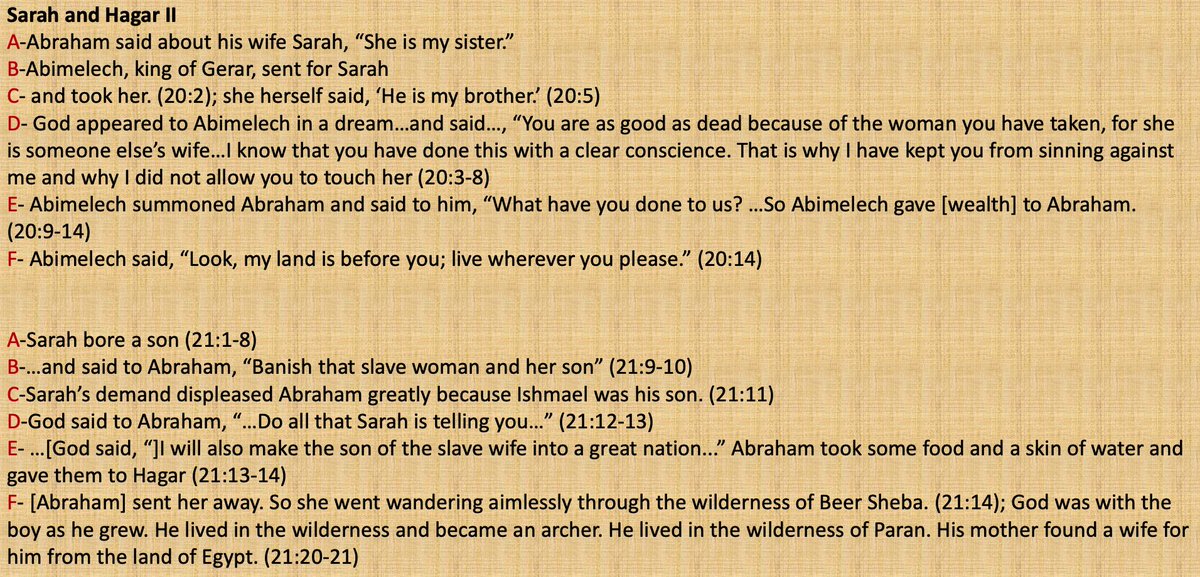
Though Abraham had repeatedly been enriched by giving his wife away, he sends out his slave and his own son with nothing more than food and water.
God does not hold back, however, making an extravagant promise to Hagar to care for her and ensure her son and his sons' future.
God does not hold back, however, making an extravagant promise to Hagar to care for her and ensure her son and his sons' future.
It appears the woman-at-the-well narratives are their own patterns and do not adhere well to this one.
As when Abraham put his trust in the pharaoh, the pharaoh acted in God’s position in the pattern, so here, Abimelech admonishes Isaac in the place we would expect God to act.
As when Abraham put his trust in the pharaoh, the pharaoh acted in God’s position in the pattern, so here, Abimelech admonishes Isaac in the place we would expect God to act.
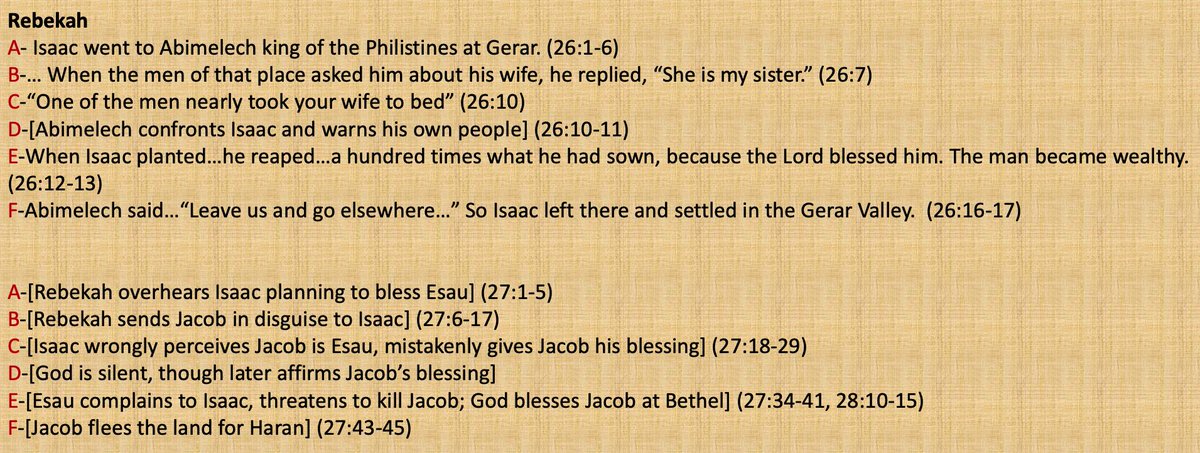
Like Sarah and Lot’s daughters, after being wrongfully used, Rebekah reverses roles in a selfish, possibly vengeful narrative to take what she wants from the man who wronged her.
These revenge narratives never end well. Here, as a result, she never sees her favored son again.
These revenge narratives never end well. Here, as a result, she never sees her favored son again.
For simplicity’s sake, I’ve left off the servant wives, though they deserve to be recognized.
Leah's father forces her on a man who doesn’t want her.
Jacob loves Rachel, but she is also denied the chance to have her husband to herself.
It goes downhill from here.
Leah's father forces her on a man who doesn’t want her.
Jacob loves Rachel, but she is also denied the chance to have her husband to herself.
It goes downhill from here.
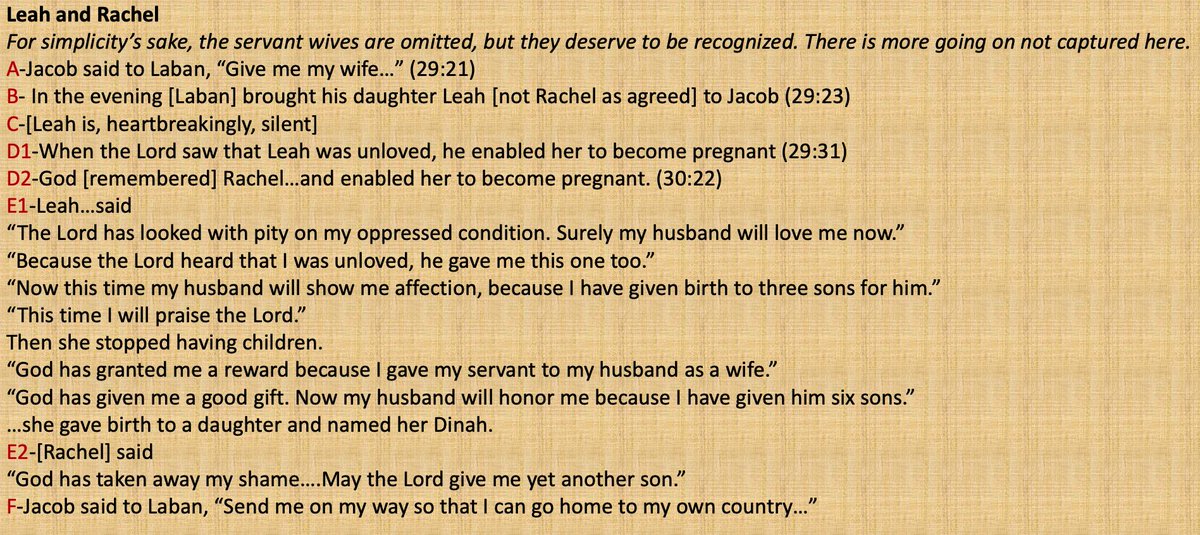
Rachel has a woman-at-the-well scene and a personal theme of weeping and death that permeates Jacob's and her sons' stories and echoes through the prophets (Jeremiah 31:15) and into the Gospels (Matthew 2:18). Central to Jacob's story, God remembers her.
In this reading, Dinah holds the place the pattern conditions us to expect the man to.
Going back to Eve, when a character sees and takes, it indicates sin. Here the sin is clear-he rapes her. The pattern echoes that of the Genesis 6:2 daughters and may clarify they were raped.
Going back to Eve, when a character sees and takes, it indicates sin. Here the sin is clear-he rapes her. The pattern echoes that of the Genesis 6:2 daughters and may clarify they were raped.
Tamar's is nearly the last of this pattern in Genesis, but moving forward in Hebrew Bible narratives, we find a new element–very often, starting with Tamar (and after the rescue of Dinah), the woman is savior.
Here, she preserves Judah’s line from destruction by Judah himself.
Here, she preserves Judah’s line from destruction by Judah himself.

Joseph's story echoes the themes of the ones before, so though not a woman, he gets a turn.
The temptation of Joseph echoes Eve’s, its narrative purpose to demonstrate Joseph’s success where his ancestors had failed, so here Joseph is in the place of the woman in the pattern.
The temptation of Joseph echoes Eve’s, its narrative purpose to demonstrate Joseph’s success where his ancestors had failed, so here Joseph is in the place of the woman in the pattern.

Proposed future iterations-
Hebrew midwives
Zipporah and the strange circumcision
Variations in the pattern highlight elements that remain consistent. Many iterations show God’s care for women who have been treated poorly by men, the serpent’s allies, or even other women.
Hebrew midwives
Zipporah and the strange circumcision
Variations in the pattern highlight elements that remain consistent. Many iterations show God’s care for women who have been treated poorly by men, the serpent’s allies, or even other women.
Though in Genesis, women’s stories do not have the same word count as men’s, we do find fully formed characters, the capacity for good and evil. They apparently exact revenge, participate in rebellions, subvert others’ evil intentions, cry out to God who hears and loves them,-
-and act as essential saviors.
In each generation, God remembers, rescues, and blesses women, even as their own loved ones fail them.
Men’s tendency to forget, neglect, and willfully imperil them is set in opposition to God’s consistent remembrance and salvation of women.
In each generation, God remembers, rescues, and blesses women, even as their own loved ones fail them.
Men’s tendency to forget, neglect, and willfully imperil them is set in opposition to God’s consistent remembrance and salvation of women.
Postscript – It may be that this pattern ought to start with the disposition of the land as well as ending with it, because in many of these stories, there is a geographical progression. That the woman would be in the center of a land progression is no coincidence.
In the ancient world, the land and women were conceptually linked – the land receives rain and produces life. Genesis 1 tells of God’s creation of a land suitable for man, and Genesis 2 culminates in a helper suitable for man, the woman.
Throughout the Hebrew Bible, God defends the land he made for his people against the polluting sin of its inhabitants. In the patterns above, God similarly defends women against others’ oppressive sin.
In the end, God’s purpose is to restore all his people in a fruitful land.
In the end, God’s purpose is to restore all his people in a fruitful land.
I'm sorry I forgot to attach you Dinah!

*Bible quotations in the images in this thread are taken from the NET Bible [occasionally modified with ESV]
netbible.org/bible/
netbible.org/bible/