California state mandated #COVID19 thresholds for schools to open are not readily available on county and state websites. To help parents stay updated, @sinabooeshaghi, working with @IngileifBryndis and me, made these continuously updated plots: github.com/pachterlab/COV…
The thresholds are from @GavinNewsom "Blueprint for a Safer Economy".
We've included a plot displaying data for the previous school opening requirements (14 days totaling 200 cases per 100,000 for TK-6th and 100 cases per 100,000 for high schools).
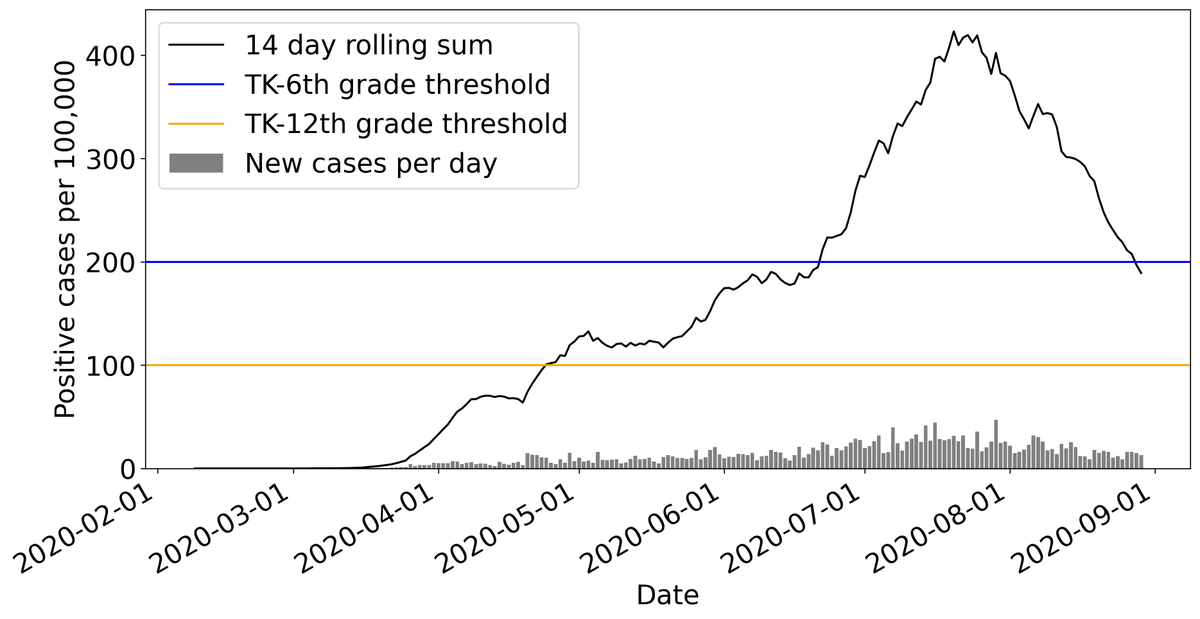
NOTE: the @nytimes data differs from the LA county reported figures at the county data portal. The differences arise from what appears to be dysfunction and chaos in county reporting.
Anyone can play with the data using the @GoogleColab notebook we provide github.com/pachterlab/COV…. In addition, @sinabooeshaghi utilizes @github actions to run the code every four hours and automatically update the plots shown in the README.
Note that these plots are currently generated for LA county, but it is straightforward to extend this to other counties.
• • •
Missing some Tweet in this thread? You can try to
force a refresh

Arguably the most boring step in genomics is the first one: normalization. Settled science. Scale + log. Move on.
Except that here's been a huge blind spot in the field. And it matters for AIxBio. A 🧵about what I think may be one of the most important papers I've written. 1/
The standard normalization is log(x/s*K+1) w/ K=10,000 in Seurat and Scanpy. It's been used in hundreds of thousands of studies. AI agents nowadays run it routinely.
In an expansive benchmark in @naturemethods, Ahlmann-Eltze & Huber conclude it's pretty much best in class. 2/
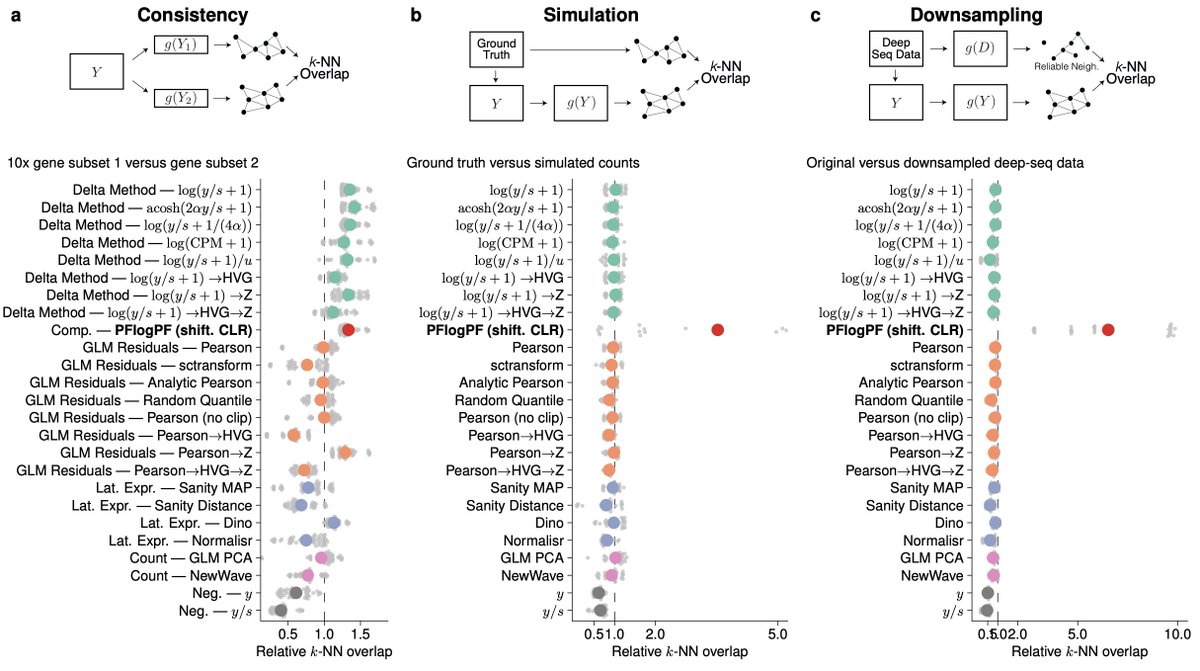
Except it isn't. Not even close. In a project that is four years in the making, we show that another transformation massively outperforms existing methods on the Ahlmann-Eltze & Huber benchmarks (red dots below). Moreover, it's optimal. What is this new method? How can it be? 3/
So this plagiarism thing has happened to our lab.. again. This time it's plagiarism of our poseidon syringe pump paper @booeshaghi et al., 2019 in @SciReports:
Text has been plagiarized, as well as figures copied directly here: 1/🧵nature.com/articles/s4159… ijirset.com/upload/2024/ma…
Here is figure 1 from our paper (LHS) and figure 1 in the plagiarized paper (RHS) published in the "International Journal of Innovative Research" 2/ ijirset.com/upload/2024/ma…
The text seems to have been rewritten with an LLM. Our introduction (LHS) vs. the plagiarized version (RHS): 3/
I've checked this paper out, as instructed. I was also interested in the main result for personal reasons: I'm 51 years old. Is it true that I've just gone through a major change? And that another one awaits me in just a few years?
The main result about major changes in the mid 40s and 60s is shown in this plot (Fig. 4a). First, I redrew it with axes that start at 0, so the scale of change here was clearer. Not as impressive, but maybe it's a thing? 2/
The authors say that this finding is even corroborated in another study (ref 14). But that's not true. I looked it up, and it shows something totally different (see RHS Fig 3c from ref 14). No change in mid 40s, but a change in the mid 30s, and the real change in the 80s 😕 3/
I recently posted on @bound_to_love's work quantifying long-read RNA-seq. In response, a scientist acting in bad faith (Rob Patro @nomad421) trashed our work. This kind of mold in science's bathroom is extremely damaging so here's a bit of bleach. 1/🧵
At issue are benchmarking results we performed comparing our tool, lr-kallisto, to other programs including Patro's Oarfish. Shortly after we posted our preprint Patro started subtweeting our work, claiming we'd run an "appallingly wrong benchmark" and that we're "bullies". 2/
This was followed, within days, by Patro posting a hastily written preprint disguised as research work on benchmarking, but really just misusing @biorxivpreprint to broadcast the lie that our work "... may be repeatable, but it appears neither replicable nor reproducible." 3/