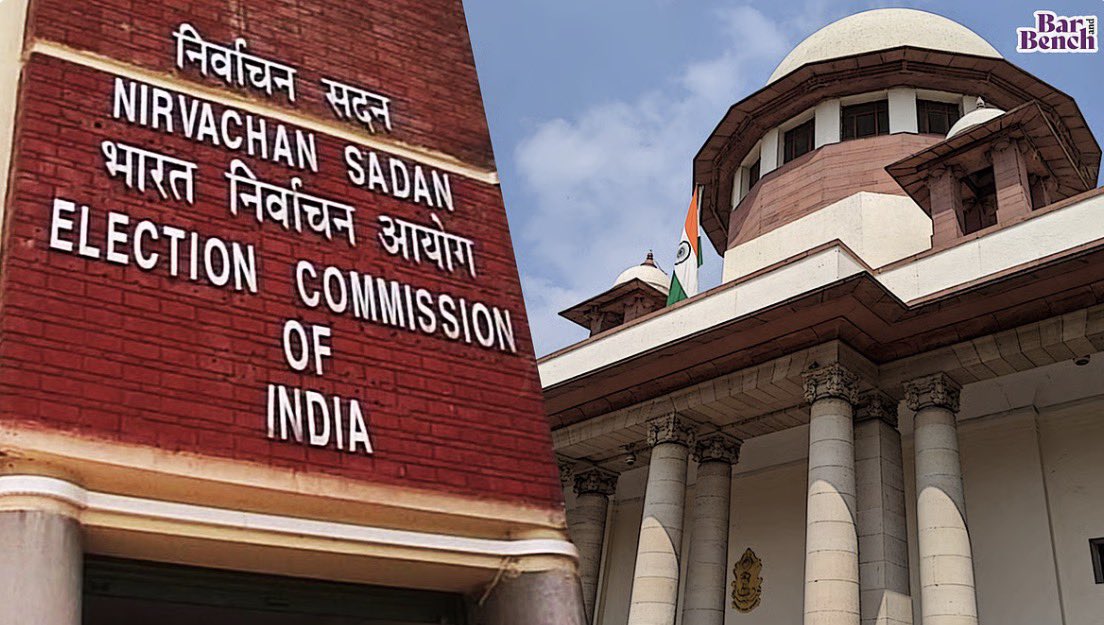
The Bench of Justices AM Khanwilkar, Dinesh Maheshwari and Sanjiv Khanna begins hearing.
Counsel for the petitioner: Main grievance in the matter is that the main exam and the CBSE has not yet asserted why the compartment exam cannot be cancelled.
Petitioner: The students will ultimately come in the category of failed students since exams will not be able to be conducted by September and the students will not be able to apply for further studies.
Advocate Rupesh Kumar for CBSE: We have increased the centres for compartment exams to 1278. We have taken a decision that in a class where 40 students could sit, now only 12 will sit. We are taking all precautions.
Supreme Court today to pronounce judgment in a narco-terror case from J&K, where the accused has spent nearly five years in custody despite no contraband being recovered directly from him
#SupremeCourt
Justice Ujjal Bhuyan: this case raises an important question concerning the interface between Section 43D(5) of the Unlawful Activities (Prevention) Act, 1967, and the constitutional guarantee of personal liberty under Article 21 of the Constitution of India. More particularly, the issue concerns the propriety of smaller benches progressively hollowing out the constitutional force of a larger bench decision without ever expressly disagreeing with it.
Then, after narrating the facts and the submissions, and also referring to two judgments in Gurwinder Singh v. State of Punjab and gumfisha Fatima v. State, we have said in para 26:
There are two judgments of this Court which we need to deal with before proceeding ahead. These two judgments, Gurwinder Singh and gulfisha Fatima, have taken a somewhat divergent view from the clear, distinctive trajectory taken by this Court for grant of bail even under special enactments like TADA, UAPA, and NDPS.
Justice Ujjal Bhuyan: A decision made by a bench of lesser strength is bound by the law declared by a bench of greater strength. Judicial discipline mandates that such binding precedent must either be followed in full, or in case of doubt, be referred to a larger bench. A smaller bench cannot dilute, circumvent, or disregard the ratio of a larger bench.
The position of law emerging from Najeeb and Sheikh Javed Iqbal is therefore clear. Watali cannot be invoked to justify indefinite incarceration of the accused under the UAPA.
For the aforesaid reasons, the attempt in gurminder to read Watali as laying down a general rule of denial of bail notwithstanding the period of incarceration is difficult to reconcile with this Court’s own subsequent clarification of what the ratio in Watali actually meant.
We also note that the bench in Gurwinder formulated the so-called twin-prong test governing grant of bail under the UAPA. It held that inquiry under Section 43D(5) must proceed in two sequential stages. First, whether the accusation is prima facie true, and second, only if the first question is answered in favour of the accused, whether ordinary bail considerations such as flight risk, etc. would justify the relief. If the first stage of the twin-prong test is satisfied against the accused, bail becomes absolutely impermissible.
With respect, this test flows neither from the text of Section 43D(5) of the UAPA Act, nor from Najeeb. In fact, on the contrary, it is in the case of Najeeb where it is categorically stated that Section 43D(5) of the UAPA Act provides no more than another possible ground, namely, that the accusations against the accused are prima facie true, for the competent court to refuse bail, in addition to the well-settled considerations like possibility of tampering with evidence, etc.
SG Tushar Mehta: CBI appeal is listed before the Delhi High Court
Sr Adv N Hariharan: I am in the position to show that the prosecutrix is not a minor. The AIIMS board says she was not a minor. All reports are in his favour still he is in jail.
SG: The main conviction is under 376(1) IPC for remainder of his life
CJI: Prayer was only to suspend the sentence. There are issues which require consideration.
SG: it has to be seen whether MLA is a public servant for the POCSO
Justice Bagchi: we do not endorse the hyper technical conclusion of the high court. This is a penal legislation which protects children from sexual exploitation.. section 21 of IPC and prevention of corruption of act..
SG: MLA is in a dominant position.
CJI: HC has suspended the sentence. We have stayed by it. Now there is suspense whether order is illegal, erroneous etc. Now in this area..HC will be reluctant to hear the main appeal.
CJI: we can set aside the order. HC can decide the appeal or if it's taking time .HC can decide the application for suspension of sentence.
Supreme Court to resume hearing today petitions challenging a 2023 law which excluded the Chief Justice of India from the selection panel to appoint the CEC and other election commissioners.
Bench: Justices Dipankar Datta and SC Sharma
Retd. IAS SN Shukla argues on behalf of Lok Prahari: we have challenged not only section 6,7,8 and also the appointments made there under. The basis is not just the judgement in Anoop Baranwal but proven legal infirmities based on governments own records that I have obtained through RTI.
Court: have you received a copy of the counter?
Shukla: only union of India has filed counter yesterday.
Court: have you received the copy? Please address us on merits.
Shukla: the impugned provisions are ultra vires articles 14 and 324.
Supreme Court remarks on women empowerment and patriarchal mindset in a divorce case between an Army officer (husband) and a dentist (wife) - Thread 🧵
The couple was granted divorce by the family court and the high court on the ground of cruelty and desertion by the wife for starting her own dental clinic away from Kargil, where her husband was posted.
The wife approached the Supreme Court not disputing the divorce, but seeking expungement of findings on cruelty and desertion.
Court: In the present world, where women are making strides in leaps and bounds, merely because the husband was an Army Officer posted in a remote location, the expectation that the wife could not even think of pursuing her career in Dentistry, is indicative of regressive and feudalistic mindset.
Court: It must be emphasised that a well-educated and professionally qualified woman cannot be expected to be confined within the rigid boundaries of matrimonial obligations alone. Marriage does not eclipse her individuality, nor does it subjugate her identity under that of her spouse.
Court: The expectation that a woman must invariably sacrifice her career and conform to traditional notions of an obedient wife meant for cohabitation, irrespective of her own aspirations or the welfare of the child, reflects a line of reasoning that is archaic, ultra-conservative, and cannot be countenanced.
Court: What is portrayed as defiance in the impugned judgments is, in truth, an assertion of independence; what is labelled as desertion is, on a closer scrutiny, a consequence of circumstances shaped by professional commitments.
Punjab minister Sanjeev Arora has approached Punjab and Haryana High Court against his arrest by ED in money laundering case.
A Bench of Chief Justice Sheel Nagu and Justice Sanjiv Berry is hearing the matter.
It is absolutely illegal. It is absolute case of political vendetta: Senior Advocate Puneet Bali, representing Arora, submits.
An absolute political orchestrate! Two FEMA raids are made. One against Shri [Ashok] Mittal; he defects, joins the ruling party, no arrest is made: Bali
Solicitor General of India Tushar Mehta’s two books — “The Bench, the Bar and the Bizarre” and “The Lawful and the Awful” — will be launched shortly
Chief Justice of India Surya Kant will preside over the event. Union Home Minister Amit Shah will attend as Chief Guest, while Attorney General for India R Venkataramani will be the Guest of Honour @AmitShahOffice #TusharMehta @Rupa_Books #SupremeCourt
SG Mehta's book launched by Union Home Minister Amit Shah , CJI Kant and AG R Venkataramani
SG Tushar Mehta: There is a particular peculiarity in being an advocate and publishing books on the lighter side of law. It feels rather like a surgeon writing humorously about his own operation theatre.
But I have deliberately, consciously, and purposefully chosen this subject, which is not a subject of just anecdotes or legal jokes or any other humorous book which is available in the market. I have chosen a different genre.
But I must clarify at the outset what these books are not. They are not a treatise. They are not a critique of any particular subject of law. And I have not even pretended to be scholarly while writing this book, the infection which infects almost everyone on this side of the Bar.
What are these two books? It is quite simple. They are a collection of true stories. Nothing is imaginary or fictional. They are a collection of true stories.
Since I am practising in India, and intend to do so for quite a number of years hereafter, I have chosen not to include any instance of Indian sport, Indian jest, or Indian judge. I have just gathered some incidents which would be very, very interesting for all of us to learn.