I have no idea what will happen in the election. But I keep seeing statements to the effect that Trump may have an upside if the economy is strong. People, the election is only 1 1/2 months away; some voting has already begun! 1/
This means that there just isn't time for economic perceptions to change much. There will be only 1 more jobs report, based on data from *last week*; it will probably show gains, but at a slowing pace, and won't change anyone's mind (unless it's disastrous) 2/
There will be a 3rd quarter GDP report, which will show big gains — but I think most people will realize that it's about the summer snapback, and not about whether we're making America great again again again 3/
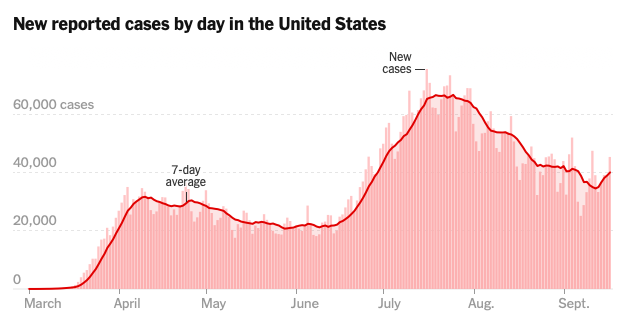
So I have a hard time seeing the economy as a major factor. Meanwhile, don't look now, but coronavirus cases are plateauing or maybe even creeping up again. Hard to see much Trump upside there either 4/
Yes, of course Trump can still win. Maybe polling is systematically wrong; maybe whatever October surprise(s) he concocts will actually work, not backfire bc of lack of credibility. But the idea that fundamentals can come to his rescue at this late date seems far-fetched 5/
• • •
Missing some Tweet in this thread? You can try to
force a refresh

Imports are about 14 percent of US GDP. Federal income tax revenue (not including payroll taxes) is about 8 %. So you might think replacing it would require a tariff rate of 8/14 or around 57 percent. But ... 2/
Tariffs would raise the cost of imports to consumers, so we'd import less, which would mean you need a higher tariff rate. But this reduces imports further, meaning a still higher tariff, and so on 3/
The Fed survey of economic well-being is out; some changes at the margin, but the basic story remains that Americans say they're doing mostly OK, their local economy isn't too bad, but the national economy is terrible 1/
Consistent with polling. Here's Quinnipiac on Wisconsin voters 2/
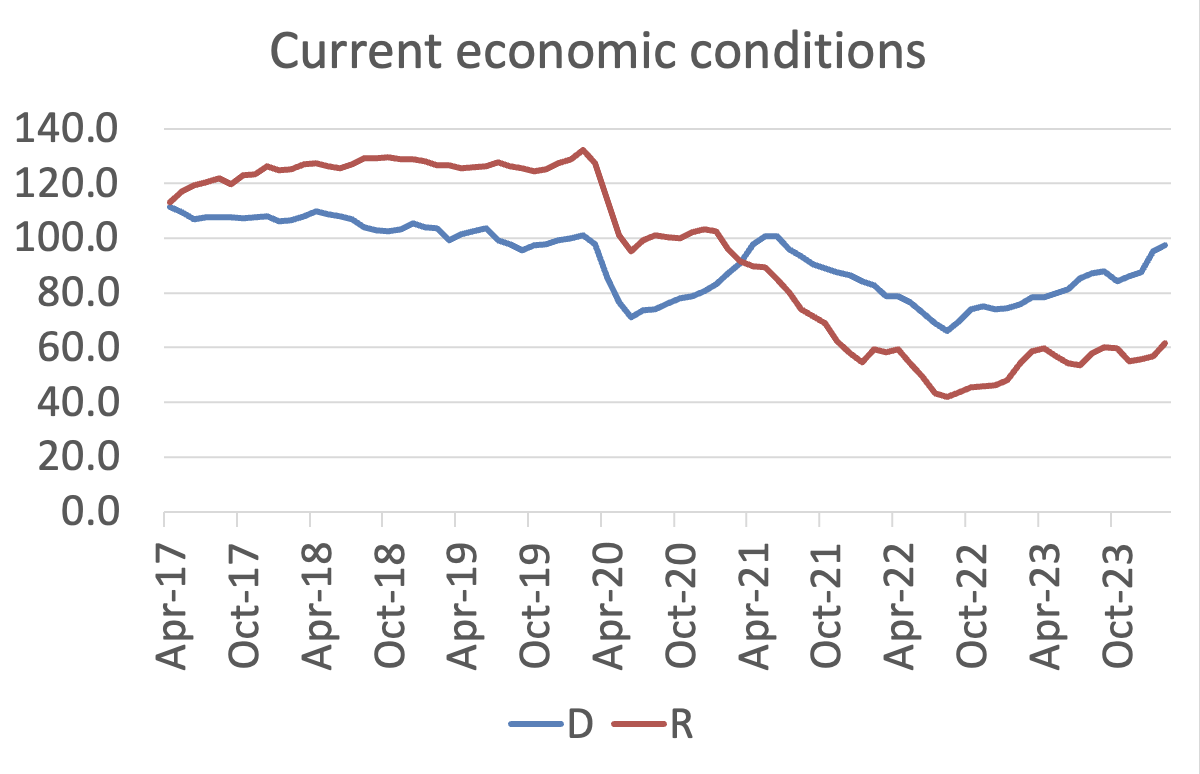
With the recent rise in consumer sentiment, time to revisit this excellent Briefing Book paper. On reflection, I'd do it a bit differently; same basic conclusion, but I think partisan asymmetry explains even more of the remaining low numbers 1/ briefingbook.info/p/asymmetric-a…
The Michigan sentiment index has two components: current conditions and expectations. It's kind of legitimate to have partisan diffs on expectations, if you think your party has better policies. It's the gap on current conditions that's startling 2/
Michigan doesn't provide partisan breakdowns every month until 2017 (hence the limited range of that chart). A quick and dirty approach is to use annual averages, with whatever months they do provide for each year, which lets us push back to 2006 3/
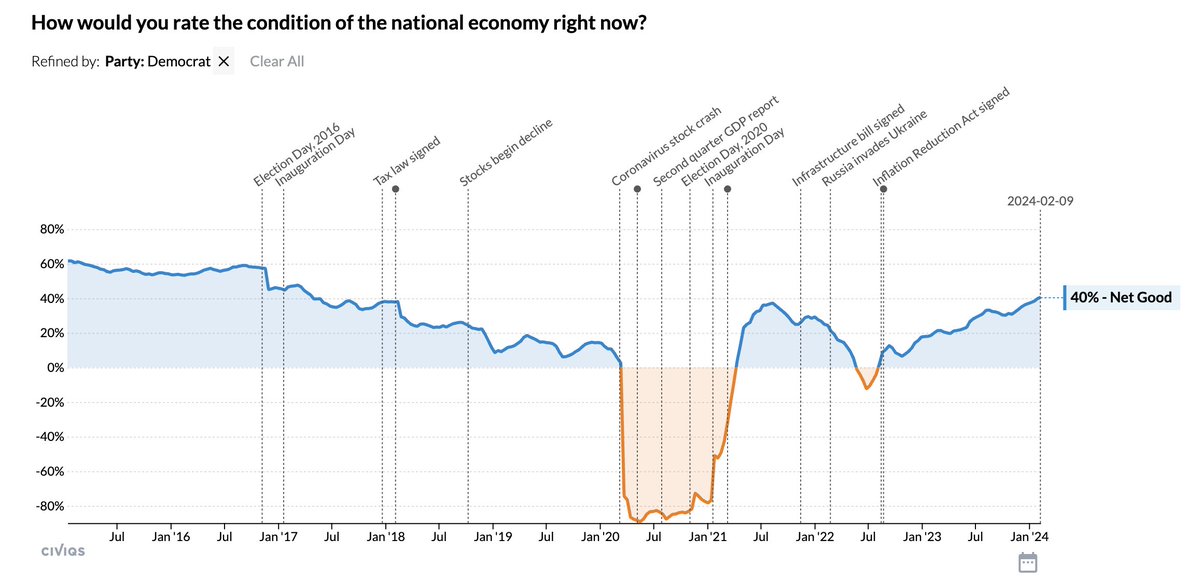
Recent economic news has been extremely good. But there's a strange meme among some D consultants that Biden shouldn't boast about it, because it seems out of touch — that people aren't feeling the good economy. But they are! 1/
The venerable Michigan survey has rocketed up lately 2/
It's true that consumer sentiment is still weaker than you might expect given the economic numbers. But that's largely partisanship. Using Civiqs numbers, Democrats have more or less fully accepted the good news 3/
Immigration is looming larger in the campaign, partly because it's becoming harder for Republicans to run against Biden on the economy. But there's a strong case that immigration has been a key part of Biden's economic success 1/
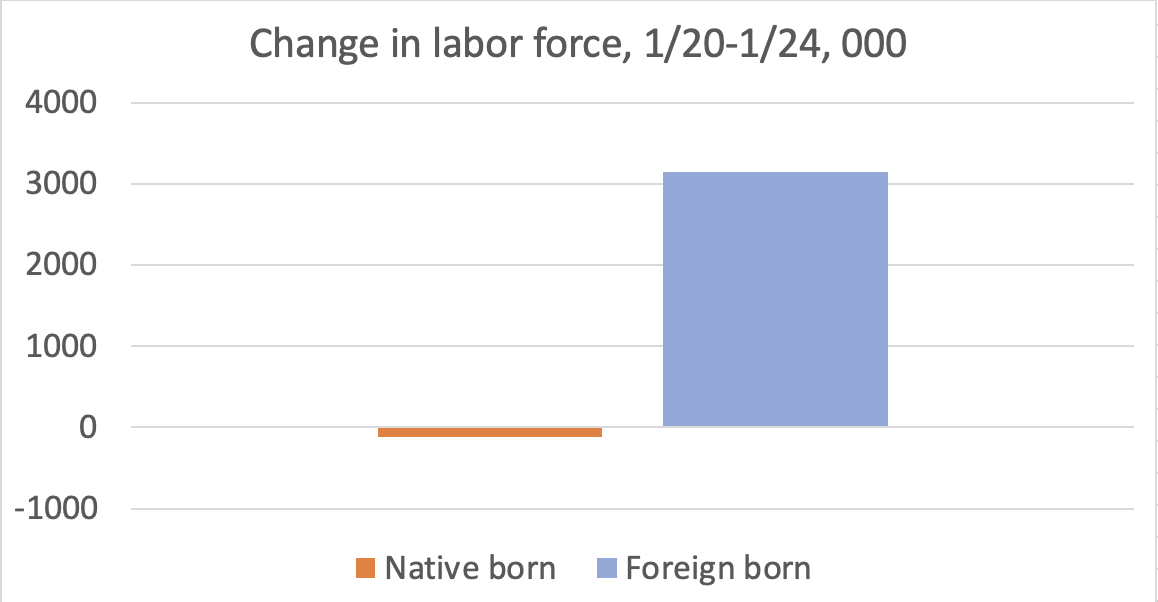
Inflation has come down so easily in part because of strong labor force growth. How much of that growth can be attributed to foreign-born workers? All of it 2/
Some people might look at that and say that foreigners have stolen 3 million jobs from Americans. But we have full employment, indeed a very tight labor market. Look at what the Conference Board survey says 3/
A tale of two inflation measures. Some analysts are still citing the blue line, when they should be citing the red line. This is professional malpractice 1/
Using annual core CPI puts you way behind the curve, for 2 reasons. First, annual: even core CPI was 4.6 in the first half of 2023, 3.2 in the second half. Second, known lags in official shelter prices lagging far behind market rents 2/
So annual CPI creates a spurious impression of stubborn inflation, with a difficult last mile to cover. PCE puts a lower weight on shelter, and on a shorter-term basis tells us that we've already traveled that last mile 3/