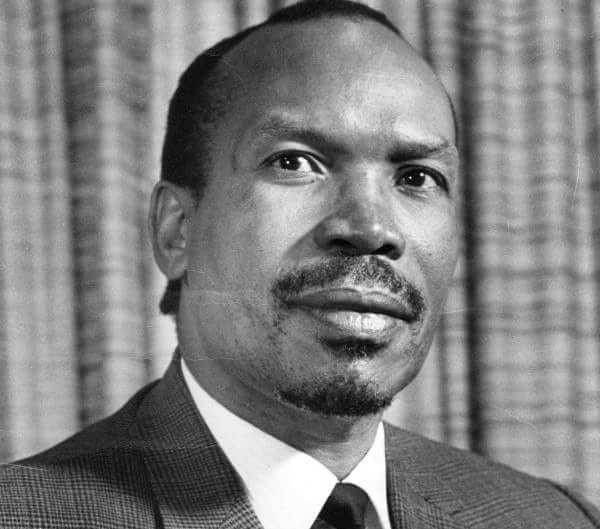
"A nation without a past is a lost nation, and a people without a past is a people without a soul."- Sir Seretse Goitsebeng Maphiri Khama, GCB, KBE (July 1, 1921–July 13, 1980), first President of Botswana (1966 to 1980).
Seretse Khama was born in 1921 in Serowe, in what was then the Bechuanaland Protectorate. He was the son of Queen Tebogo and Sekgoma Khama II, the paramount chief of the Bamangwato people, and the grandson of Khama III, their king.
The name "Seretse" means “the clay that binds". He was named this to celebrate the recent reconciliation of his father and grandfather; this reconciliation assured Seretse’s own ascension to the throne with his aged father’s death in 1925.
In September 1948, Khama married a British woman, Ruth Williams, after the British government had attempted to stop the marriage which initially was controversial because she was white. She became popular among his people.
Lady Khama and her husband had four children. Their first child Jacqueline was born in Bechuanaland in 1950, shortly after Seretse was exiled.
Their first son Ian was born in England in 1953, and twins Anthony and Tshekedi were born in Bechuanaland in 1958.
Khama founded the Botswana Democratic Party in 1962 and became Prime Minister in 1965. In 1966, Botswana gained independence and Khama was elected as its first president. During his presidency, the country underwent rapid economic and social progress.
At the time of its independence in 1966, Botswana was the world's third poorest country. Its infrastructure was minimal, with only 12 kilometres of paved roads; and few of its people had a formal education, with only 22 university graduates and 100 secondary school graduates.
Khama set out on a vigorous economic programme intended to transform the nation into an export-based economy, built around beef, copper, and diamonds. The 1967 discovery of Orapa’s diamond deposits aided this programme.
Khama instituted strong measures against corruption, the bane of so many other newly independent African nations. Unlike other countries in Africa, his administration adopted market-friendly policies to foster economic development.
Khama promised low and stable taxes to mining companies, liberalized trade, and increased personal freedoms. He maintained low marginal income tax rates to deter tax evasion and corruption. Khama was reelected three times easily winning the 1969, 1974, and 1979 elections.
For a number of years leading up to his death, Khama's health deteriorated. He suffered from heart and kidney ailments. In 1960 he had been diagnosed with diabetes.
In 1976, he underwent a heart operation in Johannesburg to install a pacemaker. From then on, he frequently flew to London for medical treatment.
In June 1980, he flew to London, where doctors diagnosed him with terminal pancreatic cancer.
On July 13, 1980, Khama died of pancreatic cancer. He was 59.
28 years after his death, his son, Ian succeeded Festus Mogae as the fourth President of Botswana; in the 2009 general election, he won a landslide victory. Ian Khama left office in 2018.
Sir Seretse Khama International Airport, Botswana's main airport, opened in 1984, was named after him. #HistoryVille
COCOA HOUSE AT 60: A MONUMENT TO AMBITION AND RESILIENCE
For 14 years, Cocoa House was the tallest building in Nigeria. Located in the heart of Ibadan, the capital of Oyo State, it rises as a landmark whose silhouette has long dominated the skyline of West Africa's largest city.
On July 30, 1965, this 26-storey tower was formally commissioned. Now, six decades on, it stands as both a monument to an era of prosperity and a testament to the resilience of a people.
The story of Cocoa House is inseparable from the golden years of cocoa production in the...
...Western Region of Nigeria. During the 1950s and 1960s, under the leadership of Chief Obafemi Awolowo and his successor, Chief Samuel Ladoke Akintola, the region leveraged its agricultural wealth to fund ambitious public projects.
In May 1988, Nigerian authorities discovered over 2,000 corroding drums of Italian hazardous waste, later estimated to be around 3,800 tons, containing PCBs, dioxin-forming solvents, asbestos fibres, heavy metals, and possibly even radioactive materials, in the...
...Niger Delta village of Koko, then Bendel State (now in Delta State).
The waste, falsely labelled as building materials and fertiliser, had been imported by an Italian businessman in collaboration with a Nigerian middleman. The materials were considered so dangerous that...
...strict protocols governed their handling and disposal in Europe. In Koko, however, they were simply dumped in an open yard on the property of a local resident who, unaware of the true nature of the cargo, had agreed to lease his land.
ON BABANGIDA AND VATSA: A TALE OF FRIENDSHIP AND BETRAYAL
On December 23, 1985, the Vatsa family had concluded plans to travel to Calabar. Typically, they spent the Yuletide in the Cross River State capital (Sufiya was Efik), Eid al-Fitr in Minna, Niger State (Vatsa was Nupe)...
...and Eid al-Adha in Kaduna. After packing for the trip, they awaited General Mamman Vatsa's return from an Armed Forces Ruling Council (AFRC) meeting. When he returned home late, the trip was postponed until the next day.
Around midnight, while Sufiya watched a film in her bedroom, Vatsa, working in his study, burst in to tell her that General Ibrahim Babangida (IBB) had summoned him. Sufiya protested, saying it was too late and that he should call his boss to reschedule for the morning.
Growing up, Victor Osimhen did not have it easy as he had to work hard menial jobs to make a living.
“I was cleaning the gutter for ₦20 for my landlord…and I did some cleaning jobs for my neighbours...and I did find pleasure in doing these things because I believe that when I work so hard to get this money, it’s so important for me…I’m cautious about how I spend,” he said.
Osimhen with his siblings used to sell newspapers and oranges and always had to run in moving vehicular traffic to sell water as well.
Even with all the hardship, Osimhen did not...let the circumstances in his environment weigh him down, he still kept moving forward.
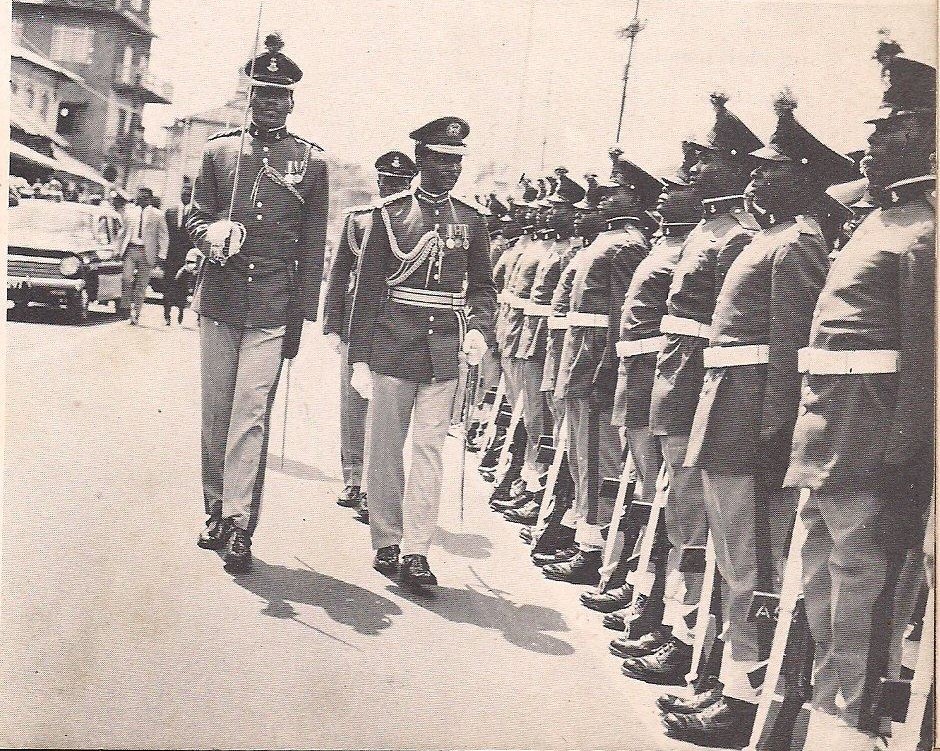
When General Yakubu Gowon was preparing for the Organisation of African Unity (OAU) Summit in Kampala, Uganda, in July 1975, his Inspector-General of Police, Muhammed Dikko Yusuf passed a strong intelligence message to him that a coup...
...against him was not just in the offing but in an advanced stage that could happen as soon as possible.
M.D Yusuf did not stop there. He further told Gowon that Colonel Joseph Nanven Garba, his right-hand man and Commander of the Brigade of Guards, was a chief plotter.
Gowon could not believe what he heard and argued that his own people would not betray him. The Brigade of Guards was composed entirely of Middle-Belt soldiers mainly from Gowon's Ngas ethnic stock in present-day Plateau State.
MOTIVATIONAL MONDAY: TAKE THE BIG GAMBLE, BE RESILIENT
During the GSM licence bid round in 2001, there was an attempt to muscle out Chief Mike Adenuga. However, the then NCC Vice Chairman, Dr. Ernest Ndukwe was very fair and transparent in the manner he handled the exercise.
But powerful forces within the Olusegun Obasanjo-led administration were bent on frustrating Adenuga from securing a telecoms licence. Additionally, President Obasanjo, allegedly, had personal issues with Adenuga.
Nevertheless, Adenuga refused to give up and eventually secured the license in August 2003. He then changed the game with Glo's per-second billing, which the more established companies, like MTN and Econet (now Airtel), had said was impossible but were then forced to adopt.