

Amid a big policy push for US semiconductor leadership, we have a new paper on how to strengthen America’s talent advantage in the sector: cset.georgetown.edu/research/the-c…
It includes 7 figures and 8 tables with 📊 on the semi workforce, from 6 sources.
Here are the highlights: [1/x]
It includes 7 figures and 8 tables with 📊 on the semi workforce, from 6 sources.
Here are the highlights: [1/x]

First, current US immigration policies are directly at odds with the push to strengthen semiconductor supply chains. You can’t expect firms to move R&D and high-end production to the US while slashing their access to talent, as we argued in WSJ: [2/x]
on.wsj.com/2HtGWd0
on.wsj.com/2HtGWd0
The square peg of immigration restrictions does not fit into the round hole of semiconductor leadership. For example:
(1) 40% of current US semi workers were born abroad
(2) so are ~60% of current grad students
(3) US is BY FAR the biggest net importer of int'l talent
[3/x]
(1) 40% of current US semi workers were born abroad
(2) so are ~60% of current grad students
(3) US is BY FAR the biggest net importer of int'l talent
[3/x]
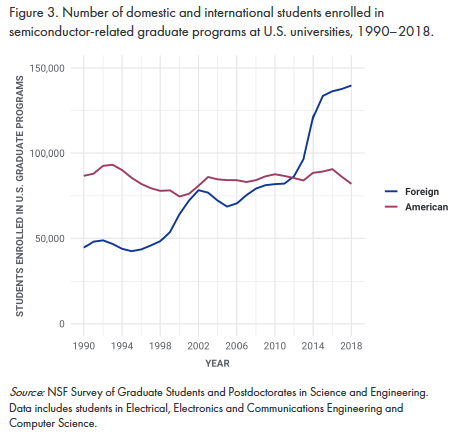
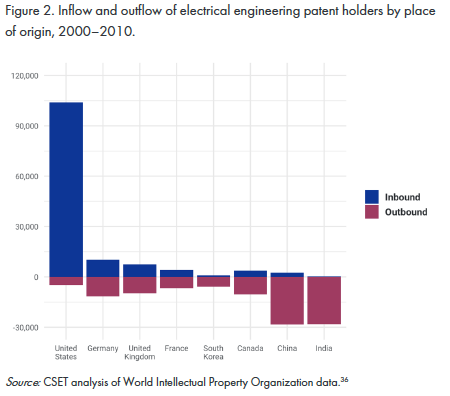
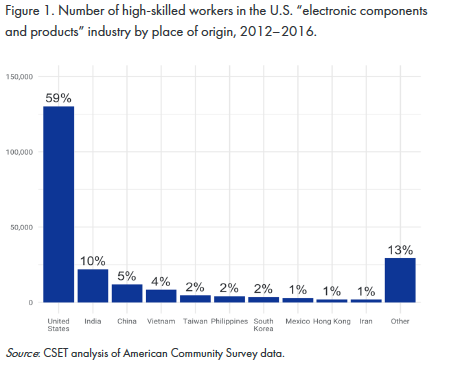
The rival that US policymakers are most afraid of—China—acknowledges that workforce shortages hurt its semi industry. As past CSET research also showed (👇), CCP leaders rue the US's ability to attract and retain top Chinese semiconductor talent: [4/x]
https://twitter.com/r_zwetsloot/status/1266150854664556545
To illustrate, consider int'l PhD stay rates from semiconductor-related fields: intention-to-stay rates among Chinese grads were around 90% in 2017 (latest yr w/ data), and been steady since 2011 despite a decade+ of CCP efforts to attract more people back. [5/x]
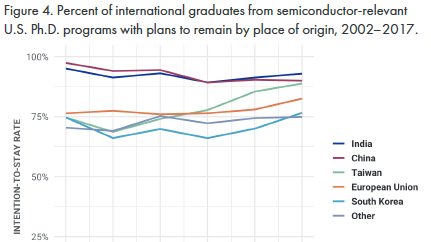
At the same time, even a small # of returnees could help China advance its industry — as the history of Taiwan's semiconductor success illustrates. So there's real risk there. In the policy section, we discuss several strategies for balancing these risks and benefits. [6/x]
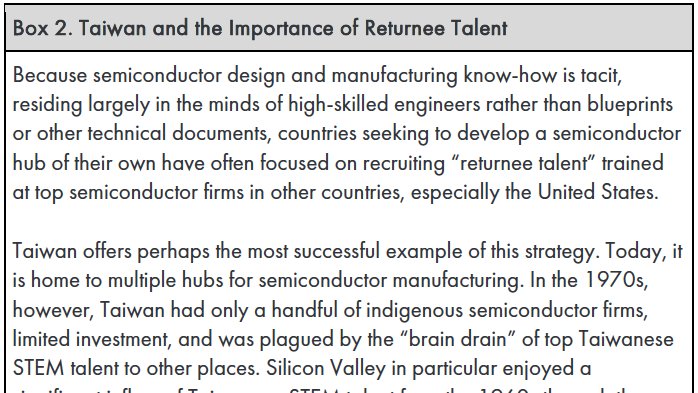
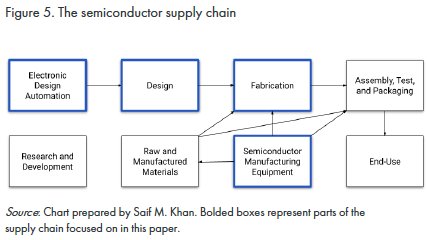
Second, the paper breaks down the semiconductor supply chain to identify high-priority areas for education and research investments. This is important because the semi industry is highly specialized, and different segments involve very different types of tech. [7/x]
To study educational requirements across segments and companies, we use an underexplored detailed dataset of green card holders with detailed degree data. We find EE and CS dominate in design/EDA, but skill reqs are a lot more diverse at fabs and SME companies. [8/x]
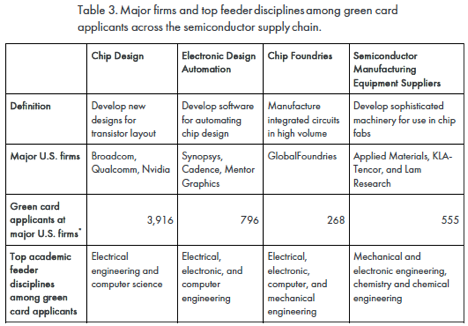
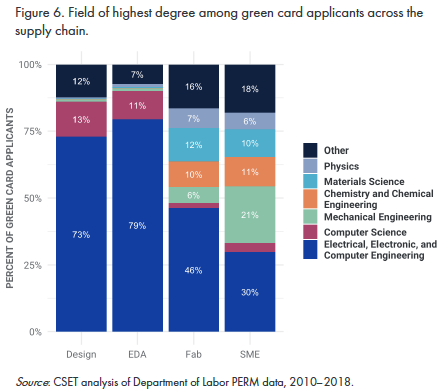
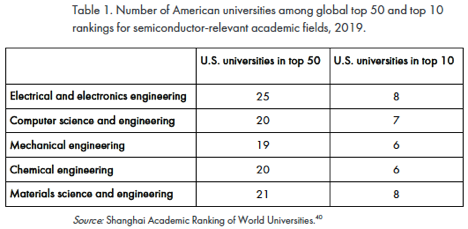
This finding implies USG should invest broadly across the physical and computational sciences — as the supply chain evolves, skill needs also change, so a narrow approach is risky. Luckily US unis are strong across all fields. But int'l competition is rapidly increasing. [9/x]
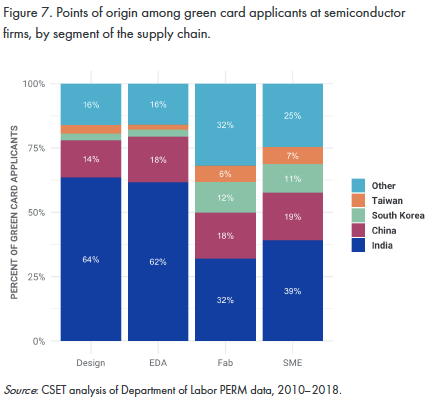
Interestingly, country of origin among green card applicants also different across these different segments: India is the biggest talent source across all four segments, but much more dominant in Design and EDA than at fabs and SME companies. [10/x]
The paper has lots more data, plus recommendations re: how to protect the sector from tech transfer threats, how to educate more Americans to strengthen the sector's talent pipelines, and (pls indulge a personal nerdy favorite) how to improve tech workforce data. [11/x]
Finally, a big thanks to @james_a_lewis @FuDaoge @flaggster73, and especially semiconductor tutor par excellence @KhanSaifM, plus many others not on Twitter, for reviewing the paper! [12/12]
Based on post convos/research, guessing this may be interesting to @EvanFeigenbaum @lorandlaskai @jjding99 @doug_rand @MartijnRasser @EBKania @GWilliamThomas @jordanschnyc @adschina @pstAsiatech @paul_scharre @AlanMcQuinn @NFAPResearch @David_J_Bier
and to @mattsheehan88 @ChhabraT @chrismeserole @AlecStapp @Kate_OKeeffe @calebwatney @scottlincicome @sjezell
• • •
Missing some Tweet in this thread? You can try to
force a refresh


