1/ The decisions of President Trump and his administration have transformed countless lives. We are telling the stories of seven individuals living with the consequences of his first term. theatlantic.com/projects/seven…
2/ After the Trump administration allowed states to attach work requirements to Medicaid, one grad student lost her coverage. Without prescriptions to manage her ADHD and asthma, she turned to cocaine and painkillers for relief, @MonicaBPotts reports. theatlantic.com/politics/archi…
3/ Barbara Szalai wasn't worried about moving upriver from a coal plant. Decades later, she says, “If I had my way, I would have left.” @prosaaquino reports: theatlantic.com/politics/archi…
4/ Natalie Romero was badly hurt in Charlottesville when a neo-Nazi plowed his car into a crowd. Years later, she's still feeling the aftershocks, @marincogan reports. theatlantic.com/politics/archi…
5/ After Justin Walker gave 119 media interviews to support Brett Kavanaugh, the president offered Walker a lifetime appointment to one of the nation’s highest courts, @cristianafarias reports. theatlantic.com/politics/archi…
6/ “It’s not easy not having your children with you ... I wouldn’t have left them in the first place.” One mother planned to bring her kids to the U.S. after her. Then the Trump administration banned immigration from Nigeria. @koviebiakolo reports:theatlantic.com/politics/archi…
7/ Rebeka Dominguez's oldest child is 17. Her youngest is 10 months. Guiding her family through remote learning is so exhausting that she's considering homeschooling instead, @Charley_Locke reports. theatlantic.com/politics/archi…
8/8 When the coronavirus hit a Colorado plant, employees felt that the company wasn’t giving them enough support. By early fall, there were more than 300 cases, @jahdkhalil reports. theatlantic.com/politics/archi…
• • •
Missing some Tweet in this thread? You can try to
force a refresh
1/ Today The Atlantic is endorsing Joe Biden for president.
Our case is simple: “Two men are running for president. One is a terrible man; the other is a decent man. Vote for the decent man.” theatlantic.com/politics/archi…
2/ In 1860, The Atlantic endorsed Abraham Lincoln. In 1964, Lyndon B. Johnson. And in 2016, at another turning point in history, we endorsed Hillary Clinton over Donald Trump.
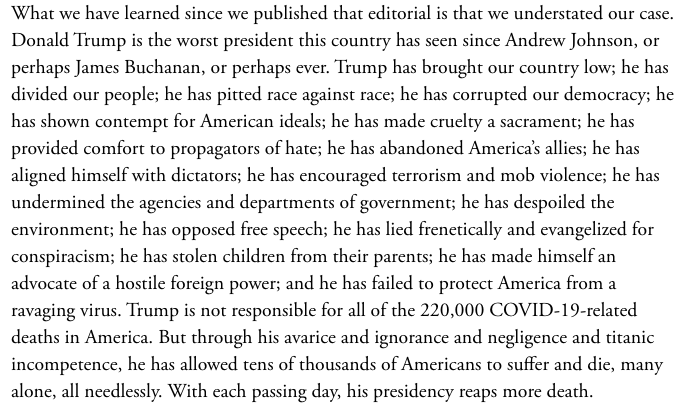
3/ What we have learned since we endorsed Clinton is that we understated our case against Trump. He is the worst president this country has seen since Andrew Johnson, or perhaps James Buchanan, or perhaps ever.
1/4 “White Noise,” The Atlantic’s first feature documentary, is the definitive inside story of the alt-right, following Richard Spencer, Lauren Southern, and Mike Cernovich as they ride a wave of racist ideas to viral fame.
2/4 To make the film, the director @DanielLombroso spent four years reporting on the alt-right. “I wanted to understand: What made white-power ideology so intoxicating, especially among my generation?” he wrote in June. on.theatln.tc/eX66m5i
3/4 Lombroso also explored those ideas in a profile of Lauren Southern, who had been one of YouTube’s most effective extremists—an alt-right propagandist masqueraded as a run-of-the-mill influencer—before she disappeared from the community. on.theatln.tc/CbPLO39
1/ As the coronavirus pandemic has killed more than 206,000 Americans, Donald Trump has spent months undermining faith in the democratic process and vacillating on proven public-health policies, @AlexisMadrigal and @yayitsrob write: theatlantic.com/health/archive…
2/ The president’s entourage has operated with a casual disregard for coronavirus protocol throughout the pandemic, but the first sign that Trump himself had direct exposure to the virus came Thursday, when Hope Hicks, a close adviser, tested positive. theatlantic.com/health/archive…
3/ Trump tweeted early Friday morning that he and the first lady had tested positive for COVID-19 and would quarantine at the White House. theatlantic.com/health/archive…
1/6 The Supreme Court decided that segregation of public schools was unconstitutional—but it was thousands of children who actually desegregated America’s classrooms, writes @beccarosen. Here are five of their stories. Introducing #TheFirsts: theatlantic.com/education/arch…
2/6 Hugh Price and his family fought for him to be one of the first Black students at an all-white high school in Washington, D.C. Once he was there, he “couldn’t wait for it to be over,” @AdamHSays reports. theatlantic.com/education/arch…
3/6 Jo Ann Allen Boyce and 11 other students desegregated their high school in Clinton, Tennessee. Then the riots came, @AdamHSays writes. theatlantic.com/education/arch…
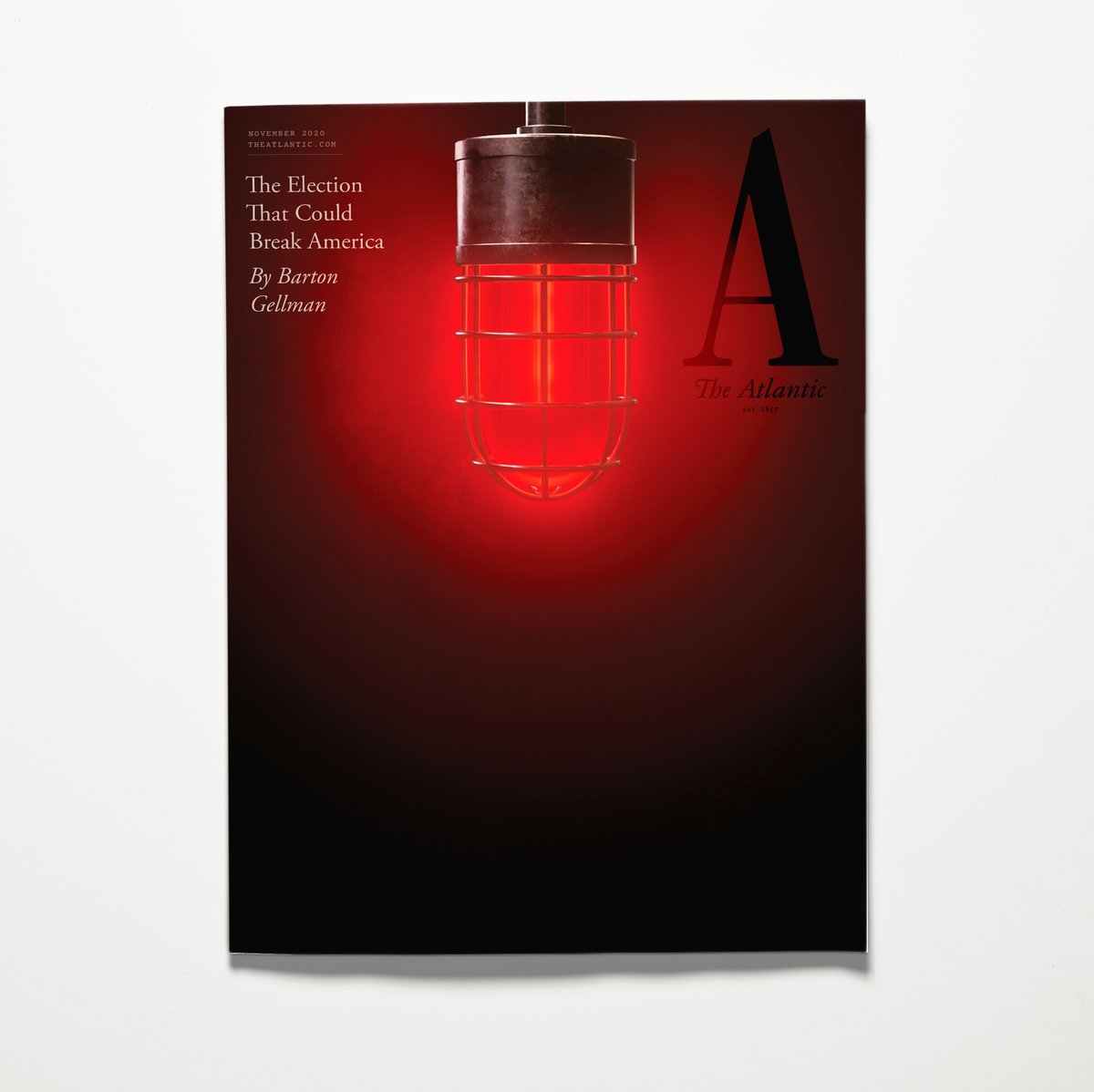
1/9 “Trump may win or lose, but he will never concede.” The worst case is not that Trump rejects the November election results, but that he uses his power to prevent a decisive outcome against him, @bartongellman reports in our latest cover story. on.theatln.tc/pb7jnqh
2/9 The danger goes beyond partisan discord. “The coronavirus pandemic, a reckless incumbent, a deluge of mail-in ballots, a vandalized Postal Service, a resurgent effort to suppress votes, and a trainload of lawsuits are bearing down on the nation’s creaky electoral machinery.”
3/9 One scenario worrying election modelers is that Trump will jump ahead on November 3, based on in-person returns, and his lead will slowly give way to a Joe Biden victory as mail-in votes are tabulated.
1/6 In our “On Teaching” project, the most experienced teachers in America’s education system reflect on their careers, their schools, and the history they’ve witnessed.
2/6 Since Booker T. Washington High School was founded in 1976, it's been a microcosm of national issues—and Karon Cogdill has taught theater through four decades of its evolution. Now the pandemic is upending her last year, writes @smosle: on.theatln.tc/2m0osHR
3/6 "Gardens don’t judge what grade you got in math. They respond to care." The New Orleans teacher Rahn Broady shows kids the nourishment they can get from being in nature, writes @djdreilinger: on.theatln.tc/xACLLxQ