

Clinical Reasoning Pearls - Problem Representation
Inspired by all the amazing things I’ve been learning with @CPSolvers and #MedTwitter I decided to study more about Clinical Reasoning. So here comes my first tweetorial about it: #medtwitter #tweetorial
Inspired by all the amazing things I’ve been learning with @CPSolvers and #MedTwitter I decided to study more about Clinical Reasoning. So here comes my first tweetorial about it: #medtwitter #tweetorial

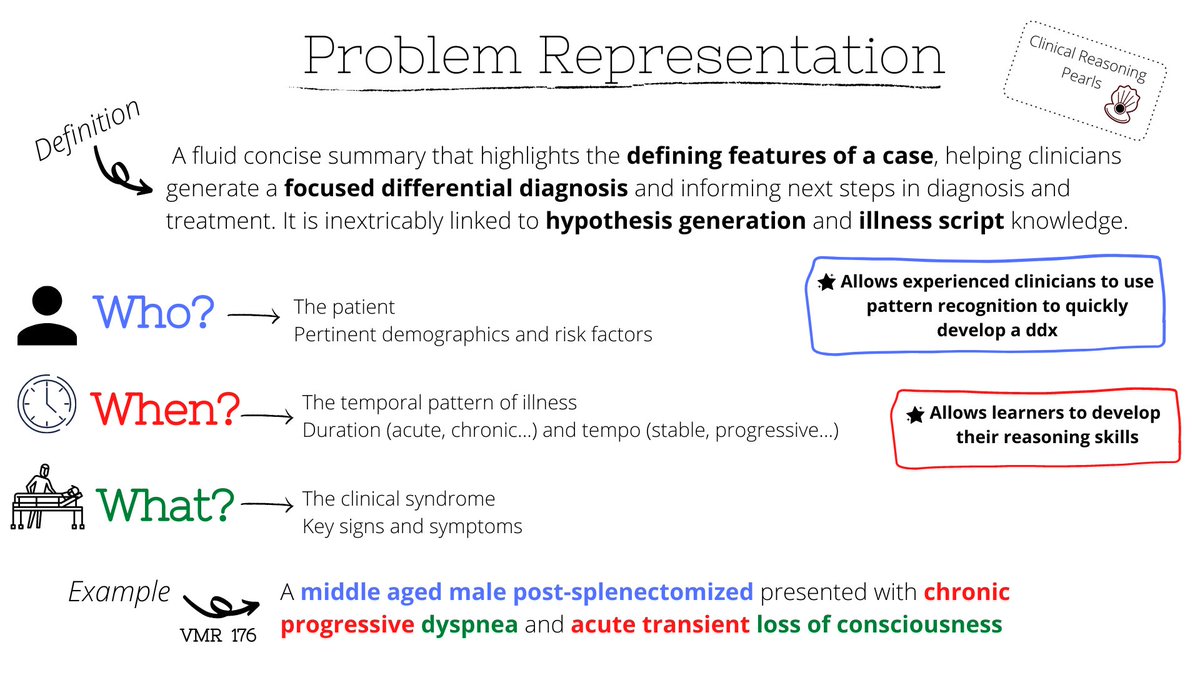
A problem representation (or Summary Statements) is a fluid concise summary that highlights the defining features of a case, helping clinicians generate a focused differential diagnosis and informing next steps in diagnosis and treatment.
It is inextricably linked to hypothesis generation and illness script knowledge; that is, experienced clinicians use a hypothesis-driven approach to problem representation.
It also allows experienced clinicians to use pattern recognition to quickly develop a ddx and allows learners (students like me) to develop their reasoning skills.
Problem Representation is the process of distilling critical information from a broader clinical scenario using semantic qualifiers, for example, young/old, constant/recurrent, diffuse/localized, mild/severe, and acute/chronic
So how to construct a problem representation?
First: it is important to understand that each clinician will have their own approach to it. We should learn that PRs are not “right or wrong” just “better” when all relevant attributes are addressed using the appropriate semantic qualifiers for the specific clinical problem.
Since problem representation is inextricably linked to hypothesis generation and illness script knowledge, a "better" problem representation will facilitate the gathering of diagnostic hypotheses and also lead to a directed search for new data.
If some key information is missing from the problem representation, or the wrong information was highlighted you can be led to think along a certain diagnostic pathway, which later you will realize is the wrong direction to be heading
So let's see a few tips to construct a Problem Representation:
Try to answer 3 main questions in your PR: Who? When? What?
Who is the patient? The pertinent demographics and risk factors
When? The temporal pattern of illness - the duration (acute, chronic) and tempo (stable, progressive)
What is the clinical syndrome? Key signs and symptoms
Who is the patient? The pertinent demographics and risk factors
When? The temporal pattern of illness - the duration (acute, chronic) and tempo (stable, progressive)
What is the clinical syndrome? Key signs and symptoms
Excludes:
Non-specific information;
Irrelevant information
Discuss the need to pick and choose what to include to avoid overloading the one liner.
Non-specific information;
Irrelevant information
Discuss the need to pick and choose what to include to avoid overloading the one liner.
Cognitive load is the amount of mental effort being used in the working memory we become worse problem solvers if our mental capacity in working memory is overloaded.
We must make choices throughout the case about what we think is most relevant to keep in the problem representation, knowing that this may change over the course of the case.
Always remember to evolve your Problem Representation - Though we often like to tie everything up with a bow the first time we see a patient, disease processes change and all pieces of the puzzle may not be evident on the first visit.
Refining our problem representation with each bit of information is important to eventually get to the correct diagnosis. Though our differential may change that doesn’t mean we necessarily missed something the first time around!
More tips in this video: by @rahulpatwari
Let's see some examples?
VMR176 @CPSolvers -A middle aged male post-splenectomized presented with chronic progressive dyspnea and acute transient loss of consciousness
Who? middle aged male post-splenectomized
When? chronic progressive and acute transient
What? dyspnea and transient loss of consciousness
Who? middle aged male post-splenectomized
When? chronic progressive and acute transient
What? dyspnea and transient loss of consciousness
2- Alicia A. is a 55 year old woman who for the past 2 months has had stiffness of her hands on awakening each morning that lasts for 1–2 hours. She has felt weak and fatigued on several occasions. She has noticed swelling of both wrists and pain when attempting to make a fist...
At first, the stiffness didn’t bother her. Now, as a basic scientist with an active experimental laboratory, she is having difficulty using micro-pipettes to create her cell cultures.
PR - a middle-aged female with a chronic, gradually progressive symmetrical oligoarticular process involving small joints characterized by moderate to severe morning stiffness.
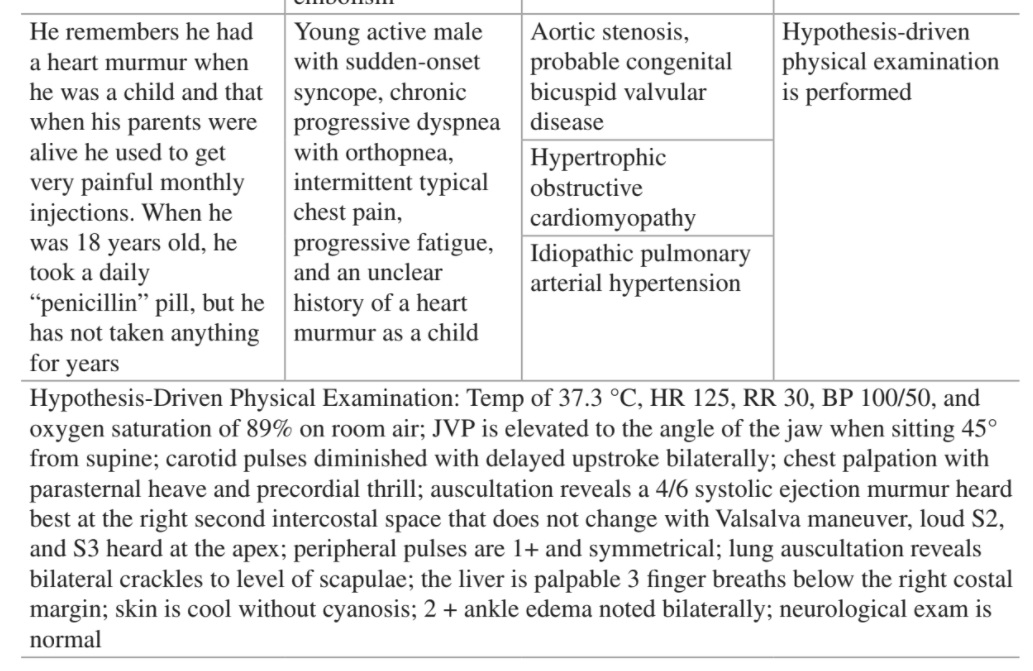
A great example from Principles and Practice of Case-based Clinical Reasoning Education: A Method for Preclinical Students
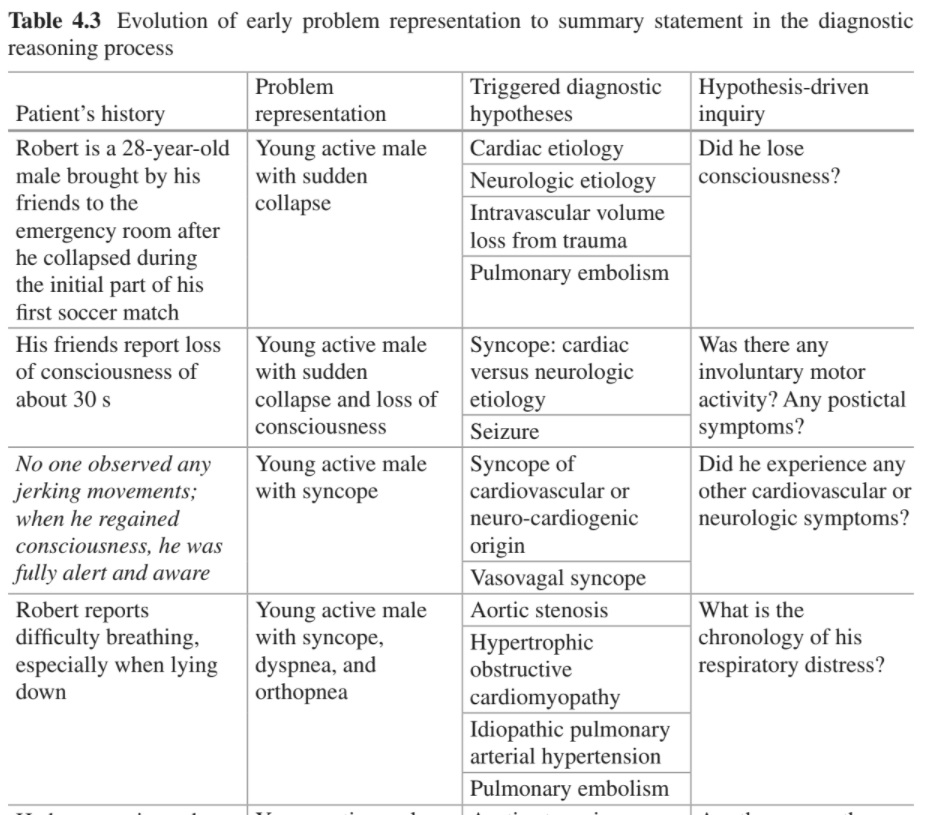
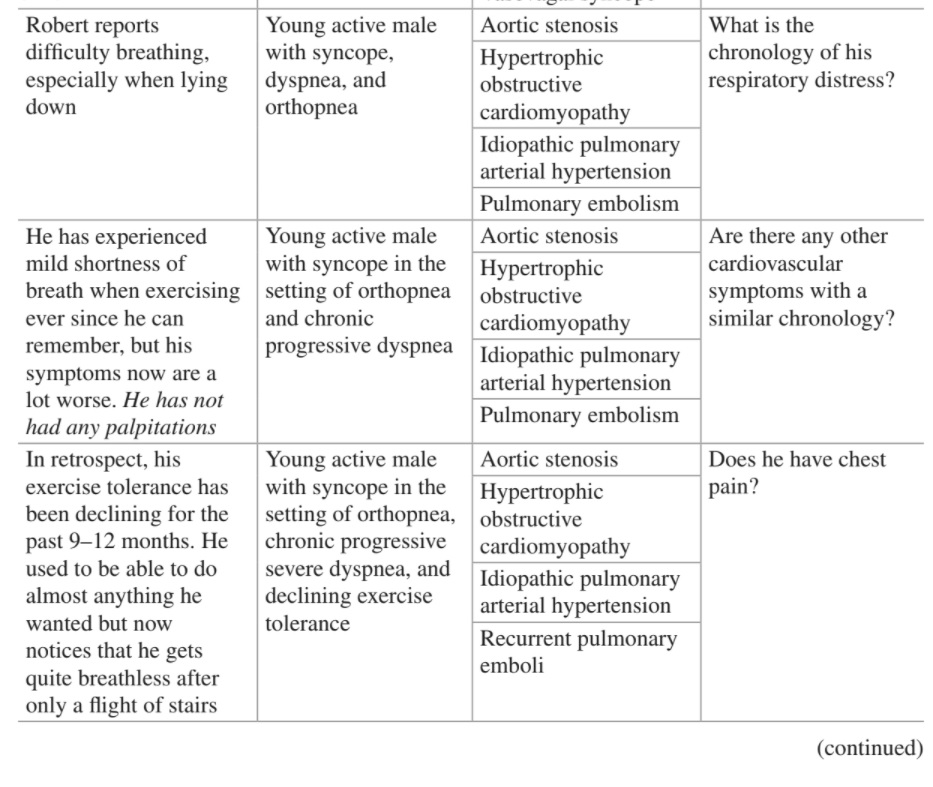
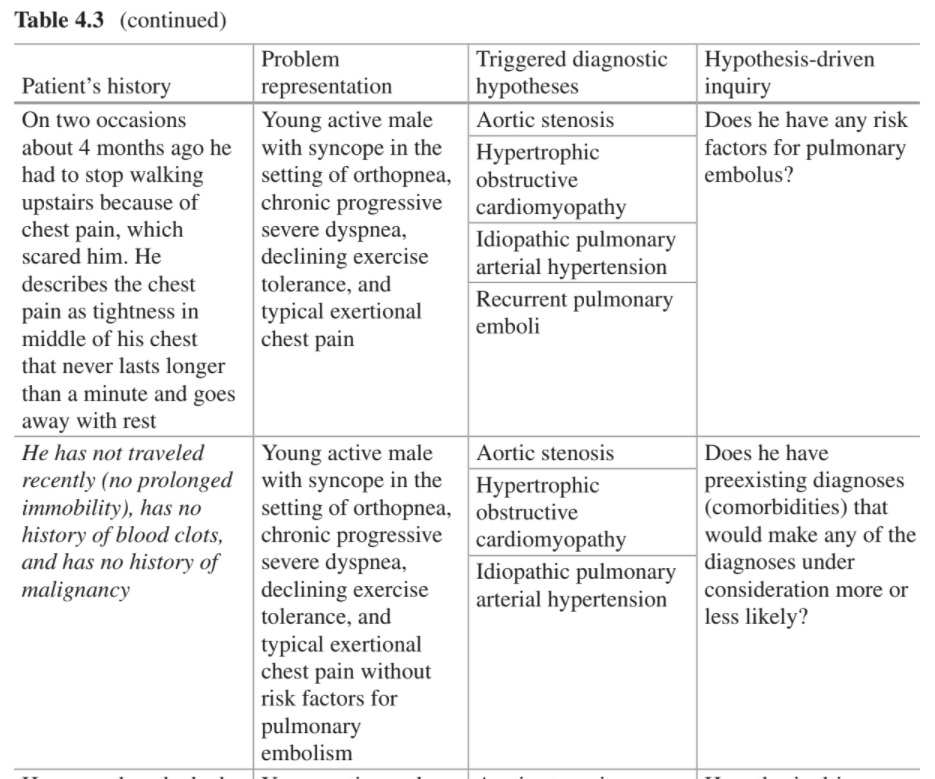
That's all! If you have some other tips or material about that please share with us! Thank you
Problem Representation Overview. CLINICAL REASONING EXERCISES. JGIM. sgim.org/web-only/clini…
Principles and Practice of Case-based Clinical Reasoning Education A Method for Preclinical Students by Olle ten Cate, Eugène J.F.M. Custers, Steven J. Durning (eds.)
Principles and Practice of Case-based Clinical Reasoning Education A Method for Preclinical Students by Olle ten Cate, Eugène J.F.M. Custers, Steven J. Durning (eds.)
October 28, 2020. Clinical Problem Solvers Virtual Morning Report 176.
Denise M. Connor. Key Clinical Reasoning Concepts. Developing Medical Educators of the 21st Century, San Francisco, CA . Feb 25-27,2019. meded21.ucsf.edu/sites/g/files/…
Denise M. Connor. Key Clinical Reasoning Concepts. Developing Medical Educators of the 21st Century, San Francisco, CA . Feb 25-27,2019. meded21.ucsf.edu/sites/g/files/…
#90 @thecurbsiders Clinical Reasoning: Become an expert diagnostician open.spotify.com/episode/4yfo5P…
Today I was listening to the second episode of @febrilepodcast, an amazing episode with a great discution about Problem Representation. So I decided to add this recommendation to my tweetorial about it:
https://twitter.com/febrilepodcast/status/1350151440770105344
• • •
Missing some Tweet in this thread? You can try to
force a refresh




