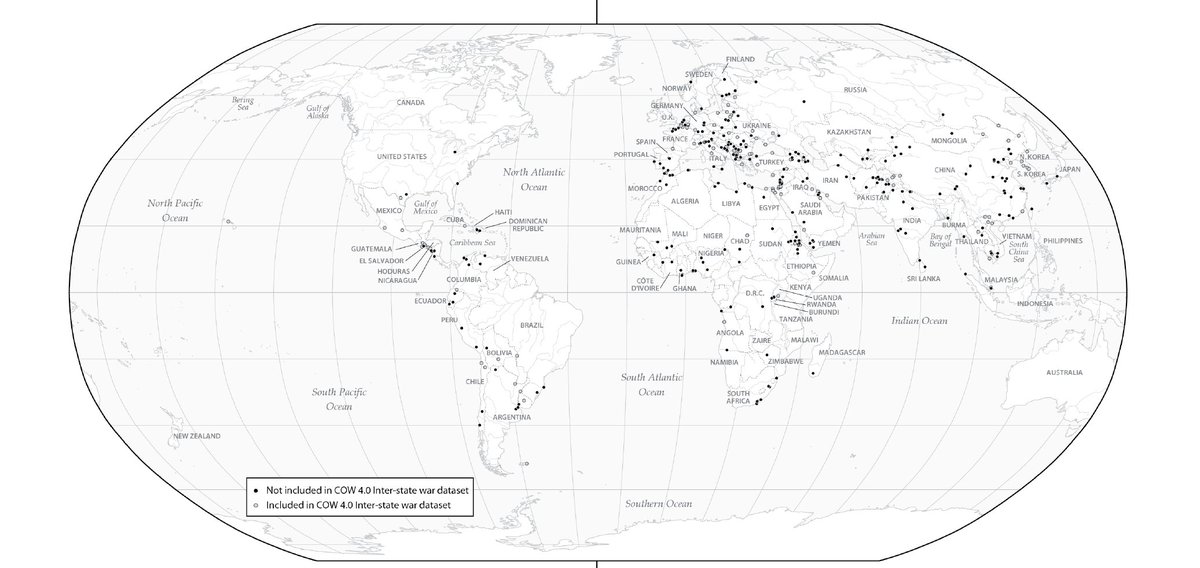
Recent scholarship has called attention to how Western-centric biases shape our understandings of war --- including which belligerents & wars matter for our studies.

A quick thread, drawing on data from my book, Divided Armies. 1/10
The exclusion of non-Western cases from our studies of war amounts to a wicked selection bias, as noted recently by @kelly_zvobgo & @meredithloken, @Prof_BearB, & @daveckang 2/10

foreignpolicy.com/2020/06/19/why…

washingtonpost.com/politics/2020/…

duckofminerva.com/2020/08/we-all…
For Divided Armies, we built a new dataset, Project Mars, that sought to incorporate these excluded belligerents and wars. A team of 134 coders worked for nearly 7 years to add 124 new belligerents & dozens of wars not included in the Correlates of War for 1800-2011. 3/10
You can see the expanded coverage of Project Mars here
But wait, there's more! We also kept records of another 90 wars that didn't meet our inclusion criteria, in large part because the evidentiary record was poor. But future historical work might change this! Need to know what we don't know to assess our blindspots 5/10
We also created a 1,200 page bibliography as a "starter pack" for scholars interested in moving off the beaten path & including new (non-Western) wars and cases. 6/10
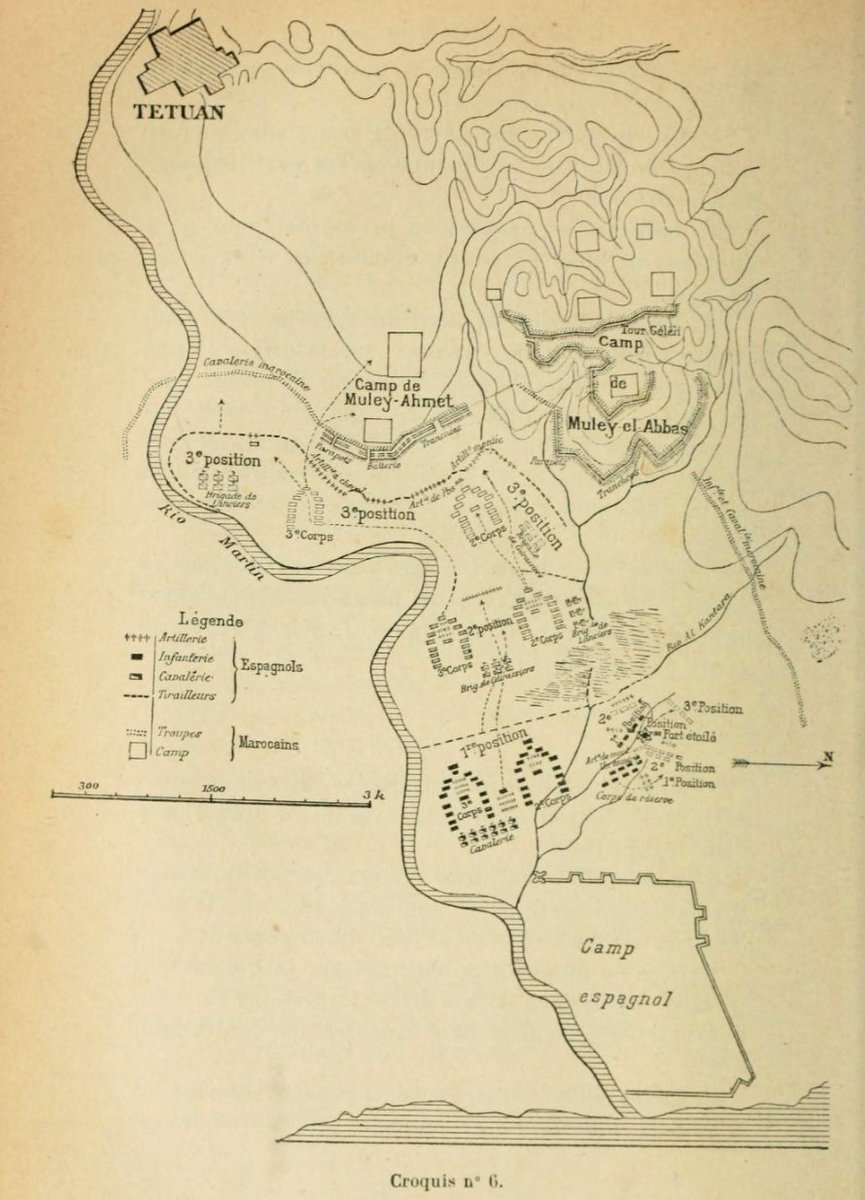
And, for every new belligerent, we collected photographic and written records, including maps, of how they fought, to show these belligerents were not "primitive" but understood modern principles of conventional war. 7/10
Why go to all this trouble? (That's a good question).

It turns out that when you add these new belligerents & wars to the mix, many of our leading theories of military effectiveness no longer find much empirical support. (Looking at you, regime type and material power). 8/10
Anyways, if you're interested, Project Mars & supporting documentation can be downloaded here: 9/10

dataverse.harvard.edu/dataset.xhtml?…
And the book is here: amazon.com/Divided-Armies…

Finis.

• • •

Missing some Tweet in this thread? You can try to force a refresh
 

Keep Current with Jason Lyall

Jason Lyall Profile picture

Stay in touch and get notified when new unrolls are available from this author!

Read all threads

This Thread may be Removed Anytime!

PDF

Twitter may remove this content at anytime! Save it as PDF for later use!

Try unrolling a thread yourself!

how to unroll video
  1. Follow @ThreadReaderApp to mention us!

  2. From a Twitter thread mention us with a keyword "unroll"
@threadreaderapp unroll

Practice here first or read more on our help page!

More from @jaylyall_red5

13 Jun
My new @PrincetonUPress book, "Divided Armies," examines how inequality within armies has decided their battlefield fate over the past 200 years.

I wrote a short piece for @ambassadorbrief that outlines the argument & the new data that underpins it

THREAD /1
Conventional wisdom has long held that victory has gone to armies with the most soldiers, the best technology, or the most productive economies.

I challenge these accounts in several ways:

/2
1) I argue that armies reflect their societies. The prewar degree of inequality within armies will determine how they fare on the battlefield well before the shooting actually begins.

/3
Read 12 tweets
1 May
In the spirit of bridge-building, I thought I'd offer a quick thread on six terrific new military histories that political scientists who study military effectiveness (and political violence more broadly) should add to their pandemic reading pile 1/10

THREAD
(Also, we should heed Barry Posen's advice:

"Read, read, read. Read diplomatic and military history. It's good for your head and it gives you a lot of raw material for thinking about both policy questions and theoretical questions.")

mei.edu/events/middle-…
These works vary sharply in subject matter but share a belief that we need to understand social and cultural dynamics within societies and armies to explain how military power is created and employed in war, and how battles and wars are ultimately won
Read 11 tweets
11 Feb
It's here! It's really here! My new book, Divided Armies, is now available from @PrincetonUPress as an e-book, soft-cover, and hardback.

Let me tell you a bit about the book. THREAD 1/11

amazon.com/dp/0691192448/…
What's it about? In a nutshell, I try to explain the battlefield performance of belligerents in modern wars since 1800. Lots of great work has focused on relative power, technology, regime type, or civil-military relations.

I take a different tack.
First, I argue that we've overlooked perhaps the key driver of battlefield performance: inequality. Specifically, prewar ethnic hierarchies within armies --- what I term "military inequality" --- shapes how armies fight and die. The worse the inequality, the worse the performance
Read 11 tweets
10 Sep 18
Wasn't going to comment on this story, but have been nudged by a friend. So, some thoughts on Afghan data, from someone who's spent the past 7-8 years measuring attitudes and control in Afghanistan (thread) nyti.ms/2NY0J2C
(1) The mismatch between official and external estimates of control is not surprising. It's doubtful that ISAF/RS has had fidelity to estimate district level control since 2011-12. No serious researcher would place stock in ISAF/RS estimates (and hasn't for years)
(2) The district probably isn't the right place to measure control. It's convenient, yes, but few Afghans identify with their district, and it doesn't mean much on the ground. These codings also mask lots of heterogeneity *within* the districts at the village level
Read 7 tweets

Did Thread Reader help you today?

Support us! We are indie developers!


This site is made by just two indie developers on a laptop doing marketing, support and development! Read more about the story.

Become a Premium Member ($3/month or $30/year) and get exclusive features!

Become Premium

Too expensive? Make a small donation by buying us coffee ($5) or help with server cost ($10)

Donate via Paypal Become our Patreon

Thank you for your support!

Follow Us on Twitter!