More fallout from #ParadisePapers: a 150+ page report from the Commerce Dept inspector general reveals it investigated Wilbur Ross for years after the project's revelations in Nov 2017.
It found that he breached federal ethics rules in several ways...
oig.doc.gov/OIGPublication…
It found that he breached federal ethics rules in several ways...
oig.doc.gov/OIGPublication…
The findings include glaring omissions in his financial disclosures.
Our story below for @ICIJorg found that Ross retained a stake in Navigator Holdings, a shipping company that did business w Putin cronies, through a chain of offshore entities.
icij.org/investigations…
Our story below for @ICIJorg found that Ross retained a stake in Navigator Holdings, a shipping company that did business w Putin cronies, through a chain of offshore entities.
icij.org/investigations…
The inspector general found that Ross also held more than 16,000 direct shares in Navigator that he completely omitted from his financial disclosures when he took office. 

Ross then sold those undisclosed shares short after the NYT's @mmcintire contacted him w questions for the upcoming #ParadisePapers story.
Here's the NYT story on that short sale:
nytimes.com/2018/06/19/us/…
Here's the NYT story on that short sale:
nytimes.com/2018/06/19/us/…
The inspector general found that Ross also privately informed Navigator about the story before it was public.
"We identified evidence supporting a finding he used his office for private gain, namely to benefit the value of his Navigator holdings," the OGE wrote on this point.
"We identified evidence supporting a finding he used his office for private gain, namely to benefit the value of his Navigator holdings," the OGE wrote on this point.
Overall, the report did not find evidence that Ross violated laws against insider trading or deliberately lied about his financial holdings.
But it found that he did violate ethics rules against conduct that gives the appearance of a conflict of interest.
But it found that he did violate ethics rules against conduct that gives the appearance of a conflict of interest.
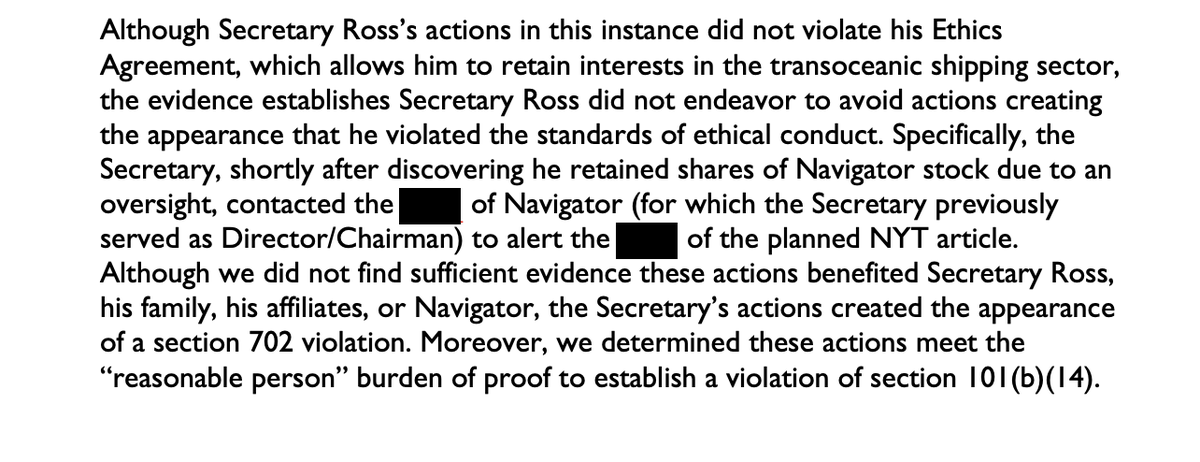
Ross told investigators he wasn't trying to hide anything when he didn't report his 16k direct shares in Navigator.
“Well, no, I just didn’t remember that I had them. Why would I disclose all those others and try to hide a few?” he said.
“Well, no, I just didn’t remember that I had them. Why would I disclose all those others and try to hide a few?” he said.
• • •
Missing some Tweet in this thread? You can try to
force a refresh