New: Key witnesses from Grenfell cladding company Arconic confirm they will continue to refuse to attend despite an assurance from the French government that French laws should not stop them
- French embassy wrote to British Foreign Office on December 7 confirming they do not believe an arcane law known as the 'French blocking statute' should prevent witnesses attending. Inquiry forwarded this note to witnesses lawyers on December 9
- But today letter from the inquiry to participants confirmed two of the four have said they will continue to refuse to give evidence. One more has asked for conditions which the inquiry is considering, and the fourth is yet to make up his mind
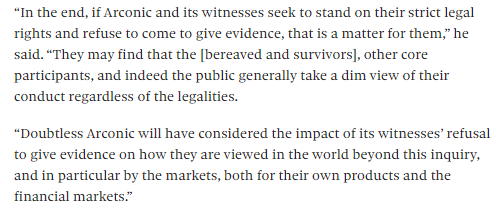
- Inquiry has no legal power to compel witnesses based overseas to attend, but has said it will effectively 'empty chair' them if they don't come (present the evidence they would have been questioned about in their absence). Inquiry's QC said this in opening:
Arconic spox says those who have declined to participate have separate legal representation and are no longer employed by the company. UK based witnesses for the firm will attend.
• • •
Missing some Tweet in this thread? You can try to
force a refresh
There's quite a lot to unpack with this story, but let's start with inquiry chair Sir Martin Moore-Bick's recommendations in his report in October 2019.
Having heard months of evidence about the difficulties people (including those with disabilities) had evacuating, he said...
- All disabled residents of high rises should be offered a personal emergency evacuation plan (PEEP)
- All high rises should have a 'plan b' evacuation plan developed
- Blocks should be fitted with devices to enable fire service to send an evacuation signal to all or part
But when a government consultation on implementation came out in July this year, it rowed back substantially. Alarms were kicked into the long grass, the evacuation plan could be a 'stay put' strategy and PEEPs should only be provided in buildings with known dangerous cladding
New: Government sought to water down Grenfell Inquiry recommendations for the evacuation of disabled people after industry lobbyists called them "costly" and "impracticable", new documents reveal
This being misunderstood by people due to the wording of the top tweet, so just to be clear:
- The recommendations made by the inquiry were not interfered with by govt or industry
- But Home Office sought to reinterpret and limit their impact when it came to implementation
Government has announced a £30m Waking Watch Relief Fund top open in January, intended to help fund the installation of fire alarms in blocks with dangerous cladding
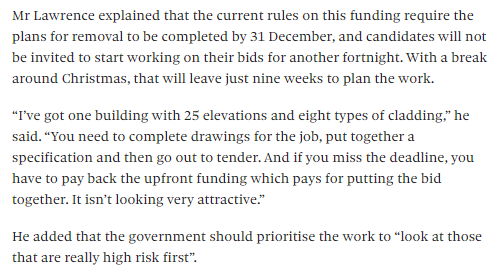
- Deadlines for applications to Building Safety Fund pushed back to June, which will be welcome relief for many who were struggling. This deadline has looked tough for some time, as we reported in October:
On the alarms funding, recent quotes I saw put it at a range of £123,000 for a block of 50 flats, to £19,500 for block of 15. So a very loose estimate would say this would cover full costs on 250 large buildings, 1,500 small ones, or a proportion of the work on a greater number
Think this is worth unpacking a bit. What the (majority Tory) committee has accused MHCLG of is a “deplorable... cycle of policy invention, abandonment and reinvention".
It's really a broadside at the mess we've made of housing policy full stop over the last few years
The main focus is Starter Homes which (now famously) the government spent £173m buying brownfield land for, and then didn't build any. But the PAC has broadened its criticism.
"This Committee has reported regularly on housing delivery since 2015, and not one of the promised housing programmes has delivered its objectives. Indeed, most have fallen woefully short."
That is a pretty extraordinary, but frankly entirely fair.
Right so, today at the inquiry we filled in a new piece of the puzzle surrounding the government's failure to change regulations in time to stop Grenfell 🧵
We have known since 2018 that the key official responsible for Approved Document B (the guidance which covers fire safety) had attended an industry briefing on 2 July 2014, where very specific warnings were given about combustible insulation and cladding insidehousing.co.uk/news/news/gove…
(I know it's probably poor form to do the whole 'this was my scoop' thing, but this was my scoop)
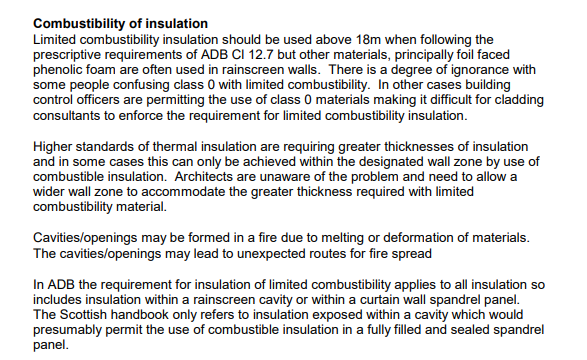
Anyway, that meeting contained very clearly delivered warnings about the use of combustible ACM cladding and insulation on high rises. Here's what was said about insulation:
- Govt officials warned about use of Kingspan insulation on high rises in 2014
- Kingspan accused of "lying" to them about testing which had been carried out on new 'trial product' - not material actually on market
We saw important new emails today which show Brian Martin (the official in charge of Approved Document B) was specifically and clearly warned about the use of K15 on high rises in summer 2014
In July 2014, he wrote to the NHBC saying "allegedly" PIR insulation had been used on buildings above 18m in height and asking for info. I think this follows a meeting about cladding risks from the same month, which I obtained the minutes of in 2018 insidehousing.co.uk/news/news/gove…